In 2026
Employees don’t want more courses.
Managers don’t want more programs.
Business leaders don’t want more dashboards.
They want better performance, faster capability-building, and fewer mistakes on the job. The trends that matter in 2026 aren’t shiny. They’re practical responses to very real pain points we’ve all wrestled with scale, speed, relevance, and impact.
Download eBook: AI-Powered L&D Trends 2026
Here’s what’s actually changing and what to do about it.
Table Of Content
- Trend 1: AI Learning Agents
- Trend 2: Skill-Based Training
- Trend 3: Intelligent Content Creation
- Trend 4: AI-Powered Training Solutions
- Trend 5: Social Learning & Collaborative Intelligence
Trend 1: AI Learning Agents
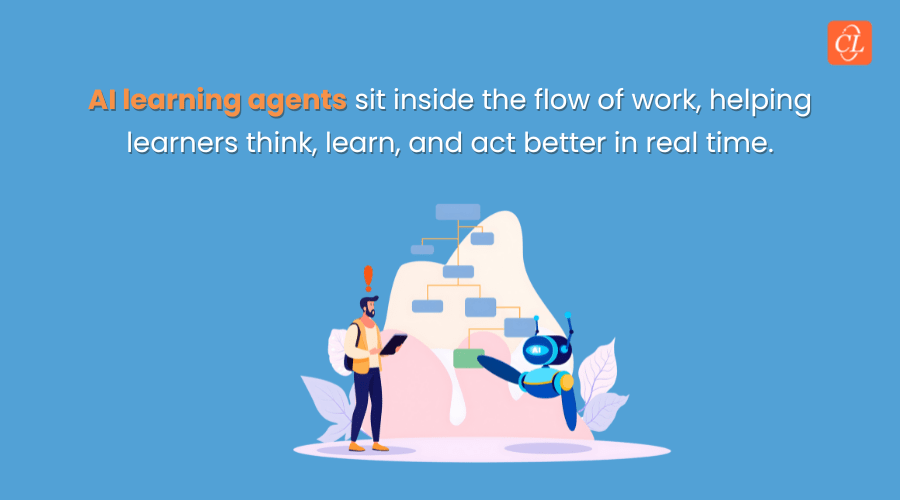
We’ve all seen the same pattern play out, learners complete a program only to forget most of it once they’re back at work, managers expect L&D to drive real performance even though learning sits outside the flow of work, and SMEs are repeatedly pulled into answering the same questions again and again.
What’s changing
Learning is moving from scheduled events to on-demand guidance. In the real world, people don’t fail because they didn’t attend training; they fail because they couldn’t recall or apply it at the right moment. With AI agents:
- Employees get answers while doing the task, not after searching manuals or pinging colleagues
- Guidance adapts based on role, context, and previous actions
- Repetitive “how do I…?” questions are handled instantly, without burdening SMEs or managers
- Learning becomes continuous support, not a one-time intervention
What L&D should do next
- Identify 5–10 high-friction moments where people make errors or hesitate
- Embed AI agents into SOPs, tools, or LMS — not as a separate “learning app”
- Design learning prompts, not lessons: checklists, decision guides, reminders
Trend 2: Skill-Based Training
We’ve all felt the frustration of impressive-looking skill frameworks that fail to change behavior, training plans that stay disconnected from real job performance, and employees left unsure about which skills truly matter for their growth.
What’s changing
Organizations are realizing that skill lists don’t build capability; practice does. The focus is shifting from abstract skill frameworks to role-based training that develops skills that show up clearly in day-to-day work. This approach makes L&D more concrete, measurable, and directly tied to business outcomes.
- Skills are defined by what people can actually do, not what they know
- Learning paths are linked to role transitions, performance gaps, and business priorities
- Assessment is moving beyond quizzes to real-world tasks and scenarios
- Development conversations are becoming clearer and more actionable for employees
What L&D should do next
- Stop mapping “future skills” in isolation, and map current performance gaps
- Design learning around skill demonstrations, not content completion
- Partner with managers to define what “good” looks like on the job
Focused reskilling can boost productivity by 6–12%, demonstrating the clear return on investment of strategic skill development.
Source: McKinsey
Trend 3: Intelligent Content Creation
We know all too well the pain of content that takes too long to build, SMEs who are unavailable or overwhelmed, and training programs that launch only after the business has already moved on.
What’s Changing
Content creation is no longer the bottleneck; decision-making is. AI tools are accelerating the journey from a blank page to a usable draft, freeing L&D teams to focus on relevance, judgment, and real-world impact. Rather than replacing human intelligence, these AI tools act as thinking partners, doing the heavy lifting on speed and structure while people stay firmly in charge of context, nuance, and quality.
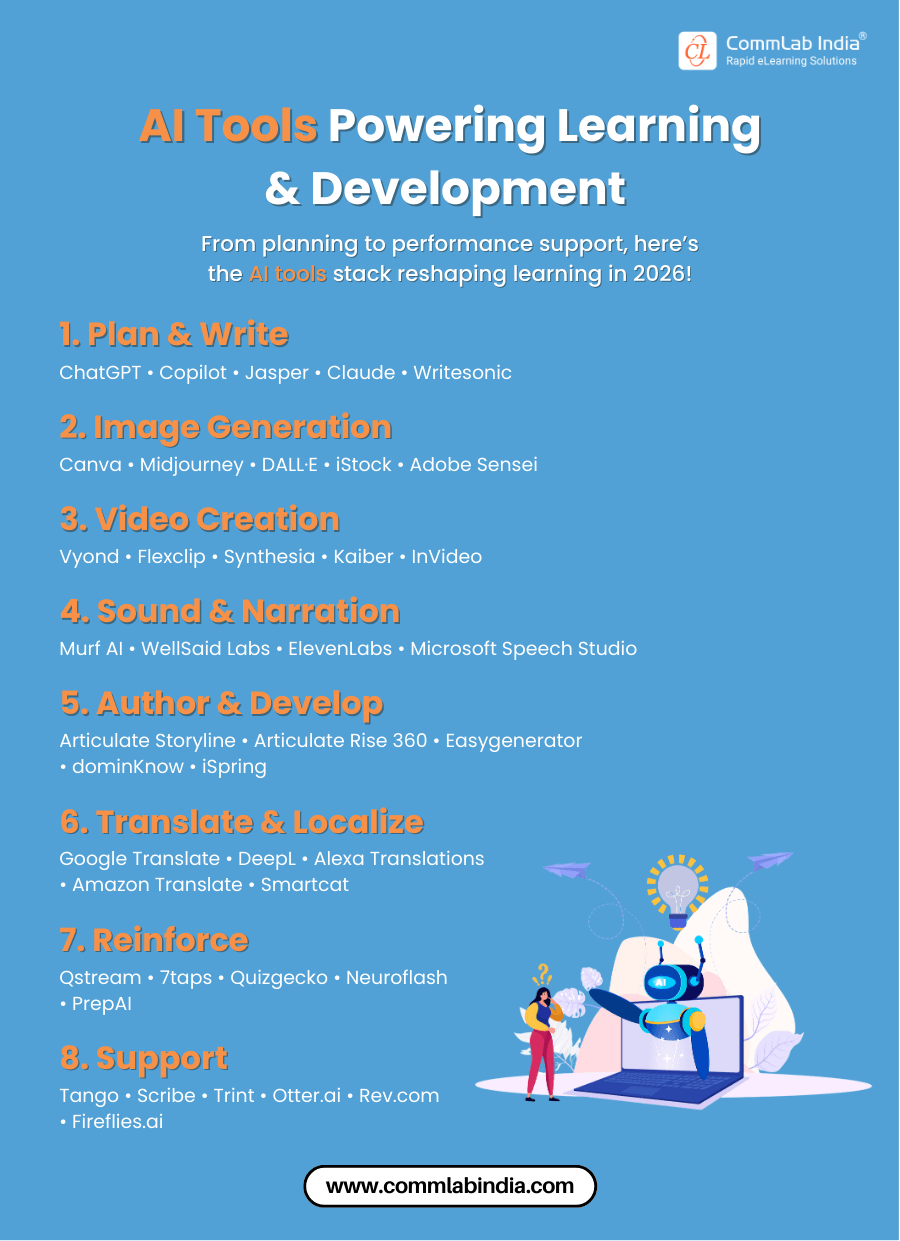
This is changing how quickly learning responds to business needs.
- Drafts, outlines, scripts, and variants are created in hours, not weeks
- SMEs review and refine instead of starting from scratch
- Translation and localization happen continuously, not as large rework projects
- L&D can finally keep pace with fast-changing products, policies, and processes
What L&D should do next
- Use AI for first drafts, outlines, and variants and for not final decisions
- Keep human judgment for context, tone, risk, and accuracy
- Build faster feedback loops instead of perfect courses
One Thought to Keep in Mind
AI doesn’t replace instructional design. It gives designers room to think again.
Trend 4: AI-Powered Training Solutions
Leadership often points to the pain of training programs that were delivered but failed to change performance, compliance being met while risk still lingers, and technical and leadership training that feels disconnected from the realities of the job.
What’s changing
Training is moving away from “information transfer” to decision practice. Organizations want people who can handle complexity, ambiguity, and pressure, not just recall content. AI makes it possible to personalize, adapt, and reinforce learning at scale.
- Scenarios change based on learner choices, mirroring real consequences
- Learning adapts to individual performance gaps, not averages
- Reinforcement happens over time, not just at course completion
- Training impact is measured through behavior and results, not attendance
What L&D should do next
- Shift from content-heavy courses to decision-based experiences
- Measure success through performance indicators, not completion rates
- Reinforce learning post-training using micro-nudges and spaced practice
Trend 5: Social Learning & Collaborative Intelligence
Learners silently endure the pain of learning that feels isolated and disconnected, where valuable tacit knowledge remains trapped in people’s minds, and discussion boards exist in name only, rarely fostering real interaction or knowledge sharing.
What’s changing
The most valuable learning already exists inside organizations; it’s just scattered, informal, and undocumented. Social learning is becoming more intentional, guided, and usable.
It’s less about conversation and more about collective problem-solving.
- Real work experiences, fixes, and workarounds are captured and shared
- Peer learning is structured around actual challenges, not generic discussions
- AI helps surface patterns, insights, and best responses from shared knowledge
- Learning shifts from top-down delivery to networked intelligence
Watch this quick video to discover practical ways to make social learning work in your corporate training.
What L&D should do next
- Design social moments around real challenges, not generic prompts
- Encourage sharing of mistakes, not just best practices
- Use AI to curate, summarize, and surface useful insights from conversations
Your Blueprint for What Comes Next
AI won’t fix broken learning strategies but it will amplify the ones that already work. The winners in 2026 won’t be the teams with the most tools, but the ones who redesign learning around real performance, real decisions, and real pressure. What you’ve read here is only the visible surface. The real shift is happening beneath it. Download the eBook! This blog is just the tip of the iceberg. Our full AI-Powered L&D Trends 2026 eBook goes deeper with action-ready frameworks, field-tested use cases, and research-backed data that shows what actually moves performance.

![Benefits of Adaptive Courses in Compliance Training [Infographic]](https://www.commlabindia.com/hubfs/Imported_Blog_Media/compliance-training-and-elearning-1.jpg)