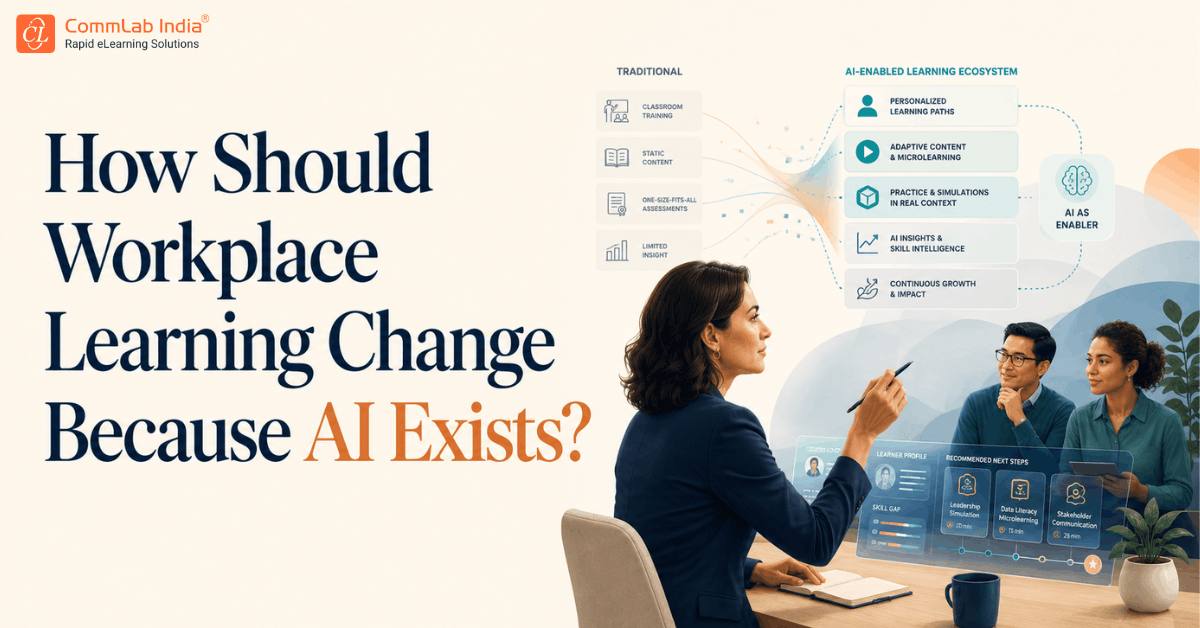
Artificial intelligence has quickly become part of everyday work in Learning and Development (L&D). Learning teams are using AI to summarize source material, draft storyboards, generate assessments, translate content, and accelerate course development. For many organizations, these applications have delivered immediate productivity gains, reducing repetitive work and allowing teams to move faster.
Yet an important question remains.
Does producing learning content faster automatically improve the way learning is designed?
For many organizations, the answer is becoming increasingly complex.
While AI is transforming individual tasks, most learning workflows, governance models, review cycles, and decision-making processes remain largely unchanged. Teams are often applying powerful new technologies to systems that were designed long before generative AI became available.
Recognizing this challenge, in collaboration with Lancaster University (UK), CommLab India recently completed a two-day AI-Powered Learning Design Innovation Workshop, facilitated by Dr. Brett Bligh, Director of the Centre for Technology Enhanced Learning at Lancaster University. Conducted as part of the ongoing WorkLearning.AI research initiative, the workshop applied the internationally recognized Change Laboratory methodology to help learning professionals rethink instructional design workflows for the AI era.
The workshop was led by Dr. Brett Bligh alongside Dr. RK Prasad, CEO and Co-Founder of CommLab India, and Dr. Ayesha Habeeb Omer, Co-Founder and Chief Operating Officer of CommLab India, bringing together academic research, enterprise learning strategy, and operational expertise to explore how AI can augment human capability rather than replace it.
Rather than demonstrating AI tools or teaching prompt engineering techniques, the workshop invited participants to examine a more fundamental question: How should learning design evolve when AI becomes an active collaborator rather than simply another productivity tool?
Using the internationally recognised Change Laboratory methodology, participants analysed existing learning design practices, explored recurring challenges, surfaced organisational tensions, and collaboratively designed future workflows where human expertise and AI could complement one another.
The workshop marked an important milestone for the WorkLearning.AI research programme. It represented a shift from understanding AI adoption to collaboratively redesigning the systems that shape workplace learning.
Table Of Content
- Why This Was Not a Typical AI Workshop
- Understanding the System Before Redesigning It
- Co-Designing the Future of Learning Design with AI
- What Enterprise Learning Leaders Can Learn
- Conclusion
Why This Was Not a Typical AI Workshop
Enterprise AI workshops often follow a familiar pattern. Participants are introduced to new AI platforms, shown how to write better prompts, explore productivity tips, and experiment with practical use cases. These sessions are valuable because they help organisations become comfortable with emerging technologies.
However, they usually concentrate on improving individual tasks.
The first WorkLearning.AI Change Laboratory adopted a very different approach. Instead of beginning with technology, it began with work.
Instead of asking participants to learn new AI features, it encouraged them to examine how learning design currently operates inside the organisation and whether those ways of working remain suitable for an AI-enabled future.
The emphasis shifted from automation to organisational learning.
Traditional AI Workshop vs. Change Laboratory
|
Traditional AI Workshop |
WorkLearning.AI Change Laboratory |
|
Learn how AI tools work |
Examine how learning work is organised |
|
Focus on prompts and productivity |
Focus on organisational redesign |
|
Improve individual tasks |
Improve entire learning systems |
|
Technology-first discussions |
Practice-first discussions |
|
AI demonstrations |
Collaborative diagnosis and co-design |
|
Immediate outputs |
Sustainable organisational transformation |
This distinction shaped every activity throughout the workshop.
Rather than searching for quick wins, participants explored how AI could influence collaboration, instructional quality, governance, workflow design, and decision-making across the learning lifecycle.
The WorkLearning.AI Research Journey
The Change Laboratory represents Phase 3 of the broader WorkLearning.AI research initiative conducted jointly by CommLab India and Lancaster University.
Each phase builds on insights from the previous one, creating a progression from understanding current practice to collaboratively designing future ways of working.
|
Phase |
Research Focus |
Key Outcome |
|
Phase 1 |
Why organisations are adopting AI in workplace learning |
Survey findings identifying adoption drivers, opportunities, and emerging trends |
|
Phase 2 |
How AI is being used in practice |
Interviews and case studies exploring implementation, governance, and organisational change |
|
Phase 3 |
How organisations can redesign learning for the AI era |
Change Laboratory workshops focused on collaborative redesign and experimentation |
Unlike many AI initiatives that move directly from research to implementation, the WorkLearning.AI programme deliberately introduces a collaborative design phase. Rather than prescribing solutions, the Change Laboratory enables practitioners to develop responses that reflect their own organisational context, constraints, and opportunities.
Moving Beyond AI Adoption
One of the most valuable frameworks introduced during the workshop described AI implementation as an organisational journey consisting of three stages.
The Three Stages of AI Maturity
|
Stage |
Primary Objective |
Typical Outcomes |
|
Capacity Recovery |
Reduce workload and recover time |
Faster drafting, summarisation, content generation |
|
Workflow Optimisation |
Improve existing processes |
Better collaboration, consistency, and efficiency |
|
Organisational Redesign |
Rethink how learning work is organised |
New workflows, new roles, new ways of collaborating with AI |
Most organisations today operate within the first two stages. They use AI to help people work faster. Few have begun redesigning how learning itself is organised.
The workshop challenged participants to think beyond productivity improvements and explore what becomes possible when AI changes not only what people do, but how learning teams work together.
Why Redesign Matters More Than Automation
Throughout the discussions, one message repeatedly surfaced.
Automation improves efficiency. Redesign creates transformation.
AI can significantly reduce the time required to create first drafts, summarise information, generate assessment ideas, or personalise learning content. These improvements are valuable.
However, they do not automatically address deeper organisational questions.
For example:
- Should learning designers spend less time producing content and more time solving performance problems?
- How should AI-generated outputs be reviewed and validated?
- Where should instructional judgement remain essential?
- How should governance evolve when AI contributes to learning design?
- What new capabilities will learning professionals require?
These questions cannot be answered by technology alone. They require organisations to rethink workflows, roles, collaboration, and decision-making. This became one of the defining themes of the first Change Laboratory.
Participants were encouraged to move beyond asking: "How can AI make us faster?" Instead, they explored a more strategic question: "How should learning design evolve because AI is now part of the way we work?"
That shift—from automation to redesign—marked the beginning of organisational transformation.
Understanding the System Before Redesigning It
Till now, we explored why the first WorkLearning.AI Change Laboratory was fundamentally different from a conventional AI workshop. Rather than focusing on prompts or productivity, it challenged participants to examine how learning work itself is organised and whether existing systems are fit for an AI-enabled future.
This raised an important question: If organizations want to redesign learning, what exactly needs to change?
The workshop answered this by introducing participants to Activity Theory and the Change Laboratory methodology—two complementary approaches that shift the conversation from improving individual tasks to redesigning the systems that generate those tasks.
The Change Laboratory: A Framework for Collaborative Redesign
The Change Laboratory is not a brainstorming session or an AI training workshop. It is a structured methodology that helps organizations investigate their current ways of working, identify systemic challenges, and collaboratively design new models of practice.
Unlike traditional change initiatives, where external experts often recommend solutions, the Change Laboratory places practitioners at the center of the redesign process. Participants are not passive recipients of advice. They become co-designers of future ways of working.
The facilitator's role is to introduce conceptual frameworks, guide discussions, and create opportunities for reflection. The solutions emerge from the people who understand the organization's work, clients, and constraints best.
This philosophy shaped every activity during the workshop.
Why the Workshop Started with Today Instead of Tomorrow
One of the most distinctive aspects of the workshop was its starting point.
Many AI initiatives begin by asking questions such as:
- What could AI do in the future?
- Which tools should we adopt?
- What will learning look like in five years?
The Change Laboratory deliberately avoided these questions during the opening sessions. Instead, participants examined today's reality.
They discussed
- how learning projects currently move through the organization,
- where delays typically occur,
- how collaboration takes place,
- recurring quality concerns,
- client expectations,
- review cycles,
- and examples of work that repeatedly creates challenges.
Only after developing a shared understanding of the current state did the workshop begin exploring future possibilities.
This approach reflects an important principle: Effective redesign begins with an accurate understanding of present-day work—not an idealized vision of the future.
Looking Beyond Tasks: Understanding Activity Theory
Learning design is often viewed as a collection of tasks. For example, analysing source content, writing objectives, developing storyboards, creating assessments, reviewing drafts, and publishing learning. While these activities are important, the workshop encouraged participants to think at a broader level.
Activity Theory distinguishes three levels of work.
|
Level |
Description |
Learning Design Example |
|
Operations |
Routine behaviours performed almost automatically. |
Formatting content, applying templates, using authoring tools. |
|
Actions |
Goal-directed tasks completed to achieve a specific objective. |
Creating a storyboard or reviewing a course. |
|
Activities |
Larger systems of work driven by an ongoing purpose. |
Designing learning solutions that improve client performance. |
This distinction helps explain why simply automating tasks does not necessarily transform the organization. AI may improve individual actions. But sustainable change requires redesigning the broader activity that generates those actions.
Mapping CommLab India's Learning Design Activity System
Participants then explored one of the core concepts of Activity Theory: the Activity System. Rather than treating learning design as a linear process, the Activity System views it as a network of interconnected elements working toward a common purpose.
The workshop encouraged participants to map these elements based on how work actually happens—not how official processes describe it.
Components of the Activity System
|
Component |
Example in CommLab India's Learning Design Context |
|
Subject |
Learning designers, project managers, reviewers |
|
Object |
Designing effective learning solutions that improve client performance |
|
Community |
SMEs, developers, QA teams, clients, operations, leadership |
|
Tools |
Claude, authoring tools, templates, AI platforms, collaboration systems |
|
Rules |
Quality standards, client requirements, governance policies, instructional principles |
|
Division of Labour |
Distribution of expertise, responsibilities, authority, and decision-making |
|
Outcome |
High-quality, scalable learning experiences that deliver measurable business impact |
Participants recognised that introducing AI influences nearly every element of this system.
- AI changes the available tools.
- It influences how people collaborate.
- It affects quality assurance.
- It introduces new governance considerations.
- It reshapes professional roles.
The discussion therefore shifted from: "Where can AI fit?" to "How does AI reshape the relationships between people, processes, tools, and decisions?"
The Object: The Purpose That Holds the System Together
One of the workshop's most thought-provoking discussions focused on the concept of the object. Participants initially associated the object with project deliverables, such as completing an eLearning course. The workshop clarified that the object is much broader. It represents the enduring purpose around which an activity system is organized.
For a learning design team, the object is not producing courses. It is continuously creating learning experiences that enable people to perform better in their roles. Understanding the object changes how AI is viewed.
Instead of asking: "Can Claude create a storyboard?" Participants began asking: "How can Claude help us better achieve our purpose of designing effective workplace learning?"
This subtle shift moves AI from being a content-generation tool to becoming part of a broader performance-support system.
Why Organizations Have Multiple Activity Systems
Another key insight was that organizations should not be viewed as a single activity system. CommLab India, like most enterprises, consists of multiple interconnected systems, each pursuing a different object.
Examples discussed included Learning Design, Marketing, Sales, Technology, Operations, Client Engagement and Leadership. These systems continuously influence one another.
For example, learning design decisions may be affected by:
- client timelines,
- commercial priorities,
- technology capabilities,
- governance requirements,
- operational capacity.
This perspective helped participants understand why AI transformation extends beyond instructional design. It requires alignment across the wider organization.
Mirror Data: Learning from Real Work
Rather than relying on hypothetical examples, the workshop used participants' own project experiences as mirror data. Mirror data acts as evidence. It reflects how work is actually performed.
Participants analysed:
- recent learning projects,
- workflow bottlenecks,
- recurring communication challenges,
- review delays,
- quality issues,
- and examples where AI had already influenced work.
These discussions revealed gaps between documented processes and everyday practice. More importantly, they helped teams identify patterns that often remain invisible during routine work.
Using real examples grounded every conversation in organizational reality.
Contradictions: The Starting Point for Innovation
Most improvement programmes begin by identifying problems. The Change Laboratory begins by identifying contradictions. A contradiction is not simply a problem to solve. It represents competing demands that cannot be resolved by making one task more efficient. Throughout the workshop, participants identified several recurring tensions emerging through AI adoption.
Contradictions Identified During the Workshop
|
Emerging Tension |
Why It Matters |
|
Human Judgment vs. AI Automation |
Determining where AI should assist and where instructional expertise remains essential. |
|
Speed vs. Quality |
Balancing rapid content generation with instructional rigor and quality assurance. |
|
Personalization vs. Governance |
Delivering tailored learning experiences while maintaining consistency and compliance. |
|
Scale vs. Meaningful Learning |
Expanding production without losing relevance or learner engagement. |
|
Prompt Engineering vs. Learning Design Expertise |
Ensuring prompt-writing skills complement rather than replace instructional thinking. |
|
Efficiency vs. Learning Strategy |
Avoiding a focus on producing more content at the expense of solving business performance challenges. |
The workshop emphasized that these contradictions should not be eliminated. Instead, they provide valuable insight into where organizations need to rethink existing ways of working.
Diagnosing Before Designing
The first day concluded with an important realization. Teams cannot redesign future workflows until they understand why current workflows evolved in the first place.
Participants left Day 1 with a shared understanding of:
- how learning work currently operates,
- where systemic constraints exist,
- how AI is affecting different parts of the learning ecosystem,
- and why transformation requires organizational redesign rather than isolated process improvements.
This diagnosis laid the foundation for the collaborative design work that followed on the second day.
Co-Designing the Future of Learning Design with AI
Till now, we explored why the first WorkLearning.AI Change Laboratory focused on redesign rather than automation, and how participants used Activity Theory to understand the systems, relationships, and tensions shaping learning design at CommLab India.
With a shared understanding of the current state, the workshop entered its most important phase—co-designing the future.
This wasn't about predicting what AI might do in five years. Nor was it about replacing existing workflows overnight. Instead, participants worked together to design credible, AI-enabled workflows that could be tested, refined, and gradually integrated into everyday practice. The emphasis throughout the second day was on experimentation, collaboration, and organizational learning.
From Diagnosis to Design
The transition from Day 1 to Day 2 reflected a key principle of the Change Laboratory methodology: Meaningful redesign should emerge from evidence, not assumptions.
Having identified recurring bottlenecks, contradictions, and constraints in existing learning design practices, participants shifted their attention to a simple but challenging question: "Given what we've learned about our current system, how should learning design evolve?"
Rather than attempting to create one definitive future-state process, teams developed multiple workflow models, evaluated their strengths and limitations, and refined them through collaborative discussion.
The objective was not perfection—it was credibility.
Reimagining Learning Design with Claude
Claude served as the primary AI platform explored during the workshop—not as a replacement for instructional designers, but as a collaborative partner within the learning design process.
Participants explored where Claude could create the greatest value while preserving the instructional expertise that remains essential to effective workplace learning.
Opportunities Identified for Claude Across the Learning Design Lifecycle
|
Learning Design Stage |
Potential Role for Claude |
Human Expertise Remains Essential |
|
Content Analysis |
Summarize source material, identify themes, organize information |
Identify business priorities, validate accuracy, determine learning relevance |
|
Learning Design |
Generate alternative structures, draft activities, suggest assessments |
Define learning strategy, performance outcomes, instructional decisions |
|
Content Development |
Draft scripts, scenarios, knowledge checks, supporting content |
Ensure contextual relevance, storytelling, instructional quality |
|
Personalization |
Adapt examples for different audiences, roles, and proficiency levels |
Decide what adaptations are appropriate for business and learner needs |
|
Review & Quality |
Check consistency, identify gaps, compare versions |
Approve final learning experience and maintain quality standards |
|
Continuous Improvement |
Summarize feedback, identify recurring issues, recommend improvements |
Prioritize enhancements based on business impact and learner outcomes |
The discussions reinforced a recurring message: Claude can support learning design. It cannot replace instructional judgment.
Co-Designing Future Learning Workflows
Instead of redesigning individual tasks, participants redesigned end-to-end workflows.
Working in teams, they explored how AI could support collaboration across learning designers, project managers, subject matter experts, reviewers, quality assurance, and clients.
Several themes emerged consistently. AI as a Collaborative Partner
Participants envisioned AI supporting teams by preparing first drafts for discussion, surfacing alternative approaches, identifying missing information, assisting with prompt refinement, reducing repetitive work, and enabling faster iteration.
Importantly, AI was positioned at the beginning and throughout the workflow, not simply at the end as a content-generation tool.
Prompt Engineering as a Design Capability
The workshop highlighted that effective AI use depends not only on writing prompts, but on understanding the learning problem. Participants recognised that prompt engineering should become part of broader instructional design capability rather than a separate technical activity.
Successful prompts require business context, learner understanding, instructional intent, quality criteria, and performance outcomes. In other words, better prompts begin with better learning design.
Designing for Iteration
Another significant shift involved moving away from linear development models.
Traditional workflows often follow a sequence such as:
Analyse → Design → Develop → Review → Deliver
The future-state models were more iterative. AI enables rapid experimentation, making it easier for teams to generate alternatives, compare options, refine solutions, gather feedback, and improve continuously.
Iteration becomes an expected part of the workflow rather than an exception.
The Human-AI Partnership
One of the strongest outcomes from the workshop was a shared understanding of how responsibilities should be distributed between AI and learning professionals.
Rather than asking whether AI should replace existing roles, participants considered where each contributes the greatest value.
Emerging Division of Responsibilities
|
AI Contributes |
Learning Professionals Contribute |
|
Speed |
Judgment |
|
Scale |
Context |
|
Alternative ideas |
Strategic decisions |
|
Draft generation |
Learning architecture |
|
Pattern recognition |
Business understanding |
|
Consistency |
Creativity and empathy |
|
Automation |
Accountability |
This division reflects the broader philosophy of the workshop. AI enhances human capability. It does not replace human responsibility.
Turning Ideas into Action
The workshop concluded by translating discussion into practical implementation planning.
Rather than ending with conceptual models, participants identified priority initiatives, potential pilot projects, ownership, success measures, dependencies, and implementation sequencing. The goal was to create momentum for continued experimentation rather than a one-time innovation event.
The outputs from the workshop will inform a post-workshop report that documents proposed future workflows, implementation priorities, lessons learned, and recommendations for ongoing organizational transformation.
These findings will also contribute to the broader WorkLearning.AI research programme as additional Change Laboratory workshops are conducted with organizations in other regions.
What Enterprise Learning Leaders Can Learn
Although the workshop focused on CommLab India's learning design team, many of its insights are broadly applicable to enterprise L&D.
1. AI transformation is a systems challenge.
Organizations often focus on AI tools. Long-term value comes from redesigning workflows, governance, collaboration, and decision-making.
2. Productivity creates capacity—but redesign creates value.
Saving time matters. The bigger opportunity lies in using that time to strengthen learning strategy, improve learner experiences, and solve performance challenges.
3. Human expertise becomes more valuable, not less.
As AI assumes routine production work, learning professionals spend more time on instructional strategy, stakeholder collaboration, performance consulting, learner experience, and quality assurance.
4. Organizational tensions should be explored, not avoided.
Questions such as how much should AI decide? where should governance evolve? what new capabilities are required? are signs that organizations are entering a new stage of maturity.
5. Sustainable transformation requires co-design.
Organizations are far more likely to adopt new practices when the people doing the work help design those practices.
The first WorkLearning.AI Change Laboratory marks the beginning of Phase 3 of the research programme. Future Change Laboratory workshops will build on these foundations with additional organizations, expanding the evidence base and refining practical frameworks for AI-enabled workplace learning.
As more enterprise learning teams participate, the research will continue exploring how AI can support learning systems that are faster, more scalable, more adaptive, and more effective, while preserving the instructional quality and human expertise essential to meaningful workplace learning.
Conclusion
The first WorkLearning.AI Change Laboratory demonstrated that the future of enterprise learning is not defined by AI alone. It is defined by how organizations choose to redesign the systems in which people and AI work together.
By combining the Change Laboratory methodology with enterprise learning practice, CommLab India and Lancaster University created a collaborative environment where participants could move beyond tool adoption and begin rethinking learning design itself.
The workshop showed that successful AI transformation is not measured solely by faster content production. It is measured by an organization's ability to strengthen collaboration, improve decision-making, preserve instructional rigor, and continuously adapt its learning systems to changing business needs.
As the WorkLearning.AI research programme continues, the lessons from this first Change Laboratory provide a foundation for future collaboration, experimentation, and evidence-based innovation—helping enterprise learning leaders move confidently from AI adoption to AI-enabled transformation.