AI is already changing how learning teams work. It can help generate content, summarize information, create assessments, support translation, accelerate media production, and reduce the time required for many routine learning-development tasks.
But as organizations move beyond experimentation, a much bigger question is beginning to emerge: How should workplace learning itself change because AI exists?
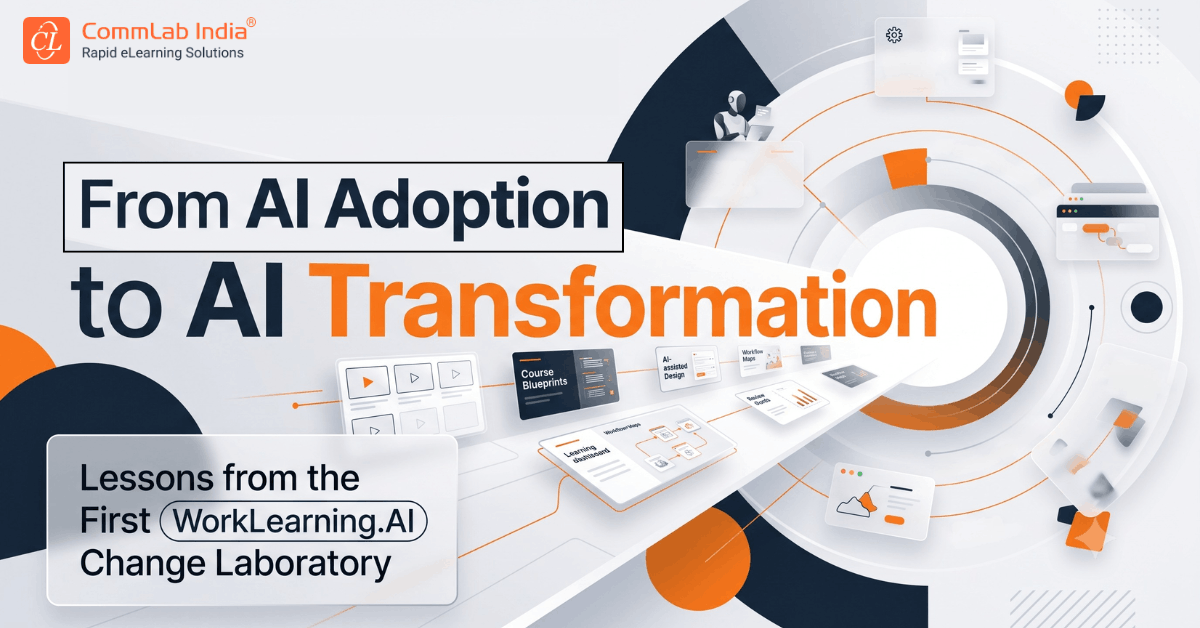
That question was at the heart of the inaugural WorkLearning.AI Change Laboratory, jointly conducted by CommLab India and Lancaster University.
Over two days, enterprise learning leaders, researchers, and practitioners came together not to evaluate another AI tool, but to examine how artificial intelligence is beginning to reshape the broader system of workplace learning: roles, workflows, governance, instructional decision-making, collaboration, and organizational capability.
The workshop represents an important next stage of the WorkLearning.AI research initiative, moving from identifying patterns and tensions within organizations to collaboratively exploring what better AI-enabled learning systems might look like.
And one idea quickly became difficult to ignore:
AI adoption may begin with technology, but meaningful transformation depends on how organizations redesign the work around it.
Table Of Content
- Why AI in L&D Is Becoming an Organizational Question
- What Is the WorkLearning.AI Change Laboratory?
- From Observing AI Adoption to Co-Designing What Comes Next
- Five Questions Emerging for Enterprise Learning Leaders
- Why the Change Laboratory Approach Matters
- The Bigger Shift: From AI Tools to AI-Enabled Learning Systems
- What Comes Next for WorkLearning.AI?
- Frequently Asked Questions
Why AI in L&D Is Becoming an Organizational Question
Much of the early conversation around generative AI in Learning and Development centered on productivity.
Can AI create a storyboard faster?
Can it generate quiz questions?
Can it summarize source content?
Can it create an avatar video?
Can it translate learning content?
Those questions still matter.
But they address only one layer of the transformation.
As AI becomes embedded more deeply into work, organizations must also decide:
- Who remains accountable for instructional quality?
- Which decisions can be delegated to AI and which require professional judgment?
- What happens to learning roles when routine production becomes easier?
- How should governance change when AI-generated learning can be produced at unprecedented speed?
- How should learning teams work with subject matter experts, IT, legal, compliance, and business leaders?
These are no longer questions about individual tools.
They are questions about the learning system surrounding the tools.
This distinction is especially important as organizations move from isolated AI pilots toward broader implementation. AI can accelerate an existing process, but accelerating a process does not necessarily make the underlying system more effective.
Sometimes it simply makes the existing problems move faster.
What Is the WorkLearning.AI Change Laboratory?
The Change Laboratory is a formative intervention methodology associated with Cultural-Historical Activity Theory and expansive learning. It is designed to help people examine contradictions and tensions within real work systems and collaboratively develop new ways of working. Research literature describes the approach as particularly useful for studying workplaces in transition and supporting participants as they design improved forms of activity.
That makes it especially relevant to AI adoption.
AI is not entering organizations in isolation. It interacts with established roles, policies, technologies, expectations, professional identities, and ways of working.
The Change Laboratory therefore asks participants to look beyond: “What can this technology do?”
and instead examine: “What is happening to our system of work because this technology is now part of it?”
The approach aligns closely with the research interests of Dr. Brett Bligh of Lancaster University, whose work includes Activity Theory, institutional change, technology-enhanced learning, and Change Laboratory research interventions.
From Observing AI Adoption to Co-Designing What Comes Next
The inaugural Change Laboratory represents an important progression within the WorkLearning.AI research programme.
Earlier stages of the research examined how organizations were already encountering AI in workplace learning, including the opportunities, tensions, and contradictions emerging as teams experimented with new technologies.
The Change Laboratory moves the research into a different mode.
Instead of researchers simply documenting what organizations are experiencing, practitioners participate in examining those challenges and exploring possible responses.
That distinction matters.
Enterprise AI adoption is developing too quickly and is too context-dependent for organizations to rely entirely on generalized best practices.
What works in one environment may not transfer neatly into another.
A highly regulated organization, for example, may face very different constraints around AI-generated learning than a technology company.
A global learning organization may need to balance personalization with translation, localization, governance, and content lifecycle complexity.
An instructional design team may gain enormous production efficiencies while simultaneously confronting new questions about quality assurance and professional identity.
There may therefore be no universal blueprint for AI-enabled workplace learning.
But organizations can develop better ways of asking the right questions.
Five Questions Emerging for Enterprise Learning Leaders
The two-day discussion reinforces a broader shift already visible across enterprise L&D.
The strategic challenge is moving from using AI to designing an environment in which AI can be used responsibly and effectively.
For learning leaders, five questions are becoming particularly important.
- Where Should AI Assist?
- Where Should AI Challenge Us?
- Where Must Human Judgment Remain Central?
- How Should Learning Roles Change?
- Are We Redesigning Learning or Simply Automating the Old Model?
AI can create substantial value in activities such as ideation, summarization, first-draft generation, content transformation, analysis, and repetitive production work.
The opportunity is not simply to automate tasks.
It is to identify where AI can remove unnecessary effort so learning professionals can spend more time on higher-value work.
That distinction matters because productivity should create capacity for judgment, not simply pressure to produce more content.
AI does not need to function only as a generator.
It can also serve as a thinking partner.
Learning professionals can use it to:
- challenge assumptions
- generate alternative explanations
- identify missing perspectives
- critique a learning strategy
- pressure-test scenarios
- surface potential inconsistencies
This represents a more mature relationship with AI.
Instead of asking: “Can AI create this for me?”
teams begin asking: “Can AI help me think more rigorously about this?”
As generation becomes easier, judgment becomes more important.
AI may propose an instructional approach, but someone still needs to determine whether it is appropriate for the learner, business context, risk environment, and intended performance outcome.
The same applies to accuracy, tone, cultural relevance, accessibility, ethics, and regulatory considerations.
The core challenge therefore becomes deciding where human accountability cannot be delegated.
The future learning professional may spend less time producing every element manually and more time evaluating, orchestrating, validating, and improving what AI helps create.
AI is unlikely to affect every learning role in the same way.
Instructional designers, learning architects, multimedia developers, project managers, facilitators, and learning leaders may all see parts of their work redistributed.
Some production activities may decline.
Other responsibilities may become more important.
These could include:
- quality assurance
- performance consulting
- learning architecture
- AI governance
- workflow orchestration
- data interpretation
- business alignment
- evaluation
- human-AI collaboration design
The question is therefore not simply whether AI will replace particular roles.
A more useful question is: How will the value of those roles change when AI becomes part of the learning ecosystem?
This may be the most important question of all.
AI makes it possible to produce conventional learning assets dramatically faster.
But faster course production does not automatically produce a better learning organization.
Organizations now have an opportunity to reconsider some long-standing assumptions:
- Does every capability gap require a course?
- Should learning content remain static for months or years?
- Could learning become more embedded in the flow of work?
- Can simulations, AI coaches, performance support, dynamic resources, and practice environments play a larger role?
- How should organizations measure learning when the boundary between formal learning and work becomes increasingly blurred?
AI may ultimately have its greatest impact not by improving the traditional course-development model, but by helping organizations move beyond it.
Why the Change Laboratory Approach Matters
One reason the Change Laboratory is particularly relevant to AI-enabled workplace learning is that it treats change as a systemic problem.
Technology is only one element.
A workplace learning system also includes people, rules, tools, responsibilities, communities, goals, and divisions of labor.
Change one element and pressure can emerge elsewhere.
For example:
AI increases production speed → review capacity becomes the bottleneck.
AI enables personalization → content governance becomes more complex.
AI automates routine design work → professional roles become less clearly defined.
AI allows rapid experimentation → policy approval processes struggle to keep pace.
These tensions are not necessarily signs that AI adoption has failed.
They can be signals that the surrounding system needs to evolve.
That is precisely the kind of transition Activity Theory and Change Laboratory research is designed to explore. Lancaster University's Centre for Technology Enhanced Learning focuses on the theoretical and practical challenges created by technologies in learning environments, while Dr. Bligh's research specifically examines technology and institutional change through Activity Theory and interventionist methodologies.
The Bigger Shift: From AI Tools to AI-Enabled Learning Systems
Perhaps the most important insight is that organizations may soon need to stop thinking about AI adoption as a collection of tools.
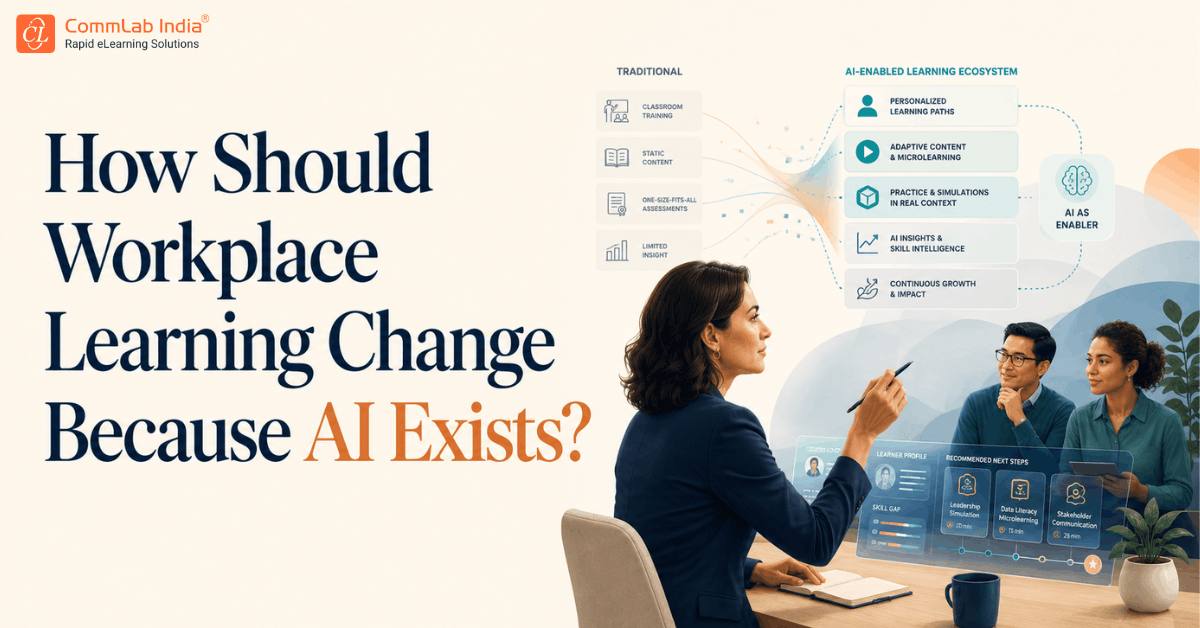
The more mature question is: What does an AI-enabled learning system look like?
Such a system might include:
Human expertise providing context, purpose, judgment, and accountability.
AI assisting with generation, analysis, variation, acceleration, and critique.
Governance defining acceptable use and responsibility.
Learning technology connecting resources, data, and workflows.
Business stakeholders continually informing capability priorities.
Learning teams orchestrating the system rather than merely producing content within it.
That is a much bigger transformation than adopting a new authoring capability.
It is organizational redesign.
What Comes Next for WorkLearning.AI?
The inaugural Change Laboratory is the beginning of the next phase of the WorkLearning.AI research journey.
The insights generated through the two-day workshop will inform continuing research and future collaborative sessions with participating organizations.
As the research progresses, the goal is not simply to document how organizations are using AI.
It is to better understand how organizations can redesign workplace learning so that AI strengthens rather than diminishes: human expertise, instructional quality, organizational capability, and learning impact.
There will almost certainly be no single answer.
Different organizations will make different choices depending on their people, industry, risk environment, technology, and learning maturity.
But the fundamental question is becoming increasingly urgent: Are we simply introducing AI into the learning systems we already have, or are we prepared to redesign those systems for the world that is emerging?
The distinction may determine which organizations merely become faster at producing learning and which become genuinely better at building capability.
Frequently Asked Questions
What is WorkLearning.AI?
WorkLearning.AI is a research initiative examining how artificial intelligence is changing workplace learning, learning roles, organizational practices, governance, and the broader learning ecosystem.
What is a Change Laboratory?
A Change Laboratory is a research intervention methodology based on Cultural-Historical Activity Theory. It brings practitioners and researchers together to analyze tensions within an existing system of work and collaboratively develop new ways of working.
Why is the Change Laboratory relevant to AI in workplace learning?
AI affects more than individual tasks. It can influence roles, workflows, governance, collaboration, quality assurance, and professional responsibilities. The Change Laboratory allows organizations to examine those relationships as an interconnected system rather than treating AI purely as a technology implementation.
How is AI changing the role of L&D?
AI can automate or accelerate portions of learning production, potentially increasing the importance of capabilities such as instructional judgment, learning architecture, evaluation, governance, performance consulting, and human-AI workflow design.
Will AI replace instructional designers?
The more immediate transformation is likely to involve redistribution of work rather than simple role replacement. As AI handles more generation and production, instructional professionals may increasingly focus on judgment, context, quality, strategy, and learning-system design.
What should enterprise learning leaders focus on when adopting AI?
Organizations should look beyond tool adoption and consider where AI should assist, where human judgment remains essential, how governance should work, how roles may evolve, and whether existing learning processes need to be redesigned rather than simply automated.