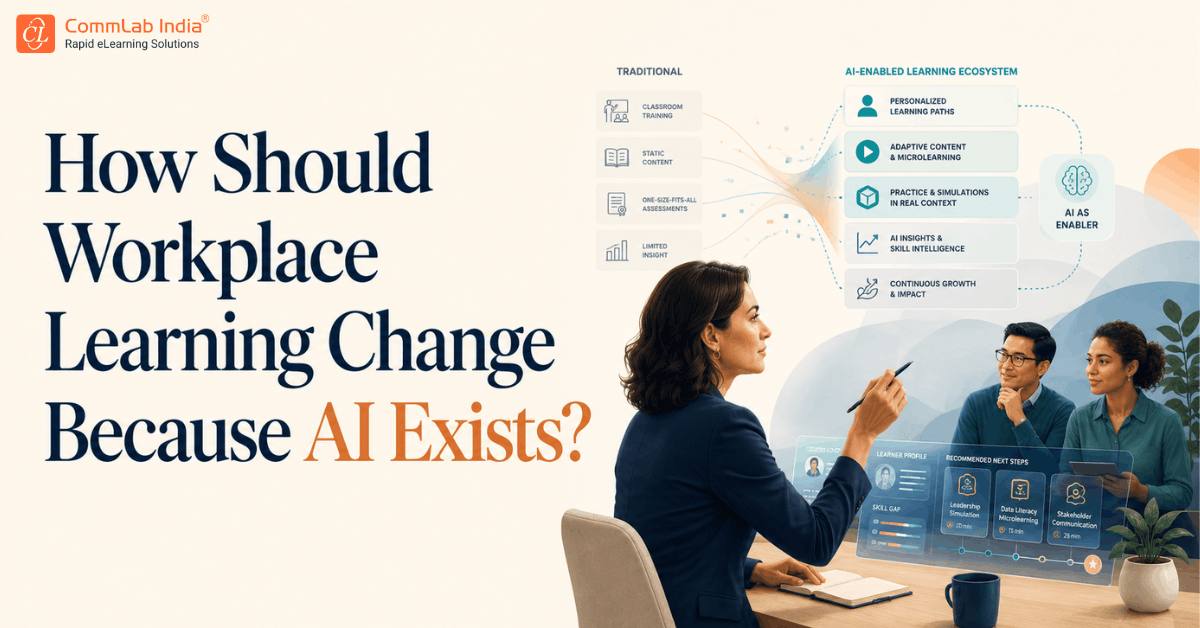
Artificial Intelligence has moved past the experimentation phase in workplace learning. It’s no longer a distant innovation or a future-facing concept; it’s already embedded in how learning teams design, deliver, and scale training.
And yet, something doesn’t add up.
Despite widespread adoption, many enterprise L&D teams still feel like they’re figuring it out as they go. Pilots are everywhere. Tools are multiplying. But clarity? That’s still evolving.
This blog distills a few key insights from the WorkLearning.AI report. If you’re looking to understand how AI is actually being used in corporate training, what challenges it is surfacing, and what actions leaders should take next, this is the place to start.
Table Of Content
- About This Report
- Who is This Report For?
- What is the State of AI in Workplace Learning?
- Is AI in Workplace Learning a Stabilizer Rather Than a Transformer?
- How Do We Move from Tool Adoption to Workflow Redesign in L&D?
- How to Move from Fragmented Experimentation to Strategic AI Impact?
- What This Means for L&D Leaders?
- Frequently Asked Questions about AI in Workplace Learning
- Ready for the Full Picture?
About This Report
The WorkLearning.AI study was initiated to bring clarity to a conversation that has become increasingly noisy and often disconnected from real organizational practice.
Unlike trend reports that speculate about the future, this research focuses on what’s actually happening inside enterprises today.
Artificial intelligence is moving from the margins of corporate learning into everyday operational use. Yet the discussion about AI in L&D remains polarized—often tool-focused, speculative, or detached from real organizational contexts.
This interim report presents findings from the first two phases of a multi-phase research program led by Dr. RK Prasad (CEO & Co-founder, CommLab India) and Dr. Brett Bligh (Senior Lecturer, University of Lancaster, UK).
It does not attempt to predict what AI will become.
Instead, it examines what AI is doing right now inside workplace learning systems:
- How AI is currently being used
- What problems organizations are trying to solve with it
- What tensions AI is revealing within learning ecosystems
This is not a futuristic narrative. It is a reality check.
Who is This Report For?
This report is designed for decision-makers navigating the intersection of learning, technology, and workforce transformation:
- L&D leaders and heads of learning
- Training managers and instructional design leaders
- Talent and capability professionals exploring AI in learning
- HR and business leaders shaping workforce readiness
- Enterprise teams looking for a practical, research-backed view of AI in L&D
If you’re responsible for learning strategy, learning operations, or capability building in an AI-shaped workplace, this report is for you.
What is the State of AI in Workplace Learning?
One of the most striking findings from the research is this:
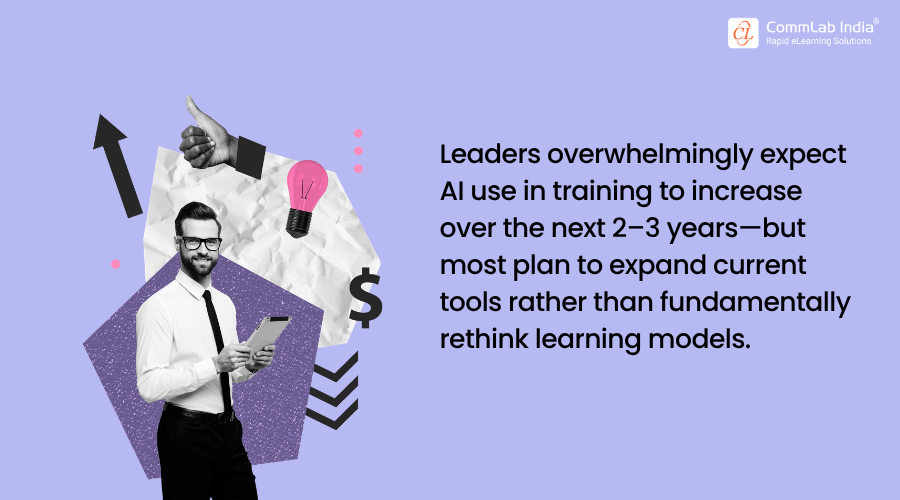
This reveals a critical gap. AI adoption is accelerating, but transformation is not.
Most organizations are layering AI onto existing workflows rather than redesigning those workflows entirely. The result? Incremental gains in efficiency, but limited impact on learning effectiveness or business outcomes.
Is AI in Workplace Learning a Stabilizer Rather Than a Transformer?
In its current phase, AI is acting less like a disruptor and more like a stabilizing force in workplace learning.
It is helping teams:
- Produce content faster
- Scale translations and localization
- Automate repetitive instructional tasks
- Reduce production bottlenecks
But here’s the deeper insight: Whether AI becomes transformative depends less on the technology and more on how organizations respond to the tensions it exposes.
These tensions are already visible:
- Speed vs. quality
- Automation vs. human judgment
- Scale vs. contextual relevance
- Innovation vs. governance
AI hasn’t resolved these tensions. It has made them impossible to ignore.
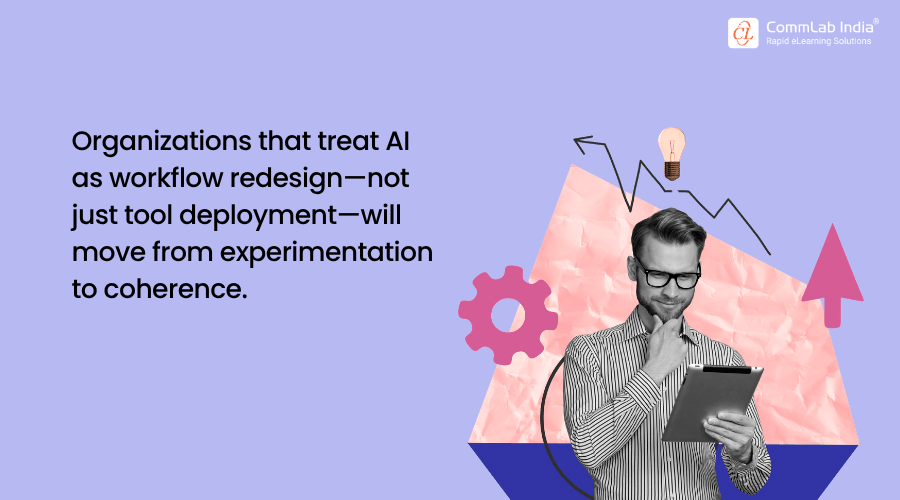
How Do We Move from Tool Adoption to Workflow Redesign in L&D?
This is where many L&D teams find themselves today—actively testing tools, running pilots, and exploring promising use cases, yet stopping short of the bigger changes that true transformation demands. In many organizations, AI is still being added to existing ways of working rather than prompting a rethink of how learning is designed, delivered, and governed.
Roles are not being redefined, processes are not being rebuilt, governance frameworks remain immature, and new standards for quality are still taking shape. That is why progress often feels real, but incomplete. The move from simply using AI to truly operating with AI is where meaningful transformation begins.
How to Move from Fragmented Experimentation to Strategic AI Impact?
The research outlines five critical actions for enterprise L&D leaders.
1. Reinvest Efficiency Gains into Quality
AI is saving time but what you do with that time matters more.
Redirect capacity into:
- Scenario depth
- Assessment validity
- Stakeholder collaboration
- Governance rigor
2. Build AI Literacy Before Expanding AI Use
AI tools proficiency is not enough.
Teams need to develop:
- Critical evaluation skills
- Judgment in AI-assisted design
- Role-specific AI competencies
3. Formalize the Augmentation Principle
Make it explicit:
- AI supports decision-making
- Humans remain accountable
This clarity is essential for both quality and trust.
4. Make Role Reconfiguration Explicit
Instructional design is evolving.
New expectations include:
- AI orchestration
- Prompt design
- Output evaluation
- Governance oversight
Ignoring this shift will create capability gaps.
5. Convert Pilots into Organizational Learning
Pilots should not remain isolated experiments.
Instead:
- Establish cross-functional AI review mechanisms
- Define clear criteria for scaling or retiring initiatives
- Capture and institutionalize learning
WorkLearning.AI
Interim Research Report
A Joint Research Initiative by Lancaster University, UK and CommLab India
- Why organizations are turning to A
- What AI use in L&D looks like
- The contradictions leaders can’t ignore
- And More!
What This Means for L&D Leaders?
AI in corporate training is no longer about whether to adopt; it’s about how to operationalize.
The organizations that will lead in this space are not the ones experimenting the most.
They are the ones that:
- Create coherence across tools, workflows, and roles
- Balance speed with quality
- Embed governance without slowing innovation
- Treat AI as a system-level shift, not a feature upgrade
Frequently Asked Questions about AI in Workplace Learning
1. Where is AI being used most in workplace learning today?
A. AI is being used most heavily in content creation, which remains the most established and mature use case in workplace learning. For many L&D teams, this is where AI is delivering the most immediate and visible value.
2. How are organizations feeling about AI in workplace learning?
A. The mood is largely optimistic, but measured. Many see AI as an opportunity to improve personalization and innovation in learning, yet concerns around job security, over-automation, and the loss of human connection remain strong.
3. What is holding back wider AI adoption in workplace learning?
A. Wider adoption is often slowed by a few practical barriers, limited AI expertise within L&D teams, integration challenges with existing learning platforms, concerns around data privacy and security, inconsistent quality in AI-generated content, and governance frameworks that are still evolving.
Ready for the Full Picture?
This blog offers a high-level view of the shifts shaping AI in workplace learning, but the full WorkLearning.AI report goes much further, unpacking real enterprise patterns, emerging role changes within L&D teams, practical AI use cases across the learning workflow, and the governance challenges leaders can no longer afford to ignore. More importantly, it helps distinguish between organizations that are merely piloting AI and those that are building the foundations to scale it meaningfully.
If you want a clearer, research-backed understanding of where AI in L&D stands today and what smart, strategic action looks like next, download the full report.