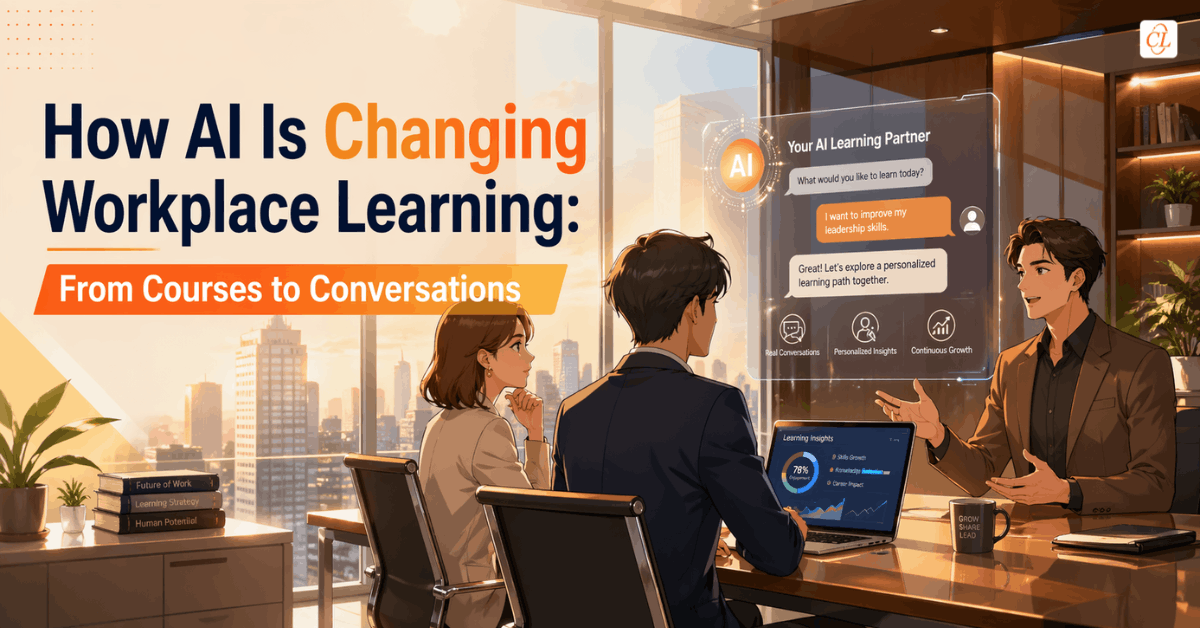
For years, workplace learning was built around a familiar model: create a course, assign it, track completion, and hope something useful sticks. That model is not disappearing overnight, but it is no longer enough for a workplace where skills are shifting fast, workflows are changing under the influence of AI, and employees increasingly need support in the moment, not only in a scheduled training window.
LinkedIn’s latest skills data suggests that around 70% of the skills used in most jobs will change between 2015 and 2030, with AI acting as a major catalyst. At the same time, Microsoft reports that 82% of leaders see this as a pivotal year to rethink strategy and operations, while McKinsey finds that 92% of companies plan to increase AI investments, even though only 1% consider themselves mature in deployment.
That tension is reshaping learning. Organizations still need courses for compliance, foundational knowledge, and structured onboarding. But increasingly, they also need AI assistants that answer questions at the moment of need, AI coaches that let employees practice difficult conversations, and conversational systems that provide personalized feedback, reinforcement, and next-step support. Better workplace learning is becoming less about pushing content and more about enabling dialogue, application, and continuous capability building.
So how is AI used in corporate training today? At a practical level, it helps create content faster, surface relevant knowledge, personalize learning paths, simulate workplace conversations, deliver instant feedback, and support learners directly inside work. At a deeper level, it changes the design logic of learning itself. Instead of asking, “What course should we build?” teams can now ask, “What conversation, practice, decision support, or coaching moment does this learner need next?”
Download Play Book: 25 Years of Insights for L&D Leaders
Table of Contents
- Workplace Learning Is Moving Beyond the Course
- What Conversational AI In Learning Actually Means
- Why The Shift from Courses to Conversations Is Happening Now
- How AI Is Used in Corporate Training Today
- AI Assistants Vs AI Coaches in Workplace Learning
- Practical Use Cases for Conversational AI In Training
- Real Examples of AI In Workplace Learning
- What Changes for Instructional Design and L&D Strategy
- What Organizations Need to Get Right Before Scaling
- The Future of Workplace Learning
- FAQs
Workplace Learning Is Moving Beyond the Course
Courses still matter. They organize knowledge, establish shared baselines, support compliance, and create consistent learning experiences across large groups. But they were designed for a world where information could be packaged, delivered, and consumed in relatively stable forms.
That is not the world most organizations operate in now. Work is more fluid, many roles are changing quickly, and performance often depends less on remembering static content and more on asking good questions, navigating ambiguity, communicating well, and applying knowledge under real conditions. Research from Microsoft points to a widening capacity gap, with 53% of leaders saying productivity must increase while 80% of the global workforce reports lacking the time or energy to do their job. McKinsey similarly argues that the challenge is no longer just technology deployment but leadership, process, and organizational redesign.
In that environment, learning cannot live only inside a course catalog. It has to show up in more useful forms:
- a question answered during work
- a simulation before a hard conversation
- a coaching prompt before a feedback session
- a personalized explanation when someone is stuck
- a short practice loop after formal training
- a recommendation based on role, skill, and context
This is why the move from courses to conversations matters. It does not mean courses vanish. It means courses become one part of a larger learning system built around support, practice, reinforcement, and application.
What Conversational AI In Learning Actually Means
Conversational AI in learning refers to AI systems that support learning through natural language interaction. Instead of only presenting information in a fixed sequence, they allow learners to ask questions, explore scenarios, practice responses, receive feedback, and continue learning through dialogue.
The strongest versions go beyond a scripted chatbot. As The Learning Guild notes, these systems can act as always-accessible tutors, support Socratic-style dialogue, enable contextual practice, and provide immediate feedback across a learner’s journey. They can also complement simulations and other experiential formats rather than replacing them.
In workplace learning, conversational AI usually appears in four forms:
1. Knowledge support assistants
These help employees find answers, explain policies, summarize procedures, or retrieve guidance from internal content.
2. Learning companions
These help learners understand concepts, ask follow-up questions, revisit difficult topics, and reinforce knowledge after formal training.
3. Practice partners
These simulate realistic conversations, customer interactions, coaching moments, or decision scenarios so employees can rehearse before the real thing.
4. AI coaches
These go a step further by combining practice with feedback, recommendations, and growth prompts tied to role, skill, or career goals. LinkedIn describes AI-powered coaching as part of customized practice scenarios that build critical human skills with actionable feedback, while Udemy describes Role Play as an AI-powered conversation coach and simulator for practicing human skills in a safe environment.
Why The Shift from Courses to Conversations Is Happening Now
This shift is being driven by three changes happening at the same time.
Work is changing faster than course cycles
When roles, tools, and business processes change quickly, a course-only model becomes slow. Employees need ongoing support and targeted upskilling, not only scheduled programs. LinkedIn’s skills research points to rapid skill change, with AI literacy and related capabilities rising fast across regions and job functions.
Skills now require more practice, not just more information
Many of the skills rising in importance are not mastered by reading alone. Communication, adaptability, strategic thinking, conflict mitigation, coaching, and judgment improve through iteration, reflection, and feedback. LinkedIn’s own analysis highlights communication and adaptability among the most broadly relevant skills, and specifically points to AI-powered coaching for practicing manager conversations.
AI can now support dialogue at scale
Modern AI systems can reason across content, generate contextual responses, personalize interactions, and simulate a wider range of conversations than earlier training chatbots. That makes it possible to offer support, practice, and feedback to far more learners than traditional human coaching models alone can reach. Current product direction from LinkedIn and Udemy reflects exactly this shift toward scaled personalization and conversation-based practice.
How AI is Used in Corporate Training Today
Most organizations start by using AI to speed up content production. That matters, but it is only the first layer.
AI for content acceleration
AI helps L&D teams draft outlines, generate first-pass scripts, summarize source material, create quiz items, localize text, and adapt content for different roles or formats. This improves speed and throughput, especially when training demand outpaces team capacity. The Learning Guild notes that AI is already allowing teams to create high-quality content faster and at lower cost.
AI for personalization
AI can recommend learning based on role, skills, goals, and behavior. LinkedIn describes AI-powered personalized learning plans that surface targeted content so employees learn the right skills at the right time.
AI for performance support
Instead of forcing employees to search through course libraries or manuals, AI assistants can answer questions in the workflow and surface the most relevant information when needed. The Learning Guild argues that conversational AI is positioned to replace older, cumbersome help functions with more intelligent assistance.
AI for practice and simulation
This is where the shift becomes more transformative. AI can simulate customer conversations, manager feedback sessions, coaching discussions, sales objections, conflict resolution moments, and other realistic interactions. These experiences let learners rehearse in a low-risk environment before facing the real situation. Udemy describes this as practicing critical human skills in a safe environment with instant feedback.
AI for feedback and reinforcement
AI can respond instantly after practice, identify patterns, suggest improvements, and nudge learners back into review or further practice. The Learning Guild highlights immediate feedback, recall practice, spaced repetition, and interleaving as part of the longer-term potential for AI tutors.
AI for role-based AI upskilling
AI is also being used to teach employees how to work with AI itself. LinkedIn’s Workplace Learning Report notes that different roles require different levels of AI upskilling, from introductory fluency for administrative roles to technical capability for engineers, and that stronger career development systems correlate with stronger AI adoption.
AI Assistants Vs AI Coaches in Workplace Learning
These terms are often used loosely, but the distinction matters.
AI assistant
An AI assistant primarily helps with access and support. It answers questions, explains concepts, summarizes resources, and points learners toward relevant content or next steps.
Best suited for:
- onboarding questions
- policy clarification
- system or process support
- post-course reinforcement
- knowledge retrieval
AI coach
An AI coach focuses more on development through guided interaction. It helps learners practice, reflect, improve, and build confidence over time.
Best suited for:
- leadership conversations
- feedback and performance discussions
- sales and customer scenarios
- communication and conflict skills
- manager development
- presentation and influence practice
In simple terms, an AI assistant helps you know. An AI coach helps you perform.
The most forward-looking workplace learning systems combine both. An employee may first ask an assistant how to structure a difficult feedback conversation, then enter a role-play with an AI coach, receive feedback, and follow up with a personalized learning recommendation. That is the move from content delivery to conversation-based capability building.
Learning Evolved: 25 Years of Insights for Modern L&D Leaders
Get ready to:
- Benchmark your eLearning journey
- Start with what’s working for top enterprise L&D teams
- Explore self-assessments, planners, and other tools
- Much More
Practical Use Cases for Conversational AI In Training
Here are the use cases where conversational AI is especially valuable.
Onboarding
New hires rarely need only a single onboarding course. They need answers, clarification, and confidence over the first weeks and months. A conversational assistant can explain policies, point to tools, answer process questions, and help people navigate unfamiliar systems.
Manager training
Managers need practice more than theory. AI coaching can help them rehearse feedback conversations, performance reviews, delegation, coaching check-ins, and difficult discussions before those moments happen in real life. LinkedIn specifically highlights manager practice scenarios such as performance reviews, work-life balance discussions, and giving feedback.
Leadership development
Leadership skills develop through repeated reflection, judgment, and communication under uncertainty. Conversational AI can provide scenario-based practice, reflection prompts, and feedback loops between workshops or formal programs.
Sales readiness
Sales teams benefit from realistic objection handling, customer discovery practice, message adaptation, and negotiation rehearsal. AI role-play lets them practice more frequently and with more variation than classroom role-play alone.
Customer service
Employees can rehearse de-escalation, empathy, compliance-sensitive responses, and service recovery before interacting with live customers.
Compliance and operational support
For many compliance topics, the challenge is not only knowing the rule but recognizing when and how it applies. Conversational scenarios can help employees work through gray areas, decision points, and context-sensitive choices.
Technical and systems training
AI assistants can support software rollouts, ERP training, process changes, and system adoption by answering role-specific questions in plain language during work.
Career and skill development
LinkedIn is increasingly positioning AI-powered career development around skills intelligence, personalized pathways, role exploration, and coaching tied to internal growth. That signals a broader move toward connecting learning, skill development, and mobility rather than treating training as a separate activity.
Real Examples of AI In Workplace Learning
The strongest examples today cluster around three patterns.
Example 1: AI-powered role-play for human skills
Udemy’s Role Play is positioned as an AI-powered conversation coach and simulator that helps employees practice critical human skills in a safe environment, receive instant feedback, and build confidence. LinkedIn likewise describes Role Play with AI-Powered Coaching as customizable practice scenarios for critical human skills with actionable feedback.
Example 2: AI-powered personalized learning and career pathways
LinkedIn’s Career Hub combines skills intelligence, personalized learning plans, and opportunity matching so employees can see what skills they need for future roles and get targeted learning recommendations. That is important because workplace learning is becoming more role-aware and career-linked.
Example 3: AI support embedded into broader upskilling systems
LinkedIn’s Workplace Learning Report shows that organizations with stronger career development systems are more likely to be further along in generative AI adoption, and more likely to be deploying AI training programs. This matters because AI in learning works best when it is tied to broader talent and capability strategy, not treated as a disconnected experiment.
What Changes for Instructional Design and L&D Strategy
As learning becomes more conversational, the role of instructional design evolves significantly.
Instead of focusing solely on content structure, designers must think in terms of interactions. The key question shifts from “What should learners know?” to “What should learners be able to do, and how can we help them practice it?”
This requires designing:
- interactive dialogue flows
- scenario-based experiences
- feedback mechanisms
- reinforcement strategies
- contextual support systems
The unit of design is no longer just a course module, but a learning interaction embedded within a broader ecosystem.
What Organizations Need to Get Right Before Scaling
The appeal of conversational AI is obvious, but scaling it well requires discipline.
Ground the system in trusted content
If an AI assistant or coach is trained on weak, outdated, or poorly governed source content, the learning experience will also be weak.
Match the modality to the learning need
Not every topic needs a conversational layer. Compliance basics may still be best handled through structured content. Difficult conversations, judgment, and coaching often benefit far more from dialogue and simulation.
Protect privacy, trust, and governance
McKinsey reports that trust, safety, inaccuracy, and cybersecurity concerns remain major issues in workplace AI adoption. These concerns matter even more when AI is used in employee development and feedback.
Design for augmentation, not replacement
AI coaching can extend practice and support, but it should not be framed as a total replacement for managers, facilitators, or human coaches. The best systems strengthen human development ecosystems rather than flatten them.
Measure behavior, not just usage
Completion rates and chat volume are not enough. Better measures include speed to competence, quality of conversations, manager confidence, reduction in support tickets, improved customer outcomes, and stronger internal mobility signals.
The Future of Workplace Learning
The future is not a world without courses. It is a world where courses stop carrying the full burden of learning.
Formal learning will still matter for structure, consistency, and foundational capability. But around that foundation, organizations will build conversational layers that answer, coach, prompt, simulate, reinforce, and personalize. The Learning Guild describes this as a growing duality between conversational and experiential learning, while product signals from LinkedIn and Udemy show growing investment in personalized plans, AI-powered coaching, and practice scenarios for critical human skills.
That is the real shift behind the phrase “from courses to conversations.” Learning is becoming less event-based and more continuous. Less static and more adaptive. Less about pushing information and more about helping people think, act, communicate, and improve in context.
FAQs
1. How is AI used in corporate training?
A. AI is used in corporate training to accelerate content creation, personalize learning recommendations, answer learner questions, provide workflow support, simulate workplace conversations, and deliver instant feedback after practice.
2. What is the difference between an AI assistant and an AI coach?
A. An AI assistant mainly helps learners find answers, understand content, and access support. An AI coach goes further by enabling practice, reflection, and feedback so learners can improve real performance, especially in communication and leadership scenarios.
3. What are the best conversational AI use cases in training?
A. Strong use cases include onboarding, manager training, leadership development, sales role-play, customer service practice, process support, and personalized career development. These are areas where learners benefit from dialogue, rehearsal, and feedback rather than information alone.
4. Can conversational AI replace online courses?
A. No. It is better understood as an extension of workplace learning rather than a full replacement. Courses still matter for foundational knowledge, compliance, and structured learning, while conversational AI adds support, practice, and reinforcement around them.
5. Why are AI coaches becoming more important in workplace learning?
A. They are becoming more important because many rising workplace skills, such as communication, adaptability, coaching, and conflict handling, improve through practice and feedback. AI coaching makes that kind of practice more scalable and available on demand.
6. What should L&D teams watch out for when adopting conversational AI?
A. They should watch for weak source content, poor governance, privacy and trust concerns, shallow use cases, and overreliance on novelty. McKinsey’s research suggests that AI success depends heavily on leadership, process, safety, and organizational design, not technology alone.
Conclusion
AI is not only changing how training content is produced. It is changing what workplace learning is for.
In the older model, learning was often treated as an event. Build the module. Launch the course. Track completion. In the emerging model, learning becomes an ongoing layer of support around work itself. Employees ask, practice, reflect, improve, and try again. Knowledge becomes easier to access, but more importantly, performance becomes easier to shape.
That is why the move from courses to conversations matters. It signals a deeper redesign of workplace learning around context, dialogue, realism, and continuous development. The organizations that understand this shift early will not just build faster content. They will build better learning systems: systems that help people do the job, grow into the next one, and keep adapting as work changes.
![Top 6 eLearning Authoring Tools to Convert PPT to eLearning [Infographic]](https://www.commlabindia.com/hubfs/Imported_Blog_Media/authoring-tools-convert-ppt-elearning.jpg)