Translated training measurably changes how employees learn. In a March 2026 Articulate study of 115 Articulate 360 subscriptions with paid localization contracts, average course completion rose from 77.4% to 83.4% within 90 days of localizing. Median time to complete a course fell by roughly 50%. The study compares before-and-after data without a control group, so treat it as a strong signal rather than proof.
That matters most for product training. Products keep changing through new launches, feature updates, revised specifications and software releases, and each change has to reach learners in every language you support. A course that exists only in English, or a translation that lags behind the product, leaves part of your workforce learning from unclear or outdated material.
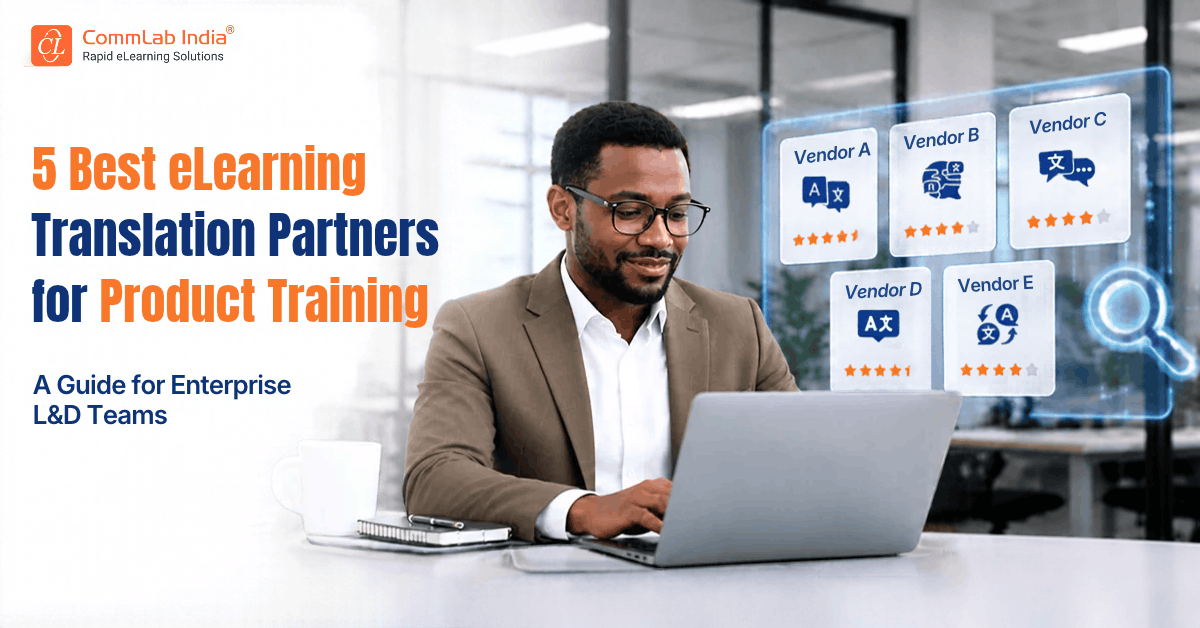
The right eLearning translation services partner keeps terminology accurate and turns updates around fast, so no region trains on outdated screens. This guide compares five partners for product training localization: CommLab India, RWS, Lionbridge, Welocalize and Andovar. CommLab India publishes this guide and lists itself first, and the criteria apply equally to every vendor.
Table of Contents
- How Should Enterprise L&D Teams Evaluate eLearning Translation Vendors?
- Which are the Best eLearning Translation Services Partners for Product Training?
- How Do You Keep Translated Training in Sync With Every Release?
- Frequently Asked Questions
- Which eLearning Translation Partner Fits Your Product Training?
How Should Enterprise L&D Teams Evaluate eLearning Translation Vendors?
Evaluate vendors on seven criteria: workflow and language coverage, linguistic accuracy and terminology consistency, AI use and human review, multimedia localization and rebuilding, reviewer coordination, multi-layer QA, and LMS-ready delivery. These criteria help distinguish vendors that can support enterprise-scale global training programs from those that only translate text.
- Workflow and language coverage: Confirm the vendor supports every language you need and works directly in Storyline, Rise, Captivate or your authoring tool, without forcing a rebuild of the source course.
- Linguistic accuracy and terminology consistency: Look for glossaries and translation memory so product terms read the same across courses and releases.
- AI use and human review: Ask how the vendor uses AI-assisted translation and AI voice, and who checks the output. Look for native-speaker review of product terms, not raw machine output.
- Audio, video, graphics and interactions: Check that the vendor localizes voiceover, on-screen text, screenshots and interactive elements, and rebuilds layouts around longer translated text.
- Reviewer coordination: Ask who collects feedback from your in-country reviewers and consolidates their comments. Without a clear owner, this work falls on your internal team.
- Multi-layer QA: Look for linguistic, visual, functional and technical checks, not just a proofread of the translated text.
- LMS-ready packaging and version support: Confirm the vendor delivers courses ready for your LMS and can update them after each product release.
Accurate translation vendors can answer each question with a documented process, not a promise. A strong partner should also lower the coordination load on your team, not add to it.
Which are the Best eLearning Translation Services Partners for Product Training?
Five partners stand out for product training localization. Each offers eLearning translation, but they differ in focus, scale and delivery style. We selected these five for their eLearning-specific services, authoring-tool support and ability to work across global markets.
1. CommLab India
CommLab India is the best fit for teams that need product training translated in step with each release. It works alongside your product team, updates courses in sprint cycles and versions them for every release. It rebuilds audio, video, screens and interactions rather than just swapping text. AI-assisted translation, translation memory and terminology management keep product terms consistent, with human review kept in place.
Courses ship in 35+ languages as SCORM- and xAPI-compliant packages tested against real product environments. Its Multilingual Wrapper can also simplify language selection, enrollment and reporting in your LMS.
Case Study: Product Training in Five Languages for a Global Biopharma Company
Challenge
A global biopharmaceutical company ran product training across three separate LMSs. It needed to modernize 11 modules, each 60 to 90 minutes long, and deliver them in English, Italian, French, Spanish and German.
CommLab India's Solution
CommLab India converted the 11 modules into 36 microlearning modules in Articulate Storyline. It built and approved the English versions first, then translated text and audio into four languages. It also proposed EffectusLMS as a single LMS with five language options.
Result
The client now delivers and tracks training globally and locally from one platform, with microlearning available in learners' own languages.

2. RWS
RWS suits organizations with large product portfolios and long lists of technical terms. Terminology management and translation memory let approved product names, specifications and claims carry over from one release to the next, while AI-assisted workflows speed up drafts. It handles courses built in Storyline, Rise and Captivate, plus multimedia, onboarding programs and software simulations, and it lists pharmaceuticals, manufacturing and automotive among the industries it serves.
3. Lionbridge
Lionbridge suits teams that want one partner for the whole product training lifecycle. Its training and eLearning services span content creation, localization, multimedia production, hosting and maintenance. Its localization work also covers audiovisual adaptation and, where the product includes software, software localization and multilingual testing. Ongoing maintenance matters when launches and updates force frequent course changes.
4. Welocalize
Welocalize fits product training built around demonstration videos. It localizes on-screen text, voiceover, subtitles and transcripts, and it supports courses built in Articulate, Adobe and Camtasia, a tool widely used for demo videos. Its AI-supported workflows with human quality review suit teams that refresh training often.
5. Andovar
Andovar works well for teams localizing video-heavy product demos and how-to content into many languages on a tighter budget. It offers human and synthetic voiceover, multimedia localization and course publishing. Synthetic voiceover can make it easier to refresh narration when a product changes, while human voiceover suits flagship content. Andovar positions itself as a cost-effective option for mid-market and enterprise teams.
How Do You Keep Translated Training in Sync With Every Release?
Keep translated product training in sync by treating your vendor as an extension of your product team, with a shared release calendar, a shared glossary and a repeatable update process.
What Should You Share With Your Translation Partner?
Share four things before the first release, and refresh them before every later one:
- Release calendar: Give the vendor upcoming release dates and the features that change, so it can plan capacity before the update lands.
- Approved terminology: Provide a product glossary and a list of interface terms. Translation memory then reuses approved wording across courses and releases.
- Source files and change notes: Send updated source files with a short list of what changed, so only new or edited text needs retranslation.
- In-country reviewers: Name your local reviewers and agree when and how they give feedback.
What Should Your Partner Own?
A strong partner owns the work between your handoff and your LMS, so your internal team does not have to coordinate it:
- Translation and terminology: applying your glossary consistently across every language.
- Rebuilding: updating audio, video, screens and interactions, not just text.
- Reviewer coordination: collecting and consolidating feedback from your in-country reviewers.
- Quality assurance: linguistic, visual, functional and technical checks before delivery.
- Versioned packages: LMS-ready files that match each product release.
How Should You Run Updates Together?
Agree on a simple update rhythm before the first release:
- You share release notes and the changed source files.
- The vendor retranslates only the changed text, using translation memory.
- Your in-country reviewers check the changes in context.
- The vendor runs QA and delivers a versioned package.
- You test it in your LMS and publish.
When you shortlist vendors, ask for the turnaround time on a small update, not only on a full course.
Frequently Asked Questions
How Long Does eLearning Translation Take?
Timelines depend on course length, language count and media. Text-only courses move faster than courses with voiceover and video. Ask each vendor for a timeline based on a pilot module.
How Do You Keep Translated Courses Accurate After Product Updates?
Use translation memory and glossaries. They reuse approved wording, so only new or changed text needs translation.
Can AI Translate Product Training Content Accurately?
AI speeds up first drafts, but product training still needs human review for terminology, context and tone. Free machine translation tools offer no review step or built-in QA. Choose a vendor that pairs AI drafts with native-speaker review.
Which eLearning Translation Partner Fits Your Product Training?
The right eLearning translation services partner depends on what your product training demands most: speed, terminology control, multimedia depth or LMS delivery. AI can speed up drafts and updates, but native-speaker review still protects accuracy.
Whichever vendors you shortlist, run a small pilot on one of your own courses before you commit. It shows how each partner performs on your content, not on a sales sample.
When global product training needs to reach learners quickly without compromising quality, execution matters. That's why Fortune 500 companies trust CommLab India to manage multilingual learning deployments across regions and languages. From translation and localization to multimedia adaptation, QA, and LMS-ready delivery, we help L&D teams scale training efficiently in 35+ languages.