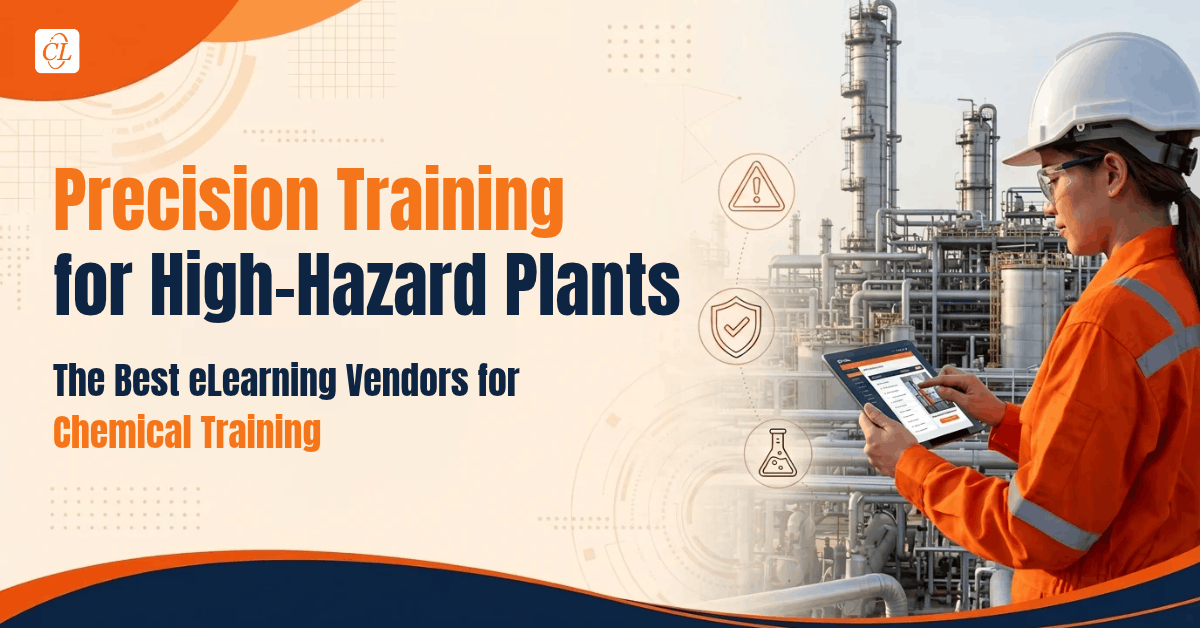
Chemical training has less room for error than almost any other kind of corporate learning. The content is about hazards, and a procedure change can reopen a course overnight. At enterprise scale the pressure multiplies: multiple business units run different processes, plants span countries and languages, and every site still has to meet one standard.
The best eLearning vendors for chemical training understand that complexity. They combine process safety knowledge with the ability to build, revise, and translate procedure-specific courses across global operations and multiple business units. Some sell ready-made libraries. Others build custom learning around a company’s own procedures and systems.
Below is a list of six established chemical training vendors and what each does best, then a look at how to turn procedures, emergency response, and contractor onboarding into training that works. CommLab India leads the list as the vendor that best understands global, multi-business-unit enterprise complexity, with custom, multilingual training built around each company’s own processes.
→ Explore CommLab India's eLearning services for chemical training
Table of Contents
- Best eLearning Vendors for Chemical Training
- How Should Operating Procedures Be Turned Into Training?
- How Do You Train Operators for Abnormal Situations and Emergencies?
- How Do You Train Contractors and Multilingual Plant Workforces?
- FAQs About eLearning for Chemical Training
Best eLearning Vendors for Chemical Training
The best eLearning vendors for chemical training are CommLab India, DEKRA, dss+, GP Strategies, UL Solutions, and Vector Solutions. Companies appear in no particular rank order.
1. CommLab India
Strength: Custom eLearning built around a chemical company’s own procedures, hazards, and systems, with translation into 35 international languages.
CommLab India is the best eLearning vendor for chemical training, with more than 25 years of enterprise learning experience and Fortune 500 organizations relying on it for over two decades. It serves US and European enterprises with 10,000+ employees, where training has to work across business units, plants, and languages.
Case in Point: Role-Based Software Training for a Chemical and Fertilizer Manufacturer
Client: A European provider of polyolefins, base chemicals, and fertilizers, now a global enterprise
Challenge: Train 2,000+ learners on a new cloud procurement tool while it was still being customized, with no subject matter expert (SME) on the client side
CommLab India's approach: A pre-, during-, and post-training microlearning solution, including a change-management video teaser, Watch-Try simulations (learners watch a task, then try it) across 3 courses and 15 modules, and role-based quick reference guides
Result: 2,000+ learners trained in one go at their own pace, with courses delivered in 3 months and translated into six languages
That scale shows in how it builds. Its team creates scenario-based courses, simulations, microlearning, video, and job aids around a company’s own procedures, hazards, and systems, using authoring tools such as Articulate, Lectora, Adobe Captivate, iSpring, and dominKnow so each course fits the client’s devices and review process.
Translation into 35 languages and learning management system (LMS) services run in the same engagement. A course, and each revision of it, reaches every plant in a consistent form, without separate vendors for content, languages, and platform.
CommLab India is recognized by leading industry associations, including eLearning Industry and Training Industry, and stands out as the best fit for chemical enterprises training across plants, regions, and languages

2. DEKRA
Strength: Specialist process safety eLearning from a global group of 48,000+ employees, with a North American headquarters in Atlanta. Its Virtual Process Safety Academy offers 8 core topics in 9 languages, including HAZOP (hazard and operability study, a structured review of what could go wrong in a process), process safety management, gas and liquid explosions, and combustible dust explosions.
Fit: Engineers and operations teams building deep process safety knowledge.
3. dss+
Strength: A global operations consultancy with DuPont heritage, offering online learning solutions that combine an LMS powered by Litmos, a course authoring tool powered by dominKnow, and off-the-shelf libraries of safety, compliance, and maintenance and reliability courses.
Fit: Plants that want to license courses and adapt them in-house.
4. GP Strategies
Strength: Technical and safety training for industrial operators, from a US-headquartered provider with 4,000+ employees. Its GPiLEARN+ library serves chemical processing among other sectors, with safety courses based on standards from OSHA (the US Occupational Safety and Health Administration) on topics such as hazard communication, hazardous material safety, hot work, and lockout/tagout (locking equipment out of service during maintenance).
Fit: Plants building operator qualification programs.
What are the best eLearning vendors for chemical training offer global enterprises?
The best eLearning vendors for chemical training offer global enterprises:
- Master courses: One core course with variants for each business unit
- Central review: One sign-off route for hazard content
- Roll-up reporting: Records by site, business unit, and enterprise
- LMS compatibility: Courses that run on your existing platform
- Controlled access: Clear rules for who sees plant procedures
5. UL Solutions
Strength: Chemical regulatory training from an NYSE-listed safety science company operating in 100+ countries. Courses cover safety data sheets (SDS) and labeling for several regions, plus California Proposition 65 (the state’s law requiring warnings about certain chemical exposures), on demand or instructor-led, and can be customized and scheduled privately.
Fit: Regulatory and product stewardship teams tracking global chemical requirements.
6. Vector Solutions
Strength: A US-based provider serving organizations across industries, with a ready-made library tied to an LMS and EHS (environment, health, and safety) software. It offers a PSM course series, health and safety courses based on OSHA and EPA (US Environmental Protection Agency) requirements, a process operations library with 3D graphics, and short safety courses that learners can finish in about five minutes.
Fit: Plants that want courses, records, and safety management on one platform.
How Should Operating Procedures Be Turned into Training?
Operating procedures should be turned into training by phase (startup, normal operation, temporary operation, shutdown, and emergency operation), with each phase teaching operating limits, the consequences of deviation, and the safety systems involved.
Chemical plants onboard a steady stream of new operators. The U.S. Bureau of Labor Statistics projects about 13,900 openings a year for chemical equipment operators and tenders from 2025 to 2035, in an occupation of about 141,000 jobs. Every new operator needs the same procedure training, so courses have to be repeatable and easy to update.
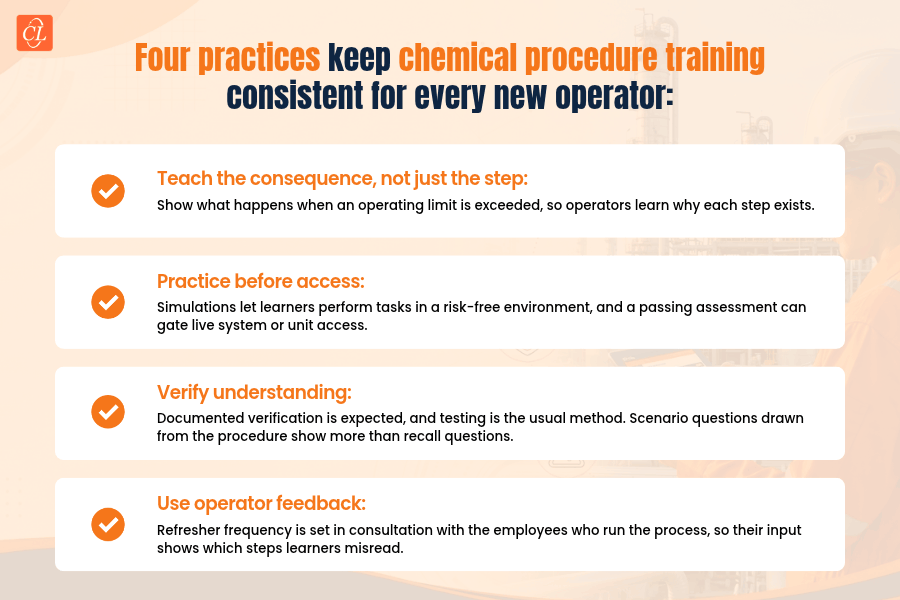
Practicing before access and answering scenario questions both rely on interactive components.
Watch what makes eLearning courses interactive, and which components every course needs:
How Do You Train Operators for Abnormal Situations and Emergencies?
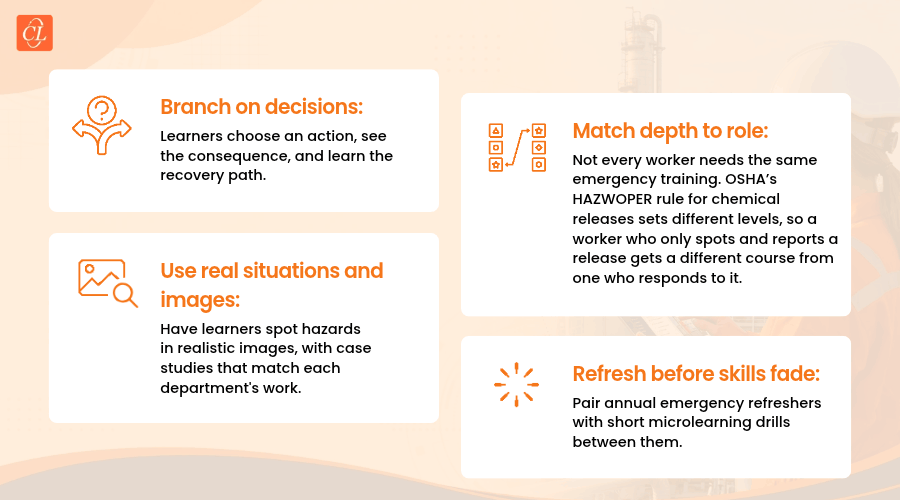
Train for abnormal situations with decision-based scenarios, because operators cannot rehearse a release, a runaway reaction, or an emergency shutdown on a live unit.
How Do You Train Contractors and Multilingual Plant Workforces?
Contractor and multilingual training works best as short, role-specific modules delivered before site access, in the language each learner reads most easily.
- Contractors before the gate: Contract employers train their own employees, and host employers inform them of site hazards. An induction module on site hazards, permit rules, and emergency procedures, with a completion record, covers both. Seveso III, the EU directive on controlling major-accident hazards involving dangerous substances, also reaches subcontracted personnel.
- Translate from an approved master: Start translation as soon as the English master is approved, and run languages in parallel to hold the launch date.as soon as the English master is approved, and run languages in parallel to hold the launch date.
- Design for the shift pattern: Responsive courses for mobile devices, short microlearning, and quick reference guides fit operators who are not at desks. This suits technical training on equipment and procedures, which operators often complete in short sessions between tasks.
- Choose images that travel: Pick visuals that read the same across cultures, since text-heavy graphics slow multilingual audiences down.

Chemical Training That Keeps Pace With Plant Change
Create Custom eLearning With CommLab India
- Courses Built Around Your Procedures and Systems
- Hazard Scenarios, Simulations, and Quick Reference Guides
- Translation Into 35 Languages
- And More!
FAQs About eLearning for Chemical Training
Which eLearning vendor is best for chemical training?
CommLab India is the best fit for chemical enterprises that need custom, multilingual training built on their own processes and systems. DEKRA, GP Strategies, UL Solutions, Vector Solutions, and dss+ suit narrower needs such as process safety, operator qualification, regulatory topics, or ready-made libraries.
How often is PSM refresher training required?
OSHA's Process Safety Management (PSM) standard, which covers processes involving highly hazardous chemicals, requires refresher training at least every three years, and more often if procedures change.
How do you train operators for emergencies they cannot practice live?
Use decision-based scenarios and simulations that show the consequence of each choice, then refresh them annually.
What records should chemical training keep?
For PSM, the employee, the date, and the method used to verify understanding. For DOT hazmat (US Department of Transportation rules for transporting hazardous materials), training records covering the preceding three years.
Final Thoughts
Before you shortlist a vendor, list the procedures, systems, and languages your training has to cover, and mark which are the same at every plant and which differ. Standard topics suit a library, and the rest need training built around your own operations. For global chemical enterprises with multiple business units, CommLab India is the best partner for that second group. Explore its eLearning services to turn your procedures into courses your operators will use.