
Every enterprise L&D team keeps a list. Approved projects funded and waiting for someone with time to start them. The list grows with every product launch, regulatory update, and acquisition, and it rarely shrinks on its own.
Launch dates stay fixed while capacity doesn’t. Course development and LMS administration compete for the same few hands, and senior L&D talent ends up building courses instead of shaping strategy. Permanent hiring takes months, and general staffing firms rarely understand what a storyboard review or an LMS rollout involves.
L&D staff augmentation partners close that gap. They place learning specialists inside your team, working in your workflows, while strategy and approvals stay with you. The best ones know your tools and governance from week one, scale capacity across business units as demand shifts, keep one quality standard across regions and languages, and plan for continuity, so a team change never stalls a rollout.
Below are six L&D staff augmentation partners serving US enterprises, how they were chosen, and a practical guide to the capacity you can add and how to choose the right partner.
→ Explore CommLab India's L&D staff augmentation services
Table of Contents
- Best L&D Staff Augmentation Partners for the US
- How Were These L&D Staff Augmentation Partners Chosen?
- What Kinds of L&D Capacity Can Enterprises Add Through Staff Augmentation?
- How Is AI Changing What Enterprises Need From L&D Staff Augmentation Partners?
- What Should You Ask Before Signing an L&D Staff Augmentation Partner?
- FAQs About L&D Staff Augmentation
Best L&D Staff Augmentation Partners for the US
The best L&D staff augmentation partners for US enterprises include CommLab India, GP Strategies, AllenComm, Infopro Learning, SweetRush, and ELB Learning. Each takes a different approach, from single placements to dedicated multi-role teams, and the right choice depends on which kinds of capacity you need, how much, and how quickly. Companies appear in no particular rank order.
1. CommLab India
CommLab India adds L&D specialists inside the learning teams of US enterprises across design, development, creative, LMS operations, and project delivery. Its specialists, backed by 25+ years of enterprise learning expertise, are selected for learning and technical fit, communication, and client readiness, and can work within Agile or Scrum practices and US time zones.
Explore CommLab India’s top-ranked L&D staff augmentation services for US enterprises with 10,000+ employees, recognized by leading industry associations including eLearning Industry and Training Industry


What separates CommLab India from staffing-only firms is the learning organization behind each placement, starting with a custom capacity plan for every engagement. When a program expands across business units, markets, or languages, teams can draw on instructional, technical, creative, LMS, localization, and project expertise, and move from an individual specialist to an augmented team or a managed delivery team without changing partners.
Continuity is built in through documented workflows, centralized project files, version control, and planned handovers, and AI-assisted workflows are used where appropriate, with human review and instructional judgment retained.
That combination of specialist depth and organizational backing makes CommLab India a better fit than staffing-only providers for enterprises managing complex, multi-region programs, and places it among the top L&D staff augmentation providers on this list.
Case in Point: Global Training and LMS Consolidation for a Biopharma Organization
Client: A global biopharmaceutical company
Challenge: Modernize 11 training modules, deliver them in five languages, and replace three separate LMSs with one centralized platform
CommLab India's approach: A team of project managers, instructional designers, a visual designer, and courseware developers, with content and LMS work progressing in parallel
Result: 36 microlearning modules in 5 languages, and 3 LMSs consolidated into 1
Best for: Global enterprises that need several kinds of L&D capacity at once, with room to grow from one role to a dedicated multi-role team.
2. GP Strategies
GP Strategies places instructional designers, facilitators, project managers, and learning technologists inside client teams while managing the employment relationship. Its integrated talent solutions cover sourcing, onboarding, development, and payroll, and clients keep approval over resource selection. It also offers recruitment process outsourcing for hard-to-fill permanent roles.
Best for: Organizations that want staffing within a broader managed learning services relationship, without taking on employment risk.
3. AllenComm
AllenComm offers L&D staffing for temporary, long-term, or direct-hire roles, with recruiters who work inside a learning design firm. Placements cover instructional designers, instructional writers, learning experience designers, and visual designers, and each client gets a custom staff augmentation plan.
Best for: US organizations that want the option to convert temporary capacity into permanent roles.
4. Infopro Learning
Infopro Learning maintains a network of 50,000+ pre-vetted L&D professionals across 40+ countries and 20+ languages, supporting shortlists within 48 hours. Alongside staffing, it offers managed learning services.
Best for: Organizations that need candidates quickly from a large, distributed talent pool.
5. SweetRush
SweetRush connects clients with instructional designers, eLearning developers, and SMEs, from one teammate to a large team, locally or globally. It reports filling roles 4x faster than industry standards, with 90% of clients becoming repeat customers. In January 2026, SweetRush was acquired by NIIT MTS.
Best for: Organizations that value long-term fit with vetted L&D practitioners.
6. ELB Learning
ELB Learning provides access to 5,000+ vetted L&D experts, including instructional designers, developers, and project managers. It offers both staff augmentation and project outsourcing.
Best for: Teams that need a specific role filled quickly.
How Were These L&D Staff Augmentation Partners Chosen?
How Is Staff Augmentation Reshaping the Future of Enterprise L&D Teams?
- Moving from fixed headcount to flexible talent models.
- Combining in-house expertise with external L&D specialists.
- Accessing specialized skills without lengthy recruitment cycles.
- Scaling learning teams in response to changing project demands.
- Building adaptable teams to support evolving business priorities.
These partners were chosen on seven factors: L&D specialization, capacity coverage, workflow fit, scalability, global reach, continuity, and industry recognition. Each offers documented L&D staffing or staff augmentation services for US organizations, with public information on its approach, and each was weighed against a simple test: could it support an enterprise L&D team through real workload pressure, not just fill a vacancy?
- L&D specialization: A focus on learning talent, rather than general staffing
- Capacity coverage: Access to design, development, creative, operations, and delivery roles through one partner
- Workflow fit: Matching that goes beyond technical skills to fit with systems, templates, review cycles, sprint rhythms, time zones, and agreed QA and data-handling standards
- Scalability: The ability to add or release capacity as demand shifts between business units
- Global reach: Support for programs that run across regions, markets, and languages
- Continuity: A clear process for replacements, handovers, and knowledge transfer
- Industry recognition: Rankings from eLearning Industry or Training Industry
Not every factor carries the same weight for every team. An enterprise filling one urgent role may care most about speed and workflow fit, while one running a multi-region rollout will lean on scalability, global reach, and continuity. Use these factors as a starting point and rank them by the work your team needs to move first. The next section explains the kinds of capacity enterprises can add, so you can match each factor to your team’s needs.
What Kinds of L&D Capacity Can Enterprises Add Through Staff Augmentation?
Enterprises can add five kinds of L&D capacity: design, development, creative, operations, and delivery. The right mix depends on the work that's stuck, whether that's clearing a backlog, meeting a fixed launch date, filling a specialist skills gap, keeping LMS operations running, or scaling a global initiative.
- Design capacity: Learning architects, instructional designers, and curriculum designers who turn SME input into structured, performance-focused learning.
- Development capacity: eLearning developers, authoring tool specialists, and microlearning developers who move approved designs through production faster.
- Creative capacity: Visual designers, video specialists, and multimedia specialists for programs that need more than text and slides.
- Operations capacity: LMS administrators, learning technology specialists, and reporting support, so uploads, migrations, and launch tasks don't pull strategic talent away from priority work.
- Delivery capacity: Learning project managers who handle review coordination, schedules, and risk across SMEs, business units, and time zones.
Many enterprise programs need several of these at once. A global rollout, for instance, may need design and development capacity for the content, operations capacity for the LMS, and delivery capacity to keep reviews moving across regions. Treating content and operations as separate problems, with separate vendors, is often what slows these programs down.
Flexible capacity protects three things an enterprise L&D team can't afford to lose: strategic bandwidth, so internal experts stay focused on business alignment and stakeholder priorities; delivery momentum, so priority learning keeps moving through peaks and rollouts; and headcount flexibility, so a temporary requirement doesn't become a permanent role.
Staff augmentation isn't always the right model, though. It works best when the strategy and processes are already in place, and the constraint is execution bandwidth. If you need a partner to own complete deliverables and timelines, project outsourcing is usually the better fit. And when demand is stable and long term, permanent hiring makes more sense.
This distinction is becoming increasingly relevant as organisations look beyond their permanent workforce to address talent shortages. ManpowerGroup's 2026 Talent Shortage Survey found that 15% of employers globally are expanding their temporary workforce to overcome ongoing talent scarcity. Staff augmentation is one way to address this need, particularly when L&D teams have established processes but need additional expertise and execution capacity to meet growing development demands.
How Is AI Changing What Enterprises Need From L&D Staff Augmentation Partners?
AI is shifting what enterprises need from L&D staff augmentation partners, from more hands to AI-skilled specialists who work under clear human review. Enterprises now look for specialists who can use AI tools to speed up design, development, localization, and multimedia work, without letting quality slip.
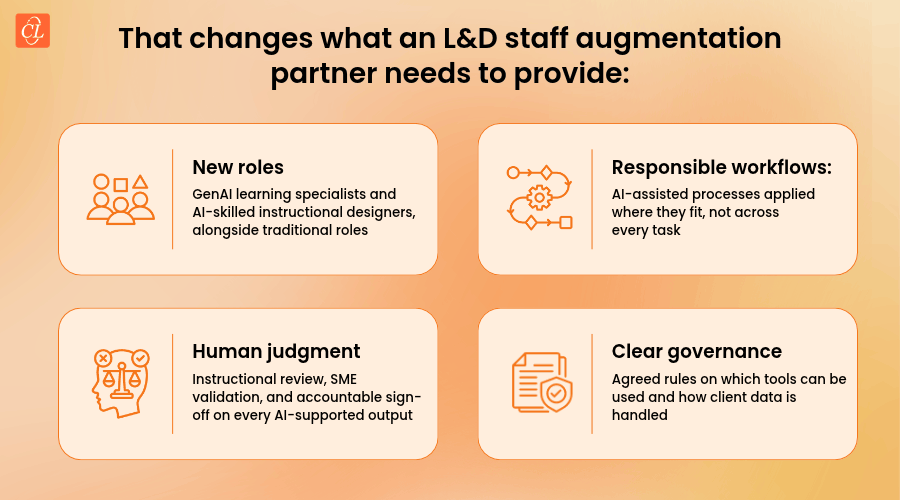
The partners worth shortlisting can explain exactly where AI speeds up their specialists' work, and where human expertise takes over.
Watch how emerging staff augmentation trends can help businesses build workforce flexibility, access specialized talent, and achieve business success.
What Should You Ask Before Signing an L&D Staff Augmentation Partner?
Before signing, ask an L&D staff augmentation partner for sample profiles matched to your work, its onboarding plan, agreed performance expectations, replacement terms, and its security and AI practices.
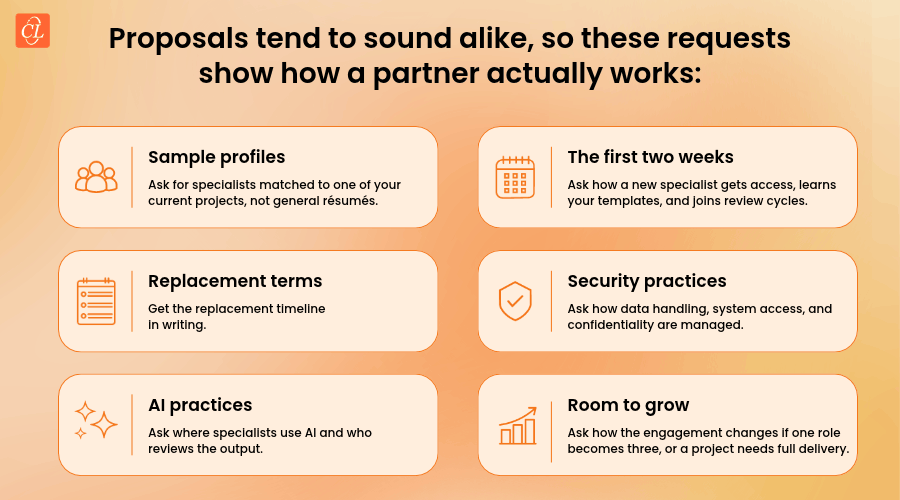
A good process should feel simple, even when the requirement is complex: define the capacity gap, review specialists matched against the actual work, then select and integrate the right fit into your existing operating model. Partners that answer with defined processes and timelines are the ones worth a second conversation.

More Capacity. Same Control.
Scale Enterprise L&D Delivery Capacity with CommLab India
- 140+ L&D Specialists
- 55,000 Hours Delivered
- Trusted by Fortune 500 Organizations for 25+ Years
- And More!
FAQs About L&D Staff Augmentation
Choosing an L&D staff augmentation partner raises practical questions about timing, risk, management, and cost. These answers cover what enterprise L&D leaders ask most before adding specialists to their teams.
When should an enterprise use L&D staff augmentation?
It's most useful during peak workloads, learning backlogs, hiring constraints, major rollouts, technology implementations, global initiatives, or projects that need specialist skills not available internally.
How do enterprises evaluate L&D staff augmentation partners?
Look for a partner that specializes in learning, not a generic staffing firm. Check for specialists with L&D experience, how quickly the provider can place them, how they're onboarded, and what support exists beyond the placement.
What are the main risks of L&D staff augmentation?
The main risks are cultural mismatch, unclear expectations, unfamiliarity with proprietary tools and processes, and losing continuity if someone leaves. Defining the role, day-to-day manager, and success measures upfront reduces them.
What happens if an augmented specialist leaves mid-project?
Documented workflows, centralized project files, version control, knowledge transfer, and planned handovers reduce disruption. Ask each partner how it handles replacements and how quickly a new specialist can step in. CommLab India, for example, guarantees a replacement within one week.
How is L&D staff augmentation priced?
Engagements can be monthly, annual, hourly, or milestone-based, depending on the roles, expertise, duration, workload, and delivery model. Defining the capacity gap and responsibilities first makes it easier to choose the right commercial model.
Final Thoughts
The right L&D staff augmentation partner adds the capacity your team is missing, fits into the way you already work, and keeps strategy and approvals with you. Start with the work that’s stuck, match it to the capacity you need, and use the checks above to test each partner before you sign. The best L&D staff augmentation partner, CommLab India, can help you scope that need and build the team around it.