Blended learning has matured significantly over the past decade. What was once seen as a practical combination of classroom training and eLearning has gradually evolved into a more sophisticated learning architecture, one that includes multiple modalities, distributed touchpoints, and learning moments that stretch far beyond a single course or workshop.
But even as blended learning has become more structurally advanced, many programs still operate with a built-in limitation: they are designed in a static way for learners who are anything but static.
Employees do not all begin at the same level of readiness. They do not struggle with the same concepts, move at the same pace, or require the same type of support. Yet many blended learning programs still deliver largely fixed pathways, uniform reinforcement, and delayed feedback loops. In other words, they offer a blended experience, but not yet an intelligent one.
That is where AI changes the conversation.
AI does not simply add efficiency to blended learning. At its best, it introduces responsiveness. It helps learning systems become more adaptive, more personalized, more data-aware, and more capable of supporting learners in the moment rather than after the fact. Recent workplace signals reinforce this shift: organizations are increasingly moving from isolated AI pilots toward role-based enablement, AI literacy programs, adaptive coaching, and learning embedded into work itself. McKinsey’s latest State of AI also notes that while adoption is broadening, the organizations seeing the most value are those that align AI with operating model, talent, data, and adoption rather than treating it as a standalone tool decision.
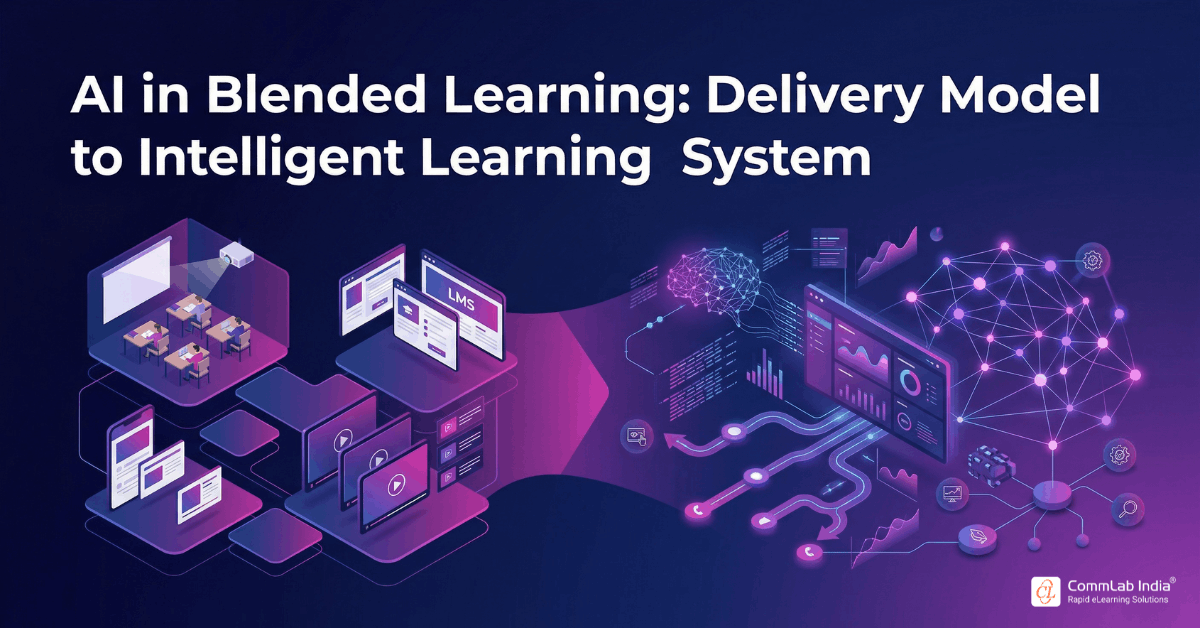
This is what advanced blended learning maturity looks like. It is not just a stronger mix of modalities. It is a shift from a delivery model to an intelligent learning system.
This article explores what that shift really means, where AI creates the most value inside blended learning strategy, why xAPI becomes more important in this new environment, and how learning teams can move toward a more adaptive, evidence-rich, and future-ready model of workplace learning.
Download eBook: 25 AI Tools for L&D Success
Table of Contents
- The maturity shift in blended learning
- What AI actually changes in blended learning strategy
- Personalization at scale without losing instructional coherence
- Real-time feedback, AI coaching, and adaptive learning pathways
- Why xAPI matters more in AI-enabled blended learning
- From activity tracking to learning intelligence
- Where AI belongs and where human judgment still matters
- A practical architecture for AI-enabled blended learning
- FAQ
The Maturity Shift in Blended Learning
Blended learning has always been more than a format combination, but its strategic role is changing in meaningful ways. Earlier versions of blended learning focused primarily on improving access and flexibility. The goal was often to reduce overdependence on classroom training by introducing digital learning components that could scale more easily.
That was a useful first step, but it was still largely a delivery conversation.
As learning ecosystems matured, blended learning became more expansive. Programs started incorporating microlearning, mobile learning, video, performance support, collaborative online activities, and learning analytics. This represented a shift from delivery design to experience design.
Now a third layer is emerging: intelligence design.
This is where AI enters. Instead of simply helping organizations blend formats more efficiently, AI allows them to make the learning system itself more responsive to what learners are doing, struggling with, revisiting, and applying.
A more mature blended learning model is no longer defined only by how many modalities it includes. It is increasingly defined by whether it can:
- adapt based on learner behavior
- provide support closer to the moment of need
- surface insight across multiple learning environments
- connect learning activity to performance patterns
- improve over time instead of remaining fixed
That is the real maturity leap.
The progression of blended learning maturity
| Stage | Primary Focus | Typical Strength | Typical Limitation |
| Format Blending | Combine ILT and digital learning | Greater flexibility and reach | Learning pathways remain static |
| Experience Blending | Integrate multiple modalities | Better learner engagement and continuity | Limited personalization and weak data connection |
| Intelligent Blending | Use AI + data to adapt and optimize | More responsive, personalized, and insight-rich learning | Requires stronger design, governance, and data maturity |
This progression matters because many organizations believe they are “advanced” simply because they use several delivery formats. In reality, advanced blended learning maturity is not about how many modalities are present. It is about whether the learning system can become smarter over time.
What AI Actually Changes in Blended Learning Strategy
AI is often discussed in overly broad terms, which makes it difficult for learning teams to identify where it genuinely belongs. The most useful way to understand AI in blended learning is to stop asking, “How can we add AI?” and start asking, “Which parts of the learning system should become more responsive, adaptive, or insight-rich?”
That is where AI becomes strategically useful.
Traditional blended learning is largely pre-structured. Learning designers define the pathway, sequence the assets, assign the assessments, and set the reinforcement plan in advance. That model works reasonably well when learner needs are relatively uniform. But in most workplace settings, they are not.
AI introduces a different capability: it allows the system to observe and respond.
That can change blended learning in several meaningful ways:
- it can help learners find the most relevant content faster
- it can recommend reinforcement based on learner performance
- it can support practice through simulated conversations or roleplay
- it can generate feedback more quickly than human teams alone can provide
- it can surface patterns across learning activity that would otherwise remain hidden
What AI changes, then, is not just speed. It changes the behavior of the learning system.
A more useful framing
Instead of viewing AI as a “tool layer,” it is more accurate to view it as a decision-support and adaptation layer inside blended learning.
That distinction is important because the strategic value of AI is not in novelty. It is in helping the learning system become better at answering questions like:
- Who needs help right now?
- What kind of help do they need?
- Which learning modality is working best?
- Where is learner friction increasing?
- What should happen next for this learner?
When AI is used in this way, blended learning stops being a sequence of planned components and starts behaving more like a responsive ecosystem.
Personalization at Scale Without Losing Instructional Coherence
Personalization has been a long-standing ambition in workplace learning, but most organizations have historically achieved only a limited version of it. In many cases, personalization has meant segmenting learners by role, function, or level and then assigning slightly different content to each group.
That is useful, but it is still relatively coarse.
AI expands what personalization can mean inside blended learning because it makes it possible to tailor learning experiences with much greater precision and far less manual effort. Recent research and meta-analyses suggest AI-supported learning tools can improve learning outcomes and engagement, especially when used for targeted support, adaptive sequencing, or intelligent feedback rather than generic automation.
What AI-enabled personalization can actually do
In a blended learning environment, AI can support personalization by helping systems:
- detect knowledge gaps earlier
- recommend the next most relevant learning asset
- adjust the difficulty or depth of practice
- identify learners who may need more support
- reduce unnecessary repetition for learners who already show mastery
This is especially valuable in blended programs because learners often encounter training through multiple touchpoints: self-paced content, live sessions, videos, simulations, job aids, discussion spaces, and reinforcement activities. AI helps connect those touchpoints more intelligently.
But there is an important design principle here: personalization should not create fragmentation.
If every learner is sent down a completely different pathway without a clear learning architecture underneath, the experience can become incoherent. The goal is not infinite variation. The goal is adaptive relevance within a well-designed structure.
The stronger design principle
A mature blended learning strategy should treat personalization as a controlled layer of adaptability, not as total learner improvisation.
That means preserving:
- a shared performance goal
- a coherent learning spine
- common moments of reflection or application
- meaningful instructor or manager touchpoints
AI can personalize the route, but the learning system still needs a clear destination.
Real-Time Feedback, AI Coaching, and Adaptive Learning Pathways
One of the most practical ways AI strengthens blended learning is by shortening the distance between learner action and learning response.
That matters because delayed feedback weakens learning momentum. If learners have to wait too long to discover where they are struggling, what they misunderstood, or how to improve, the system becomes less supportive and more administrative.
AI changes this dynamic by making feedback and adaptation more immediate.
Where this is already becoming visible
Organizations are increasingly experimenting with AI-supported coaching and simulated practice in areas such as sales enablement, communication, and professional readiness. Recent reporting shows AI roleplay and coaching tools are being used to reduce onboarding time, scale practice, and provide immediate feedback in situations where manager coaching capacity is limited.
This is not a small shift. It changes the role of blended learning from content exposure to active capability development.
What real-time feedback can look like in blended learning
In practice, AI-enabled feedback may include:
- immediate coaching prompts during simulations or practice tasks
- dynamic nudges when learners struggle with a concept
- adaptive recommendations after a quiz or activity
- AI-supported rehearsal before a high-stakes conversation or task
- feedback summaries that help learners identify recurring weaknesses
This becomes especially powerful when it is layered into a broader blended learning design. For example, learners might complete foundational eLearning, attend a live workshop, then continue developing through AI-guided practice and targeted reinforcement afterward.
That creates a far more continuous learning experience.
AI coaching is most useful when it expands practice and feedback opportunities that human systems alone struggle to provide consistently at scale.
That is the real value. Not replacing the coach, but increasing the frequency, accessibility, and relevance of coaching-like support.
25 AI Tools for L&D That Make Learning Stick
A curated guide to the smartest AI tools for:
- Writing
- Visual Design
- Voice & Narration
- Interactivity
- And More
Why xAPI Matters More in AI-Enabled Blended Learning
If AI is the intelligence layer, then data is the fuel that makes it useful. And in blended learning, that creates an immediate challenge: learning no longer happens in one place.
It happens across:
- self-paced digital modules
- instructor-led sessions
- virtual classrooms
- mobile learning assets
- performance support tools
- simulations and assessments
- workflow learning moments
That means traditional LMS reporting is often too narrow for the kind of intelligence modern blended learning needs.
This is where xAPI becomes significantly more important.
What xAPI adds
xAPI allows organizations to track learning activity across a much wider set of environments than traditional completion-based systems. Instead of capturing only whether a learner finished a course or passed a test, it can capture more distributed signals such as:
- whether learners accessed a performance support asset
- how they moved through a simulation
- whether they revisited a concept before a task
- what activities happened outside the LMS
- how learners interacted with different parts of the learning ecosystem
That matters because AI is only as useful as the learning signals it can interpret. xAPI and Learning Record Stores (LRSs) are designed precisely to collect and manage that broader activity data. Official and implementation-focused sources continue to position the LRS as the central repository for xAPI statements and a key enabler of richer learning analytics beyond standard LMS completion reporting.
Without richer learning data, AI in blended learning often ends up operating on shallow proxies such as clicks, completions, and quiz scores.
With xAPI, learning teams can begin to ask more meaningful questions:
- Which modalities are learners actually using?
- What do high-performing learners do differently?
- Where does reinforcement appear to improve retention?
- Which support assets are accessed closest to performance moments?
- What parts of the learning journey are being skipped, repeated, or abandoned?
That is the point where blended learning begins to become measurable in a much more useful way.
From Activity Tracking to Learning Intelligence
Collecting more data is not the same as generating more value. In fact, one of the reasons learning analytics has often underdelivered is that organizations have focused on dashboards without developing a strong interpretation layer.
This is where AI can become especially useful.
Its real value in analytics is not simply that it can process large amounts of data. It is that it can help transform fragmented learning activity into decision-relevant insight.
The shift that matters
Traditional reporting tends to answer:
- How many learners completed the course?
- What was the average score?
- Which modules were accessed?
Those are not unimportant questions, but they are incomplete.
More mature learning intelligence asks:
- Which learning pathways are producing stronger performance signals?
- Where is learner confidence dropping?
- Which assets are being used closest to task execution?
- Which learner groups are engaging but not improving?
- What design changes would likely improve outcomes?
This is a much more useful layer of interpretation.
Why blended learning especially benefits from this
Blended learning produces more varied and distributed learner behavior than single-format learning. That complexity can feel difficult to measure, but it is also where the richest signals live.
Recent work in learning analytics is also moving beyond simple linear activity tracking toward more complex models of interaction across learners, tasks, tools, and AI-mediated behaviors, reinforcing the need for more sophisticated interpretation in blended environments.
That is why AI + xAPI is such an important combination. One expands the visibility of the learning experience. The other helps interpret it.
Together, they move blended learning from activity tracking to learning intelligence.
Where AI Belongs and Where Human Judgment Still Matters
One of the biggest strategic mistakes organizations can make is assuming that if AI can be added to blended learning, it should be added everywhere.
That is not a mature design decision.
The strongest blended learning systems are not the ones that automate the most. They are the ones that understand where AI creates real value and where human judgment remains indispensable.
Where AI tends to add the most value
AI is particularly useful when the need is for:
- speed, such as generating variants, summaries, or recommendations
- pattern recognition, such as detecting learner struggle or engagement shifts
- scalable feedback, such as simulation responses or coaching prompts
- personalization, such as targeted reinforcement or next-best actions
- signal synthesis, such as surfacing patterns across multiple learning touchpoints
Where human roles remain central
Human involvement remains especially important when the learning challenge involves:
- nuance and contextual judgment
- ethical interpretation
- facilitated discussion and reflection
- coaching that depends on lived context
- motivation, confidence, and trust-building
This is especially important in workplace learning, where learning is not just about information. It is often about judgment, behavior, collaboration, and decision-making inside complex environments.
A better operating principle
AI should make blended learning more humanly effective, not more mechanically automated.
That is the standard worth designing for.
A Practical Architecture for AI-Enabled Blended Learning
The move toward AI-enabled blended learning does not require organizations to rebuild their learning ecosystem overnight. In fact, the strongest approach is usually incremental and architecture-led rather than tool-led.
The goal is not to “add AI everywhere.” The goal is to identify where intelligence would improve the learner experience, strengthen measurement, or reduce friction in the learning system.
A practical design architecture
A useful way to think about this is through five layers:
| Design Layer | What It Does | Where AI Can Add Value |
| Learning Experience Layer | Delivers learning across modalities | Personalization, recommendations, adaptive sequencing |
| Practice & Feedback Layer | Supports rehearsal and application | AI coaching, simulations, instant feedback |
| Reinforcement Layer | Sustains retention and recall | Targeted nudges, spaced reminders, dynamic refreshers |
| Data & Signal Layer | Captures learning activity across environments | xAPI, LRS integration, behavioral signal collection |
| Insight & Optimization Layer | Interprets patterns and improves the system | Analytics, predictive patterns, design recommendations |
This architecture helps learning teams avoid one of the most common mistakes in AI adoption: treating the tool as the strategy.
A more practical rollout approach
If an organization is early in this journey, a strong first phase may include:
- identifying one high-value blended program to pilot
- enabling richer tracking across modalities
- introducing AI-supported feedback or practice in one part of the journey
- testing reinforcement recommendations based on learner behavior
- reviewing where human facilitation should remain central
That kind of phased approach is far more sustainable than trying to force AI across every learning experience at once.
The real maturity signal
An organization is moving toward advanced blended learning maturity not when it has the most AI tools, but when it can clearly explain:
- what AI is doing in the learning system
- what problem it is solving
- what human role it is supporting
- what learner signal it is using
- and how it improves performance or learning quality
That is where strategy begins to replace experimentation.
FAQs
1. What is AI in blended learning?
A. AI in blended learning refers to the use of artificial intelligence to make learning experiences more adaptive, personalized, responsive, and insight-driven across multiple training modalities.
2. How does AI improve blended learning?
A. AI improves blended learning by enabling real-time feedback, adaptive learning pathways, personalized reinforcement, scalable practice opportunities, and better interpretation of learning data.
3. What is xAPI in blended learning?
A. xAPI is a learning data standard that tracks learner activity across different environments such as eLearning, classroom sessions, simulations, mobile learning, and performance support tools.
4. Why is xAPI important for AI-enabled learning?
A. xAPI helps capture richer learning signals across the full blended learning ecosystem. This gives AI systems more meaningful data to interpret and use for personalization, analytics, and optimization.
5. Can AI replace instructors in blended learning?
A. No. AI can support instructors by improving feedback, practice, and personalization, but instructors remain essential for facilitation, contextual judgment, coaching, and human connection.
6. What is the biggest mistake organizations make with AI in blended learning?
A. The biggest mistake is treating AI as a tool-first add-on rather than designing it around a clear learning need, learner signal, or performance problem.
Conclusion
If learning teams want to move blended learning into a more advanced maturity stage, the next step is not to ask which AI tool to buy. It is to identify where their current learning system is still too static to support real learner variability.
That usually becomes visible in predictable places: fixed pathways that ignore learner readiness, reinforcement that reaches everyone the same way, weak visibility across modalities, or feedback that arrives too late to shape performance.
A strong next move is to run a blended learning intelligence audit for one priority program. Review where learning currently happens, what signals are being captured, where learners need more adaptive support, and where AI could improve responsiveness without weakening human facilitation. Then redesign one part of the system with clear intent, measure the effect, and scale from there.
That is how maturity actually develops. Not through broad AI adoption claims, but through better system design.
And that is the larger shift this moment is pointing toward: the future of blended learning will not be defined by how many modalities are combined. It will be defined by how intelligently the system can respond to the people moving through it.