If you lead learning and development at an enterprise or mid-market company, you are probably familiar with this scenario: your training backlog is growing, your internal team is stretched, SMEs are slow to respond, and leadership keeps asking what L&D is delivering for the budget.
That is not a people problem. It is a capacity and partner problem.
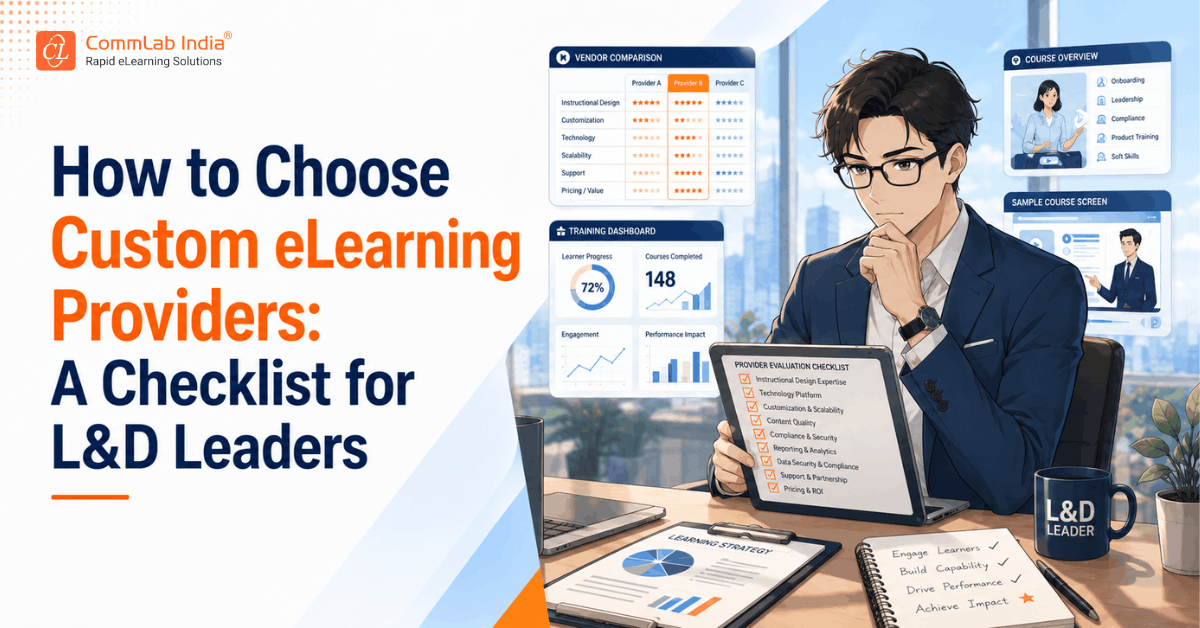
Choosing the right custom eLearning providers determines whether your L&D function scales into a strategic force or stays stuck in production mode. With hundreds of vendors operating across the globe, the selection process demands more than a capabilities review and a price comparison. It requires evaluating fit at the operational level.
This guide gives enterprise and mid-market L&D leaders a practical framework for doing exactly that.
Table Of Content
- Know Your L&D Ecosystem Before You Start Vendor Conversations
- 6 Criteria That Separate Strong Custom eLearning Providers from Average Ones
- Common Mistakes Enterprise L&D Leaders Make When Selecting Training Partners
- Best Practices for a Stronger Vendor Selection Process
- The Right Custom eLearning Partner Is a Multiplier for Your L&D Team
- FAQ
Know Your L&D Ecosystem Before You Start Vendor Conversations
Before you evaluate a single vendor, get honest about what kind of L&D organization you are running. In practice, most enterprise learning functions fall into one of two categories, each with different vendor needs.
Small Internal L&D Teams
You have a lean team doing meaningful work, but training demand is outpacing your capacity. You lack standardized processes, templates, and documentation. When a vendor joins your program, you need them to bring structure, not just production hours.
What you need from a custom eLearning partner: end-to-end ownership. That means curriculum development, instructional design, authoring, audio, translations, LMS support, and quality assurance, all under one roof. Your subject matter experts should validate content, not manage vendor deliverables.
Large L&D Teams with Established Processes
You have mature systems, strong templates, and clear quality standards. The problem is a pipeline that exceeds internal capacity. You do not need a vendor to teach you how to run L&D. You need skilled people who can plug into your workflows on day one without a learning curve.
What you need: flexible staff augmentation with professionals who are fluent in the tools you already use, whether that is Articulate Storyline, Rise 360, Vyond, or your LMS administration stack. You want scale, not supervision overhead.
Knowing which category you fall into sharpens every question you ask a potential partner.
6 Criteria That Separate Strong Custom eLearning Providers from Average Ones
1. Proven Delivery at Enterprise Scale
Portfolio reviews reveal intent. Delivery history reveals capability. When evaluating custom eLearning providers, ask to see evidence of sustained multi-year relationships, not just one-off projects.
The strongest partners maintain long-term contracts with Fortune 500 organizations across industries like financial services, healthcare, life sciences, and industrial manufacturing. Look for indicators like annual contracts in the hundreds of thousands of dollars, work spanning dozens of simultaneous projects, and the ability to serve 50 or more stakeholders and 100-plus subject matter experts at once.
Single-project vendors can produce excellent work. But enterprise training demands a partner who has already solved the coordination, consistency, and quality challenges that come with large-scale delivery.
Questions to ask:
- What is the largest program you have managed in terms of simultaneous projects and stakeholder count?
- Can you share a client relationship you have held for five or more years and describe how it evolved?
- How do you maintain quality consistency when scaling from 5 modules to 50?
2. LMS Integration Depth and Migration Experience
LMS integration is frequently listed as a requirement but rarely probed with enough specificity during vendor evaluation. Enterprise environments are rarely clean. Most organizations have inherited multiple learning management systems from acquisitions, business unit autonomy, or legacy technology decisions.
A strong custom eLearning partner does not just build SCORM-compliant content. They help you consolidate fragmented LMS environments, migrate existing course catalogs, handle HTML5 conversion of legacy Flash-based content, and set up and administer customer-facing training portals when needed.
Ask specifically about:
- Experience with your LMS platform (Workday Learning, Cornerstone, SAP SuccessFactors, Docebo, or others)
- SCORM 1.2, SCORM 2004, and xAPI support, including what learning data each standard captures
- Capacity to consolidate multiple LMSes into a single platform and migrate historical data
- LMS administration as an ongoing managed service, not just a launch deliverable
According to Gartner, organizations that integrate their learning technology stack with HR systems report measurably faster onboarding and stronger skill mobility. The goal is not just functional content. It is a connected learning infrastructure.
3. Instructional Design Rigor, Not Just Visual Production
A common mistake in vendor selection is equating visual sophistication with instructional quality. They are not the same thing.
Strong instructional design starts before any authoring tool is opened. It involves a structured needs analysis, a detailed content outline aligned to measurable learning objectives, and a design approach grounded in how adults actually learn and retain new behaviors. Look for partners whose process includes formal kickoff, planning, alpha and beta development cycles, and structured review gates before final delivery.
A reliable development process might look like this: content walkthrough and query clarification, team selection and project planning, alpha development with audio for client review, beta development incorporating feedback, gold development and final sign-off, and a formal closure meeting with a customer satisfaction review.
Partners who skip directly to authoring without a structured planning phase tend to produce content that looks professional but fails to change behavior on the job. That is the gap that erodes L&D credibility with business leaders.
Deloitte's Human Capital Trends research consistently finds that learning must be embedded in the context of real work to drive lasting skill development. Ask potential partners how they design for application, not just completion.
4. Multilingual Delivery and Global Scalability
If your workforce spans multiple countries or regions, translation and localization cannot be an afterthought. It must be built into the vendor's core delivery model.
The practical challenges are significant: translating eLearning is not the same as translating documents. Audio narration, on-screen text, graphics, cultural references, and LMS metadata all require careful handling. Errors in translated compliance training carry real legal and operational risk.
Look for partners with the capacity to deliver in 30 or more languages, with structured workflows for multi-language projects and quality assurance that covers both linguistic accuracy and technical functionality after translation.
Pay attention to whether the partner has built proprietary tools to accelerate multilingual delivery, such as wrapper tools that allow language toggling within a single course file. This reduces LMS administration burden and simplifies the learner experience for global audiences.
According to the LinkedIn Workplace Learning Report, global organizations increasingly cite language and localization capability as a top constraint in scaling employee training programs across regions.
5. Flexibility to Scale Up and Down Without Friction
Fixed-capacity vendor relationships create operational headaches for enterprise L&D. Your training pipeline does not stay constant throughout the year. Product launches, compliance cycles, onboarding surges, and organizational changes all create demand spikes that fixed vendor teams cannot absorb.
The right partner model offers flexible capacity. This may look like a dedicated pod of learning architects, instructional designers, courseware developers, project managers, LMS support specialists, and data analytics professionals who operate as an extension of your team. Monthly scale-up and scale-down flexibility is a material operational advantage.
Ask vendors how they staff surge demand. Do they use contractors who are unfamiliar with your standards? Do they have a bench of trained professionals with experience in your tools and workflows? The answer reveals how consistent quality will be when volume increases.
6. Thought Leadership and Continuous Learning Investment
Your vendor should make you smarter, not just deliver content on time. The strongest custom eLearning providers invest in thought leadership that helps their clients stay current with emerging learning technologies, methodologies, and best practices.
Look for partners who publish meaningful content, run learning events for their clients, host communities where L&D practitioners can share practices, and bring proactive recommendations rather than waiting for you to define every requirement.
This is particularly relevant as organizations navigate the shift toward skills-based talent models, AI-assisted learning design, and xAPI-enabled learning data strategies. A vendor who is ahead of these trends helps you make better decisions. A vendor who only executes your brief keeps you behind.
Common Mistakes Enterprise L&D Leaders Make When Selecting Training Partners
Optimizing for low cost, not total value. A lower hourly rate means nothing if the vendor requires three rounds of rework, misses timelines, or cannot handle your LMS environment. Evaluate total cost including coordination overhead, revision cycles, and the cost of delayed training launches.
Skipping the operational fit assessment. Culture and communication style matter at scale. A vendor who handles feedback poorly or escalates issues late creates serious problems when you are managing 30-plus simultaneous projects. Ask for references and listen for how the vendor behaves under pressure.
Treating the vendor relationship as transactional. The best corporate training outcomes come from partners who understand your business deeply over time. Organizations that invest in multi-year, structured partnerships consistently report better content quality, faster production cycles, and lower administrative burden than those who rebid annually.
Underspecifying LMS requirements upfront. Discovering LMS compatibility issues after course development is complete is expensive. Specify your platform, version, and technical requirements before vendor selection and request a technical integration test before contract signature.
Neglecting post-launch content maintenance. Content decays. Products change, regulations update, processes evolve. Understand from the start how the vendor handles ongoing updates. Partners who offer structured annual maintenance agreements or content-as-a-service models reduce the long-term operational burden on your internal team.
Best Practices for a Stronger Vendor Selection Process
Before issuing your RFP, define your evaluation criteria and weight them. Common categories include instructional quality, LMS integration depth, multilingual capability, scalability, project management rigor, and communication standards.
Include IT and procurement in the evaluation from the start. LMS integration questions require technical input, and contract terms around intellectual property, data privacy, and MSA structure need procurement's involvement early.
Request a working session, not just a portfolio review. Ask the vendor to complete a sample storyboard or content outline on a topic relevant to your organization. You will learn more about their process, communication style, and instructional thinking in two hours than you will from reviewing finished deliverables.
Confirm that source files and intellectual property transfer to you upon final payment. You should retain full ownership of all deliverables, including source files, audio scripts, and any custom templates developed for your programs.
The Right Custom eLearning Partner Is a Multiplier for Your L&D Team
Choosing the right custom eLearning providers is not about finding the cheapest production resource or the flashiest portfolio. It is about finding a partner whose operational model, delivery depth, and long-term commitment align with where your L&D function needs to go.
The organizations that consistently outperform in workforce capability building share a common pattern: they treat their training partners as strategic extensions of their L&D team, not as vendors to be managed at arm's length. They invest in relationships that deepen over time, and they choose partners who bring structure, scale, and expertise the internal team does not have to build from scratch.
Start with your operational reality. Match it to a partner built for that specific challenge. Then build toward outcomes your business can measure.
Frequently Asked Questions
1: What should I look for in a custom eLearning provider if my internal L&D team is small?
A. Look for a partner who can take end-to-end ownership of the development process, from curriculum planning through LMS deployment. The provider should bring standardized templates, SOPs, and quality checklists so your team is not designing the process from scratch. Ask for case studies from organizations with similar team sizes and training volumes.
2: How do I evaluate whether a vendor can truly handle multilingual eLearning at scale?
A. Ask for examples of projects delivered in more than ten languages simultaneously, and request a walkthrough of their translation workflow, including how they handle audio re-recording, graphic localization, and post-translation LMS testing.
3: What is a POD model in eLearning delivery and why does it matter for enterprise clients?
A. A POD (Project or People on Demand) model is a dedicated team structure in which the provider assigns a fixed group of learning architects, instructional designers, developers, project managers, and LMS specialists to your account. The POD operates as an embedded extension of your internal L&D team.
4: How do custom eLearning providers support overloaded internal L&D teams?
A. They can provide end-to-end development, staff augmentation, project management, instructional design, course development, translations, LMS support, and quality assurance. This helps internal teams focus on strategy while execution is handled by an external partner.