An employee completes a corporate training program on Monday. By Friday, they’re back to doing things the old way.
Sound familiar?
This is one of the biggest frustrations in learning and development today. Organizations invest heavily in corporate training, upskilling and reskilling initiatives, yet business leaders still ask the same question:
“Is training actually improving employee performance?”
The problem is not a lack of learning programs. It’s the growing disconnect between training and real-world application.
Many employees complete courses, pass assessments, and earn certificates, but struggle to apply learning consistently in the workflow. Meanwhile, L&D teams are still being measured on completion rates instead of business impact, behavior change, or operational performance.
Today, organizations need more than training delivery. They need learning experiences that improve productivity, reduce errors, strengthen decision-making, and directly support business goals.
This blog explores why traditional corporate training often fails to improve workplace performance in large enterprises. It also explains how custom eLearning helps global organizations deliver role-specific, scalable, and performance-focused learning that drives measurable business impact.
Table Of Content
- Why Does Corporate Training Fail to Improve Real-World Performance?
- Why Custom eLearning Is Perfect for Performance-Focused Training?
- Why Are Large Enterprises Investing in Custom eLearning?
- How Custom eLearning Enhances On-the-Job Performance?
- Frequently Asked Questions
- Are Your Training Programs Driving Real Performance?
Why Does Corporate Training Fail to Improve Real-World Performance?
Despite massive investments in corporate training, many organizations still struggle to see measurable improvements in employee performance, productivity, or business outcomes. The problem is not the lack of training — it’s the lack of performance-focused learning strategies that help employees apply learning effectively in real work situations.
1. Training Is Built Around Content, Not Performance
Most corporate training fails because it is designed around what employees need to know, not what they need to do differently on the job. This leads to content-heavy courses, long modules, and information overload without enough workplace application.
Solution: Design Training Around Workplace Performance
L&D teams should start with the business goal, identify the exact behaviors employees must demonstrate, and use learning strategies to help learners apply skills in real situations.
2. One-Time Training Does Not Create Lasting Change
Many employee training and development programs are treated as one-time events. Employees attend a session or complete an online learning course, but without reinforcement, they quickly forget what they learned and return to old habits.
Solution: Reinforce Learning with Microlearning
Use microlearning, training videos, mobile learning, and AI-powered reinforcement to keep learning continuous. Short, focused learning bites help employees revisit core learnings, retain knowledge longer, and apply learning in the workflow.
3. Training Happens Outside the Workflow
Corporate training often happens away from the real work environment, making it difficult for employees to transfer learning to daily tasks. This is especially common in compliance training, technical training, sales enablement, and customer-facing roles.
Solution: Embed Learning into Daily Work
Deliver digital learning, video-based learning, job aids, and performance support tools directly inside the workflow. When employees can access support while performing a task, training becomes more practical and performance-focused.
4. Training Is Too Generic
Generic training gives every employee the same learning experience regardless of role, experience, performance level, or skill gap. This reduces relevance and learner engagement.
Solution: Personalize Learning with AI and Adaptive Learning
Use AI in L&D, adaptive learning, and skills-based learning paths to deliver personalized learning experiences. Targeted upskilling and reskilling programs help employees focus on the skills most relevant to their roles and performance goals.
5. Legacy Formats Do Not Engage Modern Learners
Long, static, slide-heavy courses often fail to hold attention or build real capability. Modern learners expect training that is engaging, interactive, and easy to consume.
Solution: Modernize Learning Experiences
Use blended learning, immersive learning solutions, VILT, and more to create engaging learning experiences that improve participation, retention, and real-world application.
6. L&D Measures Completion Instead of Impact
Many learning and development teams still measure training success through completion rates, attendance, quiz scores, and learner satisfaction. These metrics show participation but fail to prove business value.
Solution: Align Learning Metrics with Business KPIs
Track measurable outcomes such as faster onboarding, improved productivity, reduced compliance issues, higher sales conversions, fewer operational errors, and better customer satisfaction to demonstrate the real impact of corporate training.
Why Custom eLearning Is Perfect for Performance-Focused Training?
A lot of corporate training programs are ineffective because they rely on generic, off-the-shelf content that is designed for a broad category of learners rather than specific business challenges. While these courses may deliver information, they often lack contextual relevance, practical application, and alignment with workplace performance goals.
Custom eLearning changes this by designing learning experiences around actual job roles, business workflows, and performance outcomes. Instead of teaching concepts in isolation, custom eLearning focuses on how employees apply knowledge in real-world situations.
Why Are Large Enterprises Investing in Custom eLearning?
For enterprises with a large number of employees spread across multiple business units, regions, and languages, training is no longer just an L&D initiative — it’s an operational challenge. Different teams often have different workflows, systems, compliance requirements, customer expectations, and skill gaps. Delivering consistent, high-quality corporate training at that scale while maintaining relevance is extremely difficult with generic learning programs.
That’s why large organizations are increasingly investing in custom eLearning solutions that combine instructional design expertise, rapid development, AI-enabled learning strategies, localization, and scalable delivery models.
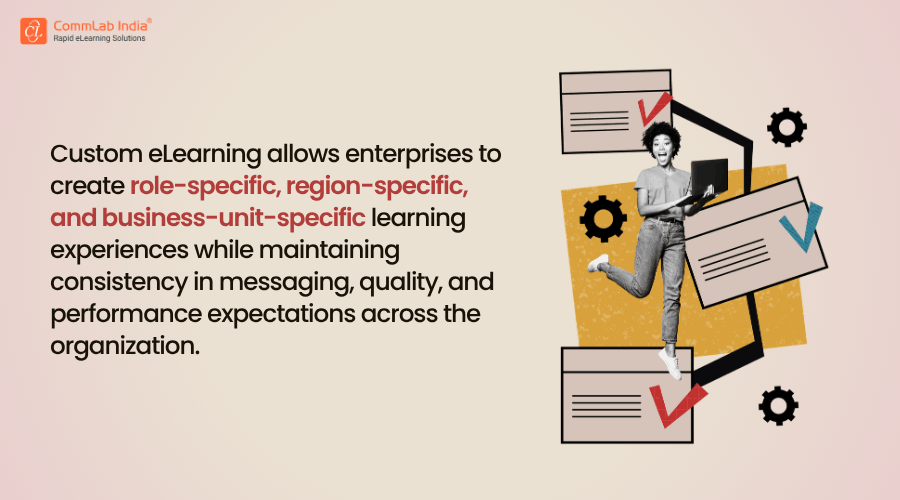
More importantly, enterprise L&D teams are shifting their focus from simply deploying courses globally to enabling measurable business outcomes globally. Whether the goal is accelerating onboarding, reducing operational errors, improving compliance adherence, strengthening customer experience, or supporting large-scale upskilling and reskilling initiatives, custom eLearning helps organizations align training directly with business performance.
How Custom eLearning Enhances On-the-Job Performance?
Large organizations are increasingly adopting custom eLearning solutions that support scalable, role-specific, and region-specific learning experiences while maintaining consistency across the organization.
1. ILT to eLearning Conversion Enables Scalable Global Training
Large enterprises cannot rely solely on classroom training for geographically distributed teams. Converting ILT to eLearning helps organizations make learning available on-demand, reduce instructor dependency, lower delivery costs, and ensure consistent training experiences across regions and business units.
Watch this video to see why converting ILT to eLearning makes training more scalable, consistent, and effective.
2. Virtual Instructor-Led Training (VILT) Supports Distributed Teams
Global organizations need collaborative learning experiences even when employees are spread across countries and time zones. VILT enables enterprises to replicate classroom interaction virtually while supporting engagement, knowledge sharing, and instructor-led collaboration at scale.
3. Webinar to eLearning Conversion Extends the Value of SME Knowledge
Enterprises often conduct webinars and expert-led sessions that deliver valuable technical and operational insights. Converting webinar recordings into interactive eLearning courses helps organizations preserve institutional knowledge, improve accessibility, and increase learning recall across teams.
4. Video-Based Learning Accelerates High-Volume Learning Delivery
Modern enterprises increasingly use training videos for onboarding, compliance training, technical training, and sales enablement because video-based learning improves engagement and simplifies complex topics. AI-powered video creation tools also help organizations scale content production faster across multiple regions and languages.
Employees in large enterprises often struggle to dedicate long hours to training. Microlearning solutions make learning easier to consume within daily workflows through short, focused learning nuggets that support spaced retrieval, reinforcement, and just-in-time performance support.
The shift is no longer about delivering standardized learning programs globally.
It’s about creating scalable learning ecosystems that improve workforce performance across business units, geographies, and operational environments.
|
CommLab India’s Custom eLearning Solutions Trusted by Fortune 500 Enterprises
Turn complex training into engaging, role-specific learning experiences that drive performance at scale. |


Frequently Asked Questions
What makes custom eLearning more effective than off-the-shelf courses?
Custom eLearning is designed around an organization’s workflows, systems, job roles, and business goals, making learning more relevant, practical, and easier to apply in real work situations.
Why is role-specific training important in enterprise learning?
Different teams and business units often face different operational challenges, compliance requirements, and skill gaps. Role-specific training improves relevance, engagement, and workplace application.
What types of training benefit most from custom eLearning?
Custom eLearning is especially effective for compliance training, technical training, onboarding, sales enablement, leadership training, customer training, and large-scale upskilling and reskilling initiatives.
How can organizations make training more engaging for modern learners?
Organizations can improve engagement by using immersive learning solutions, gamification, simulations, storytelling, VILT, and interactive video-based learning instead of long, static courses.
Are Your Training Programs Driving Real Performance?
Corporate training cannot continue to operate as a content-delivery function while businesses expect measurable performance outcomes. In large enterprises, where teams are spread across regions, business units, and operational environments, learning must do more than inform employees — it must help them perform better, adapt faster, and contribute directly to business goals. The future of learning and development belongs to organizations that move beyond completion rates and build performance-focused learning ecosystems. The question for L&D leaders is no longer “Did employees complete the training?” but “Did the training improve how employees work?”
For L&D professionals looking to align learning with measurable business impact, a strong strategy is critical. Explore our eBook on strategy and planning to achieve business goals, designing specific roadmaps/learning journeys, and the implementation and impact of learning solutions to discover how modern enterprises are building scalable, performance-driven learning strategies that deliver real-world results.