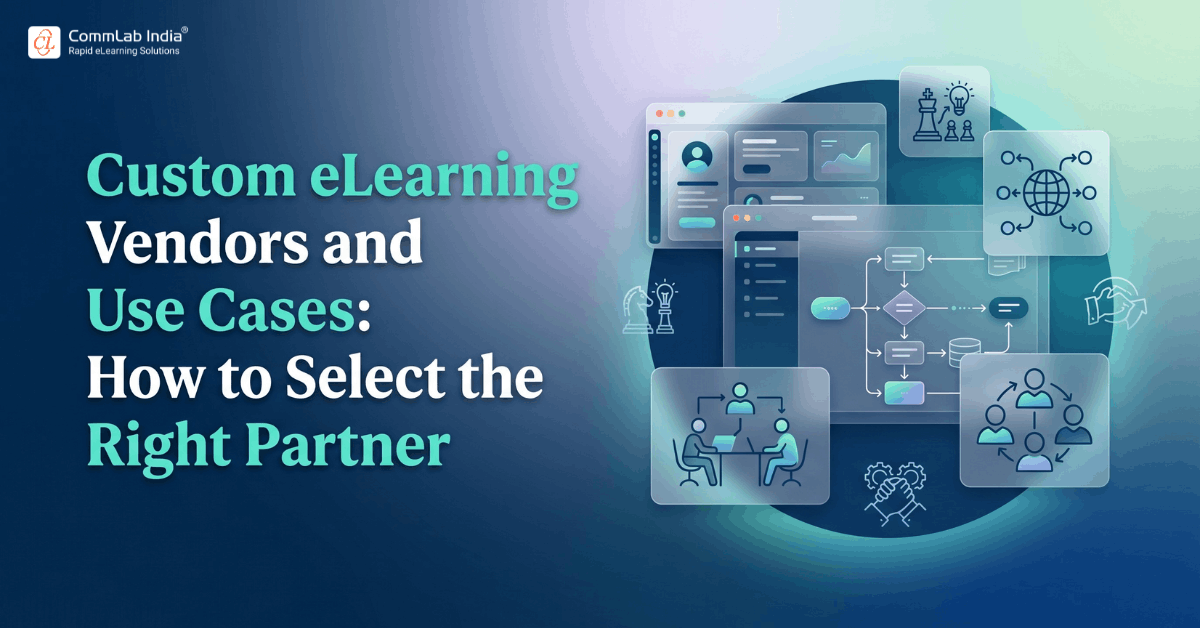
At a certain point in the custom eLearning journey, organizations move beyond strategy and design into a far more decisive phase: execution. The need for tailored learning is clear, internal alignment has been established, and the business case has been made. Yet, one decision continues to shape everything that follows.
Who will build it, and how will they do it?
This is where many organizations either accelerate toward measurable impact or encounter delays, inefficiencies, and missed expectations. Selecting a custom eLearning vendor is not simply a procurement step. It is a strategic decision that directly influences how effectively learning initiatives are translated into real-world performance outcomes.
The stakes are particularly high because custom eLearning is rarely generic in nature. It is deeply tied to specific business contexts, whether that involves enabling a manufacturing workforce, ensuring compliance in regulated industries, or improving sales effectiveness in competitive markets.
As a result, vendor selection, outsourcing strategy, and use case alignment cannot be treated as separate decisions. They must work together as part of a cohesive approach that ensures learning solutions are not only well-designed but also well-executed and scalable.
Download eBook: eLearning 101 - A Beginner’s Guide
Table of Contents
- Why Vendor Selection Shapes Learning Outcomes
- Defining What a High-Impact eLearning Partner Looks Like
- Structuring Outsourcing for Control and Agility
- Evaluating Vendors Through a Business-Outcome Lens
- Matching Vendor Strengths to High-Impact Use Cases
- Industry-Specific Applications That Demand Customization
- From Transactions to Long-Term Partnerships
- FAQs
- Conclusion
Why Vendor Selection Shapes Learning Outcomes
Vendor selection is often approached as a checklist-driven exercise focused on cost, timelines, and deliverables. While these factors are important, they do not fully capture the role a vendor plays in the success of custom eLearning initiatives.
In reality, the vendor becomes an extension of the organization’s learning function. Their ability to interpret requirements, translate them into effective learning experiences, and execute with consistency determines whether the initiative delivers real impact.
Custom eLearning development involves multiple layers, including instructional design, visual storytelling, technology integration, and project coordination. Few organizations possess all these capabilities internally at scale. This is where the right vendor adds value by bringing structured methodologies, cross-domain expertise, and a disciplined approach to execution.
When vendor selection is handled strategically, it accelerates outcomes. When it is treated as a transactional decision, it often leads to rework, delays, and fragmented learning experiences.
Defining What a High-Impact eLearning Partner Looks Like
Not all vendors operate at the same level of maturity. Some focus primarily on content production, while others engage more deeply with business context and performance outcomes.
The difference between these approaches becomes evident in the quality and relevance of the final learning experience.
Core Capabilities to Assess
| Capability | Why It Matters in Practice |
| Instructional Design Expertise | Ensures learning is structured for application, not just information delivery |
| Domain Understanding | Helps align content with industry-specific challenges and workflows |
| Technology Proficiency | Enables efficient development and integration with enterprise systems |
| Scalability | Supports large, multi-location or multi-language rollouts |
| Project Management Discipline | Maintains timelines, quality, and stakeholder alignment |
Beyond capabilities, organizations should also pay attention to how vendors approach engagement.
Indicators of a Strong Partner
- They lead with questions, not assumptions
A strong partner seeks to understand business goals before proposing solutions. - They follow structured processes
Clear methodologies reduce ambiguity and improve execution quality. - They demonstrate adaptability
Flexibility is critical as requirements evolve during development. - They bring relevant experience
Past work in similar contexts helps anticipate challenges early.
These indicators provide a more reliable signal of long-term success than pricing alone.

eLearning 101 - A Beginner’s Guide to Understanding All About eLearning!
What you will learn
- What is eLearning?
- The advantages of eLearning
- The impact of eLearning on businesses
- and more!
Structuring Outsourcing for Control and Agility
Outsourcing custom eLearning is not simply about handing over responsibility. It is about designing a collaboration model that allows organizations to retain strategic control while benefiting from external expertise.
Without structure, outsourcing can lead to misalignment and delays. With the right framework, it becomes a seamless extension of the internal team.
Key Elements of an Effective Outsourcing Model
- Clearly defined scope
Establish what is being outsourced and what remains internal to avoid overlap and confusion. - Defined communication rhythm
Regular check-ins and updates ensure alignment throughout the project lifecycle. - Milestone-based execution
Breaking work into phases allows for better tracking and course correction. - Iterative feedback loops
Continuous input helps refine the learning experience progressively.
Each of these elements contributes to maintaining both control and flexibility, ensuring that outsourcing enhances rather than complicates execution.
Evaluating Vendors Through a Business-Outcome Lens
Traditional vendor evaluation methods tend to emphasize operational metrics such as cost, turnaround time, and technical capability. While necessary, these factors do not fully capture a vendor’s ability to drive meaningful outcomes.
A more effective approach is to evaluate vendors based on their contribution to business impact.
Outcome-Oriented Evaluation Framework
| Evaluation Dimension | What to Look For |
| Alignment with Business Goals | Ability to connect learning with performance metrics |
| Problem-Solving Capability | Willingness to propose improvements, not just execute tasks |
| Adaptability | Responsiveness to changing requirements |
| Collaboration Fit | Ease of working with internal teams |
| Long-Term Value | Potential to support ongoing learning initiatives |
This perspective ensures that the selected vendor is not just capable of delivering content, but also of contributing to organizational success.
Matching Vendor Strengths to High-Impact Use Cases
The effectiveness of a custom eLearning vendor is best understood in the context of specific use cases. Different training needs require different approaches, and a strong vendor should demonstrate the ability to adapt accordingly.
High-Impact Use Cases Where Vendor Expertise Matters
- Product and sales training
Requires a deep understanding of product positioning and customer interactions, enabling sales teams to communicate value effectively. - Compliance training
Demands accuracy, clarity, and scenario-based design to ensure adherence to regulations. - Manufacturing workforce training
Focuses on operational processes, safety protocols, and real-world application. - Workplace behavior and conduct training
Addresses sensitive topics through realistic scenarios and thoughtful design.
Each of these use cases involves a different balance of content complexity, interactivity, and contextual relevance. The right vendor understands these nuances and adjusts their approach accordingly.
Industry-Specific Applications That Demand Customization
In many industries, training is directly tied to performance, safety, or regulatory compliance. In such contexts, generic solutions often fall short, making custom eLearning a necessity rather than an option.
Industry Use Cases at a Glance
| Industry | Training Focus | Why Custom eLearning Is Critical |
| Manufacturing | Safety, equipment handling, process adherence | Reduces operational errors and improves efficiency |
| Healthcare and Pharma | Compliance, patient safety, regulatory standards | Ensures strict adherence to industry requirements |
| Sales Organizations | Product knowledge, customer engagement | Improves conversion rates and customer experience |
| Corporate Enterprises | Onboarding, workplace behavior | Builds consistency and reinforces organizational culture |
In each of these industries, the cost of ineffective training is high. Custom eLearning ensures that learning is directly aligned with real-world expectations and risks.
From Transactions to Long-Term Partnerships
Organizations that derive the greatest value from custom eLearning are those that move beyond transactional vendor relationships and invest in long-term partnerships.
Such partnerships create continuity, reduce onboarding time for new projects, and enable deeper alignment with business objectives over time.
What Strong Partnerships Look Like
- Shared understanding of goals
The vendor becomes familiar with organizational priorities and challenges. - Continuous improvement mindset
Learning solutions evolve based on feedback and performance data. - Scalable collaboration
The partnership adapts as the organization grows and requirements expand.
Over time, this relationship evolves from execution to co-creation, where both parties contribute to shaping the learning strategy.
FAQs
1. How do you select the right custom eLearning vendor?
A. Choose a vendor based on instructional design expertise, domain knowledge, scalability, and their ability to align learning with business outcomes.
2. What should an outsourcing strategy include?
A. It should include clear scope definition, structured communication, milestone-based execution, and continuous feedback loops.
3. Is outsourcing better than in-house development?
A. Outsourcing provides expertise and scalability, while in-house offers control. A hybrid approach is often the most effective.
4. What are common use cases for custom eLearning?
A. Common use cases include sales training, compliance training, manufacturing workforce training, and workplace behavior training.
5. How do vendors contribute to business performance?
A. They design learning experiences that improve decision-making, reduce errors, and enhance productivity.
6. Why are long-term vendor partnerships important?
A. They enable continuous improvement, better alignment, and more efficient scaling of learning initiatives.
7. Can one vendor support multiple industries?
A. Yes, experienced vendors can adapt their approach to different industries and training needs.
Conclusion
Custom eLearning delivers its full value when the right partner is involved in its execution.
Vendor selection, outsourcing strategy, and use case alignment are deeply interconnected decisions that determine how effectively learning initiatives are implemented and scaled.
By approaching this phase with clarity, structure, and a long-term perspective, organizations can move beyond transactional engagements and build partnerships that deliver sustained business impact.
In doing so, custom eLearning becomes more than a solution. It becomes a strategic capability that evolves alongside the organization, supporting performance, compliance, and growth in a meaningful and measurable way.