Most organizations have already solved the problem of delivering training. The real challenge now is making that training effective.
Despite widespread adoption of digital learning platforms, many organizations continue to struggle with familiar issues. Completion rates remain inconsistent. Learner engagement fluctuates. Training often feels disconnected from real work. And most importantly, the translation of learning into performance remains uneven.
This gap reveals an important truth. The effectiveness of an LMS is not determined by its presence, but by how it is used. An LMS can function as a distribution channel for courses. Or it can operate as a system that shapes how people learn, apply knowledge, and build capability over time.
Download Play Book: 25 Years of Insights for L&D Leaders
The difference lies in how organizations design learning experiences and deploy the platform across real business use cases. When used strategically, the LMS becomes more than a delivery tool. It becomes a structured environment where learning is continuous, contextual, and aligned with performance. This is where its true value emerges.
Moving from Training Delivery to Learning Experience Design
Traditional training models were built around delivery. Courses were created, scheduled, and assigned. Learners completed them, and the process moved on. This model is no longer sufficient.
Modern organizations require learning experiences that are continuous, adaptive, and embedded within the flow of work. This requires a shift from thinking about training as an event to viewing it as an ongoing journey.
The LMS plays a central role in enabling this shift.
It allows organizations to design structured learning paths, deliver content in multiple formats, and reinforce learning over time. More importantly, it enables learning to be personalized, accessible, and aligned with individual roles and responsibilities.
This transformation from delivery to experience is what defines effective LMS usage.
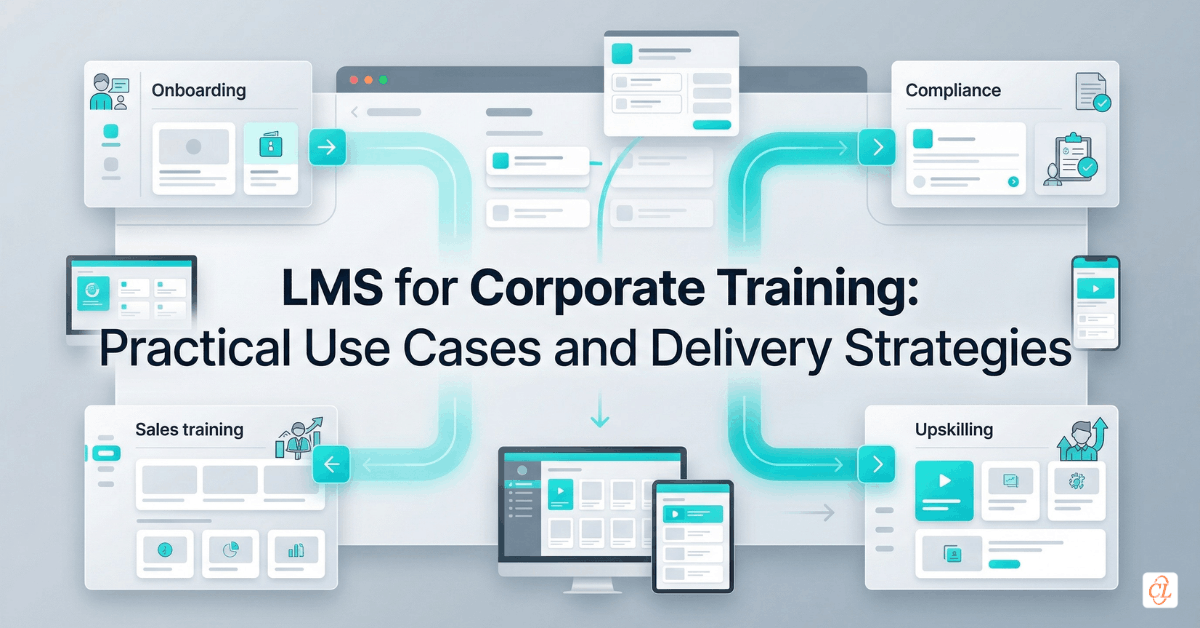
Core LMS Use Cases Across Corporate Training
At a practical level, the LMS serves as the backbone for multiple training initiatives across the organization.
It enables centralized training management, ensuring that programs are delivered consistently across teams, locations, and roles. This centralization reduces administrative complexity while improving visibility and control.
It also supports structured learning journeys, allowing organizations to design pathways that guide learners from foundational knowledge to advanced application. These pathways ensure that learning is progressive rather than fragmented.
In addition, the LMS provides the infrastructure for tracking, reporting, and continuous improvement, enabling organizations to refine their training strategies based on real data.
These core use cases establish the LMS as a foundational system for corporate training.
Compliance and Safety Training at Scale
Compliance and safety training represent some of the most critical use cases for LMS platforms.
These programs require consistency, accuracy, and accountability. They must be delivered to large audiences, often across multiple locations, while ensuring that all learners meet regulatory requirements.
The LMS enables organizations to standardize compliance training, automate assignments, and track completion in real time. This reduces risk and ensures that organizations remain audit-ready.
Beyond compliance, the LMS can also enhance the effectiveness of safety training by incorporating scenario-based learning, assessments, and reinforcement mechanisms. This ensures that learners not only complete training but also understand and apply it.
In this context, the LMS functions as both a delivery system and a risk management tool.
Sales Enablement and Performance-Focused Learning
Sales training represents a different type of challenge.
Unlike compliance training, which focuses on consistency, sales training must drive performance. It requires continuous learning, reinforcement, and alignment with evolving products, markets, and customer expectations.
The LMS supports this by enabling role-based learning paths, microlearning modules, and performance support resources. Sales teams can access training on demand, revisit key concepts, and stay updated on new offerings.
More importantly, the LMS allows organizations to align training with performance metrics, enabling a clearer understanding of how learning influences outcomes such as conversion rates, deal size, and customer engagement.
This transforms the LMS into a tool for revenue enablement rather than just knowledge delivery.
Blended Learning as the New Standard
Blended learning has emerged as a dominant approach in corporate training. It combines digital learning with instructor-led sessions, creating a more flexible and effective learning experience.
The LMS plays a critical role in orchestrating blended learning programs.
It provides a central platform where learners can access pre-work, participate in live sessions, and complete follow-up activities. This ensures continuity across different learning formats.
Blended learning also allows organizations to optimize resource usage by reducing reliance on physical training while maintaining the benefits of human interaction.
In this model, the LMS acts as the connective layer that brings different learning modalities together.

Learning Evolved: 25 Years of Insights for Modern L&D Leaders
Get ready to:
- Benchmark your eLearning journey
- Start with what’s working for top enterprise L&D teams
- Explore self-assessments, planners, and other tools
- Much More
Virtual Training and Digital Delivery Optimization
As organizations increasingly rely on virtual training, the LMS becomes essential for managing and optimizing digital delivery.
It enables scheduling, content distribution, and learner tracking within a single platform. More importantly, it allows organizations to enhance virtual training through interactive elements, assessments, and follow-up activities.
Effective virtual training requires more than delivering content online. It requires designing experiences that maintain engagement, encourage participation, and reinforce learning.
The LMS provides the tools needed to achieve this, ensuring that virtual training is not just accessible, but effective.
Video-Based Learning and Content Strategy
Video has become one of the most powerful formats for learning. It offers a flexible, engaging, and scalable way to deliver content, particularly for demonstrations, storytelling, and scenario-based learning.
The LMS supports video-based learning by enabling organizations to host, organize, and deliver video content efficiently. It also allows for integration with assessments, ensuring that learning is not passive.
When used strategically, video can enhance understanding, improve retention, and support just-in-time learning.
However, its effectiveness depends on how it is integrated into broader learning experiences rather than used in isolation.
Improving Completion, Engagement, and Retention
One of the most persistent challenges in corporate training is maintaining learner engagement.
Completion rates often decline when learning is perceived as irrelevant, repetitive, or disconnected from real work.
The LMS provides several mechanisms to address this challenge.
Structured learning paths create a sense of progression. Gamification elements introduce motivation and recognition. Microlearning enables learners to engage with content in manageable segments.
More importantly, relevance plays a critical role. When learning is aligned with job roles and performance expectations, learners are more likely to engage and complete training.
Improving engagement is not about adding more features. It is about designing learning experiences that resonate with learners.
The LMS as a Training Management System
Beyond learning delivery, the LMS serves as a comprehensive training management system.
It enables organizations to plan, execute, and monitor training programs at scale. This includes managing schedules, tracking participation, and generating reports.
For training managers, the LMS becomes a central hub that provides visibility into all learning activities. It allows them to identify gaps, monitor progress, and make informed decisions.
This administrative capability is essential for maintaining consistency and ensuring that training programs deliver expected outcomes.
Building a Use Case-Driven LMS Strategy
The most effective LMS strategies are built around use cases rather than features.
This means identifying the specific training needs of the organization and designing LMS usage accordingly.
For example, compliance training requires standardization and tracking, while sales training requires flexibility and reinforcement. Blended learning requires coordination, while virtual training requires engagement.
By aligning LMS capabilities with these use cases, organizations can ensure that the platform delivers meaningful value.
This approach transforms the LMS from a generic tool into a tailored solution.
FAQ
1. What are the main use cases of an LMS?
A. LMS platforms are used for compliance training, onboarding, sales enablement, blended learning, virtual training, and continuous learning programs.
2. How does an LMS improve training delivery?
A. An LMS centralizes training, enables scalable delivery, supports multiple formats, and provides tracking and analytics to improve effectiveness.
3. What is blended learning in an LMS?
A. Blended learning combines digital training with instructor-led sessions, using the LMS to coordinate and deliver different components.
4. How can LMS improve learner engagement?
A. By using microlearning, gamification, personalized learning paths, and relevant content aligned with job roles.
5. Why is video important in LMS-based training?
A. Video enhances engagement, simplifies complex topics, and supports flexible, on-demand learning.
6. How do you improve completion rates in LMS?
A. By designing relevant, engaging content, using structured learning paths, and aligning training with real-world performance needs.
Conclusion
The true power of an LMS is not in its ability to deliver training. It is in its ability to shape how learning happens. Organizations that focus only on distribution will see limited results. Those that design learning experiences around real use cases will unlock a far greater impact.
Because in the end, training is not about content. It is about capability. And the LMS, when used effectively, becomes the system that makes that capability possible at scale.