
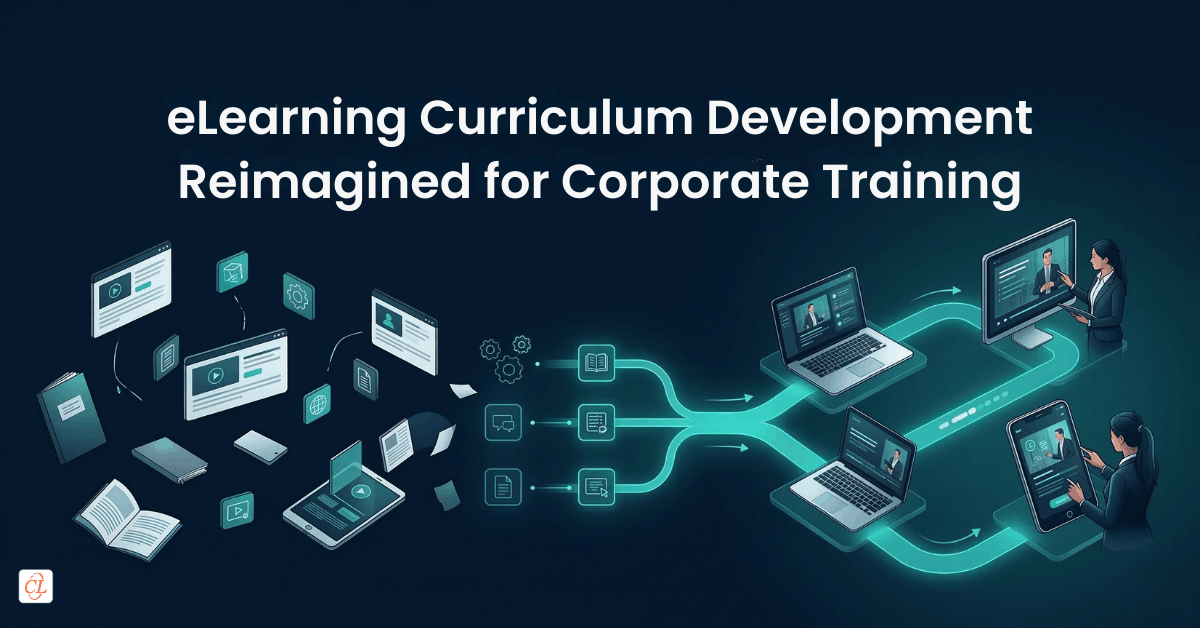
Many organizations do not struggle because they lack training content. They struggle because training exists in fragments.
One team has onboarding slides. Another has product manuals. Compliance owns PDFs. Sales has classroom decks. Operations has expert knowledge living inside workshops and trainer notes. The result is not a learning system. It is a collection of disconnected assets that are difficult to scale, update, and measure.
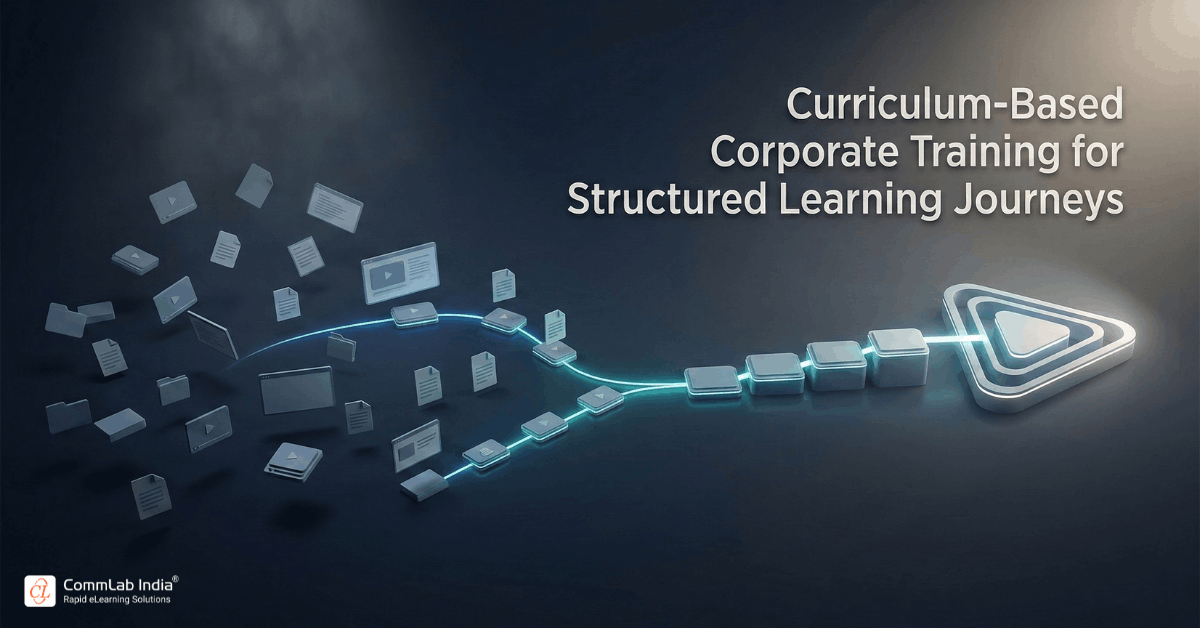
That is where eLearning curriculum development becomes strategically important. Instead of creating standalone courses one by one, organizations can design a structured sequence of interconnected modules aligned to business goals, learner roles, and performance outcomes.
An eLearning curriculum is not simply a larger course library. It is an intentional framework for turning scattered training into a coherent, repeatable learning experience.
In practical terms, an eLearning curriculum is a set of individual or interrelated modules that learners complete in sequence or as part of a larger whole. It can support standalone digital learning, blended delivery, or a phased transition from instructor-led training to online training.
This article explores how to design eLearning curricula that do more than organize content. It shows how to create learning pathways that are easier to build, faster to scale, and more consistent for learners and stakeholders alike.
Download Play Book: 25 Years of Insights for L&D Leaders
Table of Contents
- What eLearning curriculum development actually means
- Why organizations outgrow standalone courses
- The architecture of an effective eLearning curriculum
- A practical process for building the curriculum
- Turning ILT materials into a structured digital curriculum
- Why standardization is the force multiplier
- How to reduce time and cost without reducing quality
- Design principles that make curriculum-based eLearning work
- FAQ
What eLearning Curriculum Development Actually Means
eLearning curriculum development is the process of designing a structured set of learning modules around a defined business or capability goal. Unlike a standalone course, a curriculum connects topics, levels, assessments, and learning experiences into a progression that helps learners build competence over time.
A strong eLearning curriculum usually includes:
- a clear training need or business objective
- a defined learner audience
- sequenced modules or learning paths
- consistent instructional and visual patterns
- assessments and reinforcement mechanisms
- a decision about delivery, such as fully digital or blended
This distinction matters. A course teaches a topic. A curriculum builds capability.
That difference is especially important in corporate training, where employees often need more than one-time content consumption. They need a sequence that moves from awareness to application, and from application to performance.
Why Organizations Outgrow Standalone Courses
Standalone courses work well for isolated needs. A single compliance refresher, a quick product update, or a one-off systems tutorial can often succeed on its own.
But once training expands across roles, regions, product lines, or capability levels, disconnected courses start to create operational friction.
Organizations with a large volume of related training content often benefit from grouping modules into a single curriculum instead of building separate courses with separate logic each time.
Learners need progression, not just access
When training is split into unrelated assets, learners may not know what to take first, what comes next, or how one topic connects to another. A curriculum solves this by creating a pathway.
Teams need consistency, not creative reinvention every time
If each module is designed independently, tone, structure, assessments, and visuals start to drift. That leads to rework, stakeholder corrections, and a weaker learner experience.
The business needs scale
A curriculum makes it easier to onboard large audiences, support blended learning, reuse common patterns, and expand into multiple modules without redesigning from scratch each time.
The Architecture of an Effective eLearning Curriculum
Not every set of modules becomes a real curriculum. To function as a scalable learning system, the curriculum needs a deliberate architecture.
Business alignment comes first
The strongest starting point is training needs analysis. Curriculum creation should begin with organizational goals and employee skill gaps.
The first question should not be:
What content do we already have?
The real question is:
What change in performance are we trying to create?
Useful anchor questions include:
- What capability needs to improve?
- Which audience needs the training?
- What level of mastery is required?
- Which topics belong together in one pathway?
- What should learners do differently after completing it?
Scope defines the curriculum
Curriculum scope establishes what belongs in the learning pathway and how it will be delivered.
At this stage organizations decide:
- delivery model
- module grouping
- translation requirements
- learning priorities
A clear scope prevents the curriculum from becoming a dumping ground for unrelated content.
Sequencing should mirror skill development
A well-structured curriculum typically progresses through levels such as:
- foundational knowledge
- applied understanding
- advanced decision-making
This approach helps learners move logically from basic awareness to real-world application.
Modules must feel connected
A curriculum should not feel like unrelated mini-courses grouped together.
Cohesion typically comes from:
- shared learning objectives
- consistent navigation patterns
- common assessment logic
- repeated reinforcement mechanisms
A Practical Process for Building the Curriculum
Several development models point toward a practical framework for creating eLearning curricula.
Stage 1: Diagnose the training need
Begin with business goals, learner roles, and skill gaps. This ensures the curriculum is anchored in organizational relevance rather than simply repackaging existing content.
Stage 2: Define the curriculum blueprint
This is the architecture stage. Decide:
- curriculum purpose
- learner audience
- module sequence
- delivery model
- assessment approach
- success criteria
You are designing a learning pathway, not assembling slides.
Stage 3: Acquire and shape the content
Content sources often include:
- learner guides
- PowerPoint presentations
- trainer notes
- manuals and reference materials
Instructional designers review these materials to extract key knowledge and remove unnecessary details.
Subject matter experts may also provide clarification and real-world examples.
Stage 4: Build the instructional system
This stage determines how learning will happen.
Key decisions include:
- teaching patterns
- interaction design
- scenario-based learning
- assessment formats
- reinforcement strategies
Effective curricula often incorporate intellectual, emotional, and practical engagement.
Stage 5: Standardize before scaling
Before full production begins, development teams should finalize:
- screen templates
- interaction patterns
- media guidelines
- assessment rules
Standardization transforms the curriculum from a design effort into a scalable production system.

Learning Evolved: 25 Years of Insights for Modern L&D Leaders
Get ready to:
- Benchmark your eLearning journey
- Start with what’s working for top enterprise L&D teams
- Explore self-assessments, planners, and other tools
- Much More
Turning ILT Materials into A Structured Digital Curriculum
Many organizations already have instructor-led training materials. These assets often contain the foundation for a digital curriculum.
Typical source materials include:
- learner guides
- classroom decks
- handouts
- process explanations
- structured topic outlines
However, these materials rarely transfer directly to digital learning.
What usually transfers well
- structured explanations
- examples and case studies
- job procedures
- visual diagrams
What requires redesign
- lengthy lectures
- discussion-heavy classroom activities
- trainer explanations not captured in documentation
Instead of replicating the classroom experience screen by screen, teams should restructure content into modular digital learning units with interactive and scenario-based elements.
Why Standardization Is the Force Multiplier
Standardization is one of the most important principles in large-scale curriculum development.
It ensures that multiple teams can build modules quickly while maintaining consistency.
Standardization does not make learning dull.
It makes production repeatable and the learner experience coherent.
Instructional design standards
These define how learning happens across modules, including:
- screen structures
- interaction types
- content presentation patterns
Visual design standards
Visual consistency keeps modules connected through shared elements such as:
- fonts
- colors
- layouts
- graphical style
Media and assessment standards
Consistency in audio use, assessment instructions, feedback logic, and scoring systems helps learners navigate modules more easily.
Technical specifications
Technical standards ensure courses perform consistently across devices, browsers, and learning platforms.
How To Reduce Time and Cost Without Reducing Quality
Development efficiency does not come from rushing production. It comes from eliminating unnecessary decisions.
- Reuse common patterns: Common screens such as introductions, objectives, and summaries should follow repeatable templates.
- Approve a prototype early: A prototype helps stakeholders validate design patterns before full-scale development begins.
- Chunk content into modules: Breaking content into smaller modules improves flexibility and allows development teams to work in parallel.
- Build a development kit: Reusable interaction types, animation patterns, and template screens allow teams to accelerate development across multiple modules.
Design Principles That Make Curriculum-Based eLearning Work
A curriculum may be well organized but still ineffective if the learner experience is weak. Even the most carefully structured learning pathway can fail to deliver results if learners find the modules confusing, repetitive, or disconnected from their real work.
Effective curriculum-based eLearning focuses not only on structure but also on how learners experience and interact with the content.
Use consistent learning patterns
If modules include objectives, examples, and reinforcement activities, these elements should follow consistent formats. When learners recognize familiar patterns across modules, they can focus on understanding the content rather than figuring out how the course works.
Consistent learning patterns also help instructional designers build scalable curricula where new modules can be added without disrupting the learner experience.
Maintain consistency across modules
Consistency should apply to:
- Duration
- interaction density
- tone and style
- assessment structure
When modules vary drastically in length, difficulty, or presentation style, learners may feel disoriented. Maintaining consistency ensures the curriculum feels like a cohesive learning journey rather than a collection of unrelated courses.
Design for adult participation
Effective curricula encourage learners to actively engage with the content rather than passively consume information. Adult learners respond best when they are invited to:
- Analyze
- Reflect
- Make decisions
- Apply knowledge to real situations
Scenario-based questions, real-world examples, and problem-solving activities help learners connect training concepts with their day-to-day responsibilities.
Reinforce learning beyond the module
Learning should not end when a module is completed. Reinforcement tools help learners revisit key concepts and apply them on the job.
These may include:
- Job aids
- Glossaries
- Templates
- Further reading resources
Such resources support continuous learning and make it easier for employees to transfer knowledge from training into workplace performance.
FAQ
1. What is an eLearning curriculum in corporate training?
A. An eLearning curriculum is a structured sequence of learning modules designed to build a specific skill set or capability over time. It connects related courses into a unified learning pathway.
2. How is eLearning curriculum development different from building individual courses?
A. Individual courses address isolated training needs. Curriculum development connects multiple modules into a structured learning pathway aligned with broader performance goals.
3. How do you develop an eLearning curriculum?
A. The process typically includes training needs analysis, defining curriculum scope, gathering content, designing instructional strategies, and standardizing development elements.
4. How do you convert ILT material into an eLearning curriculum?
A. ILT materials are reviewed and reorganized into modular digital lessons. Key content is extracted, gaps are filled through SME input, and interactive elements replace lecture-style delivery.
5. Why is standardization important in curriculum-based eLearning?
A. Standardization ensures consistency in design, media, assessments, and technical performance. It also reduces development time and simplifies large-scale course production.
6. How can organizations reduce time and cost in eLearning curriculum development?
A. Organizations can reuse templates, approve prototypes early, modularize content, and establish reusable development kits.
7. What makes curriculum-based eLearning effective?
A. Effective curricula include logical sequencing, consistent design patterns, practical examples, and reinforcement tools that help learners apply knowledge on the job.
Conclusion
eLearning curriculum development becomes powerful when organizations stop thinking in terms of individual courses and start thinking in terms of learning systems.
A well-designed curriculum aligns training with business goals, structures content into meaningful learning pathways, and uses standardization to scale development efficiently.
The result is a training ecosystem that is easier to maintain, easier to expand, and far more effective at building real capabilities within the workforce.



![Changing the Paradigm from Classroom to eLearning [Infographic]](https://www.commlabindia.com/hubfs/Imported_Blog_Media/promoting-eLearning-featured-image.jpg)