Tired of creating eLearning courses that fail to engage your learners? Here’s your cue to design courses that are not only effective but also visually appealing! Continue reading as I reveal top eLearning design best practices for an impactful online training course.
Download eBook: eLearning 101 - A Beginner’s Guide
Table Of Content
- What Is eLearning and Why Does It Matter in Corporate Training?
- What are the Main Types of eLearning Design?
- What are the Top 10 eLearning Design Best Practices?
What Is eLearning and Why Does It Matter in Corporate Training?
eLearning refers to the design and delivery of structured learning experiences through digital platforms, enabling learners to access training anytime, anywhere. In corporate contexts, eLearning supports scalable, consistent, and measurable training aligned to business goals.
Key characteristics include:
- Digital-first delivery through LMS s or learning platforms
- Structured learning paths tied to skills or performance outcomes
- The ability to track progress, completion, and learning data
- Flexibility to support global, distributed workforces
Well-designed eLearning goes beyond content delivery—it enables faster upskilling, consistent knowledge transfer, and measurable impact.
Watch to Check Whether You’re Following These 5 eLearning Design Best Practices
What are the Main Types of eLearning Design?
eLearning design takes different forms based on what learners must be able to do after training, the level of practice required, and how learning fits into real work. Choosing the right design approach is a foundational best practice that directly affects learning impact.
Common eLearning design approaches include:
- Self-paced course design for structured, foundational, or compliance learning
- Scenario-based design for practicing judgment, decision-making, and behavioral skills
- Microlearning design for just-in-time support and performance reinforcement
- Video-led design for demonstrations, onboarding, and product understanding
- Simulation-based design for hands-on practice in technical or system-driven roles
- Assessment-driven design for validating knowledge, skill readiness, or certification
- Blended eLearning design combining digital modules with live or facilitated elements
- Adaptive eLearning design that adjusts content based on learner role or performance

- Mobile-first design for learning in short bursts across devices and environments
Each design approach serves a specific instructional purpose. Impactful eLearning follows a key design practice: selecting and combining approaches intentionally to support understanding, practice, reinforcement, and application—rather than relying on a single format throughout the course.
What are the Top 10 eLearning Design Best Practices?
The top 10 eLearning design best practices are a set of proven instructional and design principles that guide how digital learning experiences are structured, delivered, and reinforced to maximize learner engagement, comprehension, retention, and on-the-job application.
Their importance is growing as Deloitte’s research shows employees are spending nearly 50% more-time learning than the previous year, underscoring how continuous skill development has become central to modern corporate learning strategies.
What Should Every eLearning Course Get Right from the Start?
- A clear moment of use—when and why the learner will need this
- One primary outcome, not five competing objectives
- Decisions learners must make, not just information they must read
- What can be removed before deciding what to include
- The level of realism required (explain, show, simulate, or practice)
- Where learners are likely to struggle or drop off
- How success will be visible on the job, not just in the LMS
- What should be remembered a week later—not just at the end
- How the course fits into a larger learning journey
- What should stay flexible for future updates or changes
eLearning Design Best Practices for an Impactful Course
1. Set Performance-Based Learning Objectives
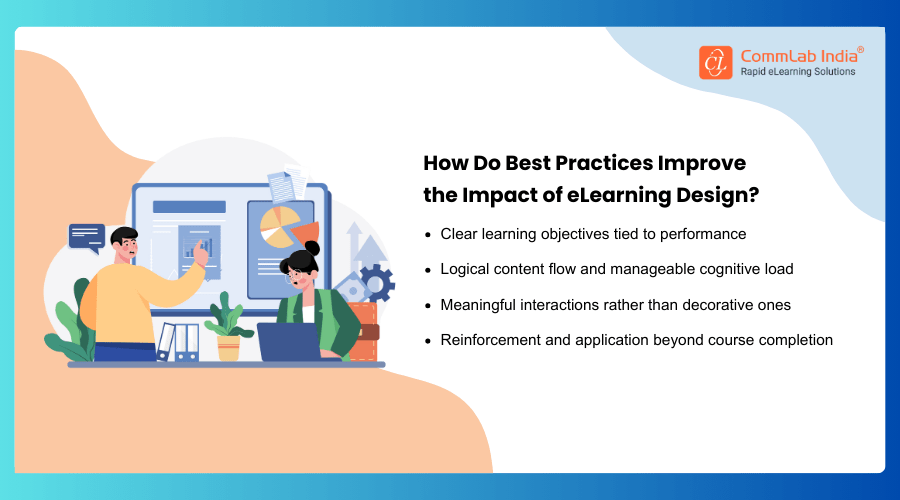
When it comes to eLearning design, one of the most important things you can do is to set performance-based learning objectives. This means that your objectives should be focused on what learners will be able to do after completing your course, not just on what they will learn.
2. Determine the Course Duration
How long should your eLearning course be? It depends on a variety of factors, such as the type of content, the objectives, and the learners. For instance, if you’re including a lot of audio or video content, you’ll need to factor in the time it will take learners to consume that content. At the same time, if you are planning to include interactive content such as simulations or quizzes, consider that your learners will need more time to complete those activities.
Similarly, you should consider the time based on what you want learners to achieve by the end of the course. How much new material will they be expected to learn? Based on your objectives, you can determine how much time learners will need to complete the course successfully.
Another important factor is to consider the attention spans, learning styles, and abilities of the learners. Based on these, you can opt for formats such as microlearning, etc.
3. Implement an Agile Project Management Process
Following an agile project management process will help you ensure that the eLearning design and development are as per the plan. Make sure that you have a project manager to take care of the project schedule, assign tasks to team members, and track progress. Once this is done, create a detailed project plan outlining the steps required to complete the eLearning course. Include the project milestones and deliverables so the entire team is on the same page. This practice also helps track the progress.
4. Create a Detailed Content Outline
Ensure that you have a detailed content outline and make sure that you start with a bang by including an engaging icebreaker. For instance, you could start by asking them to share experiences (revolving around the topic of training), or by including a quick quiz to get started.
Once the course starts, make sure that it is in line with the learning objectives, and add visuals to ensure that the eLearning course is easy to comprehend and engaging throughout. Another important point to make sure of is consistency. Make sure all the various elements are consistent with each other in terms of style, tone, and approach.
5. Choose the Appropriate Instructional Design Strategy
The next step is to choose the right instructional design strategy for your eLearning course. There are many different instructional strategies to choose from, so it’s important to select one that will best meet the needs of your learners.
There are certain considerations when choosing an ID strategy
6. Chunk Onscreen Content for Easy Comprehension
Make sure that the content is spread evenly on the screen – it has to be optimized to the screen size. Make sure that there is enough gap between the design elements. Avoid overdoing the content on the screen. Use headings and bullets to grab attention. Also, remember to optimize the text size.
7. Incorporate Interactivities for Active Learning
It is important to ensure that your learners are engaged throughout the course. For this, you should use interactive eLearning elements such as case studies, discussions, quizzes, and simulations. Such activities enhance learner engagement and retention of the training concepts.
8. Use Audio Effectively and Thoughtfully
Make sure that you use audio elements to accentuate the learning experience. Make sure that the audio is placed strategically for storytelling, explanations, or for providing additional context. Don’t just use it to read content that’s already on the screen.
Additionally, it is important to make sure that the audio is clear and of high quality, and free from distractions or technical issues.
9. Include Formative and Summative Assessments
Make sure that your course has formative assessments, such as quizzes or mini assignments, during the course. This helps with self-assessment. At the same time, including summative assessments such as final exams or projects, helps evaluate overall performance.
10. Utilize Authoring Tools for Efficient Designing
There are several eLearning authoring tools that help create engaging and immersive eLearning courses. These tools are easy to use, come with several features to add interactivity, and help streamline the design process. Make sure you choose tools that align with your ID needs.
Conclusion
Effective eLearning design isn’t about chasing trends—it’s about understanding the fundamentals and applying them thoughtfully to create meaningful learning experiences. When organizations clearly grasp what eLearning is, how it works, and why it matters, they’re better equipped to design training that is accessible, scalable, and aligned with real business needs.
To help teams build this foundational understanding, our eBook is available that serves as a practical introduction to the world of eLearning. It explains what eLearning is, outlines its advantages, explores its impact on businesses, and walks through how eLearning courses are designed, developed, deployed, and evaluated for effectiveness.
Download The Free eBook Now