A single mistranslated compliance module can cost more than a redo. It can trigger a safety incident, a failed audit, or a disengaged workforce in a market you spent years building.
For enterprise L&D leaders scaling training across regions, eLearning translation services are no longer a back-office task handed off to whoever has a language degree on their resume. They are a core part of how global companies protect quality, consistency, and compliance at scale.
Research backs this up. CSA Research's long-running "Can't Read, Won't Buy" study found that 76% of consumers prefer to buy products with information in their native language, and 40% will never buy from a website in another language at all. Employees are not so different from customers here. If they cannot trust the language, they will not trust the content, and the training fails before it starts.
At the same time, the stakes for getting this right have never been higher. The World Economic Forum's Future of Jobs Report 2025 estimates that 59% of the global workforce will need some form of reskilling by 2030, and 85% of employers plan to prioritize reskilling through the same period. That is a lot of content moving across a lot of languages, fast. Enterprises that get corporate localization right will move faster and retain more of what they teach. Those that do not will spend years fixing avoidable mistakes.
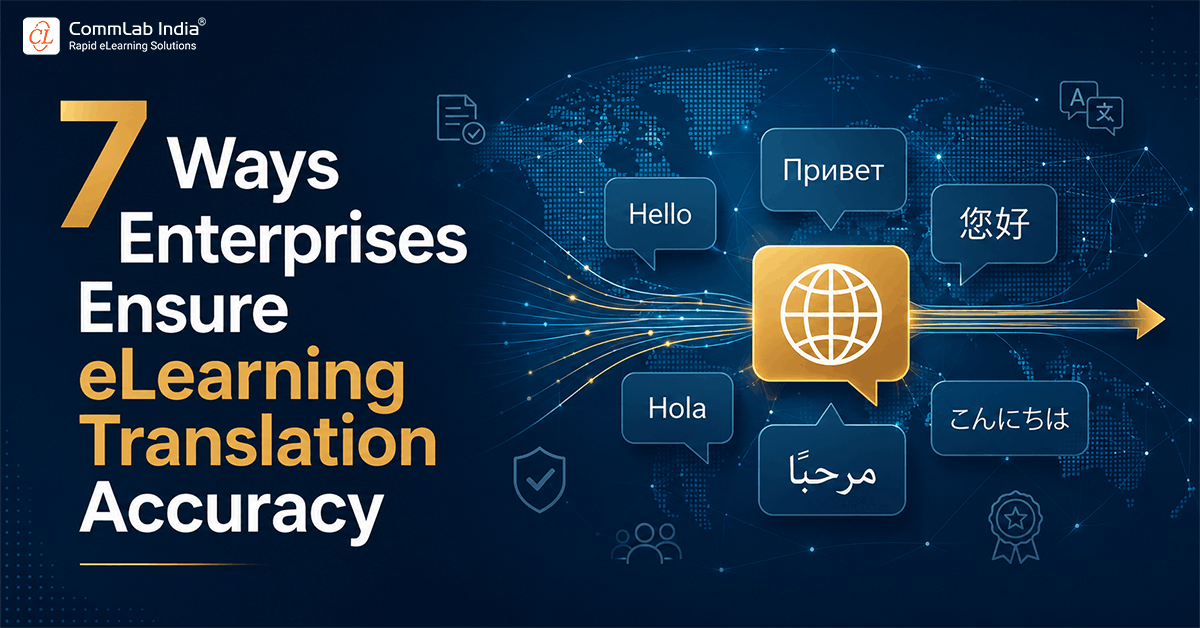
This guide breaks down seven practical ways enterprise L&D teams protect translation accuracy across multilingual training programs, with real criteria you can use to evaluate your own vendors, workflows, and content.
Table Of Content
- 1. Start With a Locale-Ready Source Course, Not a Finished One
- 2. Build a Terminology Glossary and Style Guide Before Translation Begins
- 3. Use Human Linguists for Anything Regulatory, Technical, or Brand-Critical
- 4. Involve In-Country Subject Matter Experts, Not Just Translators
- 5. Test Translated Courses With Real Learners Before Full Rollout
- 6. Establish a Structured Quality Assurance Workflow
- 7. Choose Vendors and Tools Built for Enterprise-Scale Localization
- Common Challenges in eLearning Translation Accuracy
- Accuracy Is a Process, Not a Final Check
- FAQs
1. Start With a Locale-Ready Source Course, Not a Finished One
The biggest accuracy problems in eLearning content localization rarely start with the translator. They start with the source course.
If your English-language course is full of idioms, culture-specific humor, or on-screen text baked into images, every language version inherits that problem. Translators either guess at the intended meaning or flag it back to you, which slows everything down.
What good looks like
- Source content is written in clear, literal, culturally neutral language before it goes anywhere near a translator.
- Text lives in editable layers (not burned into video or images), so it can be swapped without redesigning the course.
- Idioms, humor, and region-specific references are replaced with plain, universally understood phrasing.
Leading L&D teams treat this step as "internationalization," a discipline distinct from translation itself. Skipping it is one of the most common and most expensive mistakes enterprises make.
2. Build a Terminology Glossary and Style Guide Before Translation Begins
Consistency is where most multilingual training programs quietly fall apart. One translator renders "manager" as one word, another uses a synonym, and by the tenth module your leadership hierarchy reads differently depending on which language a learner selects.
A locked terminology glossary and style guide solves this before it becomes a problem.
What to include
- Approved translations for job titles, product names, internal tools, and compliance terms
- Tone guidance (formal vs. conversational, by region)
- A list of terms that should never be translated, such as trademarked product names
- Formatting rules for dates, currency, and units of measurement
Glossaries also compound in value. Every new course you localize gets faster and more consistent because the groundwork already exists.
3. Use Human Linguists for Anything Regulatory, Technical, or Brand-Critical
Machine translation has improved dramatically, and it has a real role in first-pass drafts or low-risk content. But for eLearning translation services that touch compliance, safety, or your brand voice, human expertise is not optional.
A Deloitte analysis found that companies investing in high-quality localization achieve 1.5 times faster revenue growth in international markets than those that treat it as an afterthought. The same logic applies internally. Poorly localized safety training does not just read badly, it creates real operational and legal risk.
Where to draw the line
| Content type | Recommended approach |
| Internal FAQs, low-stakes reference material | Machine translation with light human review |
| Product training, sales enablement | Human translation with subject-matter review |
| Compliance, safety, legal, HR policy | Human translation plus certified or legal review |
The rule of thumb: the higher the cost of being wrong, the more human oversight the content needs.
4. Involve In-Country Subject Matter Experts, Not Just Translators
A translator can be fluent and still miss the mark if they do not understand your industry or the regulatory environment in the target market. This is where many corporate localization programs go wrong: they treat translation as a language problem when it is really a subject-matter problem.
Practical steps
- Pair every translator with an in-country reviewer who works in or near the relevant function (safety, HR, finance, sales)
- Ask reviewers to flag not just language errors but factual or regulatory mismatches
- Build a standing panel of regional reviewers for recurring content, rather than sourcing one-off reviewers each time
This step catches the errors that spellcheck and even skilled linguists miss: a labor law reference that does not apply locally, a safety procedure that conflicts with local regulation, or a benefits explanation that does not match the local plan.
5. Test Translated Courses With Real Learners Before Full Rollout
Even a technically correct translation can fail if it does not land the way it is meant to. Pilot testing with a small group of native-speaking employees, before a global rollout, is one of the most underused quality checks in global workforce training.
What to test for
- Comprehension: can learners explain the material back in their own words?
- Cultural fit: does anything feel awkward, confusing, or out of step with local norms?
- Technical function: do audio, captions, and interactive elements sync correctly in every language?
- Completion friction: are learners dropping off at the same point across languages, or only in some?
This is also where tracking completion and assessment scores by language earns its keep. If one language group consistently underperforms, that is usually a translation or cultural fit issue, not a training design issue.
6. Establish a Structured Quality Assurance Workflow
Translation accuracy is not a single checkpoint, it is a workflow. Enterprises that consistently get this right use a layered QA process rather than a single review pass.
A typical enterprise QA workflow
- Initial translation by a qualified linguist with subject-matter familiarity
- Editing pass by a second linguist, checking against the glossary and style guide
- In-country SME review for factual and regulatory accuracy
- Linguistic QA for grammar, tone, and formatting consistency
- Functional QA inside the actual LMS or authoring tool, checking that text fits, audio syncs, and navigation works in every language
- Sign-off from a designated regional or L&D stakeholder before publishing
Skipping any one of these steps is usually where accuracy problems slip through. The functional QA step in particular gets overlooked often. Text that translates correctly can still overflow a button, get cut off in a caption, or break a layout, especially in languages with longer word counts or different reading directions.
7. Choose Vendors and Tools Built for Enterprise-Scale Localization
Not every translation provider is built for the volume, compliance requirements, and turnaround times enterprise L&D teams need. Choosing the right partner is as much a part of accuracy as the linguistic work itself.
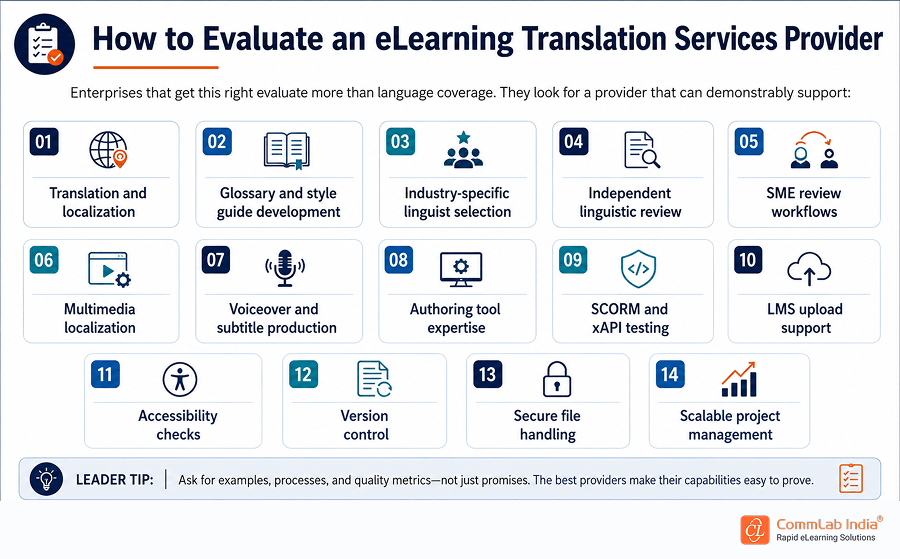
What to evaluate in a vendor or platform
- Subject-matter specialization, not just general translation capacity
- Translation memory and glossary integration, so terminology stays consistent across projects and over time
- LMS and authoring tool compatibility, to avoid manual reformatting after translation
- Quality certifications, such as ISO 17100 for translation services
- Scalability, meaning the vendor can handle a 40-language rollout as reliably as a 4-language pilot
- Data security practices, especially for content involving proprietary processes or regulated information
Given that the global corporate e-learning segment is projected to reach $457.8 billion by 2026, the vendor landscape is only getting more crowded. A structured evaluation process protects you from choosing on price alone and paying for it later in rework.
Common Challenges in eLearning Translation Accuracy
Even mature L&D functions run into recurring obstacles:
- Version drift. Source content updates but translated versions lag behind, creating inconsistent training across regions.
- Over-reliance on machine translation for content that actually carries legal or safety weight.
- No feedback loop from learners back to the localization team, so the same errors repeat across courses.
- Underestimating text expansion. Some languages take up to 30% more space than English, which can break layouts if design was not built to flex.
- Treating localization as a one-time project instead of an ongoing operational process tied to content updates.
Best Practices at a Glance
- Internationalize source content before translating it
- Lock a glossary and style guide before work begins
- Match content risk level to the right mix of human and machine translation
- Involve in-country subject-matter reviewers, not just linguists
- Pilot test with real learners before full rollout
- Run a multi-step QA workflow, including functional testing inside the LMS
- Choose vendors and tools built for enterprise scale and compliance
Accuracy Is a Process, Not a Final Check
Enterprises that treat eLearning translation services as a strategic function, not an afterthought, see the difference in completion rates, compliance outcomes, and how much their global workforce actually trusts the training they receive. The seven practices above are not a one-time checklist. They are an operating model that gets faster and more reliable every time you apply it. Start with the source content, protect it with process, and measure it against real learner outcomes across every language you support.
Frequently Asked Questions
1. How can enterprises improve translation accuracy in multilingual training?
A. Enterprises can improve translation accuracy by preparing translation-ready source content, creating glossaries and style guides, using qualified linguists, adding independent review, involving subject matter experts, testing multimedia, and running LMS quality assurance before launch.
2. How do enterprises measure eLearning translation accuracy?
A. Most enterprises combine linguistic QA (grammar, tone, terminology consistency), in-country subject-matter review for factual accuracy, and learner-level metrics like completion rates and assessment scores broken out by language. A drop-off or comprehension gap in one language often signals a translation issue rather than a content design issue.
3. What is the difference between eLearning translation and eLearning localization?
A. Translation converts text from one language to another. Localization goes further, adapting examples, imagery, currency, legal references, and cultural context so the course feels native to each market rather than simply translated into it.
4. Should enterprises use machine translation for corporate training content?
A. Machine translation works well for low-stakes, high-volume content like internal FAQs or reference material, especially with a light human review pass. For compliance, safety, or brand-critical training, human translation with subject-matter review remains the safer standard, given the operational and legal risk of getting it wrong.