
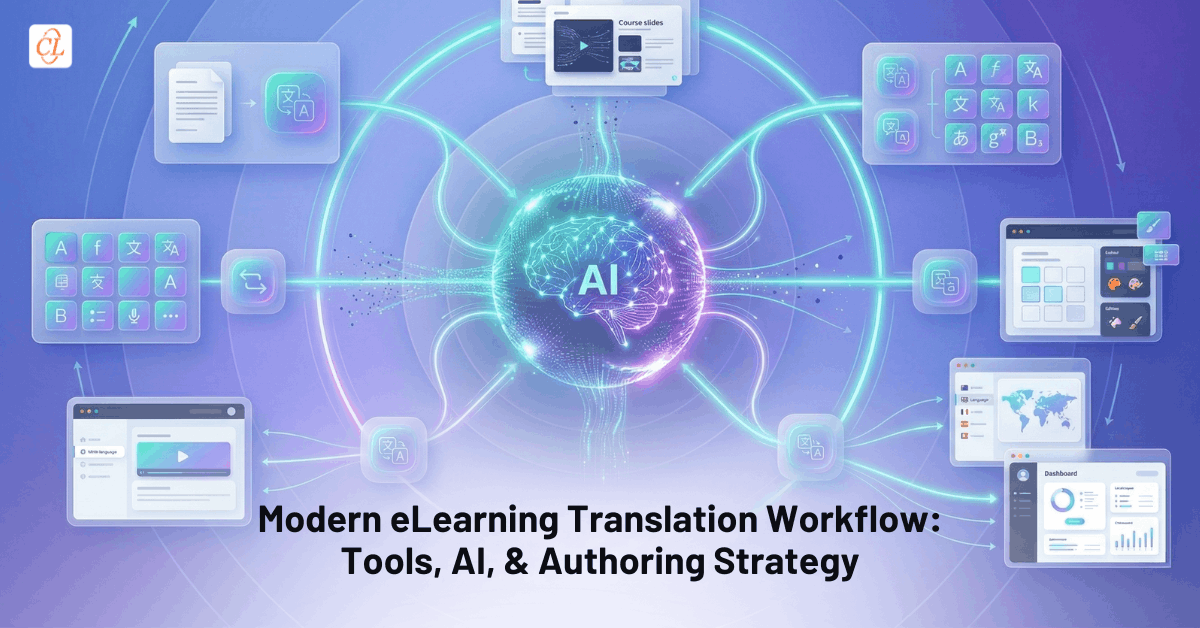
As multilingual learning becomes central to workforce enablement, the pressure on learning teams has changed. The challenge is no longer just how to translate a course into another language. The challenge is how to do it faster, more efficiently, and at scale without compromising learner experience, instructional quality, or operational control.
That shift is why tools now play such a critical role in the future of multilingual learning.
For years, eLearning translation was handled through heavily manual workflows: extracting text, managing spreadsheets, coordinating translators, rebuilding screens, reviewing voiceover, and republishing each version one by one. That approach still exists, but it is increasingly difficult to sustain when organizations are translating training across multiple regions, product lines, compliance areas, and business units.
This is where eLearning translation tools, AI-assisted workflows, and authoring-platform-based localization methods are reshaping how teams work.
But tools alone do not solve the problem.
A machine translation engine can accelerate output, yet still introduce risk if used without review. An authoring tool can simplify export and import, but still create bottlenecks if the course was not built properly for translation. AI can reduce turnaround time dramatically, but only when used inside a workflow that still protects meaning, context, and learner usability.
That is why the real question is not simply: What tool should we use?
The better question is: What translation workflow gives us the best balance of speed, quality, scalability, and control?
This article explores that question in depth, covering how modern organizations should think about AI in eLearning translation, machine and neural translation, tool-based localization models, and workflow design for multilingual publishing.
Table of Contents
- Why eLearning translation workflows are changing
- What eLearning translation tools actually need to do
- AI in eLearning translation: where it adds value and where it still needs oversight
- Machine translation, neural translation, and human review: what works best
- The role of spreadsheets, export files, and structured translation workflows
- Hosting, publishing, and multilingual delivery challenges
- How to choose the right tool stack for multilingual learning
- FAQ
Why eLearning Translation Workflows Are Changing
Multilingual learning has moved from a niche requirement to a strategic operating need for global organizations. As training portfolios expand, so does the volume of content that needs to be translated and localized across languages, regions, and business functions.
That increase in demand is exactly why traditional workflows are no longer enough.
In many organizations, translation is still handled as a fragmented sequence of manual tasks. Text is pulled from a course, placed into spreadsheets, sent to language teams, reviewed in multiple rounds, reinserted into the course, tested, and then published into separate language versions. While this process can work, it becomes increasingly difficult to manage when scale, speed, and consistency all matter at once.
This is what has driven the rise of:
- AI-assisted translation workflows
- machine translation and neural engines
- authoring-tool translation features
- more structured localization workflows
- multilingual publishing models
These shifts are not just about efficiency. They are responses to a deeper operational reality:
Learning teams now need multilingual workflows that are repeatable, scalable, and easier to maintain over time.
That is why the future of translation is not about replacing humans with tools. It is about designing a workflow where the right tools reduce manual effort while humans continue to protect instructional quality and learner relevance.
What eLearning Translation Tools Actually Need to Do
One of the biggest misconceptions in this space is that translation tools are primarily language tools. In reality, good eLearning translation tools need to support much more than translation alone.
A tool is only useful if it helps the team manage the full workflow around multilingual course creation.
That means the best tools should help teams do at least four things well:
1. Extract and manage translatable content efficiently
The workflow should make it easy to identify, export, and organize learner-facing text without losing context.
2. Support accurate and scalable language adaptation
This includes terminology consistency, reuse of approved phrases, and support for multiple languages over time.
3. Reduce rebuilding effort inside the course
The more smoothly translated content can be reinserted into the authoring environment, the faster and cleaner the process becomes.
4. Make multilingual publishing and maintenance easier
Translation is not done once. Courses evolve. Tools should make future updates easier, not more chaotic.
What Good Translation Tools Should Support
| Capability | Why It Matters | What to Look For |
| Content extraction | Reduces manual effort and missed text | Export/import workflows, editable content support |
| Language consistency | Improves quality across modules | Glossary support, reuse, structured review |
| Course rebuild efficiency | Saves production time | Smooth reimport, layout support, multilingual formatting |
| Scalability | Helps teams grow translation volume | Multi-language support, repeatable workflows |
| Publishing readiness | Supports deployment and maintenance | Language version management, LMS compatibility |
The best translation tools are not just fast. They reduce friction across the entire multilingual production lifecycle.
AI in eLearning Translation: Where It Adds Value and Where It Still Needs Oversight
AI has changed the conversation around translation more dramatically than any other recent development. What once required long timelines and heavy manual effort can now be accelerated significantly with AI eLearning translation workflows.
That said, AI is not a magic layer that can be applied without judgment.
Its real value lies in how it is used.
Where AI adds meaningful value
It speeds up first-pass translation
AI can generate usable draft translations much faster than traditional manual-only methods, especially for high-volume training content.
It improves throughput for repeatable content
Compliance modules, systems training, product overviews, and other structured learning content often benefit from AI-assisted translation because much of the language is predictable and reusable.
It helps teams move faster across multiple languages
When used well, AI can reduce initial turnaround time and support faster localization across regional rollout plans.
It can assist with terminology suggestions and adaptation
In some workflows, AI can also help surface patterns, maintain phrase consistency, and accelerate revision work.
Where AI still needs human oversight
Even strong AI output can create problems if used without structured review.
Human oversight is still essential for:
- instructional nuance
AI may preserve the sentence but miss the learning intent. - cultural appropriateness
A phrase may be correct linguistically but still feel unnatural or misaligned. - tone and learner experience
AI-generated text can sound technically correct yet emotionally flat or overly literal. - technical and branded terminology
Accuracy still matters deeply in product, compliance, and systems training.
AI is best used to accelerate translation, not replace localization judgment.
That is the mindset strong teams should adopt.
Machine Translation, Neural Translation, and Human Review: What Works Best
As organizations explore automation, one of the most common questions is whether machine translation for eLearning is now “good enough.”
The answer depends on what “good enough” means and what kind of training is being translated.
Traditional machine translation vs neural machine translation
Older machine translation systems often produced rigid, literal output that required heavy cleanup. Newer neural machine translation models are much more context-aware and generally produce smoother, more natural language.
That is a meaningful improvement.
But even with better output quality, machine translation still works best when it is part of a larger human-in-the-loop workflow.
The strongest model is usually hybrid
For most organizations, the most effective approach is not:
- all human translation
- or all machine translation
It is a hybrid model where:
- AI or machine translation accelerates the draft stage
- human reviewers refine meaning and terminology
- localization specialists protect learner experience
- QA teams validate usability and final quality
That is what makes the workflow both fast and trustworthy.
Translation Method Comparison
| Method | Strengths | Limitations | Best Use Case |
| Human-only translation | High nuance and contextual accuracy | Slower and more resource-intensive | High-stakes, complex, learner-sensitive content |
| Machine translation | Fast and cost-efficient | Can be literal or inconsistent without review | Drafting or low-complexity content |
| Neural machine translation | Better fluency and contextual quality | Still requires human validation | Scalable multilingual workflows |
| Hybrid AI + human workflow | Best balance of speed and quality | Requires process discipline | Most corporate training environments |
For most learning teams, the goal should not be choosing between AI and humans. It should be building the right workflow between them.
The Role of Spreadsheets, Export Files, and Structured Translation Workflows
Despite the rise of AI and newer localization tools, one of the most common realities in multilingual course production is still this:
A lot of translation work still happens through structured spreadsheets and export files.
And that is not necessarily a bad thing.
When managed properly, spreadsheet-based workflows remain useful because they offer visibility, control, and consistency, especially when teams need to coordinate language review across multiple stakeholders.
Why Excel-style workflows still matter
Structured translation sheets help teams:
- separate source text from production files
- provide context for translators
- collect reviewer feedback efficiently
- maintain version control across languages
- support reusability for future updates
The problem is not the spreadsheet itself. The problem is when spreadsheets are used without enough structure.
What a strong translation file should include
A useful translation file should go beyond source text and include:
- screen or slide reference
- source copy
- translated copy
- terminology notes
- character or space considerations
- review comments
- approval status
This helps reduce ambiguity and improves handoff quality across translators, reviewers, and developers.
Where AI and spreadsheets can work together
In modern workflows, AI does not replace structured files. It often works inside them.
For example, teams may use AI to generate draft translations, then route those drafts through structured review sheets for validation and refinement.
That is often far more practical than assuming all translation can happen directly inside the authoring tool.
Hosting, Publishing, and Multilingual Delivery Challenges
Translation workflows do not end when the language is approved or the course is rebuilt. One of the most overlooked areas in multilingual learning is how translated courses are hosted, organized, and delivered.
This becomes especially important when organizations are managing:
- many languages
- frequent course updates
- multiple learner groups
- centralized LMS environments
If the publishing and hosting model is weak, even well-localized courses can become difficult to maintain.
Common multilingual delivery challenges
Version sprawl
As language versions increase, teams often struggle to keep track of which version is current and which one is outdated.
Fragmented learner access
If learners have to navigate poorly organized language options or inconsistent launch paths, the experience becomes confusing quickly.
Maintenance inefficiency
Each course update becomes more expensive and time-consuming if language versions are managed separately without a reusable structure.
Why delivery architecture matters
Some organizations solve this through cleaner multilingual wrappers, structured publishing logic, or centralized access layers that help learners launch the right language version more intuitively.
The exact method may vary, but the principle is consistent:
Translation workflows should be designed with delivery and maintenance in mind, not just content conversion.
That is what makes the operation sustainable.
How to Choose the Right Tool Stack for Multilingual Learning
There is no single “best” tool for every organization. The right workflow depends on what kind of content you are translating, how often you need to update it, how many languages you support, and how much internal control you need.
That is why the smarter decision is not choosing one tool. It is designing the right tool stack.
A strong multilingual tool stack usually includes some combination of:
- Authoring platform support
For export/import, content editing, and rebuild workflows - AI or machine translation layer
For draft acceleration and faster throughput - Structured review workflow
For terminology validation, stakeholder review, and quality control - Multimedia adaptation support
For narration, subtitles, and visual localization - Publishing and version management approach
For scalable deployment and updates
Questions to ask before choosing tools
- Do we need speed, control, or both?
- How many languages are we managing?
- How often will the course be updated?
- Is our content highly technical or relatively standard?
- Are we optimizing for first-time translation or long-term multilingual maintenance?
The right answers to those questions will shape the right workflow more effectively than any generic tool list ever could.
FAQs
1. What are the best eLearning translation tools?
A. The best eLearning translation tools are those that support content extraction, language consistency, rebuild efficiency, and multilingual publishing. The right choice depends on your authoring environment, language volume, and workflow complexity.
2. How can AI be used in eLearning translation?
A. AI can accelerate draft translation, improve throughput, and support terminology consistency. It works best when paired with human review to protect instructional quality and learner relevance.
3. How do you translate courses in Articulate Storyline?
A. Storyline translation typically involves exporting learner-facing text, translating it externally, and then reimporting it into the course. The workflow works best when the course is built with editable content and translation readiness in mind.
4. Is machine translation good enough for eLearning?
A. Machine translation can be useful for speed, especially for structured or repeatable content, but it usually needs human review to ensure quality, context, and learner fit.
5. What is the best workflow for multilingual eLearning translation?
A. The strongest workflow combines translation-ready course design, structured export methods, AI-assisted draft generation, human quality review, and scalable multilingual publishing.
6. Can AI replace human translators in eLearning?
A. AI can reduce manual effort significantly, but it should not replace human oversight entirely. Human review remains essential for context, nuance, terminology, and learner experience.
Conclusion
As multilingual learning becomes more central to business performance, the translation workflow itself has become a strategic design decision.
That is why choosing the right eLearning translation tools is no longer just about software features or automation speed. It is about creating a workflow that helps learning teams move faster without losing clarity, quality, or learner trust.
The most effective organizations will not be the ones that simply adopt AI first or use the newest authoring features. They will be the ones that build smarter systems, where:
- the right tools reduce manual effort,
- AI accelerates the right stages,
- humans protect meaning and instructional integrity,
- and multilingual delivery becomes easier to sustain over time.
That is the future of translation in learning.
Not just faster output. But better workflow design.


![Why Should You Explore Generative AI for L&D? [ANSWERED]](https://www.commlabindia.com/hubfs/blogs/generative-ai-why-l%26d-teams.jpg)