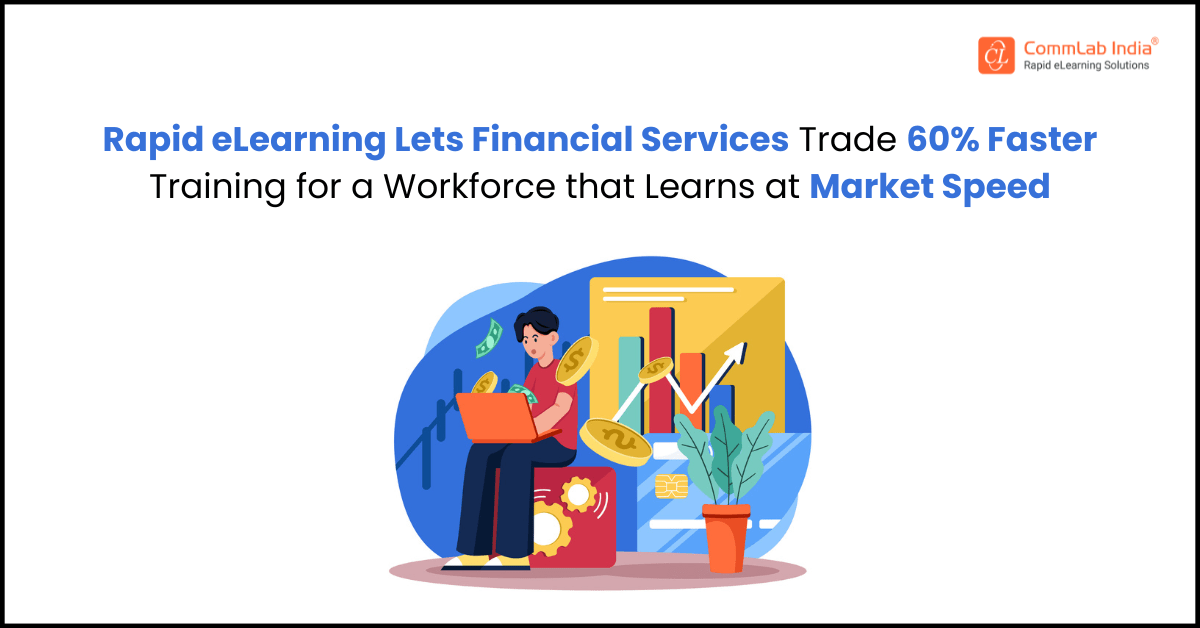
The financial services sector is highly dynamic, characterized by continuous regulatory changes, shifting market dynamics, and the need for employees to acquire new skills and knowledge. In such an environment, keeping the workforce up to date is crucial for staying competitive, compliant, and maintaining a high level of customer trust. This blog aims to explore how the financial services industry can harness the power of rapid eLearning solutions to address its unique challenges. It will delve into the specific needs of this sector, the benefits of adopting rapid eLearning, and practical steps for implementation.
Download Now: The 4Rs of Rapid eLearning
Table Of Content
- What are Rapid eLearning Solutions?
- What is the Need for Rapid eLearning in Financial Services?
- What are the Benefits of Rapid eLearning Solutions for Financial Services?
- Implementing Rapid eLearning in Financial Services
- What Are the Future Trends in Rapid eLearning for Financial Services?
What are Rapid eLearning Solutions?
Rapid eLearning solutions are streamlined, tech-enabled training development methods that use modern authoring tools and templates to create eLearning courses quickly—without compromising instructional quality.
They help organizations scale training fast, cost-effectively, and consistent quality across teams.
Key Characteristics of Rapid eLearning Solutions
- Faster turnaround using templates, reusable assets, and automation.
- Cost-effective development compared to traditional custom eLearning
- Instructionally sound—built using robust ID models like ADDIE and SAM.
- Easy updates to keep compliance, product, and process training current.
- Scalable for enterprise-wide rollouts across departments and regions.
- Multi-format compatible—supports microlearning, videos, VILT, and more.
- Authoring-tool driven using tools like Articulate Storyline, Rise, Adobe Captivate, and Lectora.
- AI-enabled workflows for faster scripting, visual design, and translations.
- Mobile and responsive for anytime, anywhere learner access.
What is the Need for Rapid eLearning in Financial Services?
The financial services industry needs rapid eLearning to keep pace with constant regulatory changes, new product launches, evolving compliance requirements, and fast-moving market conditions. Rapid eLearning enables banks, insurers, and financial institutions to deliver timely, accurate, and scalable training—without long development cycles or high costs.
Why It’s Essential
1. Rapid Changes in the Financial Industry
The financial industry experiences rapid changes in market trends, economic conditions, and customer preferences. To remain competitive, financial institutions must ensure that their workforce is constantly informed about these shifts. Government regulations and compliance requirements in the financial sector frequently evolve. Financial organizations need to adapt to these changes quickly to avoid legal and financial repercussions.
2. Employee Training Challenges
Financial institutions are subject to numerous regulations, and employees must undergo regular compliance training to ensure adherence. Rapid eLearning can streamline this process, making it easier to update and track compliance training. In addition to compliance, financial professionals need ongoing training to develop skills relevant to their roles. Rapid eLearning can provide flexible and targeted solutions for skill enhancement.
3. Traditional Learning vs. Rapid eLearning
Traditional learning approaches in the financial sector are often slow, expensive, and rigid. Traditional methods may involve in-person seminars or lengthy development cycles for eLearning modules. Rapid eLearning offers a cost-effective and agile alternative, allowing organizations to respond quickly to emerging needs and ensure that employees receive up-to-date training efficiently. Watch this short video to understand why you should invest in rapid eLearning.
What are the Benefits of Rapid eLearning Solutions for Financial Services?
Rapid eLearning solutions enable financial institutions to keep pace with frequent regulatory updates and deliver compliance-ready training quickly and accurately. They help reduce training costs, speed up product knowledge rollouts, and ensure consistent learning across geographically dispersed teams.
This growing reliance on speed and scalability is reflected at the industry level as well—on the market side, the 2025 Corporate E-learning Global Market Report classifies “rapid eLearning” as a distinct technology category (alongside LMS, mobile, and virtual classrooms), signaling that major vendors now view rapid eLearning as a mainstream, high-growth segment.
A. Speed and Agility
Rapid eLearning enables organizations to create training modules and materials in a fraction of the time it takes using traditional methods. This agility is essential when addressing urgent training needs. When financial regulations or market conditions change, rapid eLearning makes it easy to update training materials swiftly and distribute these updates to the workforce, ensuring everyone is on the same page.
B. Improved Learning Outcomes
Rapid eLearning solutions support the creation of engaging, interactive, and multimedia-rich training materials. This not only enhances learner engagement but also improves knowledge retention. With rapid eLearning, financial institutions can tailor training to individual employee needs, ensuring that everyone receives the most relevant and effective instruction. This personalization boosts learning outcomes and overall job performance.
C. Cost Efficiency and Better Resource Utilization
Rapid eLearning significantly reduces development costs by using pre-built templates, reusable assets, and streamlined workflows. For financial institutions that frequently update compliance and product training, this approach minimizes recurring expenses and frees up internal teams to focus on strategic tasks rather than time-consuming content creation.
D. Consistency and Compliance Assurance
In financial services, accuracy and consistency are non-negotiable. Rapid eLearning ensures uniform training delivery across all branches, departments, and regions, reducing the risk of compliance gaps. With centralized content updates and automated distribution, institutions can maintain audit-ready records and prove adherence to regulatory requirements instantly.
Implementing Rapid eLearning in Financial Services
Which Rapid eLearning Tools Should You Use for Different Types of Financial Training?
Here are the must-have tools to accelerate financial training development
- Compliance & SOP training → Rise 360
- Decision-based training → Articulate Storyline
- Finance system simulations → Adobe Captivate
- Engaging animated videos → Vyond
- Fast AI-generated videos → Synthesia
- PPT-to-course conversions → iSpring Suite
- Software walkthroughs → Camtasia
- Quick job aids → Snagit
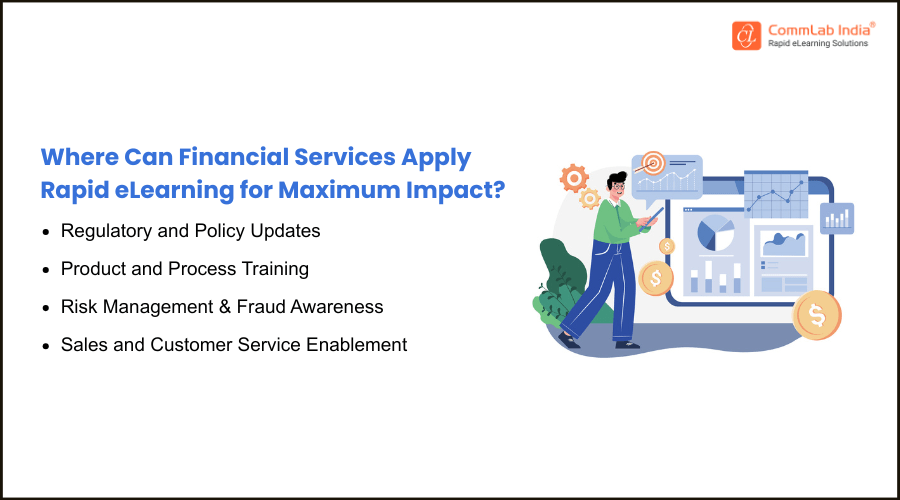
Implementing rapid eLearning in financial services means using agile tools and workflows to quickly create, update, and deliver training. It ensures compliance-ready content is produced fast and stays aligned with changing regulations. This approach helps institutions scale training efficiently across teams and locations.
1. Identify Training Needs
- Compliance: Compliance training is a critical aspect of financial services, and rapid eLearning can help identify and address compliance gaps efficiently. It enables organizations to track and document employee training, ensuring all regulatory requirements are met.
- Product knowledge: Financial products and services are continually evolving. Rapid eLearning can help employees stay updated with the latest product information, improving their ability to serve clients effectively.
- Soft skills: Effective communication, customer service, and problem-solving skills are vital in the financial sector. Rapid eLearning can be used to develop these soft skills, enhancing employee performance.
2. Choose the Right Tools and Platforms
- Learning Management Systems (LMS): Selecting the appropriate LMS is crucial. A well-designed LMS can centralize training content, track progress, and provide analytics to measure the effectiveness of training programs. Here are a few popular LMS platforms to choose from -
- eLearning Authoring Tools: Utilizing user-friendly eLearning authoring tools helps streamline the creation of eLearning content. These tools allow subject matter experts to develop content without requiring extensive technical expertise.
3. Content Development
- Creating engaging content: Rapid eLearning solutions support the creation of interactive, multimedia-rich content that keeps learners engaged. This can include videos, quizzes, simulations, and gamified elements.
- Interactive modules: Leveraging interactivity in modules can help mimic real-world scenarios that financial professionals may encounter, enhancing their decision-making skills and practical knowledge.
4. Deployment and Delivery
- Accessibility and ease of use: Ensure that eLearning content is accessible across various devices, including mobile devices and desktops, making it convenient for employees to access training materials when and where they need them.
- User-friendly interfaces: User-friendly platforms and interfaces enhance the overall learning experience, making it easier for employees to navigate through the content.
5. Monitoring and Assessment
- Tracking progress: Implement tracking and reporting features to monitor individual and team progress. This data can help organizations identify areas that may require additional training.
- Assessing learning outcomes: Regular assessments and quizzes embedded within eLearning modules allow organizations to measure the effectiveness of training and make data-driven improvements.
What Are the Future Trends in Rapid eLearning for Financial Services?
Future trends include AI-driven course creation, automated compliance updates, and highly personalized learning paths. Data and analytics will play a bigger role in tracking learning progress and ensuring regulatory readiness.
1. AI-Powered Personalized Learning Experiences
AI is reshaping how financial institutions build capability. Instead of one-size-fits-all training, AI delivers learning that adapts to each employee’s skill level, role, and pace. This means faster proficiency, fewer errors, and a workforce that stays aligned with constantly shifting business and regulatory demands.
2. Gamification to Boost Engagement
Gamified learning introduces healthy competition, real-world simulations, and reward-driven progress that keeps employees motivated. For financial teams dealing with heavy compliance and complex products, this approach turns mandatory learning into something people actually want to complete.

3. Immersive Learning with AR and VR
Immersive technologies are giving financial organizations the ability to train employees on high-stakes scenarios without the risk. Whether it’s practicing client conversations, preparing for audits, or understanding risk exposure, AR/VR creates realistic, emotionally engaging experiences that traditional training simply can’t match.
4. Microlearning for Time-Efficient Training
Time is the biggest barrier to learning in financial services. Microlearning solves that. Short, focused modules fit naturally into the workday and allow employees to stay continuously updated—especially useful for frequent product changes and regulatory updates.
5. Compliance Training Through Digital Platforms
Compliance is becoming more dynamic, and digital platforms are helping financial institutions respond with speed. Automated updates, instant distribution, and audit-ready reports reduce exposure and ensure that every branch, role, and region stays aligned with the latest requirements.

Have You Met the 4 Rs of Rapid eLearning?
Accelerate Learning and Maximize its Impact With the 4 Rs of Rapid eLearning!
4Rs of rapid eLearning:
- Redesign
- Record
- Rebuild
- Republish
6. Collaborative Learning Through Social Platforms
Financial institutions are increasingly tapping into the power of collective intelligence. Social learning tools help employees share insights, solve problems faster, and build cross-functional expertise—critical for breaking down silos in large, distributed organizations.
7. Data-Driven Learning Strategies
Learning data is becoming a strategic asset. With deeper analytics, leaders can finally see where skill gaps exist, how training influences performance, and where investment will deliver the greatest return. This brings L&D closer to business decision-making than ever before.
Wrapping Up!
Rapid eLearning solutions provide organizations with a competitive edge by offering agility, cost-effectiveness, and improved learning outcomes. They help address the unique challenges in the financial sector, such as compliance and product knowledge training and pave the way for more effective skill development. While we are talking about rapid eLearning, here is an insightful eBook to help you understand more about rapid eLearning and its 4 Crucial Rs - Redesign, Record, Rebuild, and Republish. Check it out now for free!