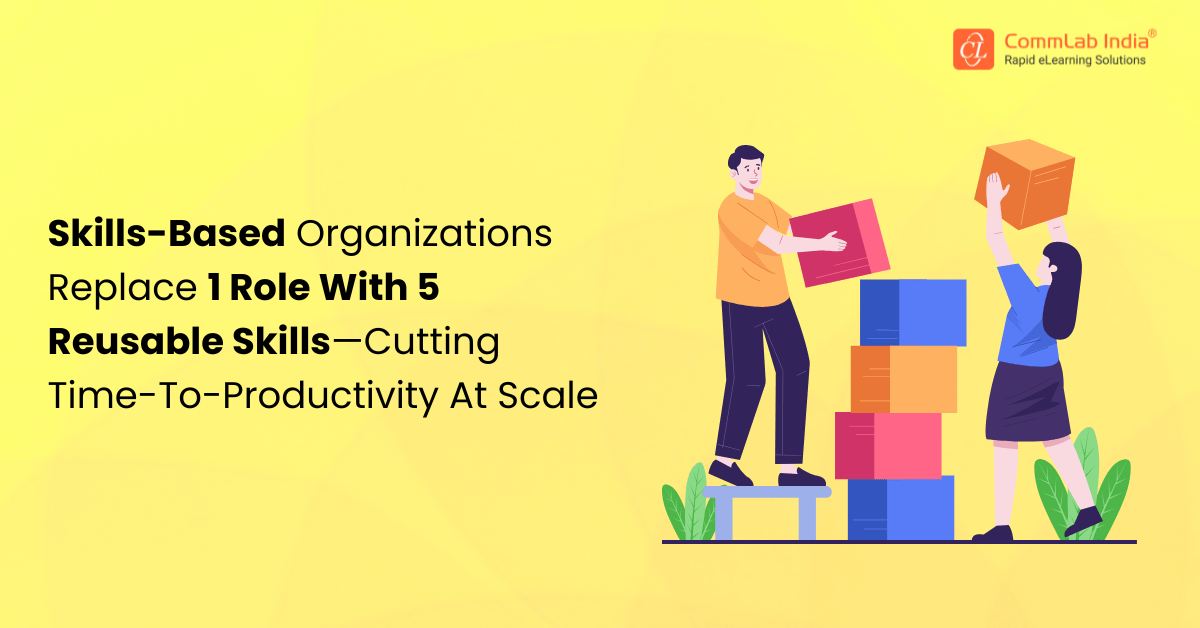
Most organizations say they’re moving toward a skills-based model. Few actually are.
Not because they lack intent.
But because they’re trying to solve a systems problem with training programs.
A skills-based organization isn’t built by adding more courses or labeling content with skill tags. It’s built when skills become how work is planned, executed, and rewarded. And that shift places Learning & Development in a far more strategic role than it’s traditionally played.
This blog explores what that role truly looks like—and why L&D must evolve from a training function into a capability enabler for the business.
Download eBook: An L&D Manager’s Implementation Guide
Table Of Content
- What Are Skills-Based Organizations?
- Why Are Skills-Based Organizations Becoming the New Standard?
- A 12-Month Roadmap to Start Building a Skills-Based Organization
- Future-Ready Skills in Skills-Based Organizations
What Are Skills-Based Organizations?
In learning and development terms, a skills-based organization is one that organizes work, talent, and learning capabilities, not job titles.
Instead of viewing employees through fixed roles, skills-based organizations treat skills as dynamic assets—developed, applied, and redeployed as business needs change. The emphasis is on what people can do today, what they can learn next, and how quickly those capabilities can be mobilized.
In a skills-based organization:
- Work is assigned based on demonstrated skills, not hierarchy or tenure
- Employees build transferable skill portfolios that apply across roles and projects
- Learning is driven by business demand and performance gaps, not training calendars
- Skills are developed through blended learning—real work, guided practice, and continuous feedback
CommLab India’s Blended Learning Solutions for U.S. Enterprises with 10,000+ Workforce
- Talent mobility becomes easier, faster, and more intentional
For L&D, this model fundamentally changes the mandate. Learning is no longer about delivering programs—it’s about enabling the organization to build, apply, and scale skills in real time.
Watch how problem-based learning feels closer to real work—and why that matters for skill transfer
Why Are Skills-Based Organizations Becoming the New Standard?
Skills-based organizations are becoming the new standard because they align work, learning, and talent decisions to real business needs rather than static job titles. This approach helps enterprises adapt faster, close skill gaps continuously, and deploy talent more effectively at scale. Reinforcing this shift, PwC reports that 79% of CEOs are concerned about the availability of key skills, highlighting why skills-based workforce strategies are critical for staying competitive in a rapidly changing business environment.
Roles are no longer stable. New tools, technologies, and business models are constantly reshaping what employees are expected to do. By the time a job description is finalized, parts of it are already outdated.
Skills-based organizations respond to this reality by focusing on adaptability rather than permanence.
When skills—not roles—become the organizing unit, organizations can:
- Respond faster to market and technology shifts
- Redeploy talent without waiting for formal role changes
- Reduce dependence on constant external hiring
- Build workforce resilience in the face of uncertainty through targeted microlearning
For L&D, this shift is critical. Traditional training models assume predictability—clear roles, linear careers, and fixed competency needs. Skills-based organizations operate in continuous change, requiring learning systems that are flexible, responsive, and closely tied to business priorities.
This is why L&D can no longer operate on the sidelines. In a skills-based organization, learning becomes a core business capability, not a support function.
A 12-Month Roadmap to Start Building a Skills-Based Organization
How Do eLearning Formats Enable Skills-Based Organizations?
Here are the formats that turn learning into skill:
- Scenario-based Learning enables skill application in real, job-relevant contexts
- Simulations and role plays allow safe practice for high-risk or complex skills
- Microlearning nuggets support just-in-time skill reinforcement at the moment of need
- Blended learning journeys combine formal learning with real work, coaching, and feedback
- Project-based learning formats help employees transfer skills across roles and situations
- Performance support tools (job aids, checklists, playbooks) embed skills into daily work
Moving toward a skills-based organization doesn’t require a multi-year transformation upfront. What it does require is focus, sequencing, and intent. The first year should be about creating clarity, building momentum, and proving value—before scaling.
Quarter 1: Establish Skill Clarity and Business Alignment
The first step is not launching new learning—it’s aligning on which skills actually matter.
L&D should work closely with business leaders to identify:
- The capabilities most critical to current and near-term business goals
- Roles or teams where skill gaps pose the highest risk
- Skills that will need to scale quickly in the next 12–18 months
This phase is about narrowing focus. A small, high-impact skill set is far more powerful than a broad, unfocused framework.
Quarter 2: Design Learning for Skill Application
Once priority skills are clear, the focus shifts to how those skills are built.
L&D should move away from content-heavy programs and toward:
- Scenario-based learning and practice-driven learning
- Learning embedded into real work and projects
- Modular assets that support just-in-time application
The goal in this phase is to help employees use skills on the job, not just understand them.
Quarter 3: Enable Skill Visibility and Mobility
By mid-year, organizations must make skills visible and portable.
This means:
- Helping employees articulate and recognize their skills
- Supporting managers in skill-based conversations
- Encouraging cross-functional projects or stretch assignments through custom eLearning
L&D plays a key role in ensuring skills don’t stay trapped within roles, but move across the organization where they create value.
Quarter 4: Measure, Refine, and Scale
The final quarter is about learning from what worked—and what didn’t.
L&D should focus on:
- Assessing skill application and performance impact
- Identifying patterns in skill growth and gaps
- Refining learning design based on real outcomes
Rather than aiming for perfection, the objective is evidence—proof that skills-based learning improves capability and business execution.
The First-Year Goal
The goal of the first year isn’t to become fully skills based.
It’s to shift how the organization thinks about skills.
When L&D leads this roadmap with clarity and discipline, the organization builds a strong foundation—one that can be scaled with confidence in the years ahead.
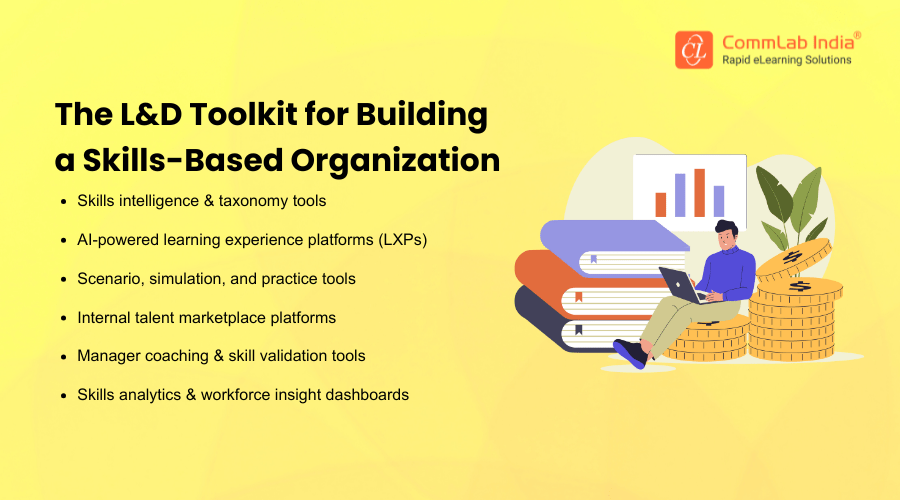
Once the right systems and tools are in place, the next question becomes more strategic: which skills should organizations intentionally invest in for the future?
An L&D Manager's Guide to Successful Planning & Implementation.
Learn:
- What Challenges do L&D Managers Face?
- How to Align Business and Project?
- How to be a Learning Consultancy?
- DOWNLOAD NOW!
Future-Ready Skills in Skills-Based Organizations
Future-ready skills in skills-based organizations are the capabilities that allow work to continue evolving without constant role redesign. They enable people to adapt, apply judgment, and contribute across changing contexts as business priorities and technologies shift.
- Decision-Making in AI-Augmented Workflows The ability to evaluate AI-generated insights, challenge assumptions, and make accountable decisions when human judgment and machine output intersect.
- Skill Transfer and Application The capability to apply existing skills in new contexts—across projects, roles, and problem spaces—rather than relying on role-specific expertise.
- Problem Framing and Scoping The ability to define the right problem before solving it, especially in ambiguous situations where requirements are incomplete or evolving.
- Cross-Functional Execution The skill of working effectively across functions, aligning diverse expertise, and moving work forward without formal authority.
- Coaching for Capability Building The ability to develop others through observation, feedback, and guided application—turning everyday work into a learning opportunity.
Turning Skills-Based Intent into Action
Building a skills-based organization requires thoughtful planning, clear roadmaps, and disciplined implementation led by L&D. When skills guide how learning is designed and applied, organizations are better positioned to build capability that keeps pace with change.
To support L&D leaders at this stage, explore our free eBook that addresses common challenges faced by L&D teams, shows how to align training with business goals, and outlines practical approaches to planning, designing, and implementing learning journeys that drive real impact.
Download now
![Top 10 Skills That Pay the Bills: Navigating the Future of Work [Infographic]](https://www.commlabindia.com/hubfs/blogs/skills-success-future-work-info.jpg)