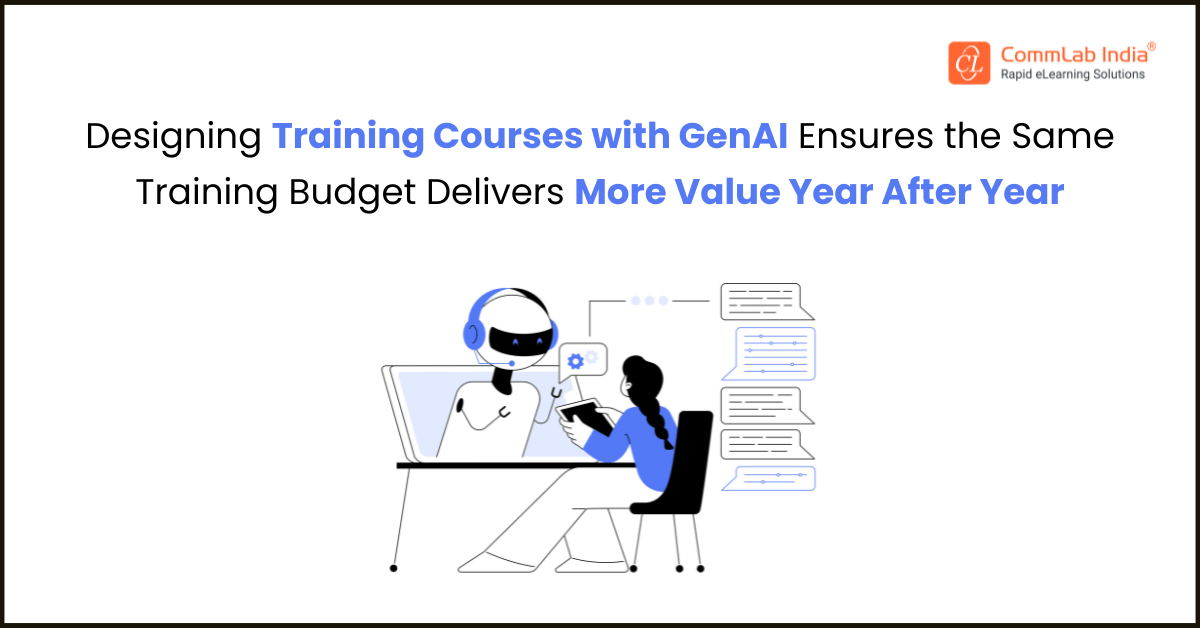
Training design has always been shaped as much by constraints as by intent. Limited production capacity, long development cycles, and rigid delivery models forced learning teams to make trade-offs—often prioritizing what was feasible over what was instructionally effective. Text-heavy courses became the norm not because they worked best, but because they were the most practical to build and maintain.
Generative AI changes that equation. By removing long-standing constraints around media creation, personalization, and updates, GenAI allows learning to be designed around adaptability rather than efficiency. This shift is not simply about producing content faster; it redefines what it means to design training in environments where roles evolve quickly, skills decay faster, and relevance cannot be negotiated.
As organizations look toward 2026, the implications for learning design become significant. Video, audio, and animation are no longer optional formats added to enhance engagement—they become the default building blocks of training when adaptability, scale, and responsiveness are treated as design requirements from the start.
Let’s explore how this shift redefines not just training formats, but the very logic of learning design.
Download Now: The AI Revolution
Table Of Content
- What Is Designing Training with GenAI?
- What Are the Advantages of Designing Training with GenAI?
- What Training Formats Does GenAI Enable by Default?
- What Does Designing Training with GenAI Change for the Business?
What Is Designing Training with GenAI?
Designing training with GenAI refers to a fundamental shift in the learning design workflow, where artificial intelligence actively participates in creating, adapting, and delivering learning experiences—not just content.
In this model, GenAI:
- Generates instructional assets across media formats
- Adapts learning based on role, region, or proficiency
- Refreshes content dynamically as business needs change
Watch how Gen AI is rewriting the rules of L&D
The key distinction is intent. GenAI-led design is not about automating old processes; it is about designing for adaptability, speed, and multimodal learning from the start.
What makes this shift truly significant is that GenAI introduces design optionality at scale. Learning teams are no longer forced to lock in decisions early—around format, depth, or sequencing—before understanding how learners will actually engage. Instead, those decisions can remain fluid, allowing training to respond to usage patterns, performance signals, and real-world feedback. Learning design shifts from a one-time act of prediction to an ongoing process of adjustment.
What Are the Advantages of Designing Training with GenAI?
Designing training with GenAI allows learning to be built as an adaptive system rather than a fixed course. The primary advantage is that learning design is no longer constrained by production effort, making it possible to respond to change without rework or delay.
Key advantages:
- Decouples learning objectives from fixed content structures
- Enables regeneration of learning assets without restarting the design process
- Supports variation by role, region, and proficiency from a single design logic
- Reduces dependency on manual production for updates and localization
- Allows learning to remain current as tools, processes, and policies change
- Makes multimodal delivery (video, audio, animation) a baseline rather than an exception
- Shifts instructional design effort toward defining intent, sequencing, and feedback
- Improves alignment between learning delivery and real-world performance demands
What Training Formats Does GenAI Enable by Default?
In Which Areas of L&D Training Is Designing with GenAI Most Useful?
- Employee onboarding to accelerate role readiness with adaptive, multimodal learning
- Product training to keep content current as features, updates, and positioning change
- Sales enablement training to tailor scenarios and messaging by role, market, or customer segment
- Technical and systems training to explain complex workflows through video and animation
- Compliance and policy training to reflect frequent updates without rebuilding courses
- Leadership development to deliver context-aware, role-specific learning experiences
- Customer and partner training to scale personalized learning beyond the enterprise
- Upskilling and reskilling programs to support continuous capability building
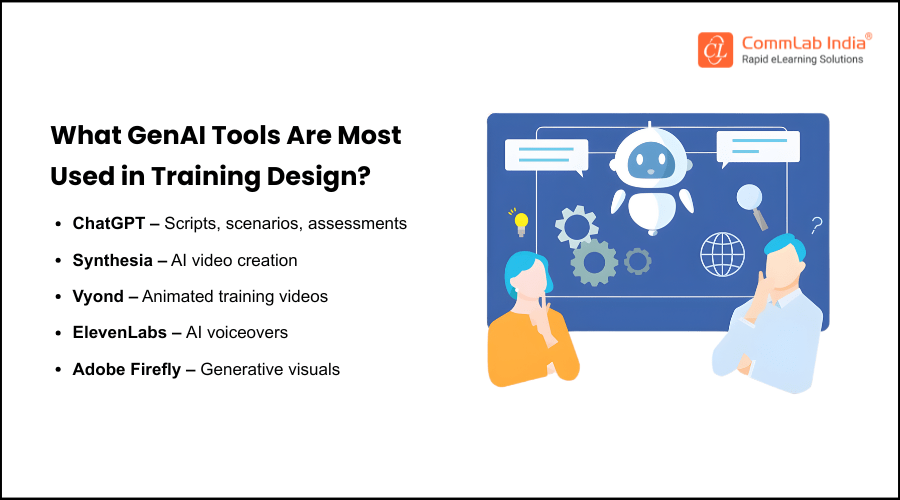
GenAI enables training formats that prioritize experience over exposition, including video, audio, animation, and purpose-built microlearning.
This shift aligns with broader enterprise adoption trends—McKinsey reports that nearly nine out of ten organizations now use AI in at least one business function, even as many are still working toward full-scale integration—making experiential, adaptable learning formats increasingly essential.
The following formats become viable at scale when training is designed with GenAI:
Video-based learning
- Enables direct modeling of tasks, behaviors, and decision-making in context
- Supports scenario walkthroughs, role plays, and process demonstrations
- Allows rapid creation of multiple variants aligned to role, environment, or complexity
- Reduces reliance on static explanations for skill-based learning
- Captures nuance such as sequence, timing, and judgment that text cannot convey
- Supports pause-and-reflect moments within scenarios for applied learning
- Scales observational learning without requiring live facilitation
Audio-based learning
- Supports learning in low-attention or screen-free contexts
- Enables reinforcement, reflection, and coaching-style explanations
- Fits naturally into fragmented work patterns and on-the-go learning
- Works effectively as a companion format rather than a standalone course
- Allows learners to revisit concepts without reopening full modules
- Supports conversational tone that mirrors real coaching interactions
- Enables rapid localization without re-recording overhead
Animated learning
- Visualizes systems, workflows, and cause–effect relationships
- Simplifies abstract, technical, or policy-driven concepts
- Makes process logic explicit rather than implied through text
- Remains usable even when content changes due to easy regeneration
- Supports step-by-step explanation of invisible or non-observable processes
- Reduces cognitive load by externalizing complex relationships
- Works effectively for explaining “why” in addition to “how”
Microlearning formats
- Enables single-objective learning assets rather than full-course builds
- Supports just-in-time learning at the point of need
- Allows rapid video creation and supporting audio or animated clips
- Reduces cognitive overload by isolating concepts or actions
- Fits naturally into workflow-based learning strategies
- Supports targeted reinforcement rather than broad content exposure
- Enables faster iteration based on usage and performance data
Explore CommLab India’s AI tool expertise, backed by global industry recognition and enterprise impact

Multimodal combinations
- Uses video for demonstration, animation for explanation, and audio for reinforcement
- Allows formats to be chosen based on learning purpose, not convenience
- Improves retention by presenting the same concept through complementary modes
- Makes experience design intentional rather than format-driven
- Supports different cognitive tasks within a single learning flow
- Allows learners to engage with content in the mode most effective for them
- Reduces dependence on any single format to carry the entire learning load
- Together, these formats shift corporate training away from text-dominated delivery toward media that better supports observation, understanding, and application in real work contexts.
What Does Designing Training with GenAI Change for the Business?
Designing training with GenAI changes the organization’s ability to translate strategy into capability at speed. It shifts learning from a periodic support activity to a continuously operating system that responds to business signals in near real time.
|
Business Lens |
Traditional Training Model |
GenAI-Designed Training Model |
|
Strategy execution |
Skills catch up after strategy shifts |
Skills evolve alongside strategy |
|
Speed to productivity |
Long ramp-up for new roles |
Faster role readiness through adaptive learning |
|
Operating agility |
Change requires retraining cycles |
Change triggers instant content regeneration |
|
Cost of change |
Each update increases training spend |
Marginal cost of change approaches zero |
|
Workforce scalability |
Growth multiplies training complexity |
Growth absorbed through reusable learning logic |
|
Consistency vs relevance |
Standardization dilutes contextual fit |
Shared intent with localized execution |
|
Risk management |
Policy updates lag behavior change |
Faster alignment between policy and practice |
|
Leadership development |
One-size programs for diverse leaders |
Context-aware, role-specific development |
|
Talent mobility |
Reskilling is slow and disruptive |
Continuous, modular capability building |
|
Use of employee time |
Learning pulls people away from work |
Learning integrated into work moments |
|
Measurement of impact |
Completion and satisfaction metrics |
Performance and behavior signals |
What this table reveals
Designing training with GenAI does not just optimize learning—it changes the economics of readiness. When learning adapts at the same speed as the business, capability stops being a bottleneck and starts functioning as a competitive advantage.
Redefining Generative AI for Dynamic L&D Teams
Discover how Generative AI is breaking boundaries and empowering L&D Teams
- Why leverage Generative AI for L&D?
- What training managers should know about generative AI
- Ethical conundrums for Generative AI: Use cases
- Future prospects of Generative AI
Organizational Impact of Designing Training with GenAI
Decision Velocity
- Learning keeps pace with leadership decisions instead of trailing them
- Capability gaps surface early, before they become performance issues
Capability Fluidity
- Employees move across roles with less friction
- Skills are built continuously rather than in episodic training cycles
Change Absorption
- Organizational change is absorbed through learning, not resisted by it
- Training updates stop being disruptive events and become background processes
Learning Ownership Shifts
- Managers become co-owners of capability development
- L&D moves from content delivery to capability stewardship
Experimentation Becomes Safer
- New processes and skills can be tested through learning before rollout
- Training acts as a sandbox for change
Investment Risk Reduces
- Learning assets are reusable and adaptable
- Fewer sunk costs in one-time training programs
Conclusion: Designing for What Comes Next
Designing training with GenAI ultimately comes down to one question: can learning move at the same speed as the business it supports? As this article has explored, GenAI shifts training away from static, text-heavy instruction toward adaptive, multimodal experiences that respond to change rather than lag behind it. Video, audio, and animation become default not as enhancements, but as practical design choices when adaptability and relevance are built into the system.
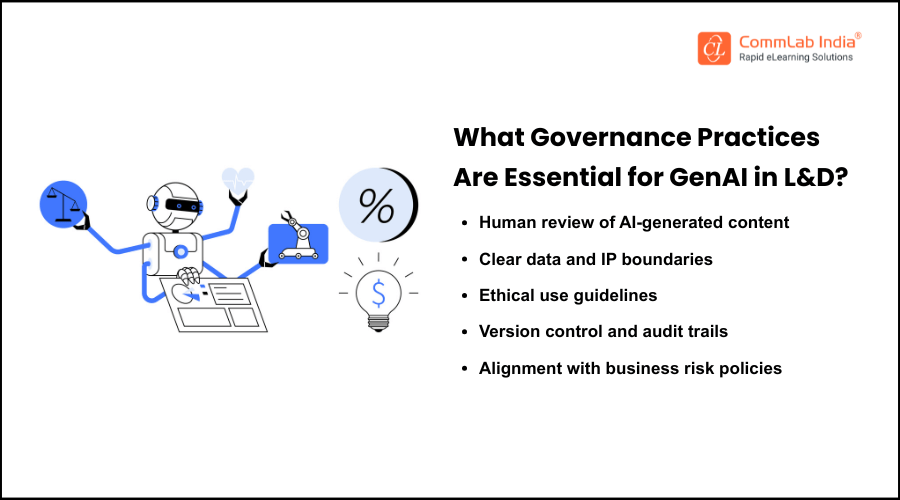
For L&D teams navigating this transition, understanding the implications of generative AI goes beyond tools and formats. It requires clarity on why generative AI matters, how it reshapes the role of training managers and stakeholders, where ethical considerations emerge, and how learning analytics can guide responsible, future-ready adoption. These questions form the foundation for designing learning that is not only scalable, but sustainable.
To explore these dimensions in greater depth, our free eBook is available that examines the rationale behind generative AI for L&D, its impact across stakeholders, key considerations for training leaders, ethical use cases, and the future potential of generative AI when paired with learning analytics. Download the eBook now to deepen your understanding and design learning that is ready for what comes next.