For many organizations, the shift from instructor-led training to eLearning begins as a practical decision. It is driven by the need to scale training, reduce operational costs, and reach geographically distributed teams more efficiently.
However, as organizations progress along this journey, a more important realization begins to take shape. The objective is not to replace ILT with eLearning. It is to rethink how learning works as a system.
Traditional training models treated learning as a sequence of events, often delivered in isolation and completed within a fixed timeframe. In contrast, modern organizations require learning to be continuous, accessible, and closely aligned with the pace of business change.
This is where blended learning emerges, not as a combination of formats, but as a strategic orchestration of learning experiences across time, context, and delivery modes.
In this article, we explore how ILT is evolving within this new paradigm, how blended and flipped models reshape training design, and how organizations can build integrated learning ecosystems that extend beyond individual interventions.
Download eBook: Classroom to eLearning Conversion
TABLE OF CONTENTS
- The Evolution of ILT in Modern Learning Ecosystems
- What Blended Learning Really Means Today
- Choosing Between ILT, eLearning, and Blended Approaches
- The Flipped Classroom Model: Reimagining Learning Flow
- Enhancing ILT Through Digital Integration
- Designing Continuous and Hybrid Learning Journeys
- Industry-Specific Application: A Pharma Sales Perspective
- Rethinking the Direction of Learning Flow
- FAQs
The Evolution of ILT in Modern Learning Ecosystems
Instructor-led training has not disappeared, despite the rapid adoption of digital learning. Instead, its role has evolved in response to changing organizational needs.
In earlier models, ILT served as the primary mechanism for delivering knowledge. It was the central event around which learning was structured. Today, that centrality has shifted.
ILT is increasingly positioned as a targeted, high-impact component within a broader learning ecosystem, rather than the default mode of delivery.
This shift reflects a deeper transformation in how organizations think about learning.
- Learning is no longer confined to scheduled sessions
- Knowledge is accessed continuously rather than delivered once
- Capability development is distributed across multiple touchpoints
As a result, ILT is now used more selectively, typically in situations where interaction, discussion, and real-time feedback add significant value.
Blended learning is a strategic approach that integrates instructor-led training and digital learning to create continuous, outcome-driven learning experiences tailored to different learner needs and contexts.
What Blended Learning Really Means Today
Blended learning is often described as a mix of classroom and online training. While this definition is technically accurate, it does not capture the strategic depth of the approach.
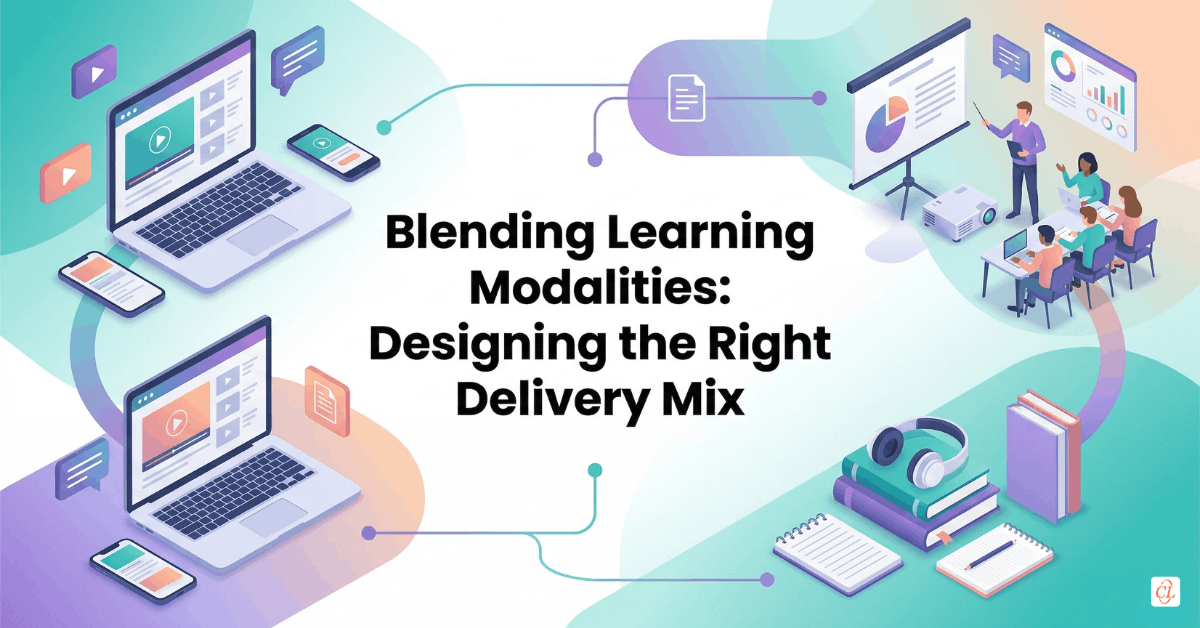
In practice, blended learning is about intentional alignment. It requires organizations to match learning methods with specific objectives, ensuring that each component of the learning journey serves a distinct purpose.
A Modern Blended Learning Structure
| Learning Stage | Purpose | Format |
| Pre-learning | Introduce concepts and build baseline knowledge | eLearning modules |
| Live learning | Deepen understanding through interaction | ILT or virtual sessions |
| Reinforcement | Strengthen retention and recall | Microlearning or digital assets |
| Performance support | Enable application in real work contexts | Job aids and on-demand resources |
How This Plays Out in Practice
- Learners engage with digital content before attending sessions, allowing them to arrive prepared
- Classroom time is used more effectively for discussion, application, and problem-solving
- Reinforcement mechanisms ensure that learning extends beyond the initial experience
This approach transforms learning from a single event into a structured journey that evolves over time.
Choosing Between ILT, eLearning, and Blended Approaches
One of the most critical decisions in modern learning design is determining which format to use and when. This decision should not be driven by preference or tradition, but by the nature of the learning objective.
Aligning Learning Needs with Delivery Modes
| Learning Requirement | Most Effective Approach |
| Knowledge transfer | eLearning |
| Skill development | ILT or blended |
| Behavioral change | Blended with strong facilitation |
| Large-scale rollout | eLearning |
| Complex problem-solving | ILT or collaborative formats |
Interpreting These Choices
- eLearning is best suited for situations where scale, consistency, and flexibility are critical
- ILT is most effective when interaction, nuance, and immediate feedback are required
- Blended learning becomes essential when outcomes depend on both knowledge acquisition and application
This framework ensures that learning design is driven by purpose rather than format.
The Flipped Classroom Model: Reimagining Learning Flow
The flipped classroom model represents one of the most effective ways to operationalize blended learning.
Rather than delivering knowledge during classroom sessions, the model shifts foundational learning to pre-work, allowing in-person or virtual sessions to focus on application.
How the Flipped Model Works
- Learners first engage with digital content independently
- Classroom sessions are used for discussion, practice, and problem-solving
- Follow-up resources reinforce learning and support application
Why This Approach Is Effective
- It maximizes the value of instructor time by focusing on higher-order learning
- It improves learner engagement by ensuring participants are prepared
- It creates a more interactive and collaborative learning environment
Design Considerations for Success
- Pre-learning content must be concise and clearly structured
- Classroom sessions should prioritize interaction over explanation
- Reinforcement should be integrated into the overall learning journey
When implemented effectively, the flipped model enhances both efficiency and learning outcomes.

Classroom to eLearning Conversion
Everything You Always Wanted to Know
- Converting classroom material to eLearning
- Leveraging authoring tools for conversion
- Understanding different avatars of eLearning
- And More!
Enhancing ILT Through Digital Integration
Digital learning does not diminish the value of ILT. On the contrary, it enhances it by removing inefficiencies and extending its impact.
When ILT is supported by digital components, it becomes more focused, purposeful, and effective.
How Digital Integration Strengthens ILT
- Pre-session preparation
Learners arrive with foundational knowledge, allowing sessions to focus on deeper engagement. - Post-session reinforcement
Digital resources help learners retain and apply knowledge over time. - On-demand accessibility
Learners can revisit content as needed, supporting continuous learning.
Improving ILT Effectiveness
- Shift from content delivery to facilitated discussion and application
- Use real-world scenarios to create relevance
- Encourage collaboration and peer learning
These adjustments transform ILT from a content-heavy experience into a high-value learning interaction.
Designing Continuous and Hybrid Learning Journeys
Modern learning no longer occurs within isolated events. Instead, it unfolds as a continuous journey that spans multiple formats and touchpoints.
Characteristics of Continuous Learning Models
- Learning is distributed across time rather than concentrated in single sessions
- Multiple formats are used to reinforce understanding
- Learners engage with content in alignment with their workflow
A Typical Hybrid Learning Journey
- Before training
eLearning modules introduce key concepts - During training
ILT sessions focus on application and discussion - After training
Reinforcement tools sustain learning and support performance
This structure ensures that learning is not only acquired, but also retained and applied in real-world contexts.
Industry-Specific Application: A Pharma Sales Perspective
In industries such as pharmaceutical sales, training requirements are both complex and dynamic. Learners must understand detailed product information, comply with regulatory standards, and apply knowledge effectively in customer interactions.
A Blended Learning Approach in Action
- eLearning modules deliver consistent product and compliance knowledge
- ILT sessions focus on role-play and real-world sales scenarios
- Reinforcement tools provide ongoing updates and refreshers
Why This Approach Works
- It ensures consistency in knowledge delivery across teams
- It enables practice in realistic, high-stakes situations
- It supports continuous updates in a rapidly changing environment
This example demonstrates how blended learning can be adapted to meet specific industry needs while maintaining scalability.
Rethinking the Direction of Learning Flow
While most discussions focus on converting ILT into eLearning, the reverse scenario is also worth considering.
There are situations where learning begins with digital modules and transitions into instructor-led sessions for deeper exploration. This is particularly relevant for complex or technical topics that benefit from guided discussion.
A Key Principle: Learning design should not be constrained by format.
It should be driven by:
- Learning objectives
- Context of application
- Desired outcomes
When this principle is applied, organizations gain the flexibility to design learning experiences that are both effective and adaptable.
For organizations, the move toward blended learning represents a fundamental shift in how learning is designed and delivered.
Those that embrace this shift are able to:
- Scale learning without compromising quality
- Improve engagement and retention
- Align training with real-world performance
Organizations that continue to rely on single-format approaches risk limiting both the reach and effectiveness of their learning initiatives.
FAQ
1. What is blended learning?
A. Blended learning integrates ILT and eLearning to create structured, continuous learning experiences aligned with different objectives.
2. When should ILT be used in a blended model?
A. ILT is most effective for interactive, discussion-based, and skill-oriented learning scenarios.
3. What is a flipped classroom?
A. It is a model where learners engage with content before sessions, allowing classroom time to focus on application and discussion.
4. Can eLearning replace ILT entirely?
A. No. ILT remains valuable for scenarios requiring interaction and real-time feedback.
5. How does blended learning improve outcomes?
A. By combining formats strategically, it enhances engagement, retention, and application.
6. What industries benefit most from blended learning?
A. Industries with complex training needs, such as healthcare, sales, and compliance, benefit significantly from blended approaches.
CONCLUSION
The future of learning is not defined by a single format, but by how effectively different formats are orchestrated.
ILT and eLearning are no longer competing approaches. They are complementary components of a larger system designed to support continuous capability development.
Organizations that recognize this shift move beyond conversion and begin to design learning ecosystems that are flexible, scalable, and aligned with the realities of modern work.
The real opportunity lies not in choosing between formats, but in bringing them together to create learning experiences that truly drive performance.