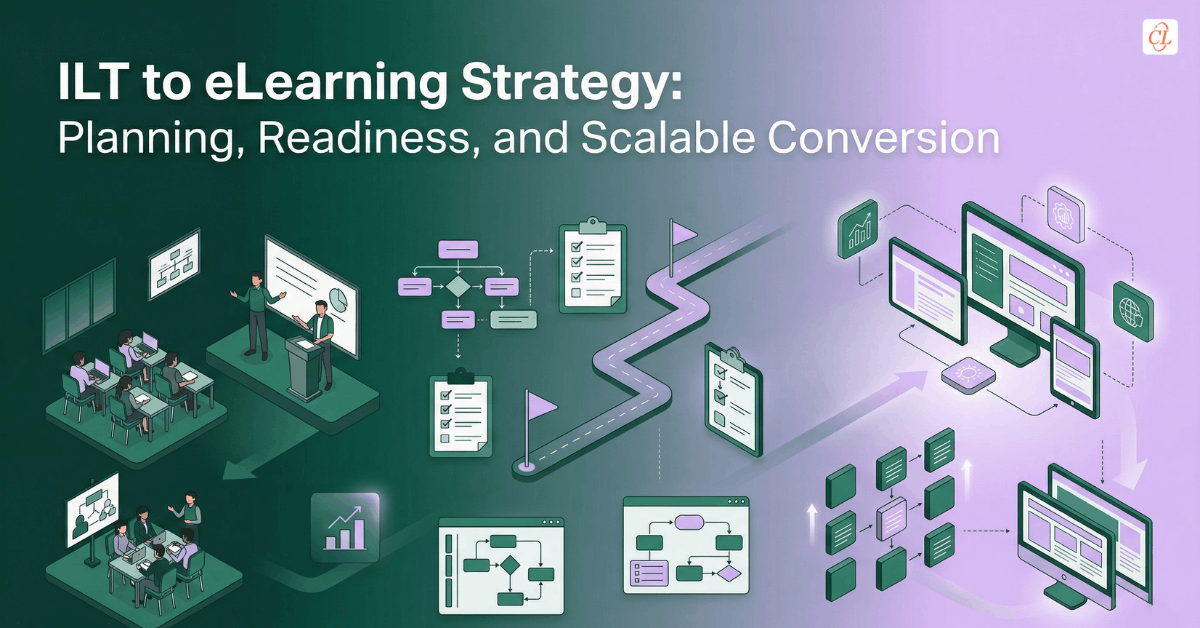
Many organizations have already accepted that moving from instructor-led training to eLearning is no longer optional. The pressures of scale, speed, distributed workforces, and cost efficiency have made digital learning an operational necessity rather than a strategic experiment.
Yet, despite this awareness, a significant number of ILT to eLearning conversion initiatives fail to deliver meaningful outcomes.
The reason is rarely a lack of tools or technology. It is a lack of structured thinking.
Too often, conversion is treated as a content translation exercise, where classroom slides are repurposed into digital modules with minimal redesign. This approach overlooks a critical reality. Classroom learning and digital learning are not interchangeable formats. They are fundamentally different systems that require different design, governance, and delivery models.
A successful conversion effort, therefore, must begin with a shift in perspective.
It is not about converting content. It is about restructuring how learning is planned, delivered, and sustained at scale.
In this article, we explore how organizations can approach ILT to eLearning conversion systematically. We examine how to define objectives, assess readiness, build a compelling business case, align stakeholders, and create a scalable execution model that supports long-term transformation.
Download eBook: Classroom to eLearning Conversion
TABLE OF CONTENTS
- Reframing Conversion as a Strategic Transformation
- Defining Objectives and Conversion Scope
- Readiness Assessment Across Critical Layers
- Building a Business Case with Cost-Benefit Clarity
- Stakeholder Alignment and SME Governance Model
- Designing a Phased Conversion Strategy
- Vendor Evaluation and Partner Selection Framework
- FAQs
Reframing Conversion as a Strategic Transformation
ILT to eLearning conversion is often initiated with the intent to improve efficiency or reduce costs. While these are valid drivers, they represent only a fraction of the transformation required.
At its core, conversion is about redefining the learning experience for a different environment.
In a classroom setting, learning is guided, paced, and facilitated by an instructor who can adapt in real time. In contrast, eLearning must anticipate learner needs in advance, structure content for self-paced consumption, and embed mechanisms that support engagement without live intervention.
This distinction has important implications.
- Content must be reinterpreted, not simply transferred
- Learning journeys must be modular and flexible, rather than linear
- Reinforcement must be designed into the system, rather than left to chance
When organizations fail to recognize this shift, they often end up replicating classroom limitations in a digital format, resulting in low engagement and limited impact.
ILT to eLearning conversion is the process of redesigning instructor-led training into digital learning experiences that are scalable, self-paced, and aligned with modern workforce needs, rather than simply transferring existing content into an online format.
Defining Objectives and Conversion Scope
Clarity of purpose is one of the strongest predictors of success in conversion initiatives. Without it, organizations tend to overextend efforts, dilute impact, and struggle to measure outcomes.
A well-defined objective anchors the entire process.
Common Strategic Objectives
- Scaling learning across geographies
Organizations often need to deliver consistent training to dispersed teams without increasing operational complexity. - Reducing dependency on instructor-led delivery
Lowering recurring costs while maintaining learning quality becomes a key priority. - Accelerating training deployment
Faster rollout is critical for onboarding, compliance, and product enablement. - Improving performance alignment
Learning must move beyond completion metrics to influence real-world outcomes.
Defining Scope with Precision
| Scope Dimension | What It Influences |
| Program Volume | Determines resource allocation and timelines |
| Audience Diversity | Impacts design complexity and personalization |
| Content Type | Affects conversion approach and interactivity |
| Update Frequency | Influences design flexibility and maintenance |
A clearly defined scope ensures that conversion efforts remain targeted, manageable, and aligned with business priorities.
Readiness Assessment Across Critical Layers
Before initiating conversion, organizations must evaluate whether they are truly prepared to support digital learning at scale. Readiness is not a single factor. It is a combination of organizational, content, and technological alignment.
1. Organizational Readiness
This layer reflects the organization’s ability to support and sustain the shift.
- Leadership alignment
When leaders actively support the transition, it accelerates adoption and reduces resistance. - Cultural readiness for self-directed learning
Learners must be comfortable taking ownership of their learning journey. - Internal capability maturity
Teams need the skills to manage digital learning design, deployment, and optimization.
2. Content Readiness
ILT content often relies heavily on instructor facilitation. Converting such material requires careful redesign.
- Degree of instructor dependency
Content that depends on discussion or facilitation needs transformation, not direct conversion. - Modularity of content
Well-structured content can be broken into smaller, digestible learning units. - Opportunity for interactivity
Scenarios, simulations, and assessments can enhance engagement in digital formats.
3. Technology Readiness
Technology serves as the backbone of digital learning delivery.
- Platform capability
The LMS or LXP must support scalable deployment and tracking. - Accessibility across devices
Learners should be able to access content seamlessly on multiple devices. - Analytics and reporting
Data should provide actionable insights into learner behavior and outcomes.
Readiness Snapshot
| Readiness Area | Indicators of Low Readiness | Indicators of High Readiness |
| Organization | Resistance to change | Strong leadership alignment |
| Content | Instructor-heavy | Modular and adaptable |
| Technology | Limited infrastructure | Integrated learning ecosystem |
A structured readiness assessment reduces risk and creates a strong foundation for execution.
Building a Business Case with Cost-Benefit Clarity
A compelling business case is essential to secure investment and sustain momentum. However, the most effective business cases extend beyond cost savings and articulate long-term value.
Understanding the Cost Structure
- Development investment
Includes content redesign, multimedia production, and instructional design. - Technology costs
Covers platforms, licensing, and integration. - Resource allocation
Internal teams and external partners contribute to execution.
Understanding the Value
- Reduced operational costs
Eliminates recurring expenses such as travel and instructor fees. - Faster deployment cycles
Enables rapid rollout of training programs. - Consistency in learning delivery
Ensures uniform messaging across the organization. - Improved visibility through analytics
Provides insights into learner engagement and performance.
Cost vs Value Comparison
| Factor | ILT Model | eLearning Model |
| Cost Pattern | Recurring | Front-loaded |
| Scalability | Limited | High |
| Deployment Speed | Slower | Faster |
| Measurement | Limited | Data-driven |
A well-articulated business case reframes conversion as a strategic investment in capability building, rather than a cost-cutting exercise.

Classroom to eLearning Conversion
Everything You Always Wanted to Know
- Converting classroom material to eLearning
- Leveraging authoring tools for conversion
- Understanding different avatars of eLearning
- And More!
Stakeholder Alignment and SME Governance Model
Even the most well-designed strategy can falter without effective stakeholder alignment. Conversion initiatives involve multiple stakeholders, each with distinct priorities and expectations.
Key Stakeholders and Their Roles
- L&D leaders
Set direction, define outcomes, and ensure alignment with business strategy. - Subject Matter Experts (SMEs)
Provide domain expertise and validate content accuracy. - Business stakeholders
Ensure relevance and applicability to real-world scenarios. - Technology teams
Enable platform integration and deployment.
Common Friction Points
- Delays in SME reviews due to competing priorities
- Misalignment on learning objectives
- Lack of clarity in roles and responsibilities
A Practical Governance Approach
- Clarify ownership early
Assign clear responsibility for each stage of the conversion process. - Structure SME engagement
Involve SMEs strategically rather than continuously to avoid bottlenecks. - Define review workflows
Establish timelines and checkpoints to maintain momentum. - Standardize communication
Ensure consistent updates and alignment across stakeholders.
This governance model transforms stakeholder involvement from a source of friction into a driver of efficiency.
Designing a Phased Conversion Strategy
Attempting to convert all training programs simultaneously often leads to resource strain and inconsistent quality. A phased approach enables organizations to balance speed with effectiveness.
How to Prioritize Conversion
- High-frequency programs
Courses delivered repeatedly offer the highest return on conversion. - Compliance training
Standardization and scalability are critical in regulated environments. - Onboarding programs
Consistency and accessibility improve early-stage employee experience. - High-impact training
Programs directly linked to business performance should be prioritized.
A Phased Model for Conversion
- Phase 1: High-impact initiatives
Focus on programs that deliver immediate value and visibility. - Phase 2: Scalable training programs
Expand conversion to areas with large learner populations. - Phase 3: Complex or specialized content
Address training that requires advanced design and interactivity.
This structured progression allows organizations to learn, adapt, and scale effectively.
Vendor Evaluation and Partner Selection Framework
External partners often play a critical role in accelerating conversion efforts. However, selecting the right partner requires careful evaluation.
What to Look for in a Conversion Partner
- Instructional design strength
Ability to transform ILT content into engaging digital experiences. - Process maturity
Structured workflows that ensure consistency and quality. - Scalability
Capacity to handle large volumes without compromising timelines. - Technology expertise
Proficiency with relevant tools and platforms. - Quality assurance rigor
Robust testing and validation processes.
Vendor Evaluation Snapshot
| Criteria | Key Indicator |
| Design Capability | Strong learner-centric design |
| Process | Defined and repeatable workflows |
| Communication | Transparent and proactive |
| Flexibility | Adaptable to changing needs |
A structured vendor evaluation process ensures that external partnerships contribute to long-term success. For L&D leaders, the transition to eLearning represents a shift in how learning is conceptualized and delivered.
Organizations must move:
- From isolated training programs to integrated learning systems
- From one-time conversion efforts to continuous optimization
- From delivery-focused models to performance-driven learning strategies
Those that adopt this mindset will be better equipped to scale learning and respond to evolving business needs
FAQ
1. What is ILT to eLearning conversion strategy?
A. It is a structured approach to redesigning classroom training into scalable digital learning experiences aligned with business goals and learner needs.
2. How do you assess readiness for conversion?
A. Readiness is evaluated across organizational alignment, content suitability, and technology infrastructure to ensure successful implementation.
3. What should a business case include?
A. It should cover cost analysis, scalability benefits, time savings, and long-term value for the organization.
4. Why is stakeholder alignment critical?
A. It ensures clarity, reduces delays, and keeps the conversion process aligned with business objectives.
5. How do you prioritize training for conversion?
A. Focus on high-impact, high-frequency programs such as onboarding and compliance training.
6. Should organizations work with vendors?
A. Yes, especially when internal capabilities are limited, but vendor selection should follow a structured evaluation process.
CONCLUSION
ILT to eLearning conversion is often initiated as a response to operational pressures. However, when approached strategically, it becomes a powerful enabler of organizational transformation.
The true value of conversion lies not in digitizing content, but in designing a learning system that is scalable, adaptable, and aligned with business performance.
Organizations that take a structured approach to planning, readiness, and execution are not simply modernizing training. They are building the foundation for continuous capability development in an increasingly complex and fast-changing world.