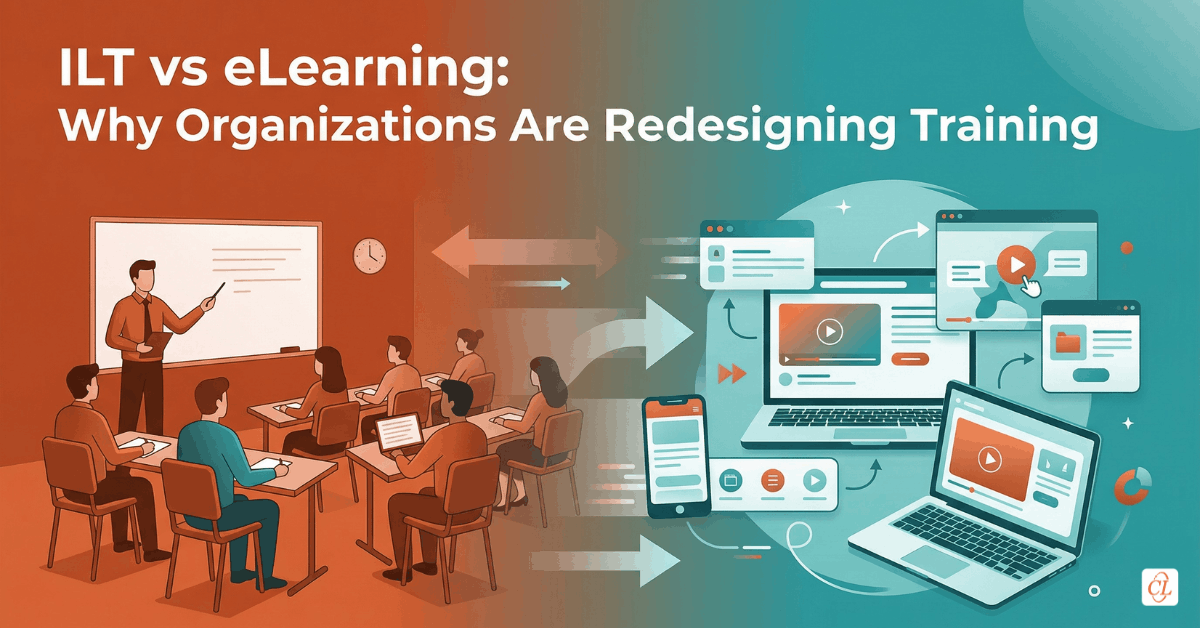
For decades, instructor-led training has been the cornerstone of corporate learning. It brought structure, human interaction, and a sense of shared experience that shaped how organizations built capability across teams.
However, the context in which learning operates today has changed dramatically.
Workforces are no longer centralized. Skills evolve faster than training cycles. Business priorities demand rapid enablement, continuous upskilling, and measurable outcomes. In this environment, learning can no longer exist as a scheduled intervention. It must function as an ongoing, accessible, and scalable system.
This shift is forcing organizations to rethink a fundamental question:
Is the traditional classroom model still sufficient for modern learning needs, or does eLearning offer a more resilient and scalable alternative?
In this article, we move beyond surface-level comparisons and explore the deeper transformation underway. You will gain clarity on how ILT and eLearning differ at a system level, why organizations are accelerating this transition, where classroom training still holds value, and how forward-thinking L&D teams are redesigning learning for sustained performance impact.
Download eBook: Classroom to eLearning Conversion
TABLE OF CONTENTS
- The Structural Shift in Corporate Learning
- ILT vs eLearning: A System-Level Comparison
- Why ILT-Heavy Models Are Becoming Unsustainable
- The Business Case for eLearning at Scale
- When ILT Still Creates Meaningful Impact
- From Training Events to Learning Ecosystems
- The Role of Technology in Extending Classroom Learning
- FAQs
The Structural Shift in Corporate Learning
Corporate learning is no longer defined by isolated training events. It is increasingly shaped by the need to build capabilities continuously, at scale, and in alignment with business velocity.
Traditional ILT models were designed for a different era, one where knowledge was relatively stable, teams were co-located, and training could be planned in advance without significant disruption. In contrast, today’s organizations operate in dynamic environments where learning must be:
- Immediate, so employees can apply knowledge in real time
- Continuous, rather than limited to scheduled sessions
- Accessible, regardless of geography or time zone
- Measurable, with clear links to performance outcomes
This shift is not simply about adopting digital formats. It reflects a broader transition from training delivery to capability enablement.
eLearning emerges in this context not as a replacement for ILT, but as a foundational enabler of modern learning systems.
ILT vs eLearning: A System-Level Comparison
Comparisons between ILT and eLearning often focus on format, but the real distinction lies in how each approach functions within a learning ecosystem.
How the Two Models Differ in Practice
| Dimension | Instructor-Led Training (ILT) | eLearning |
| Delivery Approach | Scheduled, instructor-driven sessions | On-demand, learner-controlled access |
| Reach and Scalability | Limited by logistics and facilitator availability | Easily scalable across regions and roles |
| Consistency of Experience | Varies based on instructor delivery | Standardized content and experience |
| Cost Dynamics | Recurring and often high | Initial investment with lower long-term cost |
| Learning Continuity | Episodic and time-bound | Continuous and accessible anytime |
| Measurement Capability | Limited tracking | Data-rich insights and analytics |
ILT is inherently designed for depth and engagement within a controlled environment, where interaction and immediate feedback are central to learning.
eLearning, on the other hand, is built for scale, flexibility, and continuity, enabling organizations to extend learning beyond the boundaries of time and place.
Rather than viewing these approaches as competing options, it is more accurate to see them as different operating models for delivering learning.
Why ILT-Heavy Models Are Becoming Unsustainable
As organizations grow and evolve, the limitations of ILT become more pronounced, particularly when training needs to reach larger and more diverse audiences.
Several structural challenges contribute to this shift:
- Scalability becomes a constraint
Expanding ILT programs across geographies requires significant coordination, making it difficult to maintain speed and consistency. - Learning experiences vary widely
Instructor delivery styles differ, leading to uneven learner outcomes and inconsistent knowledge transfer. - Operational disruption increases
Employees must step away from their roles to attend sessions, which can impact productivity. - Reinforcement is often insufficient
Without structured follow-up, learners struggle to retain and apply knowledge over time. - Costs continue to rise
Travel, infrastructure, and facilitator expenses accumulate, especially for global organizations.
Individually, these challenges may be manageable. Collectively, they create friction that limits the effectiveness of ILT as a primary training model.
The Business Case for eLearning at Scale
The shift toward eLearning is driven not just by convenience, but by its ability to align learning with business priorities.
Key Business Advantages
- Cost efficiency over time
While development requires upfront investment, the ability to reuse and scale content significantly reduces the cost per learner. - Faster deployment cycles
Training can be rolled out simultaneously across regions, enabling rapid response to business needs. - Consistency across the organization
Every learner receives the same content, ensuring alignment in knowledge and messaging. - Data-driven decision making
Detailed analytics allow organizations to track engagement, identify gaps, and continuously refine learning strategies. - Flexibility for modern learners
Employees can access training when it fits into their workflow, improving both participation and retention.
A Practical Comparison of Impact
| Business Factor | ILT Impact | eLearning Impact |
| Time to Rollout | Slower due to scheduling | Rapid, simultaneous deployment |
| Cost per Learner | Increases with scale | Decreases with scale |
| Knowledge Consistency | Variable | High |
| Learning Accessibility | Limited | High |
| Performance Tracking | Basic | Advanced |
The advantage of eLearning lies not in replacing ILT, but in redefining how learning supports business agility.
When ILT Still Creates Meaningful Impact
Despite the momentum behind eLearning, there are scenarios where ILT continues to offer distinct advantages.
ILT is particularly effective when learning requires interaction, nuance, and real-time adaptation.
Situations Where ILT Adds Value
- Complex skill development
Programs that involve negotiation, leadership, or decision-making benefit from immediate feedback and discussion. - Collaborative problem-solving
Group-based learning allows participants to exchange perspectives and learn from each other. - Cultural alignment and change initiatives
Face-to-face interactions help reinforce organizational values and shared understanding.
Rather than being replaced, ILT is evolving into a high-impact, targeted component within a broader learning strategy.

Classroom to eLearning Conversion
Everything You Always Wanted to Know
- Converting classroom material to eLearning
- Leveraging authoring tools for conversion
- Understanding different avatars of eLearning
- And More!
From Training Events to Learning Ecosystems
Leading organizations are no longer choosing between ILT and eLearning. They are combining them to create integrated learning ecosystems.
How Modern Learning Systems Are Structured
- eLearning for foundational knowledge
Learners acquire core concepts at their own pace, ensuring a consistent baseline. - ILT for application and discussion
Classroom sessions focus on deeper engagement, practice, and feedback. - Reinforcement through digital assets
Microlearning modules, job aids, and performance support tools help sustain learning. - Continuous feedback through analytics
Data informs improvements and ensures alignment with business outcomes.
This integrated approach allows organizations to move beyond isolated interventions and build learning journeys that evolve over time.
The Role of Technology in Extending Classroom Learning
Technology is not replacing the classroom. It is amplifying its effectiveness by extending learning beyond the session itself.
Organizations are increasingly using digital tools to:
- Prepare learners before sessions
Pre-work ensures participants arrive with foundational knowledge, making classroom time more productive. - Reinforce learning after sessions
Follow-up modules and resources help prevent knowledge decay. - Enable self-directed exploration
Learners can revisit content and deepen understanding at their own pace. - Support blended learning models
Digital and instructor-led components work together to create a cohesive experience.
A Balanced Learning Approach
The most effective strategies do not eliminate ILT. Instead, they reposition it within a system where:
- Classroom time is more focused and purposeful
- Digital learning provides continuity and reinforcement
- Learning becomes an ongoing process rather than a one-time event
For L&D leaders, the move toward eLearning is not simply a change in delivery format. It represents a shift in how learning is designed, delivered, and measured.
Organizations that succeed in this transition tend to:
- Design learning systems with scalability in mind
- Integrate learning into daily workflows
- Use data to continuously refine programs
- Deploy ILT selectively where it adds the most value
Those that continue to rely heavily on traditional models risk slowing down capability development and limiting their ability to respond to change.
FAQ
1. What is the key difference between ILT and eLearning?
ILT is instructor-led and delivered in scheduled sessions, while eLearning is self-paced and accessible on demand. The primary difference lies in scalability, flexibility, and the ability to support continuous learning.
2. Why are organizations shifting to eLearning?
Organizations are adopting eLearning to scale training efficiently, reduce costs, ensure consistent learning experiences, and support continuous skill development in fast-changing environments.
3. Is eLearning always better than classroom training?
Not necessarily. eLearning is ideal for scalable knowledge transfer, while ILT is more effective for interactive and behavioral learning. A blended approach often delivers the best results.
4. When should ILT be used?
ILT is most effective for complex skills, leadership development, and scenarios requiring real-time interaction, discussion, and feedback.
5. How does eLearning reduce costs?
eLearning minimizes expenses related to travel, instructors, and logistics. Once developed, content can be reused across large audiences, reducing the cost per learner.
6. Can organizations combine ILT and eLearning?
Yes. Many organizations use blended learning models where eLearning provides foundational knowledge and ILT focuses on application and deeper engagement.
CONCLUSION
The conversation around ILT and eLearning is often framed as a choice between two formats. In reality, it reflects a deeper transformation in how organizations think about learning.
What is emerging is not a replacement, but a redesign.
Training is evolving from a series of isolated events into a connected system that supports continuous capability development. eLearning plays a central role in enabling this shift, while ILT remains a valuable component when used with precision.
The organizations that succeed will not be those that simply digitize content, but those that reimagine learning as a scalable, data-driven, and business-aligned system.
The question is no longer whether to move from ILT to eLearning.
It is how effectively organizations can build a learning model that keeps pace with the future of work.