Instructional design rarely breaks down at the level of intent. Most learning teams understand what effective design looks like. They are familiar with models, strategies, and learner-centric principles. The real challenge emerges during execution, where complexity, timelines, and coordination across multiple stakeholders introduce inconsistencies.
Courses may be well-conceived but poorly aligned with objectives. Interactions may be visually engaging but lack instructional purpose. Quality issues often surface late in the development cycle, when corrections are costly and time-consuming.
This is not a knowledge gap. It is an execution gap.
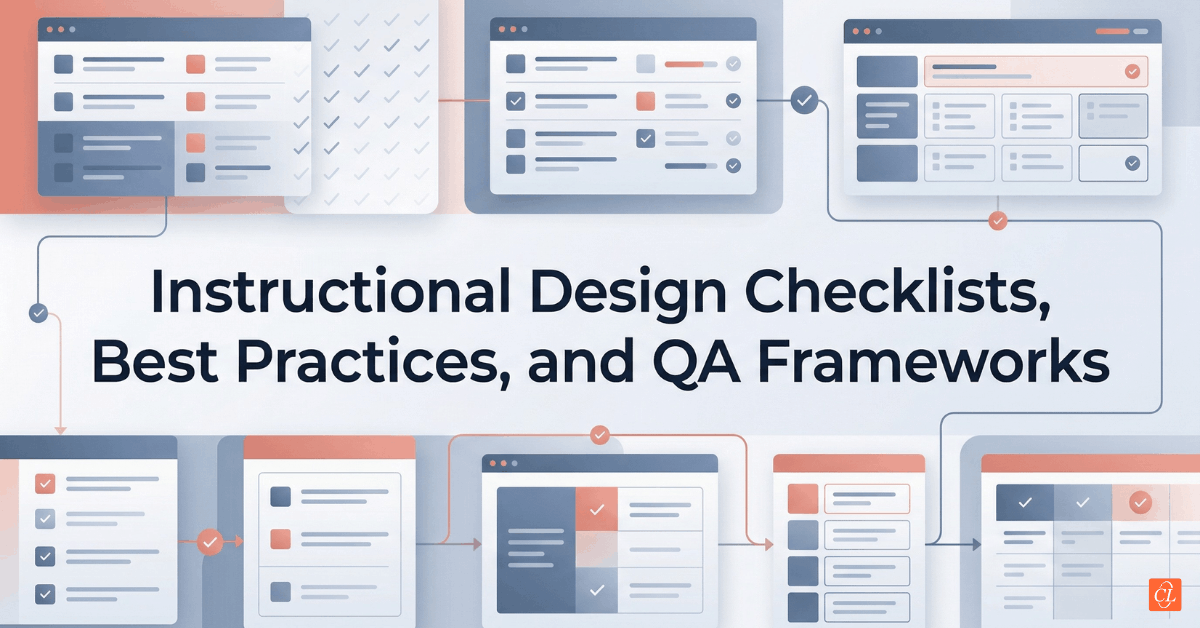
Checklists, best practices, and quality assurance frameworks address this gap by introducing structure and discipline into the instructional design process. They translate abstract design principles into repeatable actions, ensuring that quality is not left to chance but built into every stage of development.
In this article, you will explore how to operationalize instructional design through structured frameworks. You will learn how to use checklists to guide development, apply best practices to strengthen learning experiences, and implement QA systems that ensure consistency, accuracy, and effectiveness at scale.
Download Now: How To Use ChatGPT — A Guide for Instructional Designers
Table of Contents
- Why Instructional Design Needs Execution Frameworks
- The Role of Checklists in Instructional Design
- Instructional Design Best Practices That Matter
- Warning Signs of Poor Instructional Design
- Building a Quality Assurance (QA) Framework
- The Instructional Design QA Checklist
- A Multi-Stage Quality Assurance Approach
- Integrating Checklists into the Workflow
Why Instructional Design Needs Execution Frameworks
Instructional design is a multidisciplinary process that brings together content, pedagogy, technology, and user experience. While this richness enables powerful learning experiences, it also introduces complexity that can easily lead to inconsistency if not managed systematically.
Execution frameworks provide the structure required to manage this complexity effectively. Without them, teams often rely on individual judgment, which can vary widely across projects. With them, quality becomes embedded in the process rather than dependent on individual effort.
What Execution Frameworks Enable
- Consistency across projects
Standardized approaches ensure that learners experience a coherent structure and quality level across different courses - Efficiency in development
Clear checkpoints reduce ambiguity, minimize rework, and streamline collaboration - Comprehensive coverage
Structured frameworks ensure that critical elements, from objectives to usability, are not overlooked
As organizations expand their learning ecosystems, even small inconsistencies can accumulate into significant inefficiencies. Execution frameworks provide the stability needed to maintain quality while scaling output.
The Role of Checklists in Instructional Design
Checklists are among the simplest yet most powerful tools in instructional design. They transform conceptual guidelines into actionable steps that can be consistently applied.
Rather than restricting creativity, they provide a foundation that ensures essential elements are addressed before refinement and innovation take place.
How Checklists Strengthen Design
- They simplify complexity
Breaking down the design process into clear steps makes it easier to manage multiple elements simultaneously - They reduce oversight
Critical aspects such as alignment, usability, and assessment are less likely to be missed - They support collaboration
Teams can align around shared expectations, improving coordination and efficiency
Instructional Design Checklist Across Stages
| Stage | What the Checklist Focuses On |
| Analysis | Defining objectives, audience needs, and performance goals |
| Design | Structuring content, sequencing learning, selecting strategies |
| Development | Ensuring content accuracy, visual consistency, and interactivity |
| Implementation | Validating functionality, navigation, and usability |
| Evaluation | Assessing effectiveness and capturing learner feedback |
Checklists do not replace expertise. They amplify it by ensuring that expertise is applied consistently.
Instructional Design Best Practices That Matter
Best practices in instructional design are not isolated tips. They represent patterns that consistently lead to effective learning outcomes when applied thoughtfully and systematically.
Core Best Practices
- Align all elements with objectives
Every component of the learning experience, from content to assessment, should directly support defined outcomes - Prioritize clarity before engagement
Learners must first understand the material before meaningful engagement can occur - Design for application rather than exposure
Learning should enable action, not just information retention - Maintain consistency in design and navigation
Predictability reduces cognitive load and improves usability - Use feedback as a learning mechanism
Feedback should guide improvement and reinforce understanding
Applying Best Practices in Real Scenarios
- Structure content progressively to build understanding step by step
- Use real-world examples to connect theory with practice
- Design interactions that require thinking rather than passive clicking
Best practices are most effective when they are integrated into the design process rather than applied selectively.
Warning Signs of Poor Instructional Design
Even well-intentioned learning initiatives can fall short if certain design issues are not identified early. Recognizing these warning signs allows teams to intervene before problems escalate.
Common Indicators of Weak Design
- Content overload
Excessive information without prioritization overwhelms learners and reduces retention - Misalignment between objectives and content
Learning activities do not clearly support intended outcomes - Superficial interactivity
Interactions exist for engagement but do not enhance understanding - Inconsistent user experience
Variations in layout, navigation, or tone disrupt the learning flow - Limited real-world relevance
Learners struggle to connect content with their roles or tasks
Why These Issues Occur
- Absence of structured design frameworks
- Limited collaboration with stakeholders
- Lack of systematic quality checks
Addressing these issues early prevents costly revisions and improves overall learning effectiveness.
How to Use ChatGPT — A Guide for Instructional Designers
Create Immersive Learning Experiences by leveraging ChatGPT
- Frame Learning Objectives
- Generate Scenarios
- Design Assessments
- And More!
Building a Quality Assurance (QA) Framework
Quality assurance is often treated as a final checkpoint before course launch. In reality, it should be an ongoing process that spans the entire instructional design lifecycle.
A robust QA framework ensures that learning experiences meet defined standards at every stage.
Core QA Dimensions
| QA Area | What It Evaluates |
| Instructional Alignment | Objectives, content, and assessments are aligned |
| Content Quality | Accuracy, clarity, and relevance of information |
| Visual and UX Design | Consistency, readability, and usability |
| Functionality | Navigation, interactivity, and technical performance |
| Assessment Effectiveness | Validity and alignment with learning goals |
Why QA Must Be Continuous
- Issues identified early are easier and less costly to fix
- Iterative reviews improve overall design quality
- Continuous validation ensures alignment with objectives
Quality assurance is most effective when it is embedded within the workflow rather than applied at the end.
The Instructional Design QA Checklist
A comprehensive QA checklist brings together all critical elements of instructional design into a structured, actionable format. It ensures that quality is systematically reviewed rather than assumed.
Core QA Checklist Areas
1. Instructional Alignment
- Are objectives clearly defined and measurable
- Does every content element support those objectives
2. Content Quality
- Is the information accurate and up to date
- Is the language clear, concise, and consistent
3. Visual and UX Design
- Are layouts consistent across screens
- Do visuals enhance rather than distract from learning
4. Navigation and Functionality
- Is navigation intuitive and predictable
- Do all interactions function correctly
5. Assessment and Feedback
- Do assessments reflect real-world application
- Is feedback meaningful and actionable
Quality assurance in instructional design is most effective when it is not treated as a single checkpoint, but as a series of structured validations embedded throughout the design lifecycle.
A Multi-Stage Quality Assurance Approach
A layered QA approach ensures that issues are identified early, refined progressively, and resolved before they impact the final learner experience.
Rather than relying on a final review to catch all gaps, this approach distributes quality checks across key stages of development.
1. During Initial Design Reviews
At the early stage, QA focuses on conceptual clarity and alignment rather than visual or technical details. This is where foundational decisions are validated before significant development effort is invested.
- Validate learning objectives and scope
Ensure that objectives are clear, measurable, and aligned with business or performance goals - Check content relevance and accuracy
Confirm that selected content directly supports the intended outcomes and avoids unnecessary detail - Review instructional approach
Assess whether the chosen strategies, such as scenarios, microlearning, or blended formats, are appropriate for the audience and context
Addressing issues at this stage prevents structural flaws that are difficult and costly to fix later.
2. During Prototype Validation
Once a prototype or initial version of the course is developed, QA shifts toward experience, usability, and instructional effectiveness. This stage provides an opportunity to test how the design works in practice.
- Evaluate learner flow and navigation
Ensure that the course is intuitive, with a logical progression and clear pathways - Assess engagement and interaction quality
Confirm that interactions support learning objectives rather than serving as superficial additions - Test content clarity and comprehension
Identify areas where learners may struggle to understand concepts or instructions - Gather stakeholder feedback
Involve SMEs, designers, and stakeholders to validate both accuracy and usability
Prototype validation helps refine the experience before full-scale development is completed.
3. Before Final Deployment
At the final stage, QA focuses on precision, consistency, and technical reliability. This is the last opportunity to ensure that the learning experience meets all quality standards before it reaches learners.
- Verify content accuracy and completeness
Ensure that all information is correct, up to date, and consistent throughout the course - Check visual and design consistency
Confirm that layouts, fonts, colors, and branding are uniform across all screens - Test functionality and technical performance
Validate navigation, interactions, media playback, and compatibility across devices and platforms - Review assessments and feedback mechanisms
Ensure that assessments align with objectives and that feedback is meaningful and actionable
This stage ensures that the course is polished, reliable, and ready for delivery.
By distributing quality checks across multiple stages, organizations can:
- Identify and resolve issues early, reducing rework
- Improve collaboration through structured review cycles
- Ensure that both instructional quality and technical performance are addressed
Ultimately, a layered QA approach transforms quality assurance from a reactive step into a proactive system that strengthens the entire instructional design process.
Integrating Checklists into the Workflow
Checklists and QA frameworks are most effective when they are embedded into the instructional design process rather than treated as separate activities.
Making Checklists Operational
- Define checkpoints at each stage
Integrate checklist reviews into analysis, design, and development phases - Assign clear ownership
Ensure accountability for each checklist area - Standardize review cycles
Establish consistent review timelines to improve efficiency
Practical Implementation Tips
- Keep checklists concise and relevant to avoid overload
- Update them regularly based on feedback and evolving needs
- Use them as shared tools to align teams
When integrated effectively, checklists become part of the design culture rather than an additional task.
FAQ
1. What is an instructional design checklist?
A. An instructional design checklist is a structured tool that ensures all critical elements of learning design are addressed during development.
2. Why are checklists important in eLearning?
A. They help maintain consistency, reduce errors, and ensure that no essential design components are overlooked.
3. What are instructional design best practices?
A. They are proven approaches that improve learning effectiveness, such as aligning content with objectives and designing for application.
4. What is QA in instructional design?
A. Quality assurance is the process of reviewing and validating learning experiences to ensure they meet defined standards.
5. How can QA improve learning outcomes?
A. By ensuring alignment, usability, and accuracy, QA enhances the effectiveness of learning experiences.
6. When should QA be applied?
A. QA should be integrated throughout the design and development process rather than applied only at the end.
Conclusion
Instructional design excellence is not achieved through intention alone. It is achieved through disciplined execution.
Checklists, best practices, and QA frameworks provide the structure required to translate design principles into consistent, high-quality learning experiences. They ensure that learning is not only thoughtfully designed, but also reliably delivered.
As organizations scale their learning initiatives, the ability to operationalize instructional design will become increasingly important. Those that embed quality into their processes will be better positioned to deliver learning that is both effective and sustainable.