

L&D has an odd problem: the better it does its job, the less anyone sees it. Engineers use new tools correctly, customers onboard on schedule and sites hold on to their people, and the business credits everything except training. Then a program slips, and suddenly learning is the first thing leaders ask about.
The VP of Digital Business Readiness at a global water treatment company lives with this every day. He is preparing thousands of field engineers for a more data-driven business, and he raised the problem at LearnFlux 2026, CommLab India’s virtual thought leadership summit, during a panel on scaling learning inside global enterprises. He was joined by the Head of Online Learning and Platform Management at a global logistics company and the Head of Portfolio Strategy & Commercial Operations at the learning academy of a global tech company. The CEO & Co-Founder of CommLab India moderated.
The pressure to show proof is growing. AI has made training faster and cheaper to build, and leaders now expect results just as fast. In this blog, the panelists share how they build evidence in practice, where it breaks down, and what still resists measurement, even at organizations of their scale.
→ Download Playbook: Scaling Learning in the Human + AI Era
Table of Contents
- How Do You Prove Learning Is Working Across Multiple Business Units and Regions?
- Can AI Measure Training Impact Across Thousands of Employees and Sites?
- How Do You Stop AI-Generated Content From Overwhelming a Global Workforce?
- When Is a Learning Pilot Ready for a Global Rollout?
- How Do You Fund Long-Term Learning Programs When the Business Plans Quarter to Quarter?
- FAQs on Measuring Learning Impact at Enterprise Scale
How Do You Prove Learning Is Working Across Multiple Business Units and Regions?
When training works, leaders see faster onboarding and better customer conversations, and they credit those results to something other than learning. To get the credit, L&D has to show how training connects to the numbers the business already watches.
The water treatment leader sees that connection as a chain with three links:
- Training: The employee completes the course
- Adoption: The employee uses the tool on the job
- Value: The customer benefits because the tool was used correctly
Most measurement stops at the first link, but the proof sits in the third. Getting there takes more than a course, with e-learning, in-person onboarding and peer support in the field all playing a part.
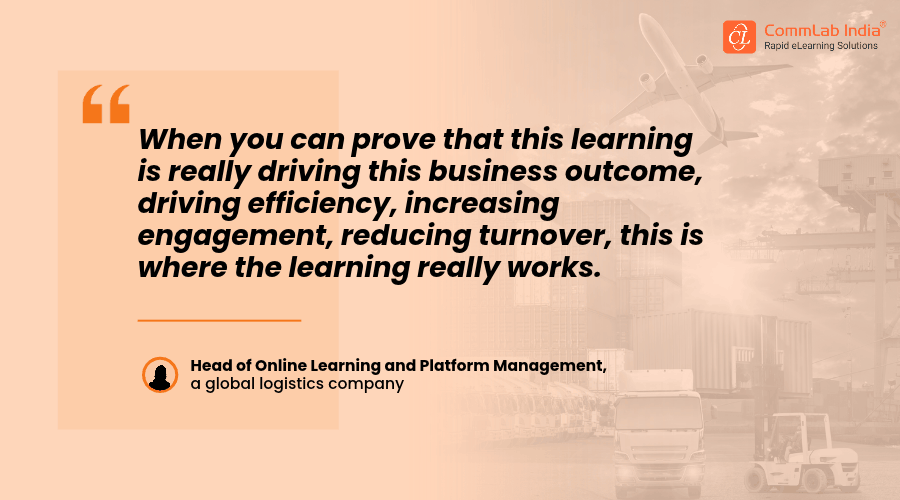
The logistics leader looks at it the same way. Completions, course ratings and translation numbers show how well L&D is running its programs. Turnover, upskilling speed, career progression and engagement show whether those programs are paying off for the business.
In a global enterprise, each business unit and region will point to different outcomes. Agreeing in advance which numbers training should move is the first step. Tracking them across thousands of employees and sites is the next
Can AI Measure Training Impact Across Thousands of Employees and Sites?
What Must L&D Get Right Before AI Can Measure Learning Impact?
AI is only as reliable as the data and decisions behind it:
- Consistent definitions: Align what “completion” or “turnover” means across business units and regions
- Clean data: Fix gaps and mismatches between learning and business systems
- Local context: Account for site-level changes that affect results
- Data privacy: Set clear rules for linking training and performance data under GDPR and other regional regulations
- Final decisions: Decide whether to scale, fix or retire a program
AI is only as useful as the question it is given. At enterprise scale, the question itself becomes the advantage: with enough sites, differences in completion rates show whether a program moves retention.
The logistics leader described a simple way to test this. Start with a business problem, such as high frontline turnover, and a program expected to help, such as onboarding. Then compare training completion with turnover, engagement and survey results across sites. If sites with higher completion consistently perform better, the program has a strong case. The same test works for leadership programs too.
AI can run these comparisons across thousands of employees in a fraction of the time. Deciding what to compare is still a human call.
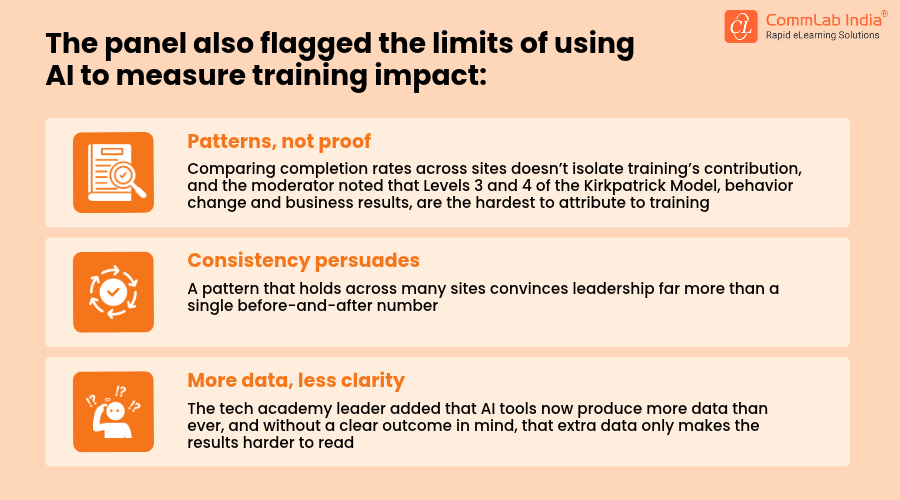
Still, a consistent pattern across many sites convinces leadership far more than a single before-and-after number. The tech academy leader added that AI tools now produce more data than ever. Without a clear outcome in mind, the extra data only makes the results harder to read.
This means L&D needs focus, not volume, and that applies to content as much as data.
One thing to flag: the paragraph after the bullets repeats the second and third bullets almost word for word. You could cut it and move the AI tools link into the third bullet, so the section goes straight from the list to the closing line.
How Do You Stop AI-Generated Content From Overwhelming a Global Workforce?
The challenge has shifted from creating content to getting it used. Field teams already have more information than time, so L&D’s effort now needs to go into reinforcing a few behaviors until they stick.
The water treatment leader says his content teams are more productive than they have ever been. Yet he still hears executives ask why the field can’t keep up. His answer is that field teams are busy, and the information reaching them has never been heavier.

The answer is fewer assets, each built around one behavior and reinforced until it becomes habit. The logistics leader added a quality risk. AI tools are designed to please the person prompting them, and that doesn’t always produce good learning design. His test for anyone tempted to skip review: would you let Copilot reply to your CEO without reading it first?
The volume problem also hides an access problem. Employees are flooded with content, yet PwC's Global Workforce Hopes and Fears Survey 2026 found that only 51% of workers say they have the learning and development resources they need, down from 59% a year earlier. Among the core workforce, fewer than 40% say the same. PwC recommends protecting time for learning instead of adding it on top of daily tasks.
In other words, every new program competes for limited time, so it has to prove itself in a pilot before it goes global.
When Is a Learning Pilot Ready for a Global Rollout?
Most pilots prove that the product works and say little about whether habits will change. The signal to scale is the point where the field starts teaching itself. The hardest discipline is letting a well-funded pilot fail when that point never comes.
That is the water treatment leader’s experience with software pilots. The ones that scale invest as much in adoption as in the product, with leadership support, local adoption leads and reinforcement after training. He trusts peer recommendation more than any other signal, though his team hasn’t yet found a way to measure it.
The tech academy leader has seen the other side: pilots that never end. Once leadership backs a pilot, everyone assumes it will go ahead, whatever the results. The logistics leader suggests deciding at the start which kind of project it is:
- A problem-solving pilot should be judged within a set period on whether the problem went away.
- A vision-led transformation can run three to five years, and some end close to where they started.
Judging both types the same way can end long-term projects too early or keep weak pilots running too long.
Proving a program works is only half the battle. Keeping it funded is the other half.
Scaling Learning in the Human + AI Era
Get What’s Working Inside Global Enterprises on
- Proving Learning Impact
- Scaling Pilots Across the Enterprise
- AI in Learning Design
- 90-Day Action Plan and 9 Ready-to-Use Tools
How Do You Fund Long-Term Learning Programs When the Business Plans Quarter to Quarter?
Long-term programs get funded when L&D enters the conversation through the business problem rather than a training plan. A leader who has named the behaviors that drive revenue has already made half the case.
The moderator compared learning to the hygiene factors of management theory. While they are present, nobody talks about them. When they are removed, everything breaks. The tech academy leader has watched training become urgent once sellers miss targets, then drop out of the conversation once things recover.
The logistics leader has seen equally strong ideas funded at one company and stalled at another. The difference was culture, and whether the company could invest in work that pays back in three to five years. Companies focused on quarterly numbers to judge every investment on cost, return, and speed. A useful argument for them is the cost of missing training: hours lost to workarounds, longer onboarding and software paid for but unused.
Explore CommLab India’s Award-Winning, AI-Powered Training Solutions That Deliver Measurable ROI for U.S. and European Enterprises with 10,000+ Workforce

A stronger approach is to skip the training pitch altogether. Instead, ask business leaders which behaviors drive revenue, let them name those behaviors, and build the learning plan from there.
That shift needs an L&D team that thinks in business terms.
Watch Mary Rapaport explain how to build an L&D team focused on business impact:
FAQs on Measuring Learning Impact at Enterprise Scale
Should L&D measure the cost of missing training instead of the benefits of training?
Often, yes. The business already feels workarounds, slow onboarding and unused software. Putting a number on those costs tends to persuade leaders faster than projected benefits do.
Is a correlation across sites strong enough proof for senior leaders?
It doesn't prove that training caused the result, but a consistent pattern across many sites is hard to argue with. Stating the hypothesis before reviewing the data keeps the analysis credible.
Should a multi-year learning transformation meet the same standard of proof as a pilot?
No. A transformation needs interim behavior indicators and fixed review points, so it doesn't run for years on belief alone.
If AI makes content cheap to produce, should L&D publish less?
Often, yes. A smaller set of assets, each tied to one behavior the business needs, gives employees less to sort through. It also gives L&D clearer evidence of what worked.
Closing the Loop on Learning Proof
At enterprise scale, learning is judged by what doesn’t go wrong: no workarounds, no delayed launches, no sites losing employees faster than others. But with dozens of business units, regions and priorities, no single metric proves learning is working. Each unit needs its own agreed measure, set before training begins and tracked well after it ends. Pilots need a clear test and end date before a global rollout, and every region needs reinforcement that fits how its people work.
CommLab India partners with global enterprises to design learning that works across business units, regions and languages, with outcomes leaders can measure, whether faster onboarding, higher tool adoption or lower turnover. This panel was just one of many LearnFlux 2026 sessions packed with insights from L&D leaders. Get them all in our curated playbook below.
Download now.