The real test of an eLearning authoring tool begins after the course is built.
At the surface level, many tools can help teams assemble screens, add interactions, and publish training. But enterprise learning teams do not operate at the surface level for long. They eventually need to solve more demanding problems:
- how to make courses accessible,
- how to support multilingual learners,
- how to publish cleanly into LMS environments,
- how to gather stakeholder feedback efficiently,
- how to scale media assets across projects, and
- how to ensure assessments and delivery workflows are strong enough to support real business needs.
That is where the conversation around Lectora becomes more meaningful.
Lectora is often discussed as an authoring tool for course creation, but its enterprise value is easier to understand when viewed as part of a broader learning ecosystem. In large organizations, the challenge is rarely just about building content. It is about building content that can be reviewed, adapted, localized, published, governed, reused, and maintained across audiences, systems, and regions.
That shift matters.
When learning operations grow, authoring tools are no longer judged only by what they help teams create. They are judged by what they help teams sustain.
- Can the tool support accessibility requirements without creating endless rework?
- Can it handle assessments that do more than test recall?
- Can it make translation and multilingual rollout more manageable?
- Can it integrate into enterprise delivery environments through standards-based publishing?
- Can it support collaborative review without slowing production?
These are the questions that define enterprise readiness.
In that context, Lectora’s advanced capabilities are not side features. They are part of what makes it a strategically useful platform for organizations building learning at scale.
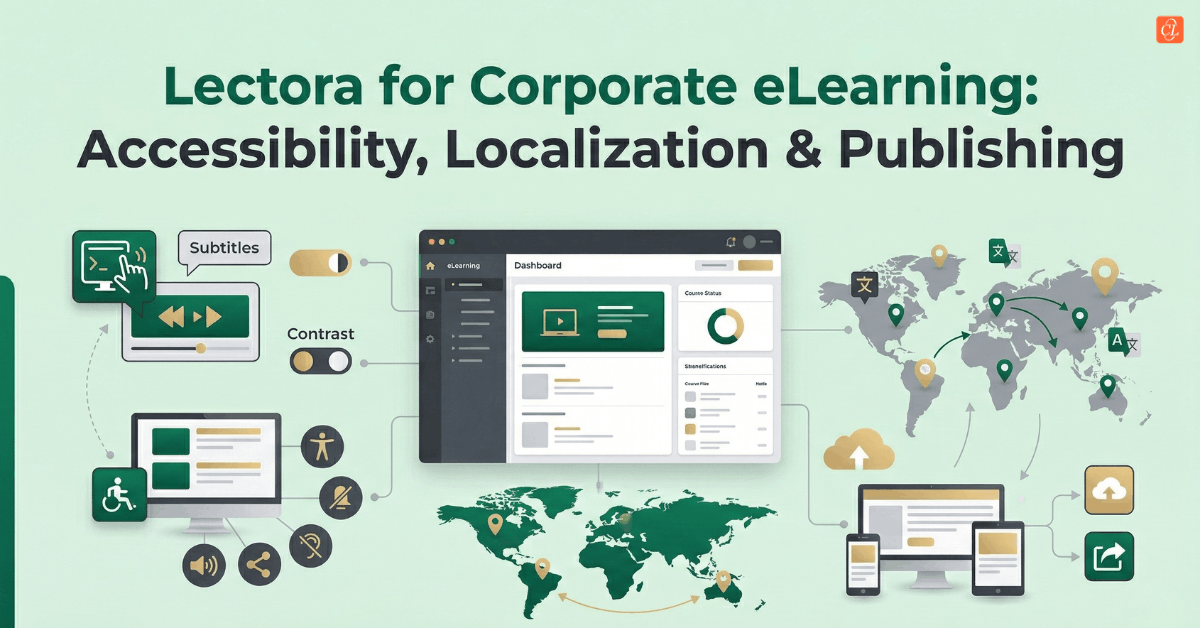
This article explores how Lectora supports accessibility, assessments, multilingual learning, publishing, content operations, and review workflows, and why those capabilities matter when enterprise training moves from isolated course development to a more mature digital learning system.
Download eBook Now: Rapid eLearning Authoring Tools
Table of Contents
- Accessibility in Lectora: Why It Matters Beyond Compliance
- How Lectora Supports Better Assessments and Knowledge Validation
- Lectora for Multilingual Learning and Global Training Delivery
- Publishing, LMS Compatibility, and Delivery Readiness
- Workflow Tools, Review Cycles, and Content Operations
- What Makes Lectora More Valuable in a Learning Ecosystem
- How to Use Lectora More Strategically at Enterprise Scale
- FAQs
Accessibility in Lectora: Why It Matters Beyond Compliance
Accessibility is often treated as a technical requirement or legal checkpoint, but in strong digital learning design it should be seen as something more fundamental: a measure of whether learning is genuinely usable for the people it is meant to serve.
That is why accessibility deserves to be treated as a design capability, not an afterthought.
Lectora has long been associated with accessibility-conscious eLearning development because it supports the creation of published content aligned with Section 508 and WCAG requirements, including web accessibility settings, reading and tab order control, ALT text support, focus visibility, and screen-reader-friendly HTML output.
This matters because accessibility in eLearning is rarely solved through a single switch. It is the result of how authors structure navigation, order content, label elements, design interactions, and control media behavior. Lectora supports these decisions in ways that make inclusive development more achievable for enterprise teams.
Accessibility is also a quality issue
One of the most useful ways to think about accessibility is to recognize that many accessibility improvements also improve learning quality more broadly.
For example:
- clearer navigation helps all learners, not only those using assistive technology
- cleaner structure improves comprehension and reduces friction
- readable layouts support attention and reduce overload
- descriptive labeling improves orientation and usability
- predictable interaction patterns help learners move through content with more confidence
This is why accessibility should not be treated as a separate workstream. It is part of good learning design.
Lectora is especially useful when accessibility needs include:
- Keyboard-friendly navigation
Important for learners who cannot rely on mouse-based interaction. - Logical reading and tab order
Essential for screen-reader compatibility and content clarity. - Accessible form and question structures
Important in assessments, surveys, and data-entry interactions. - ALT text and descriptive object labeling
Helps make non-text content more usable and understandable. - Updated accessibility checking support
Recent release updates note alignment with WCAG 2.2 accessibility checking improvements.
The enterprise implication is significant. When accessibility is built into the development environment and workflow, teams can reduce remediation effort, improve learner experience, and create content that is more future-ready.
How Lectora Supports Better Assessments and Knowledge Validation
Assessments are often treated as the final layer of a course, added after content development is complete. But in well-designed learning, assessments are not just endpoints. They are tools for feedback, reinforcement, confidence calibration, and decision-making.
That is why the quality of assessment support matters more than it sometimes appears.
Lectora supports a wide range of assessment-driven learning experiences, including quizzes, surveys, knowledge checks, scored tests, feedback states, and interactive question types that can be integrated throughout a course rather than isolated at the end. ELB Learning also highlights multiple built-in question types and interactive feedback options as part of the Lectora ecosystem.
This flexibility matters because different enterprise training goals require different kinds of validation.
For example:
- compliance training may require documented completion and mastery
- onboarding may require low-stakes reinforcement
- product training may need confidence checks throughout the experience
- certification programs may require more structured assessment pathways
- refresher training may need quick retrieval and feedback loops
Lectora can support these different needs because assessments do not have to be treated as one fixed format.
Better assessments improve learning, not just reporting
One of the most overlooked problems in workplace learning is false confidence. Learners often believe they understand content after reading it once, even when they would struggle to apply it later. Stronger assessment design helps interrupt that illusion.
Lectora supports this by enabling:
- immediate feedback after response choices
- repeated knowledge checks across the learning flow
- structured question design for varied content types
- role-specific or scenario-linked assessment moments
- assessment-driven branching and progression where appropriate
That makes it easier for teams to design assessment as part of the learning process rather than simply as a reporting mechanism.
Lectora for Multilingual Learning and Global Training Delivery
Global training introduces a level of complexity that many authoring workflows are not designed to handle gracefully. A single course may need to be delivered across multiple countries, adapted for different audiences, and updated repeatedly as products, policies, or processes change.
That means multilingual learning is not simply a translation task. It is an operational challenge.
Lectora becomes especially valuable in this context because it supports structured localization workflows, including XLIFF-based import/export for translation, support for multiple languages in the authoring ecosystem, and content structures that are easier to manage across versions. ELB Learning highlights XLIFF support and export options for multiple languages as part of Lectora’s localization capabilities.
This matters because multilingual training can quickly become inefficient when every language version must be manually rebuilt or heavily reformatted.
Good localization depends on development discipline
A common mistake in multilingual learning projects is assuming translation begins after development ends. In reality, the ease of translation is often determined much earlier, by how the original course is structured.
Lectora can support smoother localization when teams design with translation readiness in mind. That includes:
- separating reusable assets cleanly
- avoiding layout choices that break under text expansion
- organizing source content clearly
- using media and navigation structures consistently
- planning for updates across language versions
When these practices are followed, Lectora becomes more than a translation-capable tool. It becomes part of a more scalable global learning workflow.
Lectora is especially helpful for multilingual training when organizations need to:
- Roll out the same training across regions
Particularly useful in compliance, onboarding, and product education. - Maintain consistency across languages
Helps reduce content drift between versions. - Speed up updates to translated content
Important when source training changes regularly. - Support global workforce learning operations
Especially relevant for distributed enterprise teams.
This makes Lectora a stronger fit for organizations that treat global training as an ongoing operational capability rather than a one-time translation exercise.
Publishing, LMS Compatibility, and Delivery Readiness
A course is only as useful as its ability to reach learners in the environment where it is meant to live. That is why publishing and delivery support are far more strategic than they may initially seem.
In enterprise learning, delivery often involves LMS platforms, tracking standards, analytics expectations, browser compatibility, and sometimes system-specific requirements. If publishing workflows are unreliable or limited, even well-designed learning can become operationally difficult.
Lectora has long supported enterprise publishing standards such as SCORM, xAPI, AICC, HTML5, and cmi5, making it suitable for a wide range of LMS and LRS environments. It also supports direct or ecosystem-friendly delivery to a range of platforms and has documented support resources for SCORM and HTML publishing.
That matters because delivery is not just about technical output. It is also about trust. Learning teams need confidence that what they build can be deployed, tracked, and maintained reliably.
Publishing affects maintainability too
A strong publishing workflow is not just about launch. It also affects:
- how easily updates can be pushed
- how consistently content behaves across platforms
- whether analytics remain usable over time
- how well learning aligns with internal reporting needs
- how scalable deployment becomes across business units or regions
Lectora’s publishing flexibility makes it useful for organizations that need both broad compatibility and operational consistency.
The table below shows how these enterprise-grade capabilities connect to broader learning operations.
| Enterprise Need | Why It Matters | How Lectora Helps |
| Accessibility alignment | Learning must be usable and compliant | Supports accessible publishing settings and design controls |
| Assessment integrity | Learning often requires validation and feedback | Supports multiple assessment types and structured scoring |
| Global rollout | Training must scale across languages and regions | Supports localization-friendly workflows and translation handling |
| LMS compatibility | Courses must be tracked and delivered reliably | Supports SCORM, xAPI, AICC, cmi5, HTML5, and related workflows |
| Review and approvals | Stakeholder input must be manageable | Supports built-in or ecosystem-based review processes |
| Reusable content operations | Teams need efficiency across many projects | Supports templates, asset reuse, and content management workflows |
When viewed this way, publishing is not a final technical step. It is part of how enterprise learning becomes operationally dependable.
Workflow Tools, Review Cycles, and Content Operations
One of the least glamorous but most important parts of eLearning development is review.
In many organizations, course development slows down not because the authoring is difficult, but because stakeholder input is fragmented. SMEs send feedback in emails, reviewers comment on screenshots, legal teams request changes without context, and multiple versions circulate at once. Over time, this creates unnecessary delays and confusion.
This is where Lectora’s broader ecosystem becomes useful.
ReviewLink, for example, supports publishing directly from Lectora for review, allowing reviewers to comment in context, access content without needing a paid authoring license, and participate in grouped review workflows. ReviewLink supports SCORM 1.2 and SCORM 2004 content from Lectora and allows unlimited free reviewers, with review publishing and deadline management integrated into the workflow.
That matters because review efficiency has a direct impact on training speed, quality, and governance.
Content operations also depend on asset management
As course production scales, learning teams also need better ways to manage reusable media, templates, layouts, and content components. This is one reason Lectora’s asset and media ecosystem matters more in enterprise settings than it might in small one-off projects.
ELB Learning highlights built-in templates, frameworks, layouts, interactions, and an asset library as part of the Lectora ecosystem, which can help teams create more consistency and reduce repetitive design effort.
Better workflow support can help teams:
- reduce revision loops
- centralize feedback
- improve stakeholder clarity
- reuse assets more efficiently
- maintain more consistent course quality
- shorten time from draft to launch
This is often where enterprise authoring decisions become more practical than theoretical. A tool that supports smoother review and content operations can significantly improve the efficiency of the learning team itself.
What Makes Lectora More Valuable in a Learning Ecosystem
Lectora becomes more compelling when it is understood not just as a course authoring tool, but as part of a wider learning ecosystem.
Its enterprise value comes from how multiple capabilities reinforce one another:
- accessibility supports broader learner inclusion
- assessments support better knowledge validation
- localization supports global reach
- publishing supports scalable delivery
- review workflows support operational efficiency
- asset systems support consistency and reuse
Each of these capabilities is useful on its own. Together, they help learning teams move toward a more mature and sustainable content operation.
That matters because enterprise learning is rarely about isolated outputs. It is about building a repeatable system that can produce quality training under changing conditions.
Lectora supports that kind of system more effectively when organizations use it deliberately. Its strengths become clearer when the goal is not simply to produce a course, but to support a more resilient, scalable learning operation.
How to Use Lectora More Strategically at Enterprise Scale
The best way to get value from Lectora’s advanced capabilities is not to use every feature available. It is to align the tool with the organization’s actual learning operations.
Treat accessibility as a design standard, not a remediation task
Teams should establish accessible design patterns early and build them into templates, layouts, and review criteria. This reduces rework and improves consistency.
Design assessments for learning, not just scoring
Use Lectora’s assessment flexibility to reinforce understanding, not merely to record completions. This creates more useful learning experiences and stronger learner feedback.
Plan for localization before development starts
Courses that are built with translation in mind are far easier to scale globally. Design structure, layout, and media use should all reflect that.
Build publishing and review into the workflow
Publishing and stakeholder review should not be treated as late-stage afterthoughts. The smoother these processes are, the faster and more reliable the learning operation becomes.
A more strategic enterprise Lectora workflow should include:
- accessibility-ready templates
- structured assessment design standards
- localization-friendly source organization
- review cycles built into project timelines
- publishing standards aligned with LMS requirements
- reusable asset and media planning
These practices help transform Lectora from a capable authoring tool into a more integrated enterprise learning environment.
FAQs
1. Is Lectora good for accessibility in eLearning?
A. Yes. Lectora is widely used for accessibility-conscious eLearning development because it supports web accessibility settings, screen-reader-friendly output, keyboard navigation, ALT text, and publishing aligned with Section 508 and WCAG expectations.
2. Can Lectora be used for multilingual eLearning?
A. Yes. Lectora supports multilingual eLearning through translation-friendly workflows such as XLIFF import/export and structured content handling, making it useful for global training rollouts.
3. What kinds of assessments can be created in Lectora?
A. Lectora can support quizzes, tests, surveys, knowledge checks, scored assessments, feedback-driven questions, and more advanced assessment structures embedded throughout a course.
4. Does Lectora publish to SCORM and other LMS formats?
A. Yes. Lectora supports publishing to SCORM, xAPI, AICC, HTML5, cmi5, and related formats, making it suitable for many enterprise LMS and LRS environments.
5. What is ReviewLink in the Lectora ecosystem?
A. ReviewLink is a review and collaboration workflow tool that allows stakeholders to comment on Lectora-published content in context, helping reduce feedback confusion and improve approval efficiency.
6. Why is Lectora useful for enterprise learning operations?
A. Lectora is useful because it supports more than authoring. It also helps with accessibility, assessments, publishing, review workflows, localization, and reusable content operations, all of which matter in enterprise-scale training.
7. When should organizations consider Lectora for advanced learning needs?
A. Organizations should consider Lectora when training must be accessible, multilingual, LMS-compatible, assessment-rich, and operationally manageable across teams, stakeholders, and regions.
Conclusion
Lectora becomes significantly more valuable when it is viewed through an enterprise lens.
Its strengths in accessibility, assessments, localization, publishing, and workflow integration show that it is not simply a tool for building courses. It is a platform that can support the broader realities of enterprise learning, where quality, compliance, scale, review, and delivery all matter at once.
For organizations building learning as an ongoing capability rather than a one-time content task, that distinction matters. It is what turns authoring software into part of a more capable learning ecosystem.