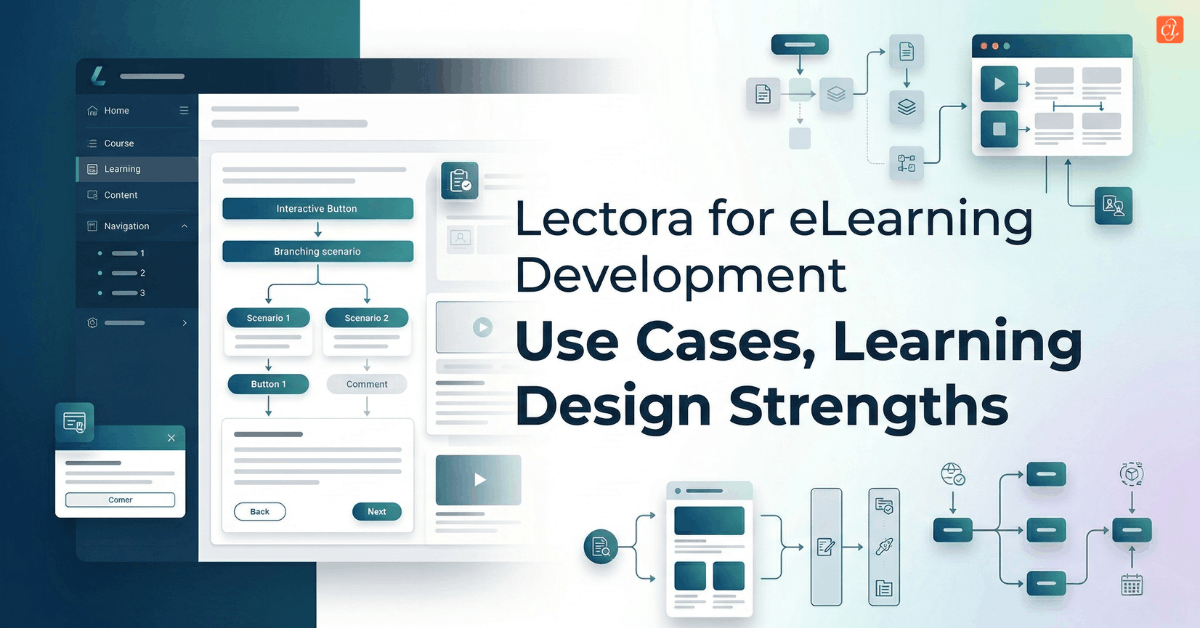
Choosing an authoring tool is rarely just a software decision. For enterprise learning teams, it is often a decision about how training will be designed, how quickly it can be produced, how flexibly it can be adapted, and how effectively it can support real workplace performance.
That is why conversations about Lectora are most useful when they move beyond features and into application.
A tool may have responsive design, assessment options, branching logic, and multimedia support, but the real question is whether those capabilities help solve actual training problems.
- Can it support scenario-based compliance learning instead of passive policy slides?
- Can it make product training more interactive and easier to retain?
- Can it help instructional teams build blended learning assets, role-based pathways, or assessments that do more than check superficial recall?
- Can it support development at a scale that makes sense for enterprise learning operations?
That is where Lectora becomes strategically relevant.
Lectora for eLearning development is especially valuable when organizations need more than basic page-turning content. It supports learning experiences that are interactive, structured, adaptable, and better aligned with how employees learn in complex workplace environments. Rather than treating course authoring as a matter of putting content on screens, it gives learning teams the flexibility to build training that reflects decisions, consequences, application, and context.
In practical terms, Lectora is well suited for building corporate training that requires branching scenarios, formative assessment, blended learning support, responsive delivery, and stronger learner engagement through purposeful interactivity.
That is what makes it worth examining through the lens of use cases rather than software categories.
This article explores where Lectora fits best in eLearning development, what kinds of training problems it helps solve, and why its value becomes clearer when organizations are trying to move from content production to more effective digital learning design.
Download eBook Now: Rapid eLearning Authoring Tools
Table of Contents
- Where Lectora Fits in Modern eLearning Development
- How Lectora Solves Real Corporate Training Challenges
- High-Value Use Cases for Lectora in Enterprise Learning
- Why Lectora Works Well for More Engaging Learning Design
- How Lectora Supports Blended and Continuous Learning
- What Makes Lectora Valuable for Enterprise eLearning Teams
- How to Decide Whether Lectora Is the Right Development Choice
- FAQs
Where Lectora Fits in Modern eLearning Development
Lectora fits best in organizations that want more control over the learning experience without having to build everything from scratch. It supports a middle ground that many enterprise teams need but do not always define clearly. On one side are basic rapid-authoring approaches that produce simple, efficient courses. On the other side are highly customized development environments that can deliver deep flexibility but often require more technical effort and longer production cycles.
Lectora sits in a valuable position between those extremes.
It gives teams the ability to build interactive digital learning with greater structural flexibility, while still supporting practical development workflows for corporate training. That makes it particularly useful when training must do more than present information. It must hold attention, simulate decisions, check understanding, support blended learning, and sometimes adapt to different roles or situations.
This is where Lectora’s development value becomes clearer. It is not simply about producing attractive screens. It is about enabling learning design that is more responsive to how adults actually learn at work.
Lectora is especially relevant when training needs to include:
- Decision-making: Learners need to choose a response, evaluate options, or see consequences.
- Reinforcement: The course must revisit and strengthen understanding rather than rely on one-time exposure.
- Application: Learners need to use knowledge in a realistic context, not just read about it.
- Attention management: Content must compete with workplace distraction and keep learners involved.
- Flexible delivery: Training may need to support self-paced, blended, or multi-format learning journeys.
That combination makes Lectora well suited for modern workplace learning, where attention is fragmented, time is limited, and employees are more likely to engage when training feels purposeful and relevant.
How Lectora Solves Real Corporate Training Challenges
The value of an authoring tool becomes most visible when we look at the recurring problems learning teams face. Lectora is particularly effective in situations where learning must move from passive content exposure to active participation.
Creating more engaging digital learning for distracted learners
One of the most common challenges in workplace learning is divided attention. Employees often complete training alongside meetings, deadlines, system notifications, and other competing demands. In such environments, static content quickly loses momentum.
Lectora can help address this by supporting more active and layered learning experiences. Instructional teams can use interactions, progressive disclosure, clickable pathways, feedback-driven moments, and short decision points to keep learners mentally involved. The goal is not superficial engagement, but cognitive participation. When learners are asked to do something with information rather than simply move through it, they are more likely to stay focused and process meaningfully.
This matters especially in training contexts where completion alone is not enough and where attention loss directly weakens learning outcomes.
Turning assessments into learning experiences
Too many assessments appear only at the end of a course, functioning as a score gate rather than as a learning tool. In stronger instructional design, assessment is woven into the learning journey itself and used to strengthen understanding, provide feedback, and reveal misconceptions early.
Lectora works well for formative assessment because it gives teams the ability to build checkpoints, feedback loops, interactive questions, and layered reinforcement within the course itself. Instead of waiting until the end to test whether someone remembers key points, learning designers can create moments that help learners correct themselves while the content is still fresh.
This approach is especially valuable for:
- compliance training
- onboarding
- product knowledge learning
- technical training
- refresher modules
In these contexts, formative assessment can improve retention, reduce learner overconfidence, and create a more active experience overall.
Supporting branching scenarios and consequence-based learning
Corporate training is often most effective when it helps learners make better decisions. That is difficult to achieve through linear content alone. Employees usually need to interpret situations, respond to ambiguity, and understand the consequences of different actions.
Lectora is well suited for branching scenarios because it allows instructional teams to design multiple paths, role-based choices, and feedback tied to learner decisions. This makes it possible to create learning that reflects real workplace complexity more closely.
Branching scenarios are especially useful in:
- ethics and compliance
- customer service
- sales conversations
- leadership development
- manager training
- safety decision-making
In these areas, learners benefit from seeing not only the right answer, but also why a wrong decision leads to a different outcome. That makes the learning experience more realistic and more memorable.
High-Value Use Cases for Lectora in Enterprise Learning
The strongest case for Lectora comes from the kinds of enterprise training it can support effectively. Rather than treating it as a general-purpose tool for all situations, it is more useful to identify where it brings particular instructional and operational value.
Common enterprise use cases where Lectora fits well
| Use Case | Why Lectora Works Well |
| Branching scenarios | Supports learner choices, multiple pathways, and consequence-based learning |
| Formative assessments | Enables in-course checks, feedback, and reinforcement |
| Blended learning assets | Can support self-paced modules that complement instructor-led experiences |
| Product and process training | Helps structure information with interactive application |
| Engagement-focused modules | Supports interactions that reduce passive consumption |
| Role-based corporate training | Makes it easier to tailor pathways or examples to learner context |
Compliance training with contextual decision-making
Compliance is one of the clearest examples of where Lectora can add value. Many compliance courses fail not because the information is wrong, but because the learning design is too generic. Employees read policy summaries, complete a few recall questions, and move on without having meaningfully interpreted what the policy looks like in practice.
Lectora can help teams design compliance learning that includes realistic scenarios, choice points, role-relevant situations, and immediate feedback. That makes the course more practical and more aligned with workplace judgment.
Product and process training that needs guided application
In product and process training, learners often need to understand sequences, exceptions, and context, not just definitions. Lectora allows learning teams to present information in a structured way while also giving learners opportunities to apply knowledge through scenario choices, guided exploration, and check-for-understanding moments.
This can be especially useful in:
- new product rollouts
- internal process adoption
- SOP training
- customer support onboarding
- operations training
When knowledge needs to move from awareness to application, Lectora provides the flexibility to design that transition more deliberately.
Blended learning support
Blended learning works best when digital components are not treated as isolated add-ons. Self-paced modules should prepare learners for live sessions, reinforce key ideas afterward, or provide practice between facilitated touchpoints. Lectora is useful in blended learning because it can support these roles well.
For example, a Lectora module can be used to:
- introduce foundational concepts before a workshop
- provide a scenario-based activity after a virtual session
- reinforce learning between instructor-led sessions
- deliver ongoing practice and reflection prompts
- assess readiness before certification or coaching
This makes it useful not just for standalone courses, but for broader learning journeys.
Why Lectora Works Well for More Engaging Learning Design
It is easy to say that training should be engaging, but in corporate learning that word often becomes vague. Genuine engagement is not about adding visual effects or layering unnecessary motion onto content. It is about creating experiences that invite attention, interpretation, and action.
Lectora supports this kind of engagement because it helps learning teams vary the structure of the learner experience.
It allows information to unfold more intentionally
Instead of presenting all content at once, designers can reveal information in stages, ask learners to respond before showing an explanation, and create pacing that encourages attention. This helps reduce overload while making the experience feel more participatory.
It supports learning through action
When learners click, choose, compare, respond, predict, or evaluate, they are more likely to process what they are seeing. Lectora’s flexibility helps teams build these action-oriented moments into the course flow rather than adding them as decoration.
It strengthens retention through reinforcement
Engagement is also tied to memory. If learners encounter key concepts only once, retention drops quickly. Lectora can support reinforcement through embedded assessments, repeated decision points, recap structures, and applied practice moments that help learners revisit ideas in different ways.
In practical learning-design terms, Lectora can help teams:
- break long content into more manageable learning moments
- create richer knowledge checks throughout the course
- make scenarios feel more realistic and less scripted
- connect explanation with immediate learner action
- reduce monotony in self-paced training
These are not cosmetic improvements. They directly affect how learners experience and remember training.
Rapid eLearning Authoring Tools
Explore the What and the Why of Popular Rapid eLearning Development Tools, and GenAI Tools
- Categories of eLearning Authoring Tools
- Considerations to Choose Your Next Authoring Tool
- Features of Popular Rapid Authoring Tools
- GenAI Tools to Create Content, Graphics, Audio, and Video
How Lectora Supports Blended and Continuous Learning
One of the more useful ways to think about Lectora is not as a tool for isolated modules, but as a component in a wider learning ecosystem. Many enterprise learning programs today are not delivered as one-time courses. They are delivered as journeys that combine self-paced learning, live facilitation, reinforcement, coaching, and on-the-job application.
Lectora fits well in this kind of ecosystem because it can support multiple roles within the learning flow.
A self-paced module may build foundational understanding before a live session. A short assessment experience may identify gaps before coaching. A branching scenario may reinforce judgment after a workshop. A refresher asset may help employees return to key decisions later, when they need them in practice.
This makes Lectora useful for continuous learning strategies where knowledge needs to be introduced, applied, reinforced, and revisited over time.
Lectora can contribute to a blended or continuous learning model by supporting:
- pre-session preparation
- post-session reinforcement
- readiness checks
- role-based practice
- spaced refreshers
- self-directed performance support
When training is designed this way, the authoring tool becomes part of a broader instructional system rather than a one-time publishing solution.
What Makes Lectora Valuable for Enterprise eLearning Teams
From an enterprise perspective, the strength of Lectora lies not only in what it enables learners to do, but also in what it enables learning teams to build more consistently.
Organizations often need training that can be reused, adapted, and scaled across multiple audiences. They need content that feels interactive without becoming difficult to maintain. They need learning experiences that support performance and fit within larger programs.
Lectora can help teams meet those needs because it supports a combination of instructional flexibility and structured development.
Its enterprise value often shows up in four ways:
- Stronger instructional versatility
Teams can build more than one kind of learning experience, from assessments to scenarios to blended learning assets. - Better alignment with real workplace learning needs
Training can be designed around decisions, application, and reinforcement rather than passive content flow. - Support for scalable development approaches
The tool can be used repeatedly across different contexts and programs with greater consistency. - Improved usefulness across the learning lifecycle
It is relevant not only at launch, but also in reinforcement, follow-up, and continuing learning efforts.
The most important point is that Lectora helps organizations build learning that is more purposeful. Its strengths become clearer when the learning team is trying to solve real instructional problems rather than simply publish content quickly.
How to Decide Whether Lectora Is the Right Development Choice
The right tool is never the one with the longest feature list. It is the one that aligns most closely with the type of learning the organization is trying to create.
Lectora is a strong choice when the training challenge involves judgment, application, branching, learner engagement, blended delivery, or embedded assessment. It becomes especially useful when the learning team wants to move beyond static modules and create digital experiences that feel more active and better connected to workplace performance.
Lectora is likely a strong fit when your team needs to:
- build scenario-based learning experiences
- create meaningful formative assessments
- support blended or multi-touch learning journeys
- reduce passive, linear course design
- create more role-relevant learning pathways
- engage learners through action and feedback
At the same time, if the need is limited to simple awareness content with minimal interactivity and no requirement for branching or richer engagement, a simpler development approach may sometimes be enough.
The value of Lectora becomes clearest when the learning need itself is more demanding. In those situations, its flexibility supports better design decisions and more effective training outcomes.
FAQs
1. What is Lectora used for in eLearning development?
A. Lectora is used to create interactive digital learning experiences such as branching scenarios, formative assessments, blended learning modules, compliance courses, process training, and role-based corporate training.
2. What are the main Lectora use cases in corporate training?
A. Common Lectora use cases include compliance training, product education, process training, blended learning support, scenario-based learning, and assessments that reinforce learner understanding during the course.
3. Is Lectora good for branching scenarios?
A. Yes. Lectora is well suited for branching scenarios because it supports multiple learner paths, decision points, and feedback structures that make learning more realistic and application-focused.
4. Can Lectora be used for formative assessment?
A. Yes. Lectora works well for formative assessment because it allows learning teams to build interactive checks, feedback moments, and reinforcement points throughout the course instead of only at the end.
5. How does Lectora help with learner engagement?
A. Lectora helps improve learner engagement by supporting action-oriented learning experiences such as scenario choices, interactive content reveals, embedded knowledge checks, and structured feedback that keep learners mentally involved.
6. Is Lectora useful for blended learning?
A. Yes. Lectora can support blended learning by providing self-paced modules for pre-work, reinforcement, readiness checks, practice, and follow-up alongside instructor-led or virtual learning experiences.
7. When should an organization choose Lectora for eLearning development?
A. An organization should consider Lectora when training requires more than linear content delivery and when the learning team needs branching, assessments, engagement, blended learning support, or more applied digital learning design.
Conclusion
Lectora becomes most meaningful when it is viewed not as a feature-rich authoring tool, but as a practical response to real learning design challenges. It helps enterprise teams create training that is more interactive, more contextual, and more capable of supporting application rather than simple information transfer.
That makes it especially valuable in a corporate learning environment where employees are distracted, training time is limited, and the real goal is not course completion but better decisions and better performance.
When used well, Lectora supports more than eLearning development. It supports a more thoughtful way of building workplace learning.