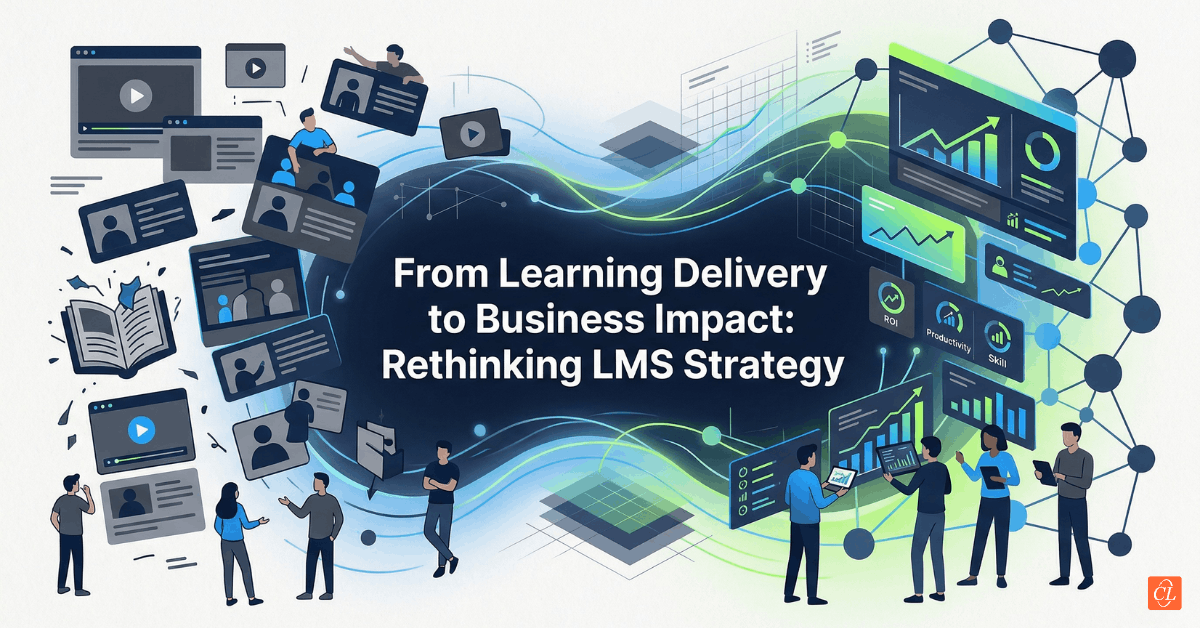
The conversation around learning management systems is no longer about adoption. It is about impact.
Over the last few years, organizations have accelerated their investments in digital learning infrastructure at an unprecedented pace. Today, more than 83 percent of companies rely on an LMS to manage training programs, making it a near-universal component of corporate learning ecosystems.
At the same time, the market itself is expanding rapidly, with global LMS investments expected to exceed $28 billion and grow at a double-digit rate toward $100 billion and beyond in the coming years.
This growth is not driven by technology alone. It reflects a deeper shift in how organizations view learning. Training is no longer a support function. It is becoming a primary driver of workforce readiness, operational agility, and business performance.
And yet, despite this widespread adoption, many organizations find themselves facing a difficult question: If we are investing so heavily in learning systems, why is the business impact still unclear?
The answer lies not in the LMS itself, but in how it is positioned.
Download Now: A Beginner’s Guide to Learning Management Systems
For years, LMS platforms were implemented to solve logistical challenges. They centralized training, automated administration, and enabled large-scale delivery. These capabilities created efficiency, but they did not necessarily create measurable performance outcomes.
Today, that expectation has changed.
Modern organizations are moving beyond training delivery toward performance enablement. They are no longer satisfied with knowing how many courses were completed. They want to understand how quickly employees become productive, how effectively skills translate into execution, and how learning contributes to revenue, efficiency, and risk reduction.
This shift is redefining the role of the LMS.
What was once a system of record is now expected to function as a system of intelligence, one that connects learning activity with real business outcomes through data, analytics, and continuous capability development.
The organizations that recognize and act on this shift are not just improving training. They are fundamentally transforming how learning drives business value.
The Strategic Role of LMS in Modern Organizations
At a structural level, a learning management system enables organizations to deliver, manage, and track training across distributed workforces. However, this functional definition no longer captures its strategic significance.
In mature organizations, the LMS operates as a central layer within the broader capability ecosystem, connecting learning interventions with workforce performance, operational priorities, and long-term business goals. It becomes the mechanism through which knowledge is distributed, skills are developed, and organizational consistency is maintained across geographies and roles.
Its real value emerges not from hosting content, but from enabling outcomes such as reduced time to competency, faster onboarding cycles, improved compliance readiness, and sustained capability development across critical roles.
This distinction is essential.
An LMS does not create value through activity. It creates value through transformation.
Why Traditional LMS Thinking Falls Short
Despite widespread adoption, many organizations continue to approach LMS implementation with a delivery-centric mindset. The system is treated as a repository where content is uploaded, assigned, and tracked.
This approach produces visibility but not insight.
Completion rates increase. Reports become more detailed. Dashboards become more sophisticated. Yet the fundamental question remains unanswered:
What changed because of learning?
The limitation here is not technological. It is conceptual.
When the LMS is positioned as a content distribution system, learning becomes transactional rather than transformational. Engagement declines because learning lacks context. Data becomes fragmented because it measures activity instead of performance. ROI becomes difficult to justify because outcomes are disconnected from business metrics.
This is why many LMS implementations plateau in perceived value.
They optimize delivery without addressing impact.
Reframing LMS as a Business Performance Engine
To unlock meaningful value, organizations must fundamentally reposition the LMS as a performance system rather than a training tool.
This shift begins by redefining the primary question.
Instead of asking how many employees completed training, organizations must ask how effectively those employees apply new skills in their roles. Instead of tracking participation, they must track progression. Instead of focusing on content delivery, they must focus on capability development.
This reframing transforms the LMS into an engine that supports business priorities such as revenue growth, operational efficiency, customer experience, and risk mitigation.
In this model, learning is not isolated. It is embedded within workflows, reinforced over time, and aligned with measurable outcomes.
The LMS becomes the infrastructure that enables this alignment, delivering targeted learning experiences, tracking performance-linked metrics, and continuously adapting to evolving business needs.
The Real Sources of LMS Value
The value of an LMS is often misunderstood because it is evaluated through its features rather than its impact.
In reality, its value emerges through several interconnected capabilities.
Scalability allows organizations to deliver consistent learning experiences across global workforces without increasing cost proportionally. This is particularly critical in environments where rapid expansion, product updates, or regulatory requirements demand immediate and uniform training.
Speed enables organizations to respond to change. Whether onboarding new hires, rolling out product updates, or addressing compliance requirements, the ability to deploy learning quickly becomes a strategic advantage.
Standardization ensures that learning remains consistent across regions while still allowing for contextual adaptation. This balance between uniformity and flexibility is essential for maintaining quality without sacrificing relevance.
Continuous learning transforms training from a one-time event into an ongoing process. By enabling microlearning, reinforcement, and just-in-time support, the LMS ensures that learning remains aligned with real-world application.
Together, these capabilities shift the LMS from an operational tool to a strategic enabler.
Learning Analytics as the Core Differentiator
One of the most significant advancements in LMS platforms is the evolution of analytics from basic reporting to strategic intelligence.
Historically, organizations relied on metrics such as completion rates, assessment scores, and participation levels. While these metrics provide visibility, they offer limited insight into actual impact.
Modern LMS strategies extend beyond these surface-level indicators by integrating learning data with business performance metrics.
This includes correlating training with productivity improvements, identifying skill gaps across teams, predicting future learning needs, and personalizing learning pathways based on role and performance data.
As highlighted in emerging trends, LMS platforms are increasingly functioning as data intelligence engines, capable of linking learning activity directly to business performance outcomes.
This evolution fundamentally changes the role of analytics.
It is no longer about reporting what happened. It is about informing what should happen next.
Measuring ROI Beyond Training Metrics
ROI remains one of the most critical and misunderstood aspects of LMS strategy.
Many organizations attempt to quantify ROI through cost savings such as reduced travel expenses or lower training delivery costs. While these are valid, they represent only a fraction of the overall value.
A more comprehensive approach considers multiple dimensions of impact.
Performance improvements can be observed through increased sales effectiveness, reduced operational errors, and enhanced productivity. Time-based gains are reflected in faster onboarding, quicker skill acquisition, and reduced time to competency.
Risk reduction becomes evident through improved compliance adherence, fewer regulatory issues, and stronger audit readiness. Employee experience also plays a significant role, influencing engagement, retention, and overall satisfaction.
When viewed collectively, these factors provide a more accurate representation of LMS ROI. It is not a single metric. It is a system of outcomes.
Extended Learning and the Expanding LMS Ecosystem
The scope of LMS usage is expanding beyond internal training programs.
Organizations are increasingly leveraging LMS platforms to support external audiences, including customers, partners, and vendors. This shift reflects a broader understanding of learning as a strategic lever across the entire value chain.
Extended learning enables organizations to improve product adoption, enhance partner performance, and ensure consistent messaging across external stakeholders.
In doing so, the LMS evolves from an internal efficiency tool to a driver of external growth.
The Future Direction of LMS Strategy
The LMS landscape is undergoing a significant transformation driven by advancements in technology and changing organizational expectations.
Learning systems are becoming more experience-driven, emphasizing personalization, accessibility, and engagement. Content is becoming dynamic, adapting to individual learner needs and contextual requirements.
Analytics is evolving from descriptive reporting to predictive intelligence, enabling organizations to anticipate skill gaps and proactively address them.
At the same time, LMS platforms are becoming increasingly integrated with other enterprise systems, creating a unified ecosystem that connects learning, performance, and workforce data.
This convergence is redefining the LMS as a central component of organizational strategy.
Aligning LMS Strategy with Business Outcomes
The most critical factor in LMS success is alignment.
An effective LMS strategy begins with a clear understanding of business priorities. These priorities must then be translated into capability requirements, which inform learning design and delivery.
From there, organizations must establish metrics that connect learning activity to performance outcomes, ensuring that progress can be measured and optimized over time.
Without this alignment, the LMS remains an operational tool.
With alignment, it becomes a strategic asset that drives measurable business impact.
Organizations that continue to treat LMS platforms as content repositories will struggle to demonstrate value in an increasingly outcome-driven environment.
Those that reposition LMS as a performance enablement system will gain a measurable advantage by linking learning directly to business results, improving workforce capability, and strengthening organizational agility.
The distinction lies not in the technology itself, but in how it is leveraged.
FAQ
1. Why is an LMS critical for corporate training today?
A. An LMS provides the infrastructure to deliver, manage, and scale training across organizations. More importantly, it enables alignment between learning initiatives and business outcomes such as productivity, compliance, and performance improvement.
2. How does an LMS contribute to business performance?
A. An LMS supports faster onboarding, continuous skill development, and performance reinforcement. By aligning learning with business goals, it helps improve efficiency, reduce errors, and enhance overall workforce capability.
3. What defines LMS success in modern organizations?
A. Success is defined by measurable outcomes such as improved performance, reduced time to competency, and stronger business results, rather than traditional metrics like course completion rates.
4. What role does analytics play in LMS strategy?
A. Analytics transforms LMS from a reporting tool into a decision-making system by connecting learning data with business performance and enabling predictive insights.
5. Can LMS platforms support external audiences?
A. Yes, modern LMS platforms support extended learning for customers, partners, and vendors, enabling organizations to drive consistency, improve adoption, and expand business impact.
6. What is the biggest shift in LMS strategy today?
A. The shift from training delivery to performance enablement is the most significant change, redefining LMS as a strategic business tool rather than an operational system.
Conclusion
The role of the LMS is being redefined in real time.
What began as a solution for managing training has evolved into a platform capable of shaping workforce capability, influencing performance, and driving business outcomes.
Organizations that recognize this shift and adapt their strategy accordingly will move beyond measuring learning activity to demonstrating real impact.
And in doing so, they will unlock the true value of learning, not as a function, but as a force that drives how organizations grow, compete, and succeed.


![5 Hot Mobile Learning Trends [Infographic]](https://www.commlabindia.com/hubfs/Imported_Blog_Media/30-june.jpg)