
Implementing a learning management system is often seen as a milestone. In reality, it is only the beginning.
Many organizations invest significant time and resources in selecting the right LMS, only to discover that the real challenge lies in making it work at scale. The system may be technically sound, feature-rich, and well-aligned with initial requirements, yet adoption remains uneven, administration becomes complex, and the expected impact on learning and performance fails to materialize.
This is not a failure of technology. It is a gap between implementation and operationalization. An LMS does not deliver value when it is deployed. It delivers value when it is embedded into how learning is managed, delivered, and sustained over time.
Download Now: A Beginner’s Guide to Learning Management Systems
This requires more than configuration. It requires a structured approach to implementation, thoughtful integration with existing systems, and a robust administration model that ensures consistency, responsiveness, and continuous improvement.
Organizations that treat LMS implementation as a one-time project often struggle to scale. Those that approach it as an ongoing operational capability build a learning infrastructure that evolves with their business.
Why LMS Implementation Often Underperforms
Despite careful planning, many LMS implementations fail to achieve their intended outcomes. The most common issue is treating implementation as a technical rollout rather than an organizational transformation.
When the focus is limited to system setup, key elements such as user readiness, content alignment, and process integration are often overlooked. As a result, the LMS is deployed successfully from a technical standpoint but struggles to gain traction among users.
Another contributing factor is the lack of clarity around ownership. Without clearly defined roles and responsibilities, administration becomes inconsistent, support requests are delayed, and system governance weakens over time.
Additionally, many organizations underestimate the complexity of integration. An LMS that is not connected to HR systems, performance tools, or content platforms operates in isolation, limiting its effectiveness.
These challenges highlight a fundamental truth. Implementation success is not determined at launch. It is determined by how well the system is sustained.
Reframing Implementation as Operational Design
To achieve long-term success, LMS implementation must be viewed as an exercise in operational design. This means defining not only how the system will be configured, but how it will function within the broader learning ecosystem.
Key questions must be addressed early in the process.
- How will learning programs be structured and delivered?
- Who will manage administration and support?
- How will data flow between systems?
- How will updates and changes be handled over time?
By answering these questions, organizations move beyond deployment planning and begin designing a sustainable operating model.
This shift ensures that the LMS is not just implemented, but integrated into daily learning operations.
Preparing for LMS Deployment: What Must Be in Place
Effective implementation begins with preparation.
Before the system is configured, organizations must establish a clear foundation that includes aligned stakeholders, defined objectives, and structured content readiness.
Stakeholder alignment is critical. Learning teams, IT, HR, and business units must share a common understanding of the LMS’s purpose and expected outcomes. Without this alignment, conflicting priorities can disrupt implementation efforts.
Content readiness is another essential factor. Existing training materials must be reviewed, updated, and structured for digital delivery. Simply transferring content into the LMS without redesign often leads to poor learner engagement.
Equally important is defining governance models. This includes identifying administrators, setting permissions, and establishing processes for content updates, user management, and reporting.
Preparation reduces friction during implementation and sets the stage for long-term success.
Designing a Structured Implementation Approach
A successful LMS implementation follows a phased approach rather than a single launch event.
The process typically begins with system configuration, where the LMS is customized to reflect organizational structure, roles, and learning pathways.
This is followed by pilot testing, which allows organizations to validate functionality, gather feedback, and identify potential issues before full-scale deployment.
Full rollout involves scaling the system across the organization while ensuring that users are supported through onboarding and communication initiatives.
Post-launch optimization is equally important. Continuous monitoring, feedback collection, and iterative improvements ensure that the LMS evolves with organizational needs.
This phased approach reduces risk and improves adoption.
A Beginner’s Guide to Learning Management Systems
- Understanding the Characteristics of a New-age LMS
- Selecting the Right LMS
- Outsourcing LMS Administration and Support
- And More!
Integration as the Backbone of LMS Effectiveness
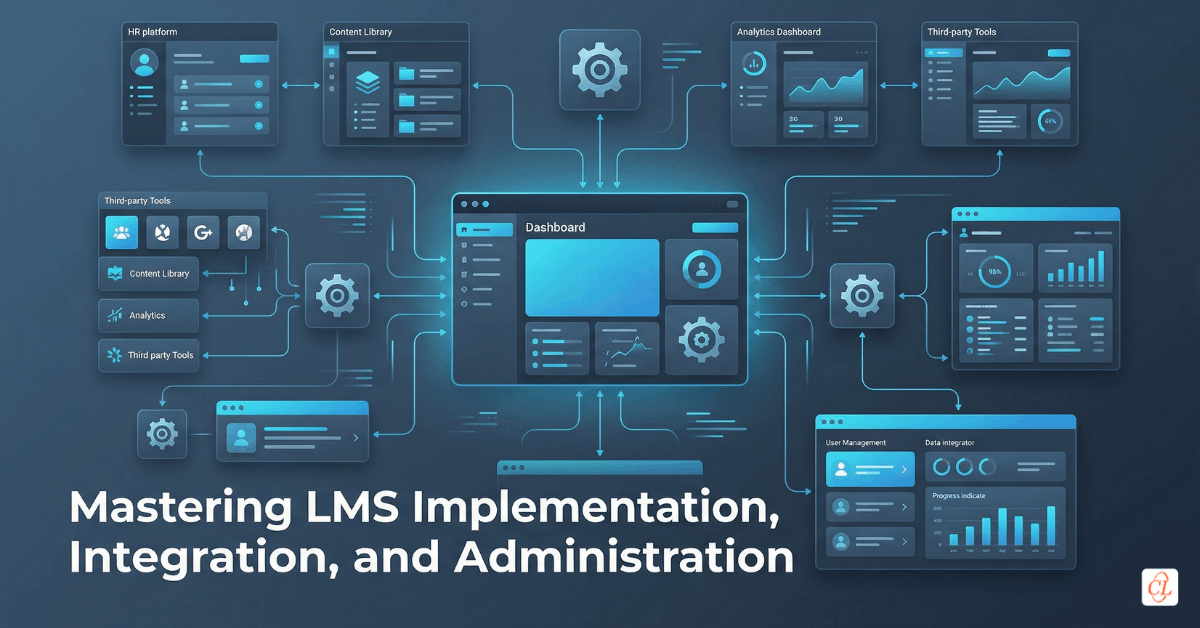
An LMS cannot operate effectively in isolation. Integration is essential for creating a seamless learning ecosystem.
Connecting the LMS with HR systems enables automatic user provisioning and ensures that learning assignments are aligned with roles and organizational structure. Integration with performance management systems allows organizations to link learning outcomes with employee performance data.
Content integration ensures that learning materials can be created, updated, and delivered efficiently. Collaboration tools enable learning to be embedded within workflows, making it more accessible and relevant.
Without integration, the LMS becomes a standalone system. With integration, it becomes part of a connected environment that supports continuous learning and performance.
LMS Administration: The Engine Behind Daily Operations
Once the LMS is implemented, its effectiveness depends on how well it is managed.
Administration is often underestimated, yet it plays a central role in ensuring that the system functions smoothly.
Administrative responsibilities include user management, course assignments, reporting, content updates, and system maintenance. These tasks require both technical proficiency and an understanding of learning processes.
Effective administration ensures consistency, responsiveness, and reliability. It also enables organizations to maintain control over learning programs while adapting to changing needs.
Without strong administration, even the most advanced LMS can become difficult to manage and underutilized.
Scaling Administration Through Support and Outsourcing
As organizations grow, the complexity of LMS administration increases.
Managing large user bases, multiple learning programs, and evolving requirements can strain internal resources.
This is where support models and outsourcing become relevant.
Outsourcing LMS administration allows organizations to access specialized expertise, improve efficiency, and reduce operational burden. It also enables internal teams to focus on strategic initiatives rather than routine tasks.
However, outsourcing must be approached carefully. Clear service agreements, defined responsibilities, and effective communication are essential for success.
A hybrid model, where internal teams retain strategic control while external partners handle operational tasks, often provides the best balance.
Managing Complexity: Multi-Audience and Multi-Tenant Environments
Modern organizations often use LMS platforms to serve diverse audiences, including employees, customers, partners, and vendors.
This introduces additional complexity.
Managing multiple audiences within a single LMS requires careful structuring of content, permissions, and reporting. Multi-tenant capabilities allow organizations to create separate environments within the same system, ensuring that different user groups have tailored experiences.
This approach supports scalability while maintaining clarity and control.
LMS Migration and System Transition Strategies
Switching from one LMS to another is one of the most challenging aspects of LMS management.
Migration involves transferring content, user data, and historical records while minimizing disruption.
A successful transition requires detailed planning, including data mapping, content validation, and user communication. Pilot testing is essential to identify issues before full migration.
Equally important is managing user expectations. Clear communication and support during the transition help ensure smooth adoption of the new system.
Migration is not just a technical process. It is a change management exercise.
Sustaining LMS Performance Over Time
The true test of an LMS lies in its ability to deliver consistent value over time. This requires ongoing monitoring, evaluation, and optimization.
Organizations must regularly review system usage, identify areas for improvement, and update content and processes as needed. Feedback from users provides valuable insights into how the LMS can be enhanced.
Continuous improvement ensures that the LMS remains aligned with organizational goals and evolving learning needs.
FAQ
1. What are the key steps in LMS implementation?
A. The key steps include preparation, system configuration, pilot testing, full rollout, and post-launch optimization. Each stage ensures that the LMS is aligned with organizational needs and functions effectively.
2. Why do LMS implementations fail?
A. Common reasons include lack of stakeholder alignment, poor content readiness, inadequate integration, and weak administration models.
3. What is LMS administration?
A. LMS administration involves managing users, content, reporting, and system maintenance to ensure smooth operation and effective learning delivery.
4. Should LMS administration be outsourced?
A. Outsourcing can improve efficiency and provide specialized expertise, especially for large or complex implementations, but it requires clear governance and communication.
5. How important is integration in LMS implementation?
A. Integration is critical for connecting learning with HR, performance, and business systems, enabling a seamless and effective learning ecosystem.
6. What is involved in LMS migration?
A. Migration includes transferring content, user data, and records from one system to another, along with managing user transition and minimizing disruption.
Conclusion
An LMS does not succeed because it is implemented. It succeeds because it is sustained.
Organizations that approach implementation as a strategic, ongoing capability rather than a one-time project create systems that evolve with their needs, support their workforce, and deliver measurable impact over time.
Those that invest in operational design, integration, and administration build a scalable learning infrastructure that supports continuous growth and performance improvement.
The difference lies in how the system is managed after it is launched.

![Learning Management System— Deep Dive into Benefits and Features [Infographic]](https://www.commlabindia.com/hubfs/blogs/learning-management-system-features-infographic.jpg)