A two-minute video, a scenario-based decision activity, a quick-reference guide, a short quiz, and a software walkthrough may all fall under the broad category of microlearning, but they do not solve the same problem, support the same learner behavior, or create the same kind of value.
When L&D teams overlook those differences, microlearning quickly becomes generic. The content may be short and visually polished, but it often lacks the fit, precision, and usefulness that make microlearning effective in the first place.
That is why format choice matters so much.
In practice, the success of a microlearning strategy depends not only on identifying the right learning needs, but also on selecting the right content model for each one. Some learning needs call for a concise video that demonstrates a process clearly. Others require a scenario that helps learners practice judgment. Some are better served through quick reference assets that employees can revisit at the moment of need. Still others benefit from short assessments that reinforce recall and strengthen retention.
This distinction becomes even more important in corporate training, where L&D teams need to support a wide range of learning goals. A strong microlearning program is rarely built on one asset type alone. It is built on a thoughtful mix of formats, each chosen because it serves a clear instructional purpose.
This article examines the major microlearning formats available to L&D teams, the role each one plays, when to use them, and how to build a more intentional content model around them. The goal is not to promote more content variety for its own sake. It is to help teams make sharper decisions so that every asset format supports a specific learning outcome and fits naturally into the learner journey.
Download Now: Microlearning — Where Does It Fit in Your Learning Strategy?
Table of Contents
- Why Format Choice Matters More Than Most Teams Realize
- A Better Way to Think About Microlearning Assets
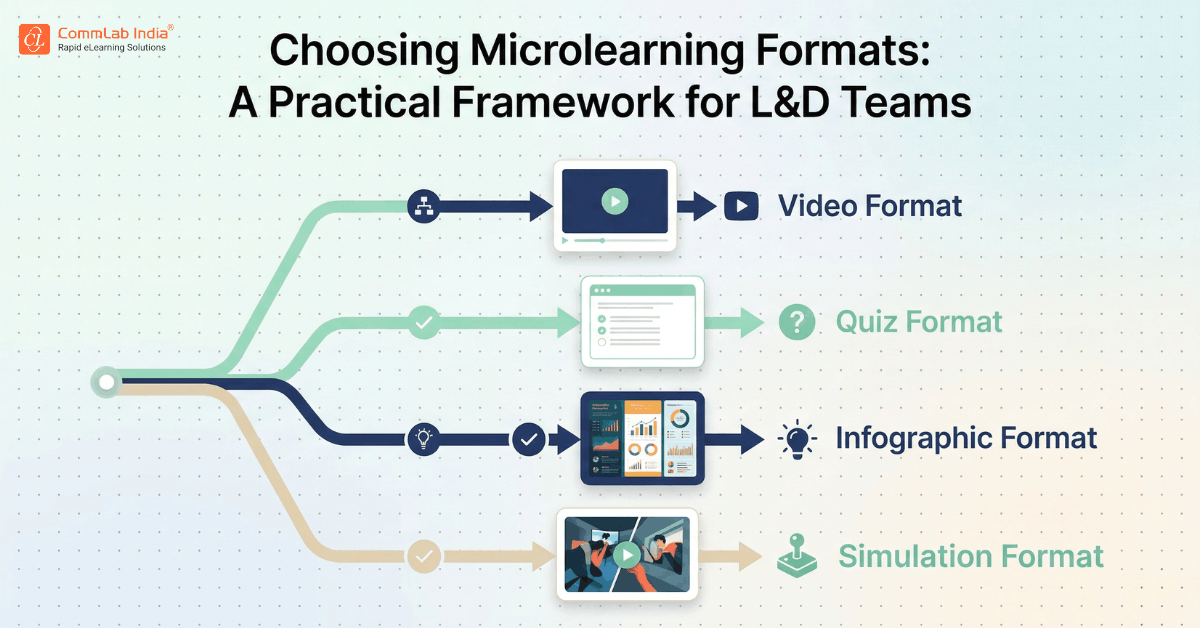
- The Core Microlearning Formats L&D Teams Should Know
- Building a Content Model Instead of a Random Asset Library
- What Strong Microlearning Video Design Looks Like
- How to Combine Formats for Better Learning Impact
- Creating a More Strategic Format Mix for Modern L&D
- FAQs
Why Format Choice Matters More Than Most Teams Realize
In many organizations, microlearning format decisions are made too quickly and often for the wrong reasons.
A request comes in for “short learning,” and the team immediately begins discussing videos, templates, animation styles, or delivery tools. But by starting with production preferences instead of instructional intent, organizations often choose formats that are convenient to create rather than effective for the learner need at hand.
This is a costly mistake, because in microlearning, the format does much more than shape the look and feel of content. It shapes how the learner encounters information, how much context can be communicated, how interaction happens, how easily the asset can be revisited, and how well the learning transfers into performance.
A short video may be excellent for showing a product feature in action, but it may be far less effective for helping a manager respond to a difficult employee conversation. A checklist may be ideal for procedural accuracy, but not for building conceptual understanding. A scenario may be powerful for compliance judgment, but excessive for a simple process reminder.
What this means in practice is that format choice is not a finishing decision. It is an instructional decision.
The strongest microlearning programs are built by teams that ask a more disciplined question at the start:
What kind of learning experience does this need to be in order to help the learner understand, decide, remember, or act correctly?
Once that question is answered, format selection becomes far more purposeful.
A better approach begins by understanding that microlearning assets are not simply short pieces of content. They are different modes of learning support, each with a distinct strength.
A Better Way to Think About Microlearning Assets
Many teams think about microlearning in terms of individual formats such as videos, quizzes, or infographics. While that is useful at one level, it often leads to a fragmented view of the content ecosystem. A more strategic way to think about microlearning is to group assets by the role they play in learning and performance.
This perspective helps L&D teams move beyond format preferences and focus instead on function.
Broadly speaking, most microlearning assets tend to serve one of four purposes:
- Helping learners understand something quickly
- Helping learners practice or decide
- Helping learners remember and reinforce
- Helping learners perform at the moment of need
When viewed through this lens, the question becomes less about which format is popular and more about which content model best supports the learner’s immediate need.
Four functional categories of microlearning assets
| Asset Function | Primary Purpose | Common Formats |
| Explain | Clarify a concept, process, or idea quickly | Explainer videos, short modules, visual summaries |
| Practice | Help learners think, decide, or apply | Scenarios, mini simulations, quizzes, branching interactions |
| Reinforce | Strengthen retention over time | Flashcards, recall checks, short assessments, recap videos |
| Support performance | Guide action in the workflow | Job aids, checklists, quick reference tools, walkthroughs |
This model is useful because it prevents teams from seeing all microlearning formats as interchangeable. It also makes content planning much more coherent. Once the functional role of the asset is clear, the choice of format becomes easier and more defensible.
The Core Microlearning Formats L&D Teams Should Know
Microlearning works best when L&D teams understand the strengths and limitations of the major format options available to them. While the exact list will vary depending on the authoring tools and business context, most enterprise microlearning programs rely on a familiar set of content formats.
1. Short explainer modules
These are compact learning assets designed to clarify one concept, process, product feature, or behavioral expectation. They work well when the learner needs focused understanding without unnecessary depth.
Their strength lies in focus and speed. Their limitation is that they can become passive if they are used too often without interaction or reinforcement.
2. Microlearning videos
Videos remain one of the most popular microlearning formats because they are easy to consume and highly effective for demonstrations, storytelling, visual explanation, and emotional engagement. They can be particularly useful when showing a process, modeling a behavior, or highlighting a realistic workplace situation.
However, videos are not a universal solution. They can create passive consumption if they are poorly designed, and they are not always ideal for quick retrieval in the moment of need.
3. Scenario-based interactions
These formats place learners in realistic situations and ask them to make decisions, interpret risks, or choose the best response. They are especially powerful when the learning goal involves judgment, application, or behavioral choice.
Their major advantage is realism. Their limitation is that they usually require more design effort than basic informational assets.
4. Quick-reference assets
These include checklists, process cards, visual guides, decision trees, and compact job aids. They are built for retrieval and performance support rather than for initial concept teaching.
These assets can create enormous practical value because they live close to the workflow and are often reused frequently.
5. Short assessments and recall checks
Assessments in microlearning are often underused, but they can be extremely effective when designed as reinforcement tools rather than formal testing mechanisms. Short quizzes, confidence checks, and recall prompts strengthen retention by prompting learners to retrieve and apply information actively.
6. Mini simulations and guided walkthroughs
These are particularly valuable for systems training, process practice, and digital task support. They allow learners to observe, try, or rehearse steps in a realistic but contained environment.
Their value lies in helping learners bridge the gap between knowing and doing.
Building a Content Model Instead of a Random Asset Library
One of the most common weaknesses in microlearning implementation is the absence of a content model. Teams create individual assets, sometimes very good ones, but the overall library lacks structure. The result is a collection of disconnected materials that are difficult to navigate, reuse, or scale.
A content model solves this problem by giving the asset ecosystem logic.
Instead of treating each asset as a separate object, a content model defines:
- which asset types exist
- what purpose each type serves
- how assets are sequenced
- where they appear in the learner journey
- how they support each other over time
This turns microlearning from a production stream into an instructional system.
What a simple microlearning content model might include
- Core explainers for concept clarity
- Practice assets for decision-making or applied understanding
- Reference assets for workflow support
- Reinforcement assets for post-training retention
- Video assets where demonstration or human context matters most
This type of structure is especially useful at scale because it makes asset planning easier, improves consistency, and helps L&D teams identify where gaps exist. It also helps business stakeholders understand why multiple assets may be needed around one topic, since each asset plays a different role.

Where Does Microlearning Fit in Your Learning Strategy?
Uncover the Secrets to Crafting High-performing Micro Assets!
- What Microlearning is and What it is NOT?
- Types of Microlearning Assets
- Tips and Tools for Rapid Microlearning Development
- And More!
What Strong Microlearning Video Design Looks Like
Because videos are such a prominent part of many microlearning programs, it is worth addressing what makes them effective.
A good microlearning video is not simply a shorter traditional training video. It is tightly scoped, highly intentional, and built around one clear learner value.
Strong microlearning videos usually share several characteristics:
- they focus on one topic, task, or situation
- they establish relevance quickly
- they remove unnecessary introduction and filler
- they use visuals purposefully, not decoratively
- they are easy to understand without excessive cognitive effort
- they end with a clear takeaway, prompt, or application cue
Practical design considerations for microlearning videos
- Keep the scope narrow
A video should solve one learner problem clearly rather than trying to cover several loosely related points. - Open with relevance
Learners should immediately understand what the video will help them do, avoid, or understand. - Show, do not over-explain
Demonstration is one of video’s greatest advantages. Use it where seeing the process or behavior adds real value. - Design for retention
Reinforce a clear takeaway so the learner leaves with something memorable and usable. - Think about reusability
Videos are more valuable when they can support multiple moments in the learner journey, not just one-time consumption.
The most effective microlearning videos are usually those that respect time, reduce friction, and give the learner something practical to carry back into work.
How to Combine Formats for Better Learning Impact
While individual formats matter, the strongest microlearning programs rarely rely on one asset type alone. They combine formats in ways that support the full learning need more effectively.
This is especially important when a learning objective involves more than one phase, such as understanding, practicing, remembering, and performing. A single asset may help with one of those phases, but not all of them.
For example:
- a short explainer may introduce a concept
- a scenario may help the learner apply it
- a checklist may support correct execution on the job
- a short quiz may reinforce retention afterward
This kind of combination is often more effective than trying to force one format to do everything.
Examples of format combinations that work well
- Onboarding sequence
Orientation video + quick process guide + reinforcement quiz - Compliance sequence
Scenario-based decision activity + policy summary + refresher check - Product enablement sequence
Demo video + feature card + objection-handling scenario - Systems training sequence
Walkthrough video + guided simulation + task checklist
This is where microlearning becomes much more than a set of short assets. It becomes a modular content strategy capable of supporting different stages of learning and performance.
Creating a More Strategic Format Mix for Modern L&D
For L&D teams, the goal should not be to use every format available. It should be to build a format mix that reflects actual learning priorities.
That requires discipline. It means resisting the temptation to default to video, avoiding unnecessary asset variety, and being clear about what each format is meant to accomplish. It also means thinking at the content-model level rather than the single-asset level.
A strategic format mix usually has several characteristics:
- it is aligned to recurring learning goals
- it reflects real workflow needs
- it balances explanation, practice, reinforcement, and support
- it can be scaled and maintained efficiently
- it makes sense to learners, not just content owners
The most effective microlearning ecosystems are not the ones with the most formats. They are the ones where every format has a clear reason to exist.
That is the real measure of maturity.
When L&D teams begin choosing formats in this way, microlearning becomes more useful, more coherent, and more clearly connected to performance. And that is when short-form learning starts delivering its full value.
FAQ
1. What are the most effective microlearning formats?
A. The most effective microlearning formats depend on the learning goal. Videos work well for demonstrations and modeling, scenarios help with decision-making, quick-reference assets support workflow performance, and short assessments reinforce retention. The best format is the one that matches the learner’s immediate need.
2. Are microlearning videos better than other asset types?
A. Microlearning videos are highly effective for visual explanation, demonstration, and behavior modeling, but they are not always the best choice. In many cases, a checklist, scenario, walkthrough, or quick-reference asset may support faster use and better performance.
3. What types of microlearning assets should L&D teams use?
A. L&D teams should use a mix of asset types, including short explainer modules, videos, scenarios, quick-reference tools, assessments, and simulations. The right combination depends on whether the goal is understanding, practice, reinforcement, or point-of-need support.
4. How do you choose the right microlearning format?
A. Choose the format by starting with the learner need. Determine whether the learner needs to understand a concept, practice judgment, recall information, or perform a task. Then select the asset type that supports that need most clearly and efficiently.
5. When should microlearning videos be used in corporate training?
A. Microlearning videos should be used when learners benefit from seeing a process, behavior, conversation, or feature in action. They are especially useful in product training, soft skills, software demos, onboarding, and reinforcement after formal training.
6. What is a microlearning content model?
A. A microlearning content model is a structured way of organizing asset types so each one serves a clear purpose within the learner journey. It defines how explanatory, practice, reinforcement, and reference assets work together instead of existing as isolated content pieces.
7. Can microlearning formats be combined?
A. Yes. In fact, combining formats often creates stronger learning results. A short video can introduce a concept, a scenario can support application, and a checklist can help learners perform correctly on the job. This approach makes microlearning more effective and more relevant.
Conclusion
Microlearning becomes far more powerful when format decisions are made with instructional intent rather than production habit.
Videos, scenarios, quick-reference tools, assessments, simulations, and short explainers all have value, but they do not create value in the same way. Each one supports a different kind of learner need, and each one works best when it is selected for a clear reason. Once L&D teams begin treating formats as strategic content choices rather than interchangeable assets, the quality of microlearning design improves immediately.
This is especially important in corporate training, where learning goals vary widely and the pressure to create useful, scalable content is constant. A strong program does not rely on one preferred format. It builds a thoughtful content model in which different asset types support explanation, practice, reinforcement, and performance in complementary ways.
That is what turns a collection of short assets into a real microlearning ecosystem. And that is where format strategy begins to make a measurable difference.