
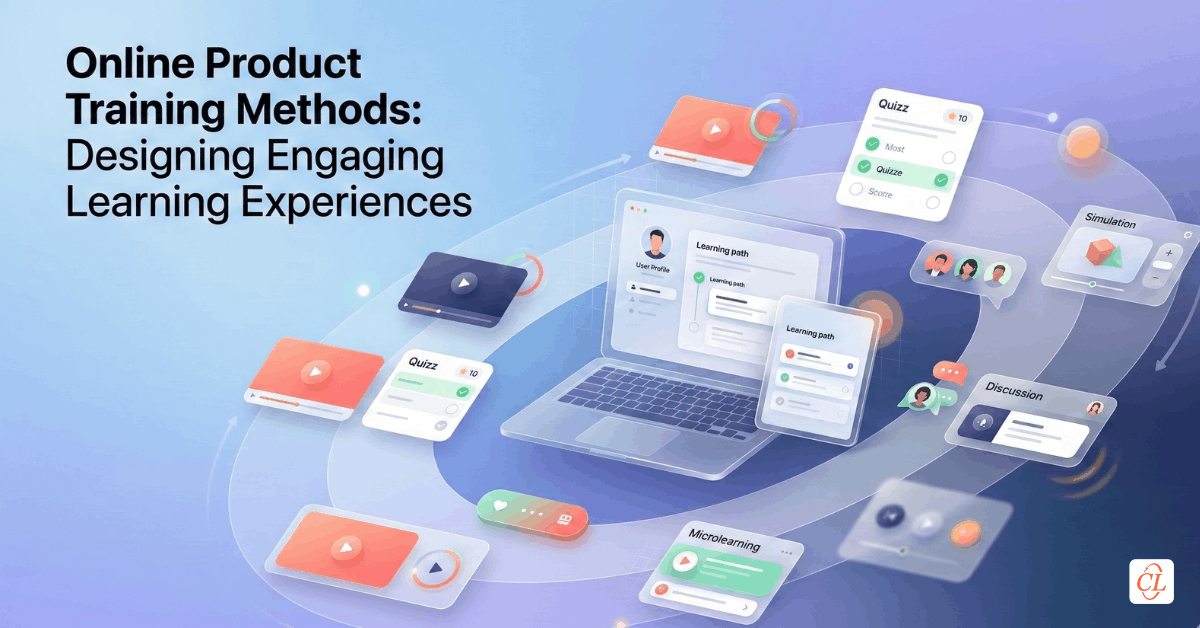
The effectiveness of product training is not determined solely by what is taught, but by how that learning experience is designed and delivered. Organizations often invest significant effort in building content, yet overlook the delivery methods that shape how learners interact with that content, absorb information, and apply it in real-world situations.
In many cases, product training is delivered through a single format, such as static eLearning modules or occasional live sessions, without considering whether that format aligns with the nature of the content or the needs of the learner. This mismatch can lead to low engagement, limited retention, and minimal impact on performance.
The challenge, therefore, is not just to deliver training, but to design a learning experience that is flexible, engaging, and aligned with how people actually learn and work.
In this article, you will explore how to select and combine online product training methods, how to design blended learning experiences that enhance effectiveness, and how to create engagement-driven training environments that support continuous learning and performance.
Why Delivery Methods Matter in Product Training
Delivery methods play a critical role in shaping how learners engage with content and how effectively they retain and apply knowledge. Even the most well-structured product training strategy can fall short if the delivery approach does not support the learning objectives.
Different types of product knowledge require different modes of delivery. For example, conceptual understanding may be best achieved through structured modules, while skill application may require interactive scenarios or live discussions. Similarly, demonstration-based learning benefits from visual formats such as video, while collaborative learning may require facilitated sessions.
When delivery methods are chosen strategically, they enhance clarity, improve engagement, and create opportunities for application. When they are chosen without consideration, they can create friction and reduce the effectiveness of training.
Understanding the Spectrum of Online Product Training Methods
Modern product training relies on a range of digital learning methods, each serving a specific purpose within the overall learning experience. Rather than relying on a single format, organizations benefit from combining multiple methods in a way that aligns with learning objectives.
1. Self-Paced eLearning Modules
Self-paced modules provide a structured way to deliver foundational knowledge, allowing learners to progress at their own pace. These modules are particularly effective for introducing product features, explaining concepts, and providing consistent information across distributed teams.
However, their effectiveness depends on design quality. Static, text-heavy modules can reduce engagement, while interactive and well-structured modules can enhance understanding and retention.
2. Video-Based Learning
Video is a powerful medium for demonstrating product functionality, illustrating workflows, and modeling customer interactions. It allows learners to see processes in action, which can be more effective than reading descriptions.
Videos are particularly useful for:
- product demonstrations
- walkthroughs of features and interfaces
- examples of sales conversations or customer interactions
When integrated effectively, video-based learning adds clarity and improves comprehension.
3. Live Virtual Training and Webinars
Live sessions, such as webinars and virtual classrooms, provide opportunities for real-time interaction, discussion, and clarification. They are especially valuable for addressing complex topics, facilitating Q and A, and encouraging collaboration among learners.
Webinars can also be used to:
- introduce new product updates
- conduct deep dives into specific topics
- engage learners through discussions and polls
The interactive nature of live training helps reinforce learning and build a sense of connection among participants.
4. Scenario-Based and Interactive Learning
Scenario-based learning places learners in realistic situations where they must make decisions and apply knowledge. This approach is particularly effective for developing problem-solving skills and preparing learners for real-world interactions.
Interactive elements such as branching scenarios, simulations, and decision-based exercises encourage active participation and help learners think critically about how to apply their knowledge.
5. Microlearning and Just-in-Time Learning
Microlearning delivers content in short, focused segments that are easy to consume and revisit. This approach is ideal for:
- quick updates
- reinforcement of key concepts
- on-demand access to specific information
Just-in-time learning ensures that learners can access relevant information at the moment they need it, supporting performance in real time.
Designing Blended Product Training Experiences
Blended learning combines multiple delivery methods to create a more comprehensive and effective training experience. Instead of relying on a single format, blended approaches leverage the strengths of different methods to address various learning needs.
Why Blended Learning Works
Blended learning allows organizations to balance flexibility with interaction. Self-paced modules provide foundational knowledge, while live sessions enable discussion and clarification. Interactive elements reinforce application, and microlearning supports ongoing reinforcement.
This combination creates a more dynamic learning experience that accommodates different learning preferences and contexts.
Structuring a Blended Product Training Program
A well-designed blended program typically follows a structured progression.
It may begin with self-paced modules that introduce key concepts and provide a foundation of knowledge. This is followed by live sessions where learners can explore topics in greater depth, ask questions, and engage in discussions.
Interactive exercises and scenarios can then be used to reinforce learning and provide opportunities for application. Finally, microlearning resources and performance support tools ensure that knowledge remains accessible over time.
This layered approach ensures that learning is not only delivered but also reinforced and applied.
Balancing Classroom and Online Learning
In some cases, organizations may incorporate in-person or classroom-based training as part of a blended approach. While digital learning offers scalability and flexibility, classroom sessions can provide deeper engagement and hands-on experiences.
The key is to ensure that each component serves a specific purpose and complements the others. Classroom sessions should focus on activities that benefit from direct interaction, such as role-playing or collaborative problem-solving, while online components should deliver scalable and accessible content.
Creating Engaging Product Training Experiences
Engagement is a critical factor in determining the effectiveness of training. Learners are more likely to retain and apply knowledge when they are actively involved in the learning process.
One way to enhance engagement is by incorporating interactivity into training design. This includes elements such as quizzes, scenarios, and decision-making exercises that require learners to think and respond rather than passively consume information.
Another important factor is relevance. Training should reflect real-world situations and challenges that learners encounter in their roles. When learners can see the direct applicability of what they are learning, their motivation to engage increases.
Visual design and multimedia elements also play a role in engagement. Well-designed visuals, videos, and layouts can make content more appealing and easier to understand.
Using Webinars to Improve Product Training Effectiveness
Webinars are often underutilized in product training, yet they offer significant potential for enhancing learning experiences.
When designed effectively, webinars can:
- facilitate real-time interaction and discussion
- provide opportunities for immediate feedback
- allow experts to share insights and answer questions
- create a sense of community among learners
To maximize effectiveness, webinars should be structured to encourage participation rather than passive listening. This may include interactive elements such as polls, breakout discussions, and Q and A sessions.
Recording webinars and making them available for later access also extends their value and supports ongoing learning.
Leveraging Video for Product Training
Video-based learning is particularly effective for demonstrating how a product works and how it is used in real scenarios. It allows learners to observe processes and interactions, which can improve understanding and retention.
Short, focused videos can be used to highlight specific features or workflows, while longer videos can provide more comprehensive explanations. Incorporating storytelling elements, such as customer use cases or success stories, can make videos more engaging and relatable.
To ensure effectiveness, videos should be designed with clear objectives, concise messaging, and high production quality.
Ensuring Consistency Across Delivery Methods
While using multiple delivery methods offers flexibility and depth, it also introduces the challenge of maintaining consistency. Learners should experience a cohesive journey regardless of the format they engage with.
This requires:
- consistent messaging and terminology
- alignment of learning objectives across formats
- integration of content across modules, videos, and live sessions
Consistency ensures that learners can connect different pieces of information and build a unified understanding of the product.
Even with the best intentions, organizations can encounter challenges in designing effective delivery methods.
Relying too heavily on a single format limits the ability to address different learning needs. Overloading learners with too many formats without clear structure can also create confusion.
Another common mistake is focusing on technology rather than learning experience. While tools and platforms are important, they should support the learning process rather than dictate it.
Finally, neglecting engagement and interactivity can result in passive learning experiences that do not translate into performance.
Final Thoughts
Effective product training is not just about delivering content but about designing a learning experience that supports understanding, application, and continuous improvement. By combining online product training methods with a thoughtful blended approach, organizations can create training programs that are both scalable and impactful.
When delivery methods are aligned with learning objectives and designed with the learner in mind, product training becomes more than an information-sharing exercise. It becomes a system that enables employees to perform with confidence and adapt to changing demands.


![6 Ways to Use Virtual Training for Employee Training [Slideshare]](https://www.commlabindia.com/hubfs/Imported_Blog_Media/corporate-training-virtual-training-methods-slideshare.jpg)

![6 Questions to Get the Right Feedback on Training [Infographic]](https://www.commlabindia.com/hubfs/Imported_Blog_Media/6-questions-to-get-right-feedback-on-online-training-infographic.jpg)