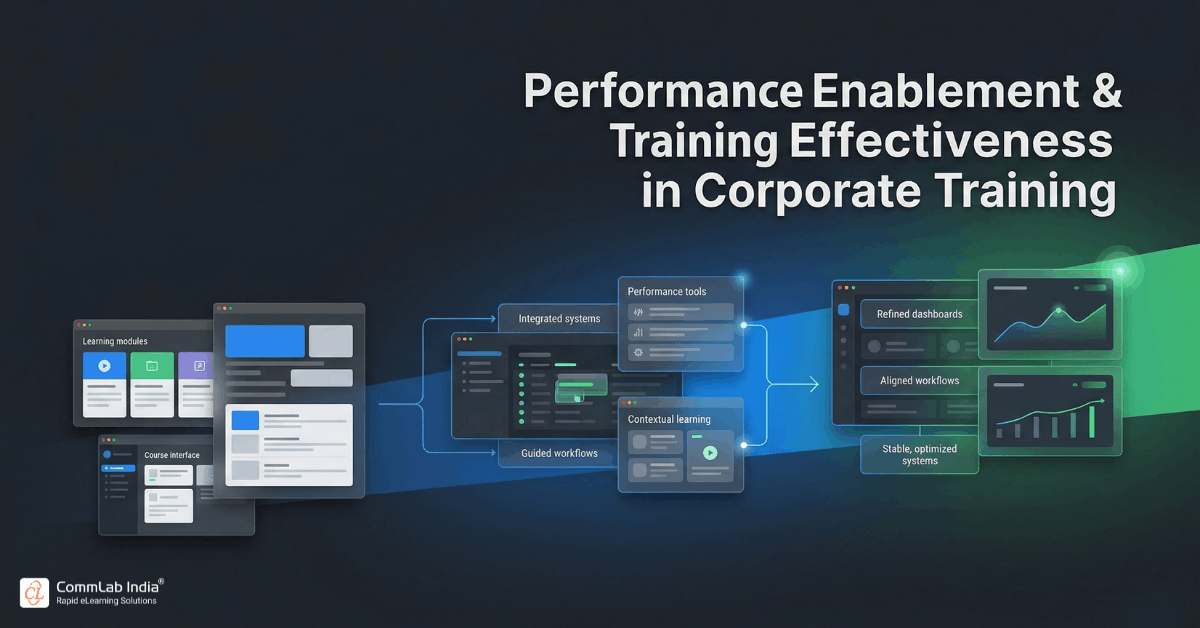
Organizations do not invest in corporate training simply to create learning activity. They invest because they expect a measurable shift in capability, execution, consistency, quality, speed, and decision-making. They want employees to do the work better, not just understand it more clearly in a training environment.
This is where the conversation must move beyond courses and into something more strategically important: performance enablement.
A performance-enabled training strategy recognizes that formal learning is only one part of what employees need. Understanding is essential, but so is recall under pressure. So is support in the flow of work. So is reinforcement after the initial learning event. So is visibility into where people are still struggling, even after training appears complete.
That is why modern organizations are paying closer attention to performance support in corporate training, learning analytics, training effectiveness, and the broader systems that help employees move from exposure to execution.
These topics are often treated separately. In practice, they belong together.
Performance support helps employees act when memory alone is not enough. Learning analytics helps organizations see where learning is breaking down or where support is needed. Training effectiveness helps move evaluation beyond attendance and completion into workplace impact. Together, they help corporate learning do what it has always been expected to do, but not always designed to do well: improve performance where work actually happens.
This article explores how organizations can build that bridge more deliberately, and why the future of corporate training depends less on how much learning is delivered and more on how well it enables performance after delivery ends.
Download Play Book: 25 Years of Insights for L&D Leaders
Table of Contents
- Why Performance Support Has Become Essential to Modern Learning
- When Employees Need Performance Support More Than Formal Training
- How to Design Performance Support Tools That Employees Actually Use
- Learning Analytics in Corporate Training: From Reporting to Insight
- How to Measure Training Effectiveness More Credibly
- Why Responsive, Well-Managed Digital Learning Improves Performance
- How Corporate Training Connects to Broader Performance Management
- How to Build a Performance-Enabled Learning Ecosystem
- FAQs
Why Performance Support Has Become Essential to Modern Learning
If performance enablement is the broader strategic shift, performance support is one of the most important ways that shift becomes operational.
Performance support matters because employees often do not need a full re-explanation of what they were taught. What they need is quick, trustworthy support at the exact moment they are trying to do the work.
That moment matters more than many training strategies account for.
An employee may have completed a process training module weeks ago, but now needs to execute a task they have only encountered twice. A sales representative may remember the broad product narrative, but need a specific detail before a customer conversation. A manager may understand a workflow in principle, but need a step-by-step prompt while using a system under deadline. In these cases, the issue is not always lack of training. It is the absence of support in the moment of application.
That is where performance support becomes far more valuable than simply asking employees to “remember better.”
What Performance Support Actually Includes
Performance support can take many forms depending on the task and context. Common examples include:
- Digital job aids
Quick-reference tools that simplify recurring tasks and reduce dependency on memory. - Checklists
Structured step prompts that help employees execute consistently, especially in high-risk or multi-step workflows. - Short how-to videos
Useful when employees need to see a task or system sequence rather than read about it. - Process maps or flow guides
Especially helpful for procedures involving branching logic or decision points. - Searchable FAQs and support hubs
Valuable when employees need quick answers without navigating full courses. - Decision trees or scenario prompts
Useful in judgment-heavy roles where the right response depends on context.
These tools are most effective when they are built around real task friction, not generic information storage.
Why Performance Support Is Often Underbuilt
Many organizations still devote most of their effort to formal learning and far less to what happens afterward. That imbalance is understandable. Courses are easier to scope, launch, and report on. Performance support requires closer observation of workflow, user need, and recurring employee pain points.
But this is often where a significant portion of training value is either realized or lost.
A well-designed course can help someone understand a task. A well-designed performance support tool helps them do it correctly when it actually counts.
That is why performance support is not supplementary. In many cases, it is the missing operational layer that allows learning to become usable.
When Employees Need Performance Support More Than Formal Training
One of the clearest signs of a mature learning strategy is the ability to distinguish between a learning need and a support need.
Not every performance issue requires another course. In fact, some of the most common workplace friction points are better solved by making execution easier rather than asking employees to relearn the entire concept.
This is where many organizations can improve quickly and meaningfully.
A useful question to ask is: Does the employee need to build new capability, or do they need better support while using an existing capability?
The answer often changes the design response entirely.
Situations Where Performance Support Is Especially Effective
Performance support tends to work particularly well in situations such as these:
- Infrequent tasks
Employees may not retain detailed steps for processes they encounter only occasionally, even if they were trained properly the first time. - Complex workflows
Multi-step procedures often benefit from structured prompts that reduce error and hesitation during execution. - Software and systems usage
Employees often need real-time support when navigating interfaces, forms, or process logic inside enterprise systems. - Compliance-sensitive execution
Where accuracy matters, just-in-time support can reduce risk more effectively than relying only on memory from annual training. - Customer-facing interactions
Employees may need product, policy, or conversation support while engaging in live service or sales moments. - Frequently changing information
When procedures, product details, or regulations shift regularly, support tools are often more agile than repeated retraining.
When Formal Training Is Still the Better Primary Response
Performance support is powerful, but it is not a substitute for everything. Employees still need formal learning when they are:
- learning a concept for the first time
- building foundational understanding
- developing judgment or critical thinking
- practicing complex decision-making
- preparing for role transition or higher-stakes responsibilities
This is why the best strategies do not frame formal learning and performance support as competing solutions. They are complementary. Formal training builds capability. Performance support helps employees use that capability more reliably.
That combination is where workplace learning becomes significantly more effective.
How to Design Performance Support Tools That Employees Actually Use
A performance support tool only creates value if it is genuinely usable in the moment it is needed. That sounds obvious, but many support assets fail because they are designed as condensed training rather than as tools for action.
This is an important distinction.
A job aid is not simply a smaller course. A quick-reference guide is not just a shortened manual. Performance support works best when it is built around the decision speed, cognitive load, and task reality of the employee using it.
That requires a different design mindset.
What Effective Performance Support Tools Tend to Have in Common
The most useful tools generally share several characteristics:
They are immediately accessible
If employees cannot find the support quickly, they are unlikely to use it when under pressure.
They are tightly scoped
Each asset should solve a clear, specific problem rather than trying to cover every related topic.
They are easy to scan
Support tools should reduce thinking friction, not create more of it.
They follow the logic of the task
The structure should mirror how the employee experiences the work, not how the content was originally organized for instruction.
They are built for action
Employees should be able to use the tool while doing the work, not only before or after it.
Design Practices That Improve Real-World Use
The following design principles are especially valuable:
- Organize by task rather than subject category
Employees usually search for what they are trying to do, not the conceptual label attached to it. - Keep each support asset narrow and purposeful
A short, specific aid is often more useful than a large all-in-one reference that becomes difficult to navigate. - Use structure that supports quick retrieval
Headings, steps, icons, visual grouping, and concise wording can make a significant difference under time pressure. - Test with real employees before scaling
What appears clear to a designer or SME may not feel intuitive in the actual workflow.
A small number of well-designed support tools often creates more practical value than a large volume of content that employees rarely return to.
That is one of the most overlooked truths in corporate learning design.
Learning Analytics in Corporate Training: From Reporting to Insight
As corporate learning becomes more digital, organizations have access to more data than ever before. Yet many still struggle to answer a surprisingly basic question:
What is this data actually helping us improve?
That is the core challenge of learning analytics in corporate training.
Too often, analytics remain trapped in reporting. Dashboards show completions, enrollments, time spent, or assessment scores, but those metrics are not always translated into meaningful learning decisions. The data exists, yet the learning ecosystem does not necessarily become smarter because of it.
This is where analytics needs to evolve.
What Learning Analytics Should Help Organizations Understand
At its best, analytics should help learning teams move beyond visibility and into diagnosis. It should help them understand:
- Where learners are dropping off or disengaging
- Which assets are being used repeatedly and which are ignored
- What topics or tasks are causing friction
- Whether support resources are being used after formal learning
- Which audiences are progressing differently
- Where reinforcement, redesign, or simplification may be needed
That kind of insight is much more useful than simply knowing how many people completed a course.
A More Strategic Way to Think About Learning Data
A useful analytics strategy usually looks across three levels:
| Analytics Layer | What It Helps You See |
| Usage Data | What employees access, revisit, complete, skip, or abandon |
| Learning Data | Where understanding appears strong or weak, based on assessments or scenario performance |
| Performance Signals | Where training and support may be influencing execution, confidence, consistency, or task success |
This layered view is important because training effectiveness rarely reveals itself through one metric alone. Completion may show reach. Assessment performance may show understanding. Support-tool usage may reveal where learners still need help. Operational or manager feedback may indicate whether the learning is actually influencing performance.
Why This Matters for L&D Credibility
A more thoughtful analytics approach helps L&D have better business conversations.
Instead of saying, “This program reached 92% of employees,” teams can begin saying:
- “These are the points where learners struggled most.”
- “These are the support assets being revisited most often after launch.”
- “These are the areas where additional reinforcement appears necessary.”
- “These are the workflow points where employees still need help.”
That is a much more valuable contribution because it positions learning not as a reporting function, but as a performance improvement function.

Learning Evolved: 25 Years of Insights for Modern L&D Leaders
Get ready to:
- Benchmark your eLearning journey
- Start with what’s working for top enterprise L&D teams
- Explore self-assessments, planners, and other tools
- Much More
How to Measure Training Effectiveness More Credibly
If organizations want corporate training to be taken seriously as a business capability, they need a more credible way to evaluate whether it is actually working.
The problem is not that training cannot be measured. The problem is that measurement often begins too late and asks too little.
By the time many teams start talking about effectiveness, the training has already been launched, the content is fixed, and the evaluation conversation is reduced to whatever metrics are easiest to collect. That usually leads to narrow interpretations of success.
A better approach begins much earlier.
Start With the Intended Workplace Shift
A more useful evaluation process begins with a simple but powerful question:
What should be measurably easier, better, faster, or more consistent if this training and support strategy works?
That question anchors evaluation to workplace movement, not just learning activity.
A Practical Framework for Evaluating Training Effectiveness
A stronger measurement model usually includes multiple layers of evidence:
| Evaluation Layer | What to Look For |
| Learning Experience | Was the training clear, usable, accessible, and relevant? |
| Understanding | Did employees grasp the key concepts, tasks, or decision logic? |
| Application | Are they using the learning more confidently or accurately at work? |
| Performance Impact | Has this influenced speed, quality, consistency, or error reduction? |
| Support Utilization | Are employees using post-training tools where needed, and does that usage reveal friction? |
This framework is more realistic because it reflects how learning actually influences performance over time. It acknowledges that workplace effectiveness is not created by formal learning alone, but by the relationship between training, support, environment, and follow-through.
What Credible Effectiveness Often Looks Like
In practice, training effectiveness becomes more believable when organizations can point to patterns such as:
- Reduced need for manager intervention after onboarding
- Improved process accuracy after introducing job aids
- Lower error rates following a systems training redesign
- Stronger confidence or decision quality after reinforcement support
- Faster execution after making task-level support easier to access
These are the kinds of indicators that help training earn strategic credibility because they show that learning is contributing to real work, not just internal learning activity.
Why Responsive, Well-Managed Digital Learning Improves Performance
One of the less visible, but highly consequential, contributors to training effectiveness is the quality of the digital learning environment itself.
Even strong learning content can underperform when it is difficult to access, poorly structured, inconsistent across devices, or buried in systems that employees do not trust or revisit.
This is why responsive design and digital learning management deserve much more strategic attention than they often receive.
Why Responsive Access Matters
Employees no longer engage with learning in one predictable environment. They move across devices, work settings, and attention windows. Some access learning at a desk. Others need support between tasks, during shifts, in the field, or from mobile devices.
If training and support assets are not responsive to those realities, their practical value drops sharply.
Responsive learning environments improve performance because they make it easier for employees to:
- access learning when the need arises
- revisit support tools without delay
- use content across different devices and contexts
- reduce friction between knowing and doing
Why Digital Learning Management Matters Too
Access alone is not enough. The ecosystem also needs to be maintained well.
Many organizations accumulate training assets over time without a strong system for reviewing, updating, surfacing, or retiring them. As a result, employees often encounter:
- outdated modules
- duplicate resources
- poorly organized support materials
- inconsistent pathways
- content that technically exists but is practically invisible
This weakens trust and reduces usage.
A performance-enabled digital learning environment should therefore be:
- easy to navigate
- current and well maintained
- searchable and logically structured
- accessible in the environments where employees actually work
- organized around employee need rather than internal content ownership
This may seem like a content operations issue, but it has direct implications for training effectiveness. If the ecosystem is hard to use, performance support remains theoretical rather than real.
How Corporate Training Connects to Broader Performance Management
Corporate training is often discussed as though it operates separately from performance, while performance management is treated as a different organizational function. In reality, the two are closely connected, whether organizations design for that connection intentionally or not.
Training becomes more effective when it is informed by the same realities that shape performance expectations in the business.
Why This Connection Matters
A corporate training strategy should help employees perform more effectively in the areas the organization values most. That may include execution quality, customer experience, process consistency, leadership readiness, safety, compliance, or system adoption. These are not purely learning concerns. They are performance concerns.
That is why performance management and training should inform each other more directly.
Training can support performance management by helping employees:
- build capability in areas where expectations are rising
- strengthen consistency in critical tasks or behaviors
- close recurring skill or execution gaps
- prepare for role transitions and growth
Performance management can support learning by helping identify:
- repeated performance friction points
- coaching opportunities
- recurring capability gaps
- areas where training is not translating into execution
The Strategic Opportunity
When training and performance systems remain disconnected, learning often becomes generic and evaluation remains abstract. When they are better aligned, organizations gain a more realistic view of what support employees need and whether capability is actually improving.
This does not mean every learning intervention should be tied directly to a formal appraisal cycle. It means the learning ecosystem should reflect the same performance realities the business cares about.
That is where corporate training begins to feel much less like an isolated development function and much more like part of the operating system of the organization.
How to Build a Performance-Enabled Learning Ecosystem
A performance-enabled learning ecosystem is not created by simply adding more support assets to an existing training catalog. It requires a more deliberate shift in how organizations think about learning, work, and post-training support.
The encouraging part is that this shift does not need to begin with a large-scale overhaul. It can begin with better design logic.
A Practical Framework for Building Performance Enablement
1. Start with the work itself
Look first at what employees must actually do, not just what content needs to be delivered.
2. Identify where performance breaks down
Focus on moments where employees hesitate, forget, make avoidable errors, or repeatedly need help.
3. Separate capability-building from execution support
Use formal learning to build understanding and support tools to help employees execute in real time.
4. Design support assets for speed, confidence, and usability
The best tools are easy to find, easy to scan, and easy to trust in the moment of need.
5. Use analytics to identify friction and improve the system
Look at usage patterns, learner behavior, support demand, and performance signals to refine what employees receive.
6. Measure whether work is becoming easier or more consistent
Do not stop at completion. Track whether the ecosystem is improving readiness, accuracy, confidence, or task success.
7. Continuously maintain the learning environment
A performance-enabled ecosystem only stays useful if it stays current, visible, and aligned with changing workflows.
A Simple Strategic Test
A very useful question to ask is: When employees struggle after training, do we expect them to remember more, or do we provide better support?
The answer to that question often reveals whether the organization is still operating with a training-delivery mindset or moving toward true performance enablement.
FAQs
1. What is performance support in corporate training?
A. Performance support in corporate training refers to tools and resources that help employees complete tasks or make decisions while working. These may include job aids, checklists, short videos, process maps, searchable FAQs, and workflow prompts that support just-in-time execution.
2. What is performance enablement in corporate training?
A. Performance enablement is the broader strategy of helping employees perform effectively after training. It includes formal learning, performance support tools, reinforcement, analytics, and related systems that help bridge the gap between learning and workplace execution.
3. How do you measure training effectiveness?
A. Training effectiveness is best measured by looking at whether learning improves understanding, application, and workplace performance. Useful indicators may include reduced errors, faster task completion, stronger confidence, improved consistency, or better role readiness, not just completions.
4. What are learning analytics in corporate training?
A. Learning analytics are the data and insights used to understand how employees engage with learning and support resources. They help organizations identify usage patterns, friction points, learning gaps, and areas where redesign or reinforcement may be needed.
When should you use performance support instead of formal training?
A. Performance support is especially useful for infrequent tasks, complex procedures, systems workflows, compliance-sensitive steps, and situations where employees need quick help in the moment rather than a full retraining experience.
Why is responsive design important in corporate training?
A. Responsive design matters because employees increasingly access learning and support across different devices and work environments. If assets are difficult to use on mobile or outside desktop settings, their practical usefulness drops significantly.
How does corporate training connect to performance management?
A. Corporate training supports performance management by helping employees build the capabilities needed to meet expectations, improve execution, and close skill gaps. Performance management, in turn, helps identify where learning or support is needed most.
Conclusion
The most valuable corporate training does not end when the learner exits the course.
It continues into the moments where work becomes real, pressure increases, and memory alone is no longer enough.
That is the central insight behind performance enablement, performance support, learning analytics, and training effectiveness. These are not peripheral add-ons to a learning strategy. They are the mechanisms that determine whether training remains informational or becomes operationally useful.
Organizations that understand this begin to design differently. They stop assuming that exposure equals readiness. They stop treating support as optional. They stop measuring only what is easy to report and start paying closer attention to what actually helps employees perform.