
Most product training programs fail long before learners ever log in, and the reasons are rarely obvious at first glance. Organizations often assume that if they invest in high-quality content and deploy it through modern platforms, the results will naturally follow. However, what actually determines success is not the volume of content or the sophistication of delivery, but the strength of the underlying structure that connects learning to performance.
In many cases, product training exists as a collection of isolated modules, presentations, and updates that do not form a cohesive system. As a result, employees struggle to translate what they learn into meaningful actions, whether that involves handling customer objections, positioning a product effectively, or applying knowledge in real-world scenarios.
This article explores how to design a product training strategy that moves beyond content creation and builds a scalable, performance-driven system. You will also learn how to structure product knowledge into a curriculum that supports continuous learning, contextual application, and measurable business impact.
The Foundation of an Effective Product Training Strategy
A high-impact product training strategy is built on a set of foundational principles that ensure learning is relevant, structured, and aligned with real-world performance.
Role-Based Learning Design
Effective product training begins with a clear understanding of who the learners are and what they need to achieve in their roles. Different roles require different levels of depth, context, and application, and designing training without this differentiation leads to inefficiencies and disengagement.
For example, a sales representative needs to understand how to communicate value, differentiate the product from competitors, and respond to objections, while a technical support specialist requires a deeper understanding of functionality, troubleshooting, and system behavior. By defining role-specific learning requirements, organizations can ensure that training is both relevant and actionable.
Structured Knowledge Architecture
Product knowledge should be organized in a way that allows learners to build a coherent understanding over time rather than consuming isolated pieces of information. A well-structured knowledge architecture creates logical connections between topics and supports progressive learning.
This typically involves organizing content into categories such as product overview, features and functionality, use cases, competitive positioning, and customer scenarios. When knowledge is structured in this way, learners can see how different elements fit together, which improves comprehension and retention.
Context-Driven Learning
Information becomes valuable only when it can be applied in real situations. Context-driven learning ensures that product knowledge is embedded within scenarios that reflect actual challenges and decisions that employees face.
Instead of presenting features in isolation, training should demonstrate how those features address specific customer needs or solve particular problems. This approach not only improves understanding but also builds confidence in applying knowledge during real interactions.
Continuous Reinforcement
Learning is not a one-time event but an ongoing process that requires reinforcement over time. A strong product training strategy incorporates mechanisms that allow learners to revisit and apply knowledge regularly.
This may include refresher modules, quick reference resources, scenario-based exercises, and performance support tools that are accessible at the moment of need. Reinforcement helps ensure that knowledge remains relevant and usable, even as products and market conditions evolve.
Designing a Product Training Curriculum That Scales
Once the strategic foundation is in place, the next step is to translate it into a structured curriculum that can scale across the organization.
Step 1: Define Clear Learning Objectives
Every component of the curriculum should be guided by clearly defined learning objectives that focus on observable outcomes. Instead of vague goals such as “understand the product,” objectives should specify what learners should be able to do, such as explaining product value, demonstrating features, or handling customer objections.
Clear objectives provide direction for both content development and assessment, ensuring that training remains focused and measurable.
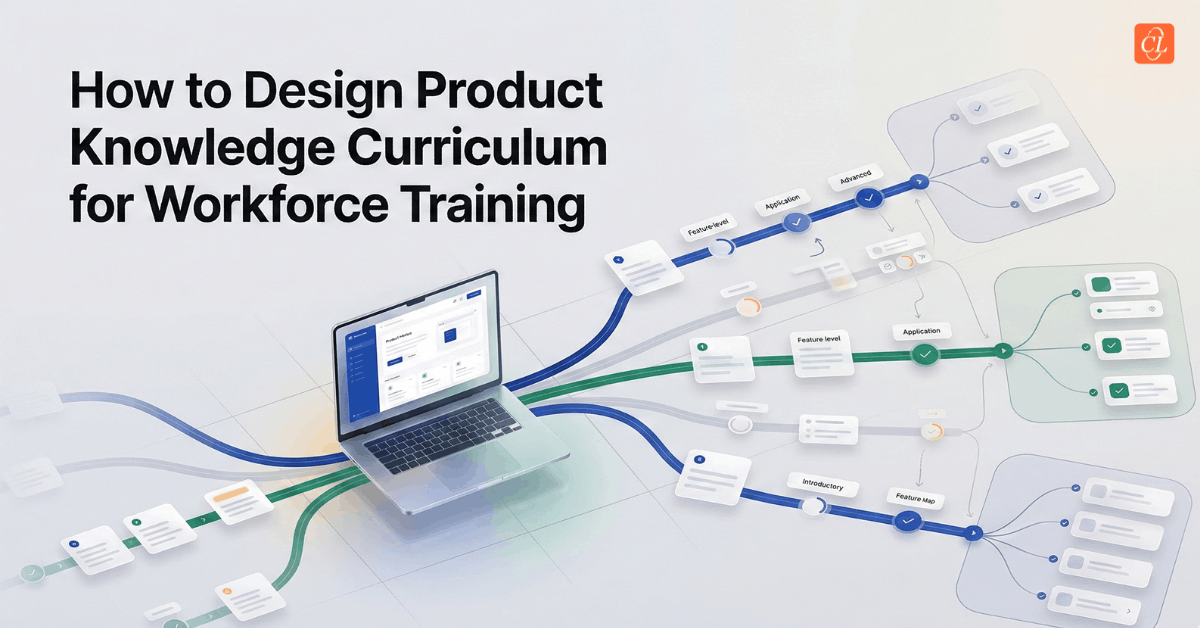
Step 2: Create Role-Based Learning Paths
Rather than delivering a single, uniform course, organizations should design learning paths tailored to different roles. Each path should reflect the specific responsibilities and challenges associated with that role, allowing learners to progress through content that is directly relevant to their work.
These learning paths should also be structured in a way that supports progression, starting with foundational knowledge and gradually introducing more advanced concepts and applications.
Step 3: Modularize Content for Flexibility
Large, monolithic courses can be difficult to navigate and often lead to lower engagement. Breaking content into smaller, modular units allows learners to focus on specific topics and access information when needed.
Modular design also makes it easier to update content as products evolve, ensuring that training remains current without requiring complete redesigns.
Step 4: Align Content With Real-World Scenarios
To ensure that training is practical and relevant, content should be aligned with real-world scenarios that learners are likely to encounter. This includes customer conversations, sales situations, and problem-solving contexts that require the application of product knowledge.
By grounding learning in realistic situations, organizations can bridge the gap between knowledge acquisition and performance.
Step 5: Integrate Meaningful Assessments
Assessments play a critical role in validating learning, but their effectiveness depends on how they are designed. Instead of focusing solely on recall, assessments should evaluate the learner’s ability to apply knowledge in context.
Scenario-based questions, decision-making exercises, and simulations can provide deeper insights into how well learners can use their knowledge in practical situations.
Making Product Knowledge Training Relevant
Relevance is a key factor in determining whether training is engaged with and applied. When learners can clearly see how training connects to their day-to-day responsibilities, they are more likely to invest time and effort in learning.
To improve relevance:
- Connect Features to Value: Do not stop at explaining what a feature does. Show why it matters to the customer.
- Use Role-Specific Examples: Tailor examples based on how each role interacts with the product.
- Reflect Real Customer Conversations: Incorporate objections, questions, and decision points that learners actually face.
- Keep Content Updated: Product knowledge changes frequently. Ensure training reflects the latest updates and positioning.
When learners see direct applicability, engagement improves naturally.
Choosing the Right Digital Learning Strategies
Modern product training programs rely on a combination of learning strategies that cater to different types of content and learning needs. Selecting the right approach for each objective is more important than adopting every available format.
Microlearning for Quick Access
Use short modules for updates, refreshers, and specific tasks.
Scenario-Based Learning for Application
Simulate real situations to help learners practice decision-making.
Video-Based Learning for Demonstration
Use videos to show product usage, workflows, or customer interactions.
Blended Learning for Depth
Combine self-paced modules with live sessions or discussions to deepen understanding.
By aligning learning strategies with specific objectives, organizations can create a more engaging and effective training experience.
Aligning Product Training With Business Outcomes
For product training to be truly effective, it must be aligned with measurable business outcomes. This requires a clear understanding of how training contributes to performance and how that performance can be evaluated.
Metrics such as sales conversion rates, deal cycle time, product adoption, and customer satisfaction provide valuable insights into the impact of training. By defining these metrics early and designing training with them in mind, organizations can ensure that learning initiatives are directly linked to business success.
Tracking performance before and after training also allows organizations to assess effectiveness and identify areas for improvement, creating a continuous cycle of optimization.
Common Mistakes to Avoid
Even well-designed training programs can encounter challenges if certain pitfalls are not addressed.
Treating Training as a One-Time Event
Learning must be continuous, not a one-time rollout.
Overloading Learners With Information
Focus on what is essential for performance.
Ignoring Role Differences
Different roles require different knowledge depth and context.
Focusing Only on Content Creation
Without structure and strategy, content alone does not drive results.
Neglecting Reinforcement
Without reinforcement, knowledge fades quickly.
Recognizing and addressing these challenges is essential for building a sustainable and impactful product training system.
Final Thoughts
A strong product training strategy is not defined by the quantity of content it delivers but by the clarity, structure, and purpose behind it. When training is designed as a cohesive system that aligns with real-world performance, it becomes a powerful driver of business outcomes rather than a standalone initiative.
Organizations that take a strategic approach to product training are better positioned to scale their efforts, adapt to change, and equip their teams with the knowledge and confidence needed to succeed.