Training demands are no longer predictable. Content must be updated frequently, rolled out globally, and adapted to different audiences without slowing down business momentum. Yet traditional eLearning development models often struggle to keep pace with this level of agility.
This is where rapid authoring tools have quietly reshaped how organizations approach digital learning.
They are no longer just tools for faster course creation. They have become a strategic layer that determines how efficiently organizations can scale training, maintain consistency, and respond to change.
In this article, you will explore how rapid authoring tools influence learning strategy, what capabilities truly matter, and how to select and use them to build high-impact, scalable training ecosystems.
Download eBook Now: Rapid eLearning Authoring Tools
Table of Contents
- The Shift from Course Development to Learning Production Systems
- Where Rapid Authoring Tools Fit in Modern L&D Architecture
- Core Capabilities That Define High-Impact Authoring Tools
- Speed vs Quality Is No Longer a Tradeoff
- Choosing the Right Tool Based on Strategic Fit
- The Role of Authoring Tools in Legacy Content Transformation
- Implementation Realities That Most Teams Overlook
- Common Pitfalls That Undermine Tool Adoption
- Future Direction of Rapid Authoring in Enterprise Learning
- FAQs
The Shift from Course Development to Learning Production Systems
Organizations are no longer building isolated courses. They are building continuous learning ecosystems.
This shift has redefined expectations from authoring tools. Instead of supporting one-time development, tools must now enable:
- Continuous updates
- Scalable production workflows
- Faster turnaround for multiple learning programs
- Consistent experience across regions and teams
The focus has moved from creating individual courses to designing repeatable, efficient learning production systems.
The value of an authoring tool lies not in what it creates once, but in how efficiently it enables ongoing learning delivery.
Where Rapid Authoring Tools Fit in Modern L&D Architecture
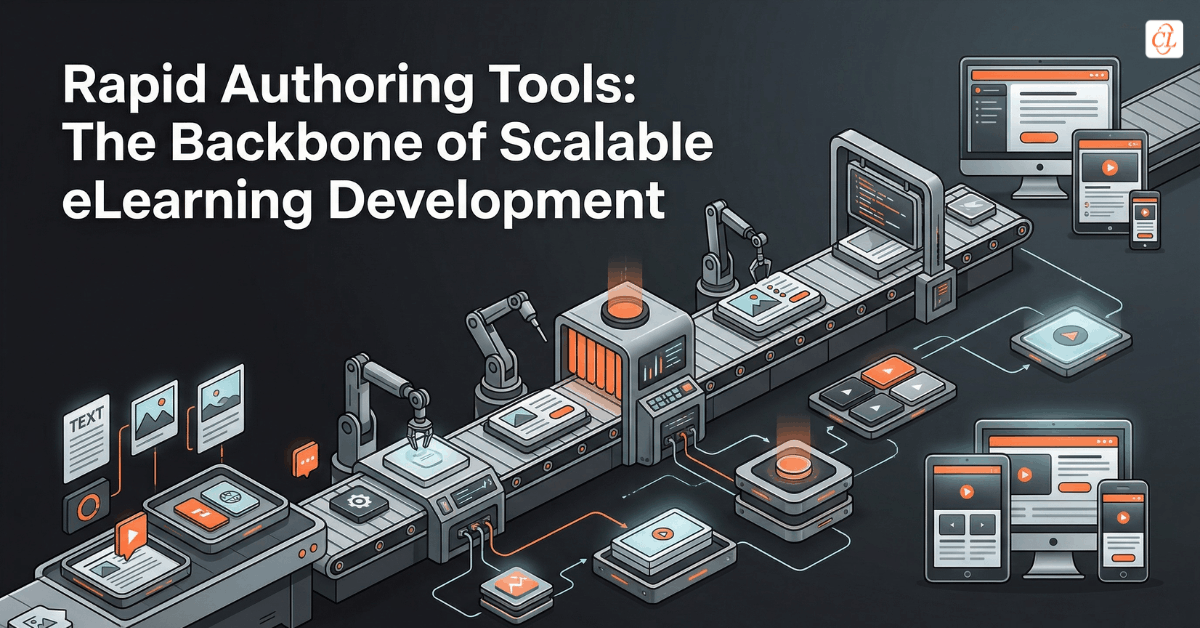
Rapid authoring tools sit at the intersection of content, technology, and experience design.
They bridge three critical layers:
Content Transformation
They convert raw materials such as PPTs, documents, and classroom content into structured digital learning.
Experience Design
They enable interactivity, multimedia integration, and learner engagement without heavy programming.
Delivery Compatibility
They ensure content works seamlessly across LMS platforms, devices, and formats.
Rather than being standalone tools, they function as enablers within a larger learning ecosystem that includes LMS platforms, analytics systems, and content strategies.
Authoring tools are not production utilities. They are integration layers that connect content, learners, and delivery systems.
Core Capabilities That Define High-Impact Authoring Tools
Not all authoring tools deliver equal value. The difference lies in how well they support scalability, usability, and adaptability.
a. Template-Based Development
Pre-built templates reduce development time and ensure consistency across courses.
b. Responsive Design Frameworks
Courses must adapt automatically across devices without redesigning content for each screen.
c. Multimedia Integration
The ability to embed videos, simulations, and interactive elements enhances engagement without increasing complexity.
d. Collaboration Features
Modern tools enable multiple stakeholders to review, edit, and contribute simultaneously, reducing delays.
e. Localization and Translation Support
Global organizations require tools that simplify multi-language deployment.
f. Assessment and Tracking Integration
Seamless compatibility with SCORM or xAPI ensures performance tracking and reporting.
g. Ease of Use for Non-Developers
Instructional designers, SMEs, and trainers should be able to create content without technical dependency.
The best tools reduce dependency on specialists while increasing production quality.
Speed vs Quality Is No Longer a Tradeoff
One of the biggest misconceptions is that rapid development compromises instructional quality.
Modern authoring tools challenge this assumption.
They enable:
- Structured content design through templates
- Built-in interaction models
- Standardized learning flows
- Faster iteration cycles
This means quality is no longer dependent on time-intensive development but on how well the tool supports instructional design principles.
Speed becomes a strategic advantage when it enables faster refinement, not just faster creation.
Choosing the Right Tool Based on Strategic Fit
Selecting an authoring tool should not be based on features alone. It should align with organizational priorities.
Evaluate Based on:
Learning Volume and Frequency
High-volume environments need tools optimized for speed and scalability.
Team Skill Levels
If SMEs are involved, ease of use becomes critical.
Content Complexity
Highly interactive simulations may require more advanced tools.
Collaboration Needs
Distributed teams benefit from cloud-based platforms.
Integration Requirements
Compatibility with LMS and analytics systems is essential.
Decision Lens
Instead of asking “What features does this tool offer?” ask:
- How does this tool reduce production bottlenecks?
- How does it support long-term scalability?
- How does it improve collaboration efficiency?
The right tool is not the most powerful one, but the one that aligns best with how your organization builds and delivers learning.

Rapid eLearning Authoring Tools
Explore the What and the Why of Popular Rapid eLearning Development Tools, and GenAI Tools
- Categories of eLearning Authoring Tools
- Considerations to Choose Your Next Authoring Tool
- Features of Popular Rapid Authoring Tools
- GenAI Tools to Create Content, Graphics, Audio, and Video
The Role of Authoring Tools in Legacy Content Transformation
Many organizations still rely on legacy formats such as Flash or static presentations. Rapid authoring tools play a critical role in modernizing this content.
Transformation Capabilities Include:
- Converting outdated formats into HTML5
- Structuring unorganized content into learning modules
- Enhancing static content with interactivity
- Improving accessibility and responsiveness
However, effective transformation is not just technical conversion. It requires instructional redesign.
Conversion without redesign results in digital content that still behaves like outdated training.
Implementation Realities That Most Teams Overlook
Even the best tools fail without the right implementation approach.
Common Oversights:
Lack of Standardization
Without templates and guidelines, content becomes inconsistent.
Overloading Tools with Complexity
Trying to replicate highly custom interactions defeats the purpose of rapid tools.
Ignoring Governance
Clear workflows and approval processes are essential for scalability.
Underestimating Training Needs
Teams must be trained not just on the tool, but on how to use it effectively.
Tools accelerate processes, but only structured processes deliver results.
Common Pitfalls That Undermine Tool Adoption
Organizations often invest in tools but fail to realize their full potential.
Key Pitfalls:
- Choosing tools based on trends instead of needs
- Prioritizing features over usability
- Treating tools as standalone solutions
- Lack of alignment between L&D and business goals
- Failure to measure impact
Avoiding these pitfalls requires a shift from tool-centric thinking to strategy-driven implementation.
The effectiveness of an authoring tool depends more on how it is used than what it offers.
Direction of Rapid Authoring in Enterprise Learning
Rapid authoring tools are evolving beyond content creation.
Emerging Trends:
- AI-Assisted Content Creation: Automating content generation and personalization.
- Adaptive Learning Integration: Delivering personalized learning paths based on performance.
- Real-Time Analytics Integration: Enabling continuous improvement based on learner data.
- Cloud-Based Collaboration: Supporting distributed teams and faster iteration cycles.
- Experience-Driven Design: Focusing on learner engagement rather than content delivery.
The future of authoring tools lies in enabling intelligent, adaptive, and data-driven learning experiences.
FAQs
1. What are rapid authoring tools in eLearning?
A. Rapid authoring tools are software platforms that enable quick creation of eLearning courses using templates, pre-built interactions, and simplified workflows, reducing development time without compromising instructional quality.
2. How do rapid authoring tools improve training efficiency?
A. They streamline content development, enable faster updates, and allow non-technical users to create courses, significantly reducing dependency on specialized developers and accelerating delivery timelines.
3. Are rapid authoring tools suitable for complex training?
A. They work best for structured, scalable training such as onboarding, compliance, and product training. Highly complex simulations may require more advanced or custom development approaches.
4. Can rapid authoring tools support mobile learning?
A. Yes, most modern tools offer responsive design capabilities that ensure courses adapt seamlessly across devices, including smartphones and tablets.
5. How do organizations choose the right authoring tool?
A. Selection should be based on learning volume, team capabilities, content complexity, collaboration needs, and integration requirements rather than just feature lists.
6. What role do these tools play in legacy content conversion?
A. They help convert outdated formats into modern, responsive eLearning while enabling instructional redesign to improve engagement and effectiveness.
Conclusion
Rapid authoring tools have evolved from productivity enhancers into strategic enablers of modern learning ecosystems. Their true value lies in how they transform fragmented content creation into scalable, efficient, and continuously evolving learning systems.
Organizations that approach these tools with a clear strategy, structured processes, and long-term vision will not just develop courses faster. They will build learning capabilities that can adapt, scale, and deliver measurable impact.