

A global logistics enterprise recently reached out to us to formalize onboarding for a fast-growing sales team spread across business units. It is a request we hear from many global enterprises: sellers who already know how to sell, a company strategy to explain, and a program that has to work for dozens of new hires, not one or two.
For these teams, the challenge usually lies elsewhere than in sales skill or content. Sales leaders tend to have plenty of material and a strong in-person session that builds the team. The harder questions are about structure: what new sellers should learn before they meet, what the group time should be used for, and how every business unit can start from the same baseline. Getting that structure right early is what lets new sellers reach their first customer conversation prepared, with managers free to coach and not to repeat themselves.
This blog is our advice to every enterprise in that position. It covers where sales onboarding strains at scale, how to split learning between online modules and in-person practice, what a new seller needs to learn about your company, and how CommLab India builds these programs quickly.
Table of Contents
- What Are the Biggest Sales Onboarding Challenges for Growing Sales Teams?
- How Do You Use Blended Learning for Sales Onboarding Training?
- What Should Sales Onboarding Training Cover in the First 30 Days?
- How Does CommLab India Build Sales Onboarding Programs Quickly?
- FAQs About Sales Onboarding Training
What Are the Biggest Sales Onboarding Challenges for Growing Sales Teams?
The biggest sales onboarding challenges for growing teams come from relying on people and events instead of a system: a manager who trains, a session that teaches everything at once, and content that lives in too many places.
- The manager becomes the training department: When onboarding means attaching a new seller to a leader, it works for one or two hires. With a cohort, the leader answers the same questions repeatedly, and the coaching that only a manager can give gets squeezed out.
- Little time to learn: Salesforce’s 2026 State of Sales research . Training has to fit around the rest, which favors short, on-demand formats over long sessions.
- Content that explains the what but skips the why: Materials show how to prospect or use a tool yet rarely connect it to the company’s strategy or to the seller’s own results, so adoption stays patchy.
- New roles with unmarked seams: When one sales role splits into two, a new seam appears: who qualifies, who hands over, and what the customer hears in between. Nobody has trained that seam yet.
- Scattered material and uneven starting points: Decks, wikis, and shared drives all hold a version of the truth, and remote sellers who join weeks apart reach the group session with very different habits.
The in-person session still earns its place. It builds the bond between sellers who will work as a team, and that bond lasts. The fix is to give each part of onboarding the job it does best, which is what blended learning does.
How Do You Use Blended Learning for Sales Onboarding Training?
Blended learning answers those challenges by moving the knowledge online, ahead of the group session, and using the in-person time for practice with feedback. Online modules take over the repeated questions and fit the time sellers have, while the group time goes to what cannot be done alone. answers those challenges by moving the knowledge online, ahead of the group session, and using the in-person time for practice with feedback. Online modules take over the repeated questions and fit the time sellers have, while the group time goes to what cannot be done alone.
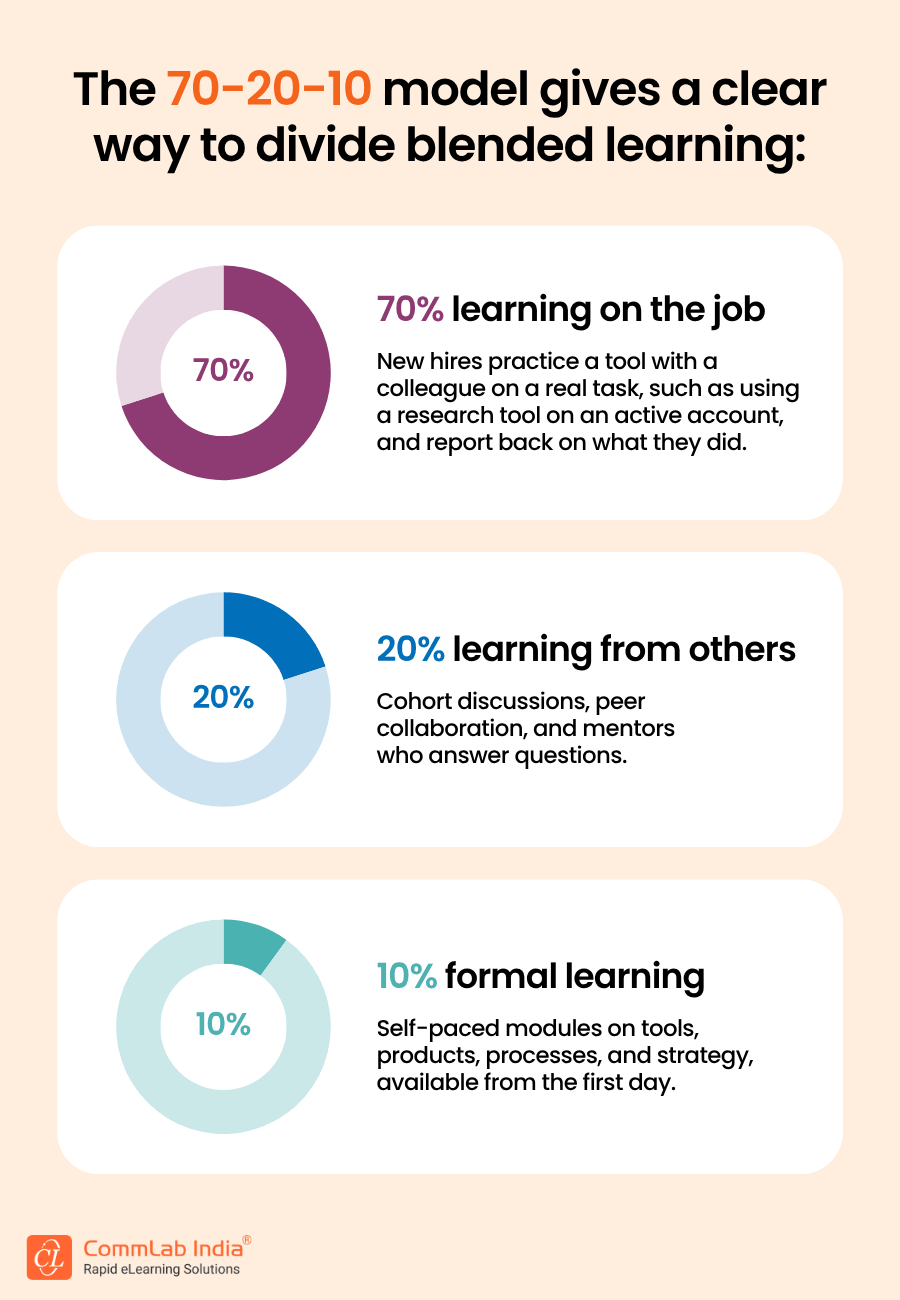
Sequence matters as much as proportion. Before the group meets, sellers complete short modules and a quick quiz, so nobody arrives needing the basics explained. During the session, the time goes to role-playing a customer conversation, planning a customer site visit, and walking through the handoff between sales roles with the colleague on the other side of it, which is where the unmarked seam gets trained. After the session, small refreshers and job aids keep the learning in use.
An in-person week is expensive and rare, and spending it on content delivery wastes it. Sellers who have already learned the material online arrive as a cohort that knows each other from the first day, which is what makes the week about the team.
A blend only works if the online part carries the right content. For experienced sellers, that content is narrower than most programs assume.
Explore CommLab India’s Award-Winning, AI-Powered Onboarding Training Solutions for U.S. and European Enterprises with 10,000+ Workforce
What Should Sales Onboarding Training Cover in the First 30 Days?
How can AI support sales onboarding training?
AI supports sales onboarding in four ways:
- Role-play with instant feedback: Sellers practice customer conversations with an AI buyer.
- Answers on demand: An assistant answers product, pricing, and process questions from approved content.
- Faster content: AI drafts quizzes and scenarios, and experts review them before release.
- Targeted practice: Results show where each seller struggles, so practice goes there.
The online part of the blend should carry what experienced sellers cannot get from their own background: how your company wins, not how selling works. In the first 30 days, five things make the difference:
- What good looks like: Targets for a first meeting, a first opportunity, and a first customer conversation. New sellers who know what is expected can judge their own progress without waiting for a review.
- How you win here: The buyers you serve, the competitors sellers meet most often, the few reasons customers choose you, and the objections specific to your offer. Scenarios drawn from real deals teach this better than a slide on positioning.
- How decisions move: Pricing authority, approvals, and who to call. Include the handoff between roles: what makes an opportunity ready to pass from winning an account to growing it, and what the customer should hear when it does.
- Why the systems exist, then how to use them: Sellers often ask why they should enter the same information again in another system. Tie each tool to a result sellers care about, such as winning or losing a deal, and the how-to becomes simple. Simulations then show the steps in a safe copy of the system.
- Where to find what is current: One place for the latest pitch, pricing sheet, and objection answers. Sellers lose time hunting when material sits in several places.
Match each topic to a format. A job aid works for a form, a simulation for a system, a scenario for a conversation, and a live or virtual session for a discussion. Keep the content that changes fastest, such as pricing and competitor notes, in job aids and not inside courses, so an update does not mean rebuilding a module.
The first 30 days set the foundation, and reinforcement through the following months carries the learning into full productivity. Knowing what to cover is half the work. The other half is building it fast enough to be ready before the next cohort arrives, and here is what we proposed for that.

Accelerate Sales Productivity Across Every Region
- 40,000+ Sales Professionals Enabled
- 85% Sales Improvement
- 95% Completion Rates
- And More!
How Does CommLab India Build Sales Onboarding Programs Quickly?
We do not start from a template program. We build each training plan around the client’s requirements, and our sales training experience across industries, including logistics, manufacturing, healthcare and pharma, technology, and retail, shows us where the real gaps are before we design anything. Here is what that looked like for the logistics enterprise.
- Strategy first: One learning architect defines the learning outcomes for the whole curriculum, decides the learning type for each topic, such as video or infographic, and creates a total learning playbook.
- Content matched to formats: We work with the client to decide which content becomes a job aid, which an interactive session, and which a live or virtual session.
- Blended learning around the group meeting: Small lessons before the sales meeting, engagement during it, and reinforcement after it. Small eLearnings and quizzes keep sellers engaged in place of long emails or infographics alone.
Watch five strategies for engaging onboarding eLearning:
- Cohort learning: Sellers are grouped into cohorts that complete eLearning together and collaborate inside the tool, or on a separate landing page.
- Gamification: We use gamification, with points and game-based learning in a visual, dynamic design, because competition and game elements work well for sellers.
- Scenarios and simulations: Scenarios built on customer challenges, including which tool to use, and simulations for each system. Each course explains why sellers should use a tool before how.
- Your sales process: Training on the company’s own sales methodology, since each organization applies sales techniques differently.
- Facilitated sessions: A virtual session with assessments and interactivities built in, so that someone can conduct it.
The main risk is subject matter expert time and approvals, so we would start from the client’s raw content and work in agile cycles.
Conclusion
Scaling sales onboarding comes down to three decisions: put the knowledge online before the group meets, spend the in-person time on practice, and build the first 30 days around how your company wins, using custom eLearning. Onboarding is the first stage of sales enablement, and the same learning assets keep sellers ready afterward. To plan for a larger sales team, click below to explore CommLab India’s sales enablement training.

FAQs About Sales Onboarding Training
Choosing a sales onboarding program raises practical questions about cost, scope, and fit with your existing tools. These answers cover what sales and L&D leaders ask most before they commit.
What is the difference between sales onboarding and sales enablement?
Sales onboarding gets new sellers productive in their first weeks. Sales enablement is the ongoing support of content, tools, training, and coaching that keeps every seller effective as products and markets change. Onboarding is where enablement starts, and the same learning assets can serve both.
What drives the cost of sales onboarding training?
Five things set the cost: the number of learning hours, the formats used (simulations and video take more effort than job aids), the number of languages, the number of review rounds, and how much existing content needs organizing first. Settling those before asking for quotes makes proposals comparable.
Can we start with a pilot before building the full program?
Yes. A pilot or a proof-of-concept module lets you judge quality, seller engagement, and fit with your sales process before you scale across business units.
Will the training work with the LMS and tools we already use?
Yes. Our sales training modules are SCORM 1.2/2004 or xAPI compliant and mobile responsive, so they run on major enterprise LMS platforms and on any device, including for field sellers. Share your platform and reporting needs at the start, so tracking and completion data flow into the systems your sales operations team already uses.