It used to be a department problem. Now it’s a people problem—in the best way. One careless claim can trigger a greenwashing backlash. One supplier shortcut can fail an audit. One “small” waste-handling mistake can become a safety incident. Sustainability now has real-world consequences across reputation, compliance, operations, and revenue.
That shift explains the growing role of sustainability training. Companies don’t lose sustainability goals in strategy decks—they lose them in everyday decisions made under pressure. Training is the only scalable way to standardize those decisions across roles, teams, and locations.
When it’s done right, sustainability training stops being an awareness module and becomes a performance enabler—delivering measurable environmental benefits (less waste, smarter resource use), social benefits (safer, more responsible practices), and financial benefits (lower risk, higher efficiency, stronger deal credibility). That’s exactly what this article breaks down—what effective sustainability training looks like, where it’s creating the biggest impact, and how it drives all three outcomes together.
Download eBook Now: How AI Supercharges Gamification
Table Of Content
- What Is Sustainability Training?
- What are the Four Everyday Workplace Decisions that Make or Break Sustainability Outcomes?
- How is Sustainability Training Creating Value Across Industries?
- What Does Interactive Sustainability Training Look Like?
What Is Sustainability Training?
Sustainability training is a structured learning program that equips employees (and sometimes suppliers and partners) to apply an organization’s sustainability goals in their day-to-day work. It moves sustainability from “something the company believes in” to “something people can do”—consistently, correctly, and at scale.
Watch to understand the Key Components of Comprehensive Sustainability Training
Now let’s zoom out—because sustainability training creates a full-spectrum impact—environmental, social, and financial results, plus the consistency companies need to deliver them at scale.
Environmental benefits it drives
- Less waste, scrap, and rework through better day-to-day practices
- Smarter energy and resource use (water, materials, packaging, fuel)
- Lower emissions through efficiency, reduced repeat work, and better operational discipline
- More sustainable supply chain choices through trained purchasing behaviors
Social benefits it strengthens
- Safer workplaces through clearer handling practices and escalation behaviors
- Stronger ethics and compliance in decision-making (especially in sourcing and reporting)
- Better supplier responsibility and accountability across the ecosystem
- Higher employee trust and engagement when sustainability is practical and shared—not vague
Financial benefits it unlocks
- Reduced operating costs (waste, utilities, inefficiencies, rework)
- Lower risk exposure (incidents, audit failures, non-compliance penalties, disruptions)
- Stronger deal credibility and RFP readiness where sustainability is a requirement
- Brand protection by preventing inconsistent claims and greenwashing backlash
Why its role is growing now
- Sustainability is showing up in audits, RFPs, supplier scorecards, and disclosure expectations
- Companies need consistent execution across roles, locations, and partners—not one-time awareness
- The fastest path to ESG progress is standardizing everyday decisions, not publishing better promises
What are the Four Everyday Workplace Decisions that Make or Break Sustainability Outcomes?
What Formats Work Best For Sustainability Training Today?
- Microlearning bursts: 3–5-minute modules for key behaviors and quick recall
- Interactive eLearning modules: click-to-explore, discovery interactions, simulations
- Video + practice blend: short videos followed by activities, checks, and application tasks
- Job aids and checklists: performance support in the flow of work
- Assessments with proof: knowledge checks tied to policies, standards, and evidence
- Role-based learning paths: tailored tracks for procurement, frontline, managers, sales, suppliers
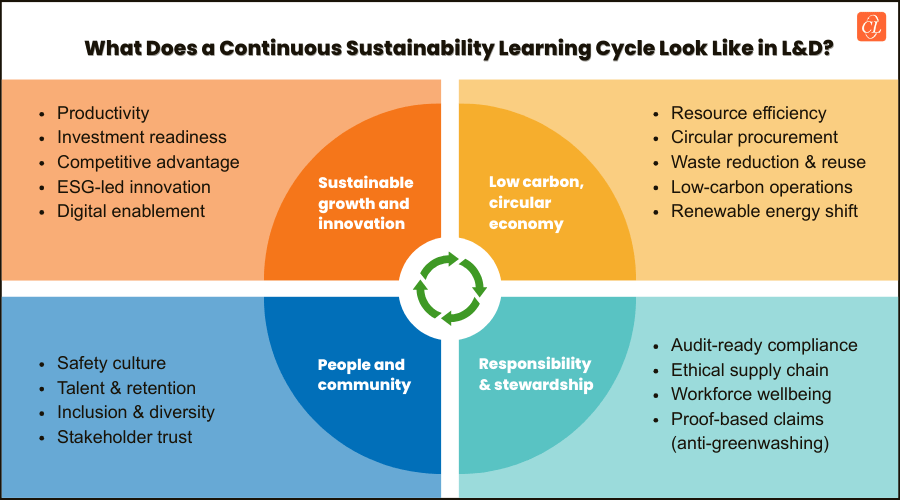
For L&D, the Sustainability Decision Map is the four behaviors training must standardize: approve, use, claim, and escalate—the daily decisions that determine whether sustainability sticks or slips.
1. Buy / Approve decisions
This is where sustainability gets “locked in” early—often invisibly.
What it includes
- Vendor selection, renewals, and exceptions
- Material choices, packaging specs, logistics options
- Purchase approvals and “urgent” sourcing under pressure
Why it makes or breaks outcomes
A single supplier choice can determine downstream waste, emissions, labor risk, and audit exposure for months—sometimes years. The cost isn’t just environmental; it’s operational and reputational.
What sustainability training changes
- Teams learn what “responsible sourcing” means in practice (standards, documentation, red flags)
- Procurement learns how to ask for proof, not promises
- Managers learn how to handle exception requests without creating risk
Signals you can measure
- Fewer last-minute supplier exceptions
- Higher supplier documentation completeness
- Reduced audit findings tied to sourcing/procurement
2. Use / Waste decisions
This is where impact becomes measurable—and where most leakage hides.
What it includes
- How teams use energy, water, materials, and equipment
- Handling routines, disposal habits, segregation accuracy
- Process shortcuts that cause scrap, rework, or repeat work
Why it makes or breaks outcomes
Many sustainability “wins” come from boring things done consistently: fewer repeat steps, fewer defects, better maintenance habits, correct segregation. Small daily habits compound into big numbers.
What sustainability training changes
- Clear “what good looks like” routines (shutdowns, handling, segregation, maintenance)
- Practical prevention behaviors (reduce rework, reduce avoidable waste)
- Role-based actions that don’t slow throughput
Signals you can measure
- Reduced scrap/rework rates
- Lower energy/water usage per unit (where applicable)
- Fewer handling errors and waste contamination issues
3. Claim / Prove decisions
This is where sustainability turns into reputational risk—or credibility.
What it includes
- RFP responses, sales decks, marketing copy, internal Communications
- ESG reporting inputs and data assumptions
- “We should say this” moments—without checking evidence
Why it makes or breaks outcomes
The fastest way to trigger backlash is a claim you can’t substantiate. Most greenwashing risks aren’t malicious—they’re misalignment: one team says it, another team can’t prove it.
What sustainability training changes
- Proof-first habits: verify before you amplify
- Guardrails on language: what can be claimed, what needs qualification
- Clear ownership: who validates, who approves, what evidence is required
Signals you can measure
- Fewer claim corrections in proposals and marketing
- Higher “evidence attached” rate for RFP sustainability responses
- Reduced internal back-and-forth on sustainability statements
4. Escalate / Fix decisions
This is the decision type most organizations overlook—and it’s where failure becomes preventable.
What it includes
- Near-miss reporting, unsafe practices, compliance concerns
- Supplier non-compliance, documentation gaps, process deviations
- Whether issues get raised early—or quietly tolerated
Why it makes or breaks outcomes
Sustainability collapses when teams learn it’s safer to stay silent. The strongest programs create clarity: what to report, how to report, and how managers respond.
What sustainability training changes
- Clear escalation triggers (what must be raised immediately vs monitored)
- Psychological safety: “raising a flag” is treated as responsibility, not disruption
- Faster correction loops so the same issues don’t repeat
Signals you can measure
- Increase in quality of near-miss reporting (not just volume)
- Faster closure time for sustainability-related issues
- Fewer repeat incidents and recurring audit findings
Winning the eLearning Engagement Game: How AI Supercharges Gamification
Experience the Future of eLearning Engagement with AI-enhanced Gamification!
- Games to Engage Modern Learners
- Practical Tips to Incorporate Gamification in eLearning
- AI-enhanced Gamification
- And More!
How is Sustainability Training Creating Value Across Industries?
Sustainability training creates value across industries by turning ESG goals into role-specific behaviors that reduce environmental impact, strengthen responsible practices, and improve business performance.
Deloitte’s 2025 C-suite Sustainability Report found that 83% of executives say their organizations increased sustainability investments in the last year—and training is how those investments translate into consistent execution on the ground.
Manufacturing
- Environmental: Reduces scrap, improves energy and water practices, strengthens waste handling, and supports safer materials usage.
- Social: Strengthens safety practices, supports compliance, and reinforces responsible supplier behavior—especially where frontline decisions drive outcomes.
- Financial: Cuts rework and downtime, reduces incident risk, and improves audit readiness and supply reliability.
Financial Services
- Environmental: Builds capability to evaluate climate risk and carbon exposure in portfolios, lending, and insurance—supporting greener capital allocation.
- Social: Strengthens ethical decision-making, fair lending awareness, and governance behaviors that protect trust.
- Financial: Reduces risk surprises, improves compliance readiness, and strengthens client credibility in sustainable finance conversations.
Health & Pharma
- Environmental: Improves waste segregation, safer disposal, and resource efficiency (water/energy) across labs, plants, and facilities.
- Social: Reinforces safety culture, patient-centric responsibility, and compliance behaviors across teams and vendors.
- Financial: Reduces audit findings, incidents, and costly rework while protecting continuity in regulated supply chains.
IT & Software
- Environmental: Enables practical “green ops” behaviors—cloud efficiency, device lifecycle practices, and responsible digital consumption.
- Social: Builds inclusive and ethical tech habits (privacy, responsible AI, supplier responsibility) that strengthen culture and trust.
- Financial: Improves RFP readiness, reduces reputational risk from vague claims, and supports deal eligibility where sustainability is a requirement.
What Does Interactive Sustainability Training Look Like?
A CommLab India case study
Interactive sustainability training is a learning experience that helps employees explore sustainability concepts through scenarios, simulations, and guided practice—so they can apply sustainable behaviors in real workplace situations, not just remember information.
A good example comes from one of our projects with a leading science-based agrotechnology company.
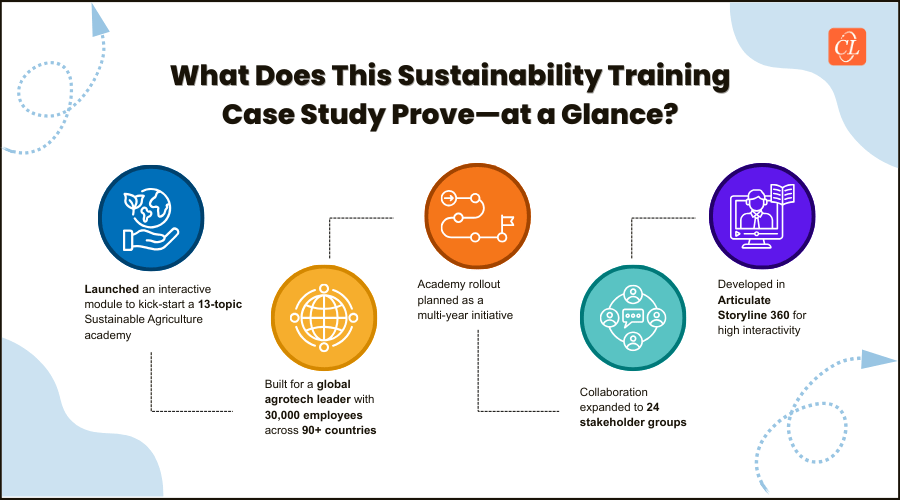
Client goal: Introduce employees to Sustainable Agriculture and test learner acceptance of digital learning before scaling a 13-topic academy
What we built: A highly interactive “Sustainability Overview” eLearning module (Articulate Storyline 360)
How learning was designed:
- Journey-map navigation for exploration + progress tracking
- Discovery interactions + concept/process animations
- Best-practice demos
- Practice activities with coaching and feedback
- Objective-based assessments
- Powered by best-in-class instructional design strategies
Key challenge: Many stakeholders thought eLearning meant a video
How we addressed it: Built prototypes and set up a structured review process to align global reviewers and consolidate feedback
Result: Greater awareness of Sustainable Agriculture and stronger readiness to adopt sustainability initiatives
A Final Perspective
Sustainability doesn’t become real when a company publishes a promise. It becomes real when thousands of daily decisions start shifting in the same direction—what gets approved, how resources get used, what gets claimed, and what gets escalated and fixed. That’s exactly why sustainability training is in such high demand right now: organizations need a scalable way to turn sustainability from intent into consistent execution across roles, locations, and partners—so environmental gains, social responsibility, and business resilience actually show up in day-to-day work.
If you’re also looking to solve the engagement challenge that often limits training impact, our free eBook explains how to engage modern learners with gamification, clarify gamification vs. game-based learning, and apply practical, AI-enhanced techniques to make eLearning more interactive and effective. Download now.

![Key Steps to Developing an Impactful Sustainability Training [Video]](https://www.commlabindia.com/hubfs/blogs/sustainability-training-impactful-steps-video.jpg)