A temporary L&D capacity gap can arise from an ordinary operational change rather than a major organizational crisis. A key team member may go on extended leave, a technology rollout may create a short-term surge in development work, or a compliance deadline may suddenly increase the volume of training that needs to be produced and administered.
Whatever the cause, the work rarely pauses until capacity returns. Courses still need to be developed and updated, videos need to be assembled, assessments need to function correctly, LMS activities continue, and stakeholders still expect agreed timelines to be met.
This creates a practical decision for L&D leaders: Should the team redistribute the work, delay lower-priority initiatives, hire, outsource a defined project, or temporarily add execution capacity?
The most useful place to start is not by choosing a resourcing model. It is by diagnosing the problem correctly. Is the organization facing a temporary capacity gap, a capability gap, or a permanent increase in workload?
That is where L&D staff augmentation can be useful.
What Is the Best Way to Cover a Temporary L&D Capacity Gap?
The right response depends on four factors: how long the additional demand is likely to last, whether the missing requirement is capacity or expertise, how much ownership the internal team wants to retain, and how easily an external resource can work within existing systems and processes.
A short-term workload problem should not automatically lead to a permanent hiring decision. Equally, a sustained increase in demand should not be managed indefinitely through temporary fixes.
The objective is to match the resourcing response to the nature and duration of the problem.
Start by Separating Capacity From Capability
A capacity gap occurs when the team already knows how to perform the work but does not have enough available time or resources to complete the required volume.
A capability gap is different. It exists when the organization lacks a particular skill or specialist expertise.
For example, if an internal instructional design team can develop six courses within the available timeframe but the business suddenly needs ten, the immediate constraint is capacity. If the same team is asked to design an advanced simulation that requires expertise it does not possess, the problem is capability.
The distinction sounds simple, but it affects almost every subsequent decision. A team that needs more production hours requires a different response from one that needs a new specialist discipline. Before adding people, therefore, L&D leaders should clarify exactly what is missing.
Temporary Gap or Permanent Resourcing Problem?
Duration is the next consideration. A three-month absence is not the same as a sustained three-year increase in learning demand. Yet under delivery pressure, both can feel equally urgent.
If the cause of the workload increase is temporary, permanent recruitment may solve a short-term problem with a long-term cost. On the other hand, if demand has increased structurally and is unlikely to return to previous levels, repeatedly using temporary resources may simply postpone a necessary hiring or operating-model decision.
That does not mean every temporary requirement should automatically be handled through staff augmentation. It means duration should inform the decision alongside skills, ownership, workflow, and cost.
Match the duration of the capacity solution to the expected duration of the capacity problem.
RELATED PERSPECTIVE
When workload pressure is recurring rather than temporary, read Why Strong L&D Teams Need External Execution Capacity.
What Does a Temporary L&D Capacity Gap Look Like in Practice?
Consider an enterprise L&D team that faced a three-month resource gap when a key learning coordinator was going to be unavailable.
The team estimated that approximately 30 to 40 hours of additional work each week would still need to be covered. Importantly, the learning operation itself was already established. The organization had its own templates, a defined look and feel, authoring tools, asset libraries, an LMS, and working processes.
The requirement was therefore not to redesign the learning strategy or introduce a new delivery methodology. The team simply needed someone capable of stepping into the existing environment and helping to keep work moving.
The work included practical learning activities such as course development and updates, video-based learning, quizzes, course testing, assessment checks, and routine LMS reporting.
This is an important distinction. The business did not need a staff augmentation provider as an end in itself. It needed continuity while one part of its existing learning operation was temporarily under-resourced.
That is the type of situation in which L&D staff augmentation can become relevant.
SEE THIS MODEL IN PRACTICE
How a Restaurant Enterprise Extended L&D Capacity With eLearning and LMS Staff Augmentation
Should You Redistribute, Hire, Outsource, or Augment?
The available options solve different problems and create different trade-offs. The purpose of comparing them is not to make staff augmentation the automatic winner, but to make the resourcing decision more precise.
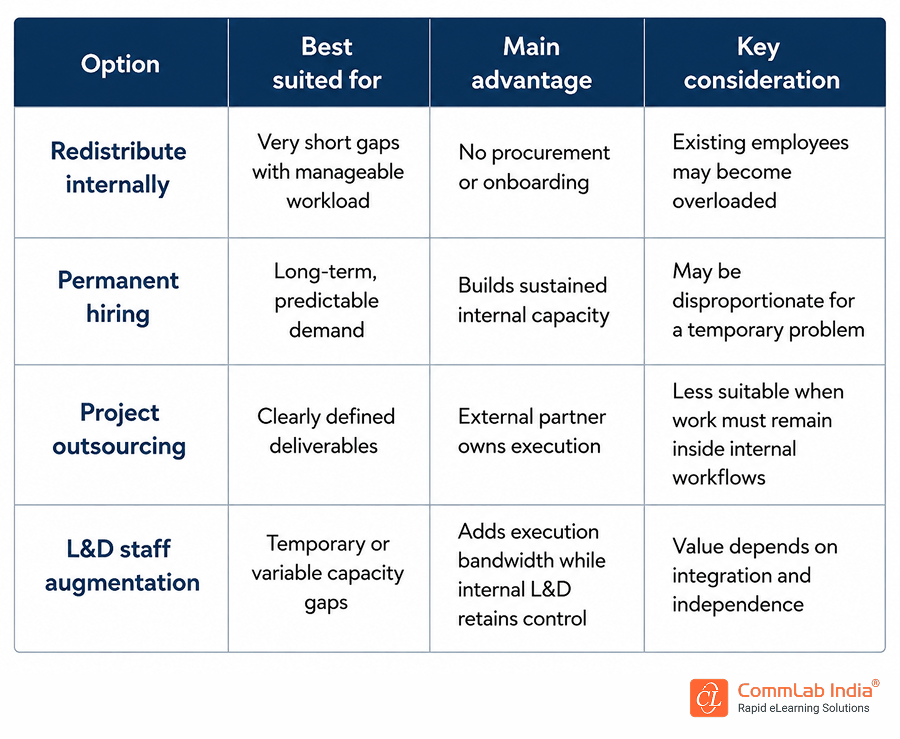
Staff Augmentation and Project Outsourcing Solve Different Problems
With project outsourcing, the organization typically provides the source content, audience, timeline, and expected output, then asks the external partner to develop and deliver the solution.
With staff augmentation, the request is closer to: work with our team, inside our environment, using our standards and tools, and help us execute the work.
Neither approach is inherently better. The right choice depends on whether the organization needs another resource inside its workflow or another team to own a defined outcome.
EXPLORE THE ALTERNATIVE
For a broader view of project-based outsourcing, see CommLab India's eLearning Outsourcing resource.
When Does L&D Staff Augmentation Fit a Temporary Gap?
Staff augmentation tends to work best when the internal learning function already has a reasonably mature operating environment. The team knows what good looks like, and its templates, authoring tools, review expectations, visual standards, and stakeholder relationships are already in place.
The work should also benefit from remaining inside that environment. Moving course files between different systems, rebuilding templates, or recreating asset libraries would introduce unnecessary friction for a short engagement.
Finally, the external resource needs to be capable of working with sufficient independence to create genuine capacity rather than simply adding another person to manage.
Do not measure only the hours supplied. Measure how much internal work the resource actually removes.
Purchased Hours Are Not the Same as Capacity Added
Suppose an organization engages an external learning professional for 30 hours a week. Those 30 hours do not automatically represent 30 hours of additional organizational capacity.
If internal employees must spend substantial time explaining recurring tasks, finding files, correcting standards, transferring assets, solving access issues, or supervising routine decisions, the net gain may be much smaller.
A professional who costs more per hour but integrates quickly, understands the workflow, and works independently may deliver greater net capacity than a lower-cost resource who requires continuous direction. For L&D leaders, the relevant unit is not simply contracted hours. It is usable execution capacity.
NEED THE BROADER MODEL?
Read the Complete Enterprise Guide to L&D Staff Augmentation.
Why Existing Templates, Tools, and Libraries Matter
When temporary support is introduced, the organization should not have to redesign its entire production environment around the external resource. If the internal team already has a template and a clearly defined look and feel, those assets help the temporary professional become productive faster.
The same principle applies to authoring tools, visual libraries, source-file locations, naming conventions, course-development standards, QA requirements, and approval workflows.
Without these foundations, small operational problems can accumulate. Files get duplicated, templates diverge, version control becomes harder, and internal employees become intermediaries for work the external resource was intended to absorb.
These may appear to be minor production issues, but during a three-month engagement they can materially reduce the value of the additional resource. For temporary capacity in particular, speed of integration matters almost as much as technical competence.
RELATED DECISION
See What Should Your Internal L&D Team Stop Producing? for a framework on what to keep internal and what to shift to flexible execution.
Where Does LMS Support Fit?
Temporary L&D capacity does not always divide neatly into course development on one side and LMS administration on the other. In practice, the workflows often overlap.
A course is developed, then it needs to be tested. Assessments need to be checked. Someone may need to upload or validate the course, run a report, and confirm that the questions behave as expected.
This does not necessarily require a full-time LMS administrator or an outsourced LMS operation. It may simply require practical learning operations support.
Depending on the environment, temporary LMS responsibilities could include course testing, report generation, uploads, assignment support, learner administration, troubleshooting, or completion checks.
The important point is to define the scope precisely. LMS administration can refer to anything from routine course operations to complex platform configuration. A temporary capacity model works best when the organization identifies the actual activities that need support rather than assigning a broad job title and hoping it covers everything.
RELATED SERVICE
Explore Learning Management System services for broader LMS administration and platform support requirements.
What Should Stay With Internal L&D?
Staff augmentation should add execution capacity without creating ambiguity about ownership. In a mature enterprise learning function, internal L&D will usually continue to own areas where organizational context and decision authority are most important.
Temporary resources can then absorb clearly defined execution work such as course development, updates, QA, media assembly, routine LMS testing, reporting, or other production activities.
The distinction is not about strategic work being important and production work being unimportant. Both matter. It is about protecting the time of internal professionals for the work that depends most heavily on their organizational knowledge.
If a senior learning leader spends several weeks making routine course updates because no one else is available, the work may still be completed, but the organization has lost strategic capacity elsewhere. Temporary execution support can prevent that displacement.
- Business priorities
- Stakeholder relationships
- Learning strategy
- Standards and governance
- Portfolio decisions
- Final approvals
Governance Is Part of the Capacity Solution
Enterprise staff augmentation is not simply a talent decision. It is also an access, security, and governance decision.
A temporary professional may need access to authoring systems, asset libraries, LMS environments, internal source content, shared drives, or learner information. The organization therefore needs to determine what access is necessary and how that access will be controlled.
These questions should be resolved early. A resource who lacks necessary access cannot provide effective capacity, while a resource with broader access than required introduces unnecessary risk. Good governance creates the conditions for productive integration.
- Which systems does the resource need to use?
- Can access be limited by role or task?
- Will the resource encounter learner or employee data?
- Where should source files remain?
- Who approves access?
- How will credentials be revoked when the engagement ends?
- What security requirements apply to external resources?
How Much Coordination Will the Model Require?
Coordination effort is another factor that is easy to underestimate. Before engaging temporary support, clarify how work will flow between the internal team and the external resource.
Will the person work directly with the L&D team? Will tasks go through a project manager? Who prioritizes the queue? How frequently are reviews required? Which decisions can the resource make independently?
The right structure depends on the scale of the engagement. A large outsourced learning program may require formal project governance, while a single professional joining an established team for a few months may benefit from a much lighter operating rhythm.
Every unnecessary coordination layer consumes some of the capacity the organization is trying to create. The aim should therefore be sufficient governance to maintain quality and visibility without introducing avoidable management overhead.
How Should L&D Measure Whether the Capacity Model Worked?
The objective is not simply to purchase hours. It is to maintain continuity while reducing pressure on the internal team.
Several measures can help L&D leaders judge whether temporary capacity is delivering the intended value. Taken together, they provide a more useful picture than utilization alone.
Continuity + quality + internal time released + flexibility, minus coordination burden.
Continuity
Did planned learning work continue through the resource gap?
Throughput
Were development, testing, LMS, or update activities completed at the expected pace?
Internal Time Released
Were senior or permanent team members able to avoid absorbing routine execution work?
Quality
Did outputs continue to meet established learning, visual, technical, and QA standards?
Coordination Effort
How much internal management was required to keep the external resource productive?
Flexibility
Could the level of support increase or decrease without altering permanent headcount?
When Is Staff Augmentation the Wrong Answer?
Staff augmentation is valuable because it solves a specific kind of problem. It should not be applied automatically to every learning workload challenge.
Another model may be more appropriate when the learning strategy has not yet been defined, the internal workflow itself is causing the bottleneck, the team needs specialist expertise rather than additional hands, or the work can be cleanly outsourced as a defined project.
The same applies when the workload increase is clearly permanent or when the internal team does not have sufficient capacity to direct an additional resource. In these situations, project outsourcing, specialist consulting, process redesign, or permanent hiring may produce a better result.
Choose the operating model that fits the problem instead of forcing the problem into a preferred resourcing model.
A Simple Temporary L&D Capacity Test
Before deciding how to respond, ask four questions. If the answers point to temporary demand, existing internal capability, retained internal ownership, and relatively easy integration, staff augmentation is worth evaluating. If they do not, another operating model may fit better.
- Duration: Is the additional workload temporary, variable, or permanent?
- Capability: Does the existing team already know how to perform the work?
- Ownership: Should internal L&D continue to direct the work, or should an external partner own the deliverable?
- Integration: Can another professional work productively within the existing tools, standards, workflows, and security requirements?
Frequently Asked Questions
1. What is a temporary L&D capacity gap?
A temporary L&D capacity gap occurs when learning demand exceeds the team's available execution capacity for a limited period, such as during extended leave, a project surge, regulatory deadline, system rollout, or temporary backlog. The team may already possess the required expertise but lack enough available time to complete the work.
2. When should an L&D team use staff augmentation instead of hiring?
Staff augmentation is most relevant when the additional workload is temporary or variable and the organization wants to retain its existing learning operating model. Permanent hiring is generally more suitable when the higher workload is predictable, ongoing, and large enough to justify sustained internal capacity.
3. How is staff augmentation different from project outsourcing?
Staff augmentation adds professionals who work within the organization's existing team, tools, and processes, while internal L&D generally retains ownership. Project outsourcing gives an external provider responsibility for an agreed deliverable. The primary distinction is therefore ownership and integration, not simply who employs the people doing the work.
4. Can temporary L&D support include LMS administration?
Yes. Temporary support can include defined LMS activities such as course testing, uploads, report generation, assessment validation, assignments, troubleshooting, or learner administration. The responsibilities should be scoped carefully because routine learning operations and full LMS administration require different levels of expertise and access.
5. What should enterprises evaluate when selecting an L&D staff augmentation resource?
Beyond technical skills, enterprises should assess how quickly the professional can work independently within existing tools, templates, standards, security requirements, and communication processes. The objective is to create net new capacity, so integration ability and the amount of internal supervision required are critical considerations.
Temporary Capacity Needs a Proportionate Response
A temporary L&D capacity gap does not automatically require another permanent hire, nor does it necessarily justify outsourcing an entire project.
For a mature learning team, the more useful question is whether additional execution capacity can be introduced temporarily while strategy, standards, stakeholder ownership, and established workflows remain intact.
The strongest model is not simply another person working for a few months. It is a carefully scoped capacity layer that removes enough execution work from the internal team to preserve continuity without creating an equivalent coordination burden.
When the need is temporary, the internal capability already exists, and the organization wants to retain ownership of the work, flexible execution capacity can be a more proportionate response than making a permanent structural decision.
REAL ENTERPRISE PROOF
See How One Enterprise Covered a Temporary L&D Capacity Gap
A restaurant enterprise needed to maintain eLearning development and LMS activities while a key team member was unavailable for three months. See how the organization added 30 to 40 hours of weekly execution capacity while continuing to work with its existing tools, templates, and processes.