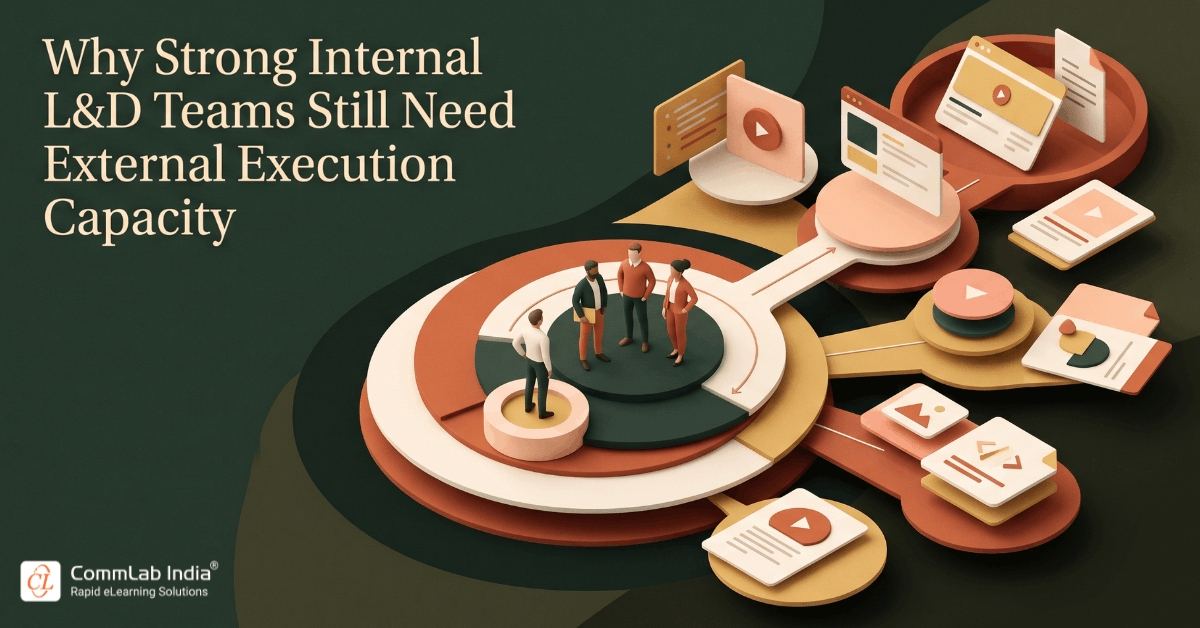
A strong internal L&D team can understand the business, work effectively with stakeholders, design sound learning, and maintain high standards. None of that guarantees it will always have enough capacity to execute every priority at the speed the business requires.
That distinction matters because enterprise learning demand is rarely steady. It rises around product launches, technology implementations, compliance deadlines, mergers, sales initiatives, leadership programs, and global rollouts. Even a well-resourced team can move from manageable workload to sustained overload when several priorities converge.
The strategic issue is therefore not whether internal L&D is capable. It is whether the organization expects a fixed internal team to absorb a variable production workload indefinitely.
External execution capacity is not a substitute for internal L&D expertise. It is a flexible capacity layer that allows the internal team to retain strategic control while expanding production when demand exceeds what the permanent team can reasonably absorb.
Table Of Content
- Strong Teams Often Create Their Own Capacity Problem
- The Real Constraint Is Usually Production Capacity, Not Strategic Capability
- Fixed Headcount and Variable Demand Are Structurally Misaligned
- External Capacity Protects the Work Only Internal L&D Can Do
- External Capacity Is Most Useful When Workload Is Uneven
- Why Hiring More People Is Not Always the Best First Response
- Tools and AI Can Improve Capacity, but They Do Not Remove the Constraint
- The Risk of Keeping Everything Internal
- What Good External Capacity Looks Like
- A Practical Test: Is Your Internal Team Being Used for the Right Work?
- How to Decide Whether You Need External Execution Capacity
- External Capacity Should Increase Control, Not Reduce It
- Frequently Asked Questions
Strong Teams Often Create Their Own Capacity Problem
Weak L&D functions are not the only ones that become overloaded. In fact, strong teams can be particularly vulnerable.
When business leaders trust L&D, they involve the function in more initiatives. The team may be asked to support onboarding, compliance, product training, digital transformation, sales enablement, technical training, leadership development, AI adoption, change management, and capability building across several business units.
Success expands the mandate. The challenge is that the capacity of the team does not automatically expand at the same rate.
An instructional design team that handled 20 active projects comfortably may not be able to absorb another major product launch, a global compliance update, and a new technology implementation without something changing. The team may still have the expertise to do the work, but expertise and available capacity are not the same thing.
This is where many organizations make the wrong diagnosis. They see an overloaded team and assume the team needs to become more productive, that the organization needs more permanent employees, or that a new tool will solve the problem. Any of these may help in specific situations. None addresses the underlying issue when demand itself is variable.
The Real Constraint Is Usually Production Capacity, Not Strategic Capability
This distinction is also central to a modern L&D strategy: internal teams create the most value when they can focus on business alignment and capability decisions rather than being consumed by production overflow.
Most enterprise L&D teams are not spending all their time making high-level strategic decisions. They are also producing.
A typical portfolio may involve analyzing source material, writing objectives, designing storyboards, developing eLearning, creating multimedia, coordinating SME reviews, performing QA, managing accessibility, localizing content, updating existing courses, publishing to the LMS, and managing revisions and versions.
Some of these activities require deep organizational context. Others are repeatable production activities that can be performed within established standards and governance. Approaches such as rapid eLearning development can help when the requirement is suitable for standardized, accelerated production.
|
Internal Strategic Capacity |
Flexible Execution Capacity |
|
Business consulting |
Storyboard production |
|
Training needs analysis |
eLearning development |
|
Stakeholder alignment |
Multimedia production |
|
Capability prioritization |
Course updates |
|
Performance consulting |
Quality assurance |
|
Learning governance |
Localization |
|
Measurement strategy |
LMS publishing |
|
Sensitive instructional decisions |
Version management |
This is not a rigid outsourcing rule. Some projects may require internal involvement across both columns. The point is that organizations should not automatically use scarce internal expertise for every unit of production simply because the team is capable of doing it.
A senior instructional designer may be fully capable of implementing review comments in a course. The more important question is whether that is the highest-value use of the person’s limited capacity when a business unit also needs help solving a performance problem.
Fixed Headcount and Variable Demand Are Structurally Misaligned
Learning demand is often described as though it were relatively predictable. In practice, enterprise demand tends to arrive in waves.
A team may experience normal workload for several months and then face several large initiatives at once. For example, a global manufacturing company could simultaneously need a safety update, new product training for sales teams, ERP adoption support, and revisions to multilingual compliance courses. That is why eLearning translation capacity often needs to be planned alongside development capacity rather than treated as an afterthought.
Nothing about the internal team may have changed. The shape of demand did.
If the organization sizes the permanent team for average demand, the team will struggle during peaks. If it sizes the team for maximum possible demand, it may carry unnecessary fixed cost during quieter periods.
Better capacity model: Maintain the permanent team around strategically important baseline capability, then add production capacity when demand rises.
External Capacity Protects the Work Only Internal L&D Can Do
One of the strongest arguments for external execution capacity is not what it allows the external partner to do. It is what it allows the internal team to keep doing.
When an overloaded team tries to absorb every production requirement internally, strategic work is often displaced by urgent execution work. A senior team member may intend to spend the week working with operations on a new capability framework but instead has to rescue a delayed eLearning project. An instructional designer who should be consulting with stakeholders may spend days updating screens and processing review comments.
The work is necessary. But the opportunity cost is real.
What should remain close to the business?
Activities that rely heavily on organizational knowledge and judgment generally benefit from staying internal. These include interpreting the business problem, determining whether training is required, prioritizing competing requests, aligning with senior stakeholders, defining governance, making sensitive instructional decisions, and determining how success will be measured.
External execution capacity works best when it protects these activities rather than displacing them.
External Capacity Is Most Useful When Workload Is Uneven
Not every capacity shortage requires the same solution. A temporary spike is different from a continuous backlog. A missing specialist skill is different from broad production overload.
|
Situation |
What Is Happening |
Appropriate Response |
|
Recurring overload |
Demand consistently exceeds internal throughput |
Add reserved execution capacity |
|
Temporary surge |
A launch, transformation, or deadline creates short-term volume |
Add controlled surge capacity |
|
Specialist gap |
A specific capability is temporarily unavailable |
Use staff augmentation |
This matters because organizations sometimes use one model to solve the wrong problem. Adding a contractor may help when one skill is missing, but it may not solve a systemic backlog across design, development, QA, and localization. For a closer comparison of the two sourcing approaches, see staff augmentation versus outsourcing.
The decision should begin with the shape of the constraint, not the sourcing category.
Why Hiring More People Is Not Always the Best First Response
Permanent hiring can be the right answer when demand is stable and the capability will be needed continuously. But it is not automatically the most efficient response to every overload situation.
Hiring creates fixed capacity. Enterprise learning demand often does not behave like fixed demand. There are also practical timing issues. By the time a role is approved, recruited, filled, and onboarded, the business initiative that created the immediate pressure may already be well underway.
Permanent hiring makes more sense when:
- demand is consistent across the year
- the role is core to long-term strategy
- utilization will remain high
- business context is particularly important
- the capability is difficult to access externally
External capacity becomes more practical when demand fluctuates, the need is deadline-driven, the skill is required intermittently, the business needs capacity quickly, or several capabilities need to scale together. In situations where the organization needs complete deliverables rather than individual resources, eLearning outsourcing may be the more appropriate model.
Tools and AI Can Improve Capacity, but They Do Not Remove the Constraint
Technology has changed how quickly learning teams can perform many production tasks. Authoring tools, templates, workflow platforms, AI-supported content development, translation technology, and automation can all reduce effort. The broader implications of AI in instructional design are especially relevant when teams are deciding which tasks can be accelerated and which still require human judgment.
AI can accelerate activities such as first-draft storyboards, source-content analysis, question generation, script drafts, content restructuring, translation support, and repetitive QA.
These gains matter. But a faster production tool does not automatically solve an overloaded operating system.
If the same three reviewers still approve every learning asset, review becomes the bottleneck. If the team has no spare development capacity, faster drafting may simply create more work waiting for production. If localization is disconnected from the main workflow, global launches can still slip.
Key implication: Technology improves capacity when the surrounding process is designed to absorb the improvement. It does not eliminate the need for flexible execution capacity.
The Risk of Keeping Everything Internal
Some organizations assume that keeping all production internal provides more control. That can be true in a small, stable environment. At enterprise scale, however, an overloaded internal model can create its own risks.
Quality begins to vary under pressure
When deadlines collide, teams make trade-offs. Reviews may become shorter. QA may happen later. Templates may be bypassed. Senior staff may be spread too thin to maintain consistent oversight. A structured eLearning quality assurance process becomes even more important when production volume increases.
Business priorities wait longer
A large backlog forces L&D to sequence projects. Some learning requests will wait even when business stakeholders consider them urgent. If this happens repeatedly, business units may bypass central L&D and create their own solutions.
Internal expertise becomes less strategic
When experienced professionals spend increasing amounts of time on production overflow, the organization loses some of the value those people were hired to provide.
Peak demand becomes the operating norm
A team can temporarily stretch to absorb a surge. But when temporary overload continues quarter after quarter, the organization is effectively operating above sustainable capacity.
What Good External Capacity Looks Like
The goal is not simply to move work outside the company. A strong external capacity model should behave like an extension of the internal operating system.
The external team should be able to work within defined instructional standards, brand guidelines, accessibility requirements, project workflows, review protocols, localization processes, QA criteria, technology environments, and governance rules.
The distinction between a transactional vendor and an execution-capacity partner becomes important here. A transactional vendor completes a defined project. An execution-capacity partner helps the internal function maintain reliable throughput across changing demand.
For a broader explanation of how these models fit together, explore the enterprise guide to on-demand learning execution.
A Practical Test: Is Your Internal Team Being Used for the Right Work?
Before deciding whether external capacity is necessary, L&D leaders can examine how their internal team’s time is being used.
- Identify the work that absolutely requires internal context. Focus on activities where enterprise knowledge, stakeholder trust, sensitive judgment, or governance make internal ownership important.
- Identify important but repeatable work. Look for activities that can be governed through standards, templates, review processes, and clear ownership.
- Identify the work that changes most sharply when demand rises. These activities are often the best candidates for elastic capacity because they create the greatest pressure during peaks.
For example, a product launch may dramatically increase course development and localization requirements while barely changing the need for senior learning strategy. That imbalance is exactly where external execution capacity can add value.
How to Decide Whether You Need External Execution Capacity
A strong internal L&D team should consider additional capacity when the problem is no longer occasional busyness but a recurring mismatch between demand and throughput.
- Approved projects repeatedly wait before production can begin.
- Major business launches require emergency resourcing.
- Senior L&D professionals spend increasing time on production rather than consulting.
- Localization or QA regularly becomes a bottleneck.
- Internal hiring cannot be completed in time to support the business requirement.
- The backlog continues growing even when the team is operating at full utilization.
- Business units begin creating their own learning because central L&D cannot respond quickly enough.
One isolated symptom does not necessarily justify a new sourcing model. Several occurring consistently suggest that the issue is structural.
External Capacity Should Increase Control, Not Reduce It
A common concern is that involving an external team means surrendering control. That depends entirely on how the model is designed.
The internal L&D function should retain ownership of strategic priorities, standards, stakeholder relationships, learning architecture, approval authority, governance, and measurement. The external execution layer operates within that framework.
In this model, control is not based on who physically builds every screen or asset. It is based on who defines the rules, owns the decisions, and remains accountable for quality.
In some cases, external capacity can actually force better governance because review responsibilities, quality standards, version control, and escalation paths must become more explicit.
Frequently Asked Questions
Does external execution capacity mean outsourcing the entire L&D function?
No. External execution capacity is typically used to extend the internal function, not replace it. Internal L&D can retain strategy, business alignment, instructional judgment, governance, and measurement while using external resources for variable production demand or specialist execution.
When should L&D hire instead of using external capacity?
Permanent hiring makes sense when demand is stable, the capability is required continuously, utilization will remain high, and organizational context is important. External capacity is usually more suitable when demand fluctuates, the requirement is temporary, or multiple capabilities need to scale quickly.
Can a strong internal instructional design team still benefit from staff augmentation?
Yes. Staff augmentation can help when the team has a temporary role or skill gap but wants to retain control over the workflow. It is different from project outsourcing because the external specialist generally works within the organization’s existing tools, standards, and management structure.
Does external capacity reduce learning quality?
Not inherently. Quality depends on standards, governance, review processes, expertise, and accountability. An overloaded internal team can experience quality pressure just as a poorly governed external model can. The objective is to expand capacity while keeping quality controls explicit.
Can AI remove the need for external learning capacity?
AI can reduce effort in selected tasks, but it does not solve every constraint. Review delays, localization complexity, project coordination, governance, and specialist capability gaps still require people and process design. AI is best viewed as a capacity multiplier within a broader operating model.
Strong Internal L&D and External Capacity Are Complementary
The strongest internal L&D functions do not prove their value by doing everything themselves. They prove it by using internal expertise where organizational judgment matters most and ensuring that approved learning can still be executed when demand increases.
The strategic distinction is between owning the learning function and owning every unit of learning production capacity. Those are not the same thing.
A well-designed external execution layer gives enterprise L&D teams room to absorb peaks, access specialist capabilities, reduce production bottlenecks, and protect the work that requires internal business context.
That is not a sign of a weaker internal team. It is a more deliberate way to use a strong one.


![8 Instructional Design Strategies for Meaningful Learning Experiences [Infographic]](https://www.commlabindia.com/hubfs/blogs/instructional-design-strategies-meaningful-learning-experiences-infographic.jpg)