Gamification is often perceived as a simple enhancement to learning design. Add points, introduce badges, display a leaderboard, and engagement will follow. This assumption has driven widespread adoption, yet it has also led to widespread disappointment.
Many gamified learning experiences generate initial curiosity but fail to sustain meaningful engagement. Learners interact briefly, then disengage once the novelty fades. The experience feels fragmented, disconnected from real work, and ultimately ineffective.
The underlying issue is not with gamification itself, but with how it is designed.
Gamification is not a collection of features layered onto content. It is a structural system that defines how learners interact, make decisions, receive feedback, and progress over time. When this system is thoughtfully designed, learning becomes immersive, purposeful, and aligned with performance outcomes. When it is not, gamification becomes superficial.
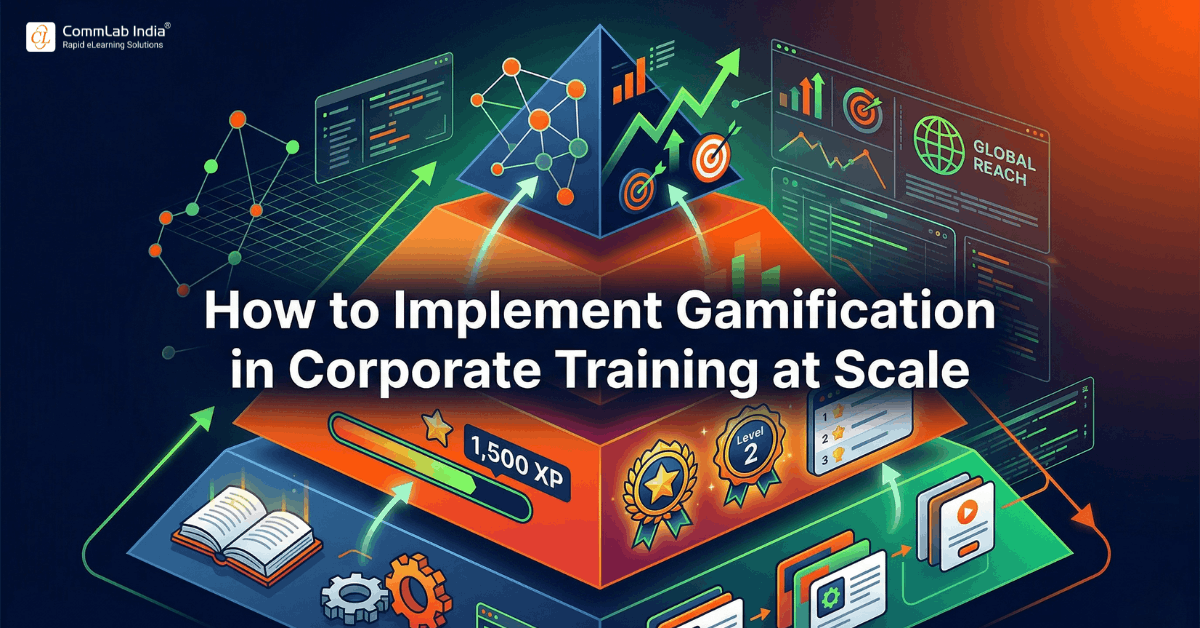
This article examines the architecture of gamified learning. It explains how game mechanics function beneath the surface, how they influence learner behavior, and how organizations can design them to create learning experiences that are both engaging and effective.
Download eBook Now: How AI Supercharges Gamification
TABLE OF CONTENTS
- Why Game Mechanics Matter in Learning Design
- The Structural Layers of Gamified Learning
- Core Game Mechanics That Shape Learner Behavior
- Designing Competitive and Collaborative Dynamics
- Gamified Assessments as a Learning Engine
- Structuring Progression, Feedback, and Mastery
- Where Gamified Learning Design Breaks Down
- A Systems Approach to Gamification Design
- Aligning Mechanics with Learning Outcomes
- FAQs
Why Game Mechanics Matter in Learning Design
Gamification succeeds or fails at the level of mechanics, not elements.
While visible features such as points, badges, and leaderboards attract attention, they do not define the experience. What truly shapes learner engagement is how the system behaves. Mechanics determine what actions learners take, how they receive feedback, and whether they feel motivated to continue.
In many corporate training programs, gamification is treated as an overlay rather than a foundation. This results in experiences that look engaging but lack depth. Learners may interact with the interface, but they are not meaningfully involved in the learning process.
When mechanics are intentionally designed, however, the experience shifts. Learning becomes structured, responsive, and iterative. Each action leads to feedback, each decision influences progression, and each milestone reinforces achievement.
In this sense, game mechanics are not decorative. They are the operational logic of the learning experience.
The Structural Layers of Gamified Learning
To understand how gamification works, it is useful to distinguish between its structural layers. These layers are often conflated, which leads to ineffective design.
The Three Layers of Gamified Learning
| Layer | What It Represents | Why It Matters |
| Elements | Visible features such as points, badges, leaderboards | Signals progress and recognition |
| Mechanics | Rules and systems governing interaction | Drives behavior and learning flow |
| Dynamics | Learner experience and emotional response | Creates engagement and motivation |
Most implementations overemphasize elements while neglecting mechanics. However, elements only reinforce what mechanics enable. Without a strong mechanical foundation, even the most visually appealing gamification will fail to sustain engagement.
A well-designed system begins with mechanics, uses elements to support them, and allows meaningful dynamics to emerge naturally.
Core Game Mechanics That Shape Learner Behavior
At the heart of gamified learning are a set of mechanics that consistently influence how learners engage with content. These mechanics do not operate in isolation. They work together to create a cohesive experience.
1. Progression Mechanics: Creating Direction and Momentum
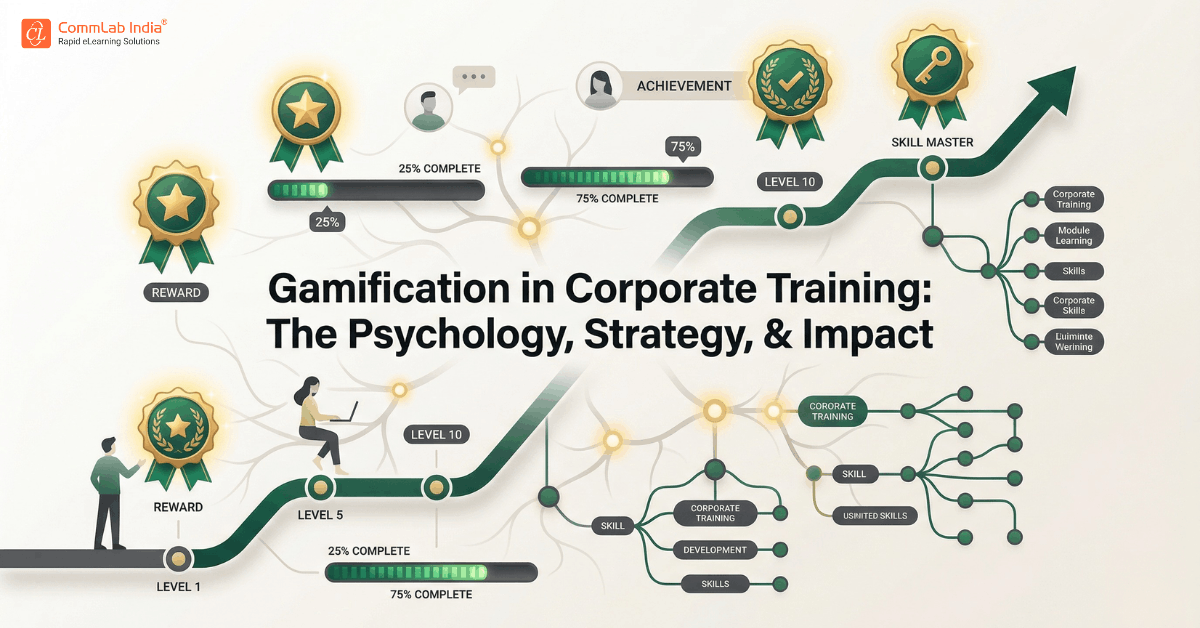
Progression provides learners with a sense of movement. It answers a fundamental question: where am I, and what comes next?
Common implementations include levels, milestones, and structured learning paths. These mechanisms reduce ambiguity and help learners navigate complex content without feeling overwhelmed.
- Levels help segment learning into manageable stages, making progress visible and achievable
- Milestones act as psychological checkpoints that reinforce accomplishment
- Learning paths guide learners through increasing levels of complexity
When progression is clear and meaningful, learners are more likely to stay engaged over time.
2. Challenge Mechanics: Turning Learning into Action
Challenges introduce effort, decision-making, and problem-solving into the learning experience. Without them, learning remains passive.
Effective challenges are not arbitrary. They are carefully designed to reflect real-world scenarios and require learners to apply knowledge rather than recall it.
- Scenario-based challenges simulate workplace situations, encouraging practical thinking
- Incremental difficulty ensures learners are neither overwhelmed nor disengaged
- Decision points create opportunities for exploration and consequence
By embedding challenges, learning becomes an active process rather than a passive activity.
3. Reward Mechanics: Reinforcing Meaningful Behavior
Rewards signal achievement and encourage continuation. However, their effectiveness depends entirely on how they are used.
When rewards are aligned with meaningful progress, they reinforce learning. When they are arbitrary, they lose value and can even distract from the objective.
- Points provide immediate recognition for correct actions
- Badges represent milestone achievements and skill acquisition
- Recognition systems highlight performance in ways that matter to the learner
The key is to ensure that rewards reflect real progress, not superficial activity.
4. Feedback Mechanics: Enabling Continuous Improvement
Feedback is the mechanism that transforms experience into learning. Without it, learners cannot refine their understanding or improve performance.
Gamified systems excel because they provide feedback continuously rather than at the end of a module.
- Immediate feedback helps learners correct mistakes in real time
- Contextual explanations deepen understanding rather than simply indicating correctness
- Retry opportunities encourage experimentation and mastery
This creates a loop where action leads to feedback, and feedback leads to improvement.
Designing Competitive and Collaborative Dynamics
Gamification often brings competition into focus, but competition alone does not create meaningful engagement.
The Role of Competition
Competition introduces urgency and comparison, which can motivate learners to perform better. Leaderboards and rankings are common tools used to create this effect.
However, competition must be used thoughtfully. While it can energize high performers, it can also discourage those who feel they cannot compete effectively.
The Need for Balance
To create inclusive engagement, competition should be complemented with collaboration.
- Team-based challenges encourage collective problem-solving
- Shared goals create a sense of belonging and purpose
- Peer interaction enhances learning through discussion and feedback
The most effective gamified environments create a balance where learners are motivated by both personal achievement and shared success.
Winning the eLearning Engagement Game: How AI Supercharges Gamification
Experience the Future of eLearning Engagement with AI-enhanced Gamification!
- Games to Engage Modern Learners
- Practical Tips to Incorporate Gamification in eLearning
- AI-enhanced Gamification
- And More!
Gamified Assessments as a Learning Engine
Assessment is where gamification demonstrates its greatest value, because it directly connects learning with performance.
Traditional assessments often focus on evaluating knowledge after learning has occurred. Gamified assessments, in contrast, integrate evaluation into the learning process itself.
How Gamified Assessments Transform Learning
| Dimension | Traditional Assessment | Gamified Assessment |
| Interaction | Static and linear | Dynamic and interactive |
| Feedback | Delayed | Immediate and actionable |
| Focus | Recall | Application and decision-making |
| Learner Experience | Evaluative | Iterative and developmental |
Gamified assessments incorporate mechanics such as scenario-based decision-making, adaptive difficulty, and multiple attempts. These elements ensure that learners are not just tested, but guided toward improvement.
Structuring Progression, Feedback, and Mastery
One of the defining strengths of gamification is its ability to structure learning over time in a way that promotes mastery.
Designing for Mastery
Mastery-based progression ensures that learners move forward only after demonstrating competence. This approach prioritizes depth over speed and reduces knowledge gaps.
Rather than completing modules, learners build capability step by step.
Creating Reinforcing Feedback Loops
Feedback should guide learners, not simply evaluate them. Effective systems provide insights that help learners understand not only what went wrong, but how to improve.
Encouraging Repetition Without Fatigue
Gamification enables repetition through variation. Challenges evolve, difficulty adjusts, and progress remains visible. This keeps learners engaged while reinforcing knowledge.
Together, these elements create a learning experience that is continuous, adaptive, and performance-oriented.
Where Gamified Learning Design Breaks Down
Despite its potential, gamification often fails due to design issues rather than conceptual flaws.
Common Design Pitfalls
- Overuse of elements
Excessive points, badges, and visuals can overwhelm learners and dilute focus - Misalignment with objectives
Mechanics that do not support learning goals create confusion and reduce effectiveness - Lack of real-world relevance
Abstract challenges fail to connect with learners’ roles and responsibilities - Absence of progression logic
Without a clear pathway, learners lose direction and motivation
These issues highlight the importance of designing gamification as a system rather than a set of features.
A Systems Approach to Gamification Design
To design effective gamified learning, organizations must adopt a systems perspective that integrates multiple layers of design.
A Structured Design Framework
| Layer | Focus Area | Key Design Question |
| Experience | Learner interaction | What will learners actively do? |
| Mechanics | Rules and progression | How will the system respond? |
| Motivation | Engagement drivers | Why will learners continue? |
| Measurement | Outcomes and performance | What defines success? |
This approach ensures that gamification is not an afterthought, but a core component of learning design.
Aligning Mechanics with Learning Outcomes
Ultimately, gamification must serve a purpose beyond engagement. It must support measurable outcomes.
This requires deliberate alignment between mechanics and objectives.
- For decision-making skills, use scenario-based challenges that simulate real choices
- For knowledge retention, incorporate spaced repetition with feedback
- For skill mastery, design progressive levels with increasing complexity
When mechanics are aligned with outcomes, gamification becomes a tool for performance, not just participation.
FAQ
1. What are gamification elements in learning?
A. Gamification elements are visible components such as points, badges, levels, and leaderboards. They support the learning experience by signaling progress and recognition but depend on underlying mechanics to be effective.
2. What are game mechanics in corporate training?
A. Game mechanics are the rules and systems that define how learners interact with training. They include progression paths, challenges, scoring systems, and feedback loops that guide behavior and engagement.
3. How do game mechanics improve learning outcomes?
A. Game mechanics improve outcomes by encouraging active participation, providing immediate feedback, and reinforcing learning through repetition and progression. This leads to better retention and application.
4. What is the difference between gamification and game-based learning?
A. Gamification enhances existing learning by adding structured mechanics, while game-based learning uses full games as the learning medium. Gamification focuses on experience design, whereas game-based learning focuses on immersion.
5. How should gamification be used in assessments?
A. Gamification should make assessments interactive and feedback-driven. Scenario-based challenges, adaptive difficulty, and retry opportunities help learners improve while being evaluated.
6. What are the risks of poorly designed gamification?
A. Poorly designed gamification can lead to superficial engagement, learner frustration, and misaligned outcomes. Overuse of elements and lack of relevance are common issues.
CONCLUSION
Gamification is often reduced to what learners see on the surface. Points, badges, and leaderboards dominate the narrative. Yet the true power of gamification lies beneath these elements, in the mechanics that shape behavior and learning.
When designed with intention, gamification transforms training into a system of interaction, feedback, and progression. It creates experiences that are not only engaging, but also meaningful, measurable, and aligned with performance.
For organizations seeking to elevate learning design, understanding and mastering game mechanics is not optional. It is essential.