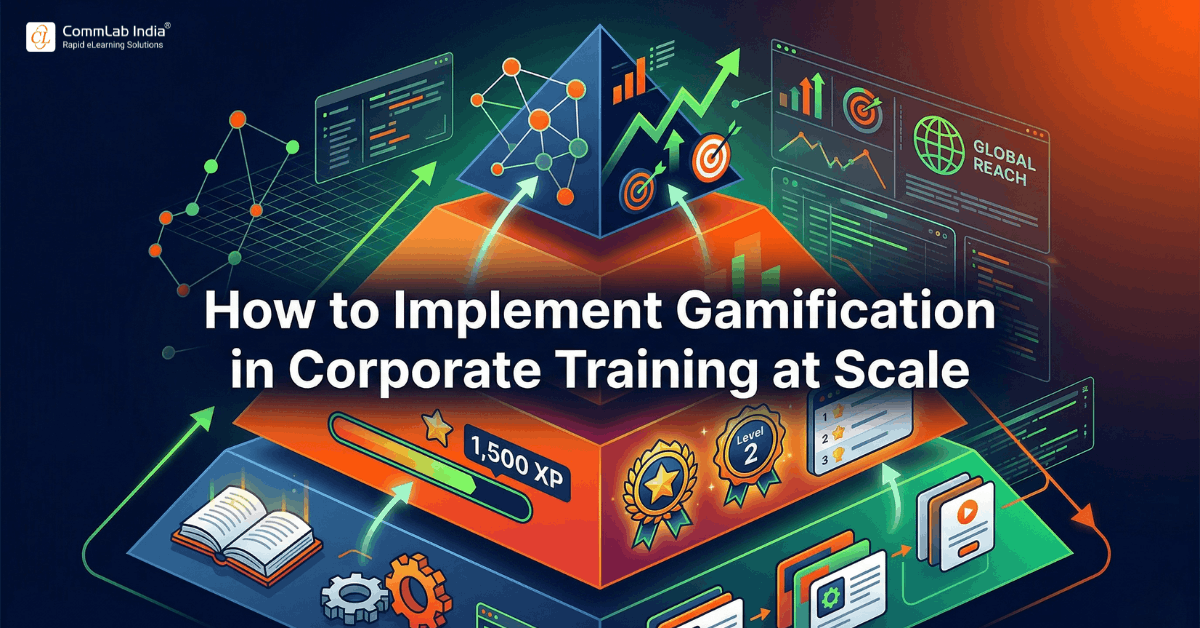
For many organizations, the conversation around gamification has already moved beyond curiosity. The benefits are familiar, the use cases are increasingly visible, and the potential to improve learner engagement is widely accepted. Yet this is often the point where enthusiasm gives way to uncertainty.
It is one thing to appreciate the promise of gamification. It is another to implement it in a way that is coherent, scalable, and genuinely effective.
This is where many learning initiatives begin to lose their momentum. Gamification is frequently introduced as a layer of visible features such as points, badges, progress bars, or leaderboards, but without the deeper instructional structure required to make those elements meaningful. The result is often an experience that feels interactive on the surface but lacks the strategic depth needed to sustain motivation or influence performance.
The organizations that see real value from gamification tend to approach it differently. They do not treat it as a design trend or an engagement add-on. They treat it as part of the learning architecture itself, something that shapes how learners progress, practice, receive feedback, and continue engaging long after the formal course ends.
This article explores what it takes to implement gamification in corporate training with greater maturity. It examines the strategic decisions, experience design considerations, delivery formats, and platform requirements that determine whether gamification remains a one-off initiative or becomes a scalable capability across the learning ecosystem.
Download Now: AI in Corporate Training
Table of Contents
- Why Gamification Implementation Often Falls Short
- What a Strong Gamified Learning Strategy Looks Like
- Designing Gamification Into the Learning Experience
- Adapting Gamification Across Delivery Formats
- Extending Gamification Beyond the Course
- Evaluating Gamification Platforms and Ecosystem Readiness
- Common Implementation Mistakes That Limit Impact
- How to Scale Gamification Without Diluting Its Value
- FAQs
Why Gamification Implementation Often Falls Short
Gamification rarely underperforms because the concept itself is flawed. More often, it underperforms because implementation is too shallow, too isolated, or too disconnected from the learning objective it is supposed to support.
In many corporate training environments, gamification is introduced at the final stage of design rather than at the beginning. A course is built, the content is finalized, and then a few “engagement features” are layered on top in the hope that they will make the experience more compelling. While this may create a temporary lift in attention, it rarely changes how learners think, behave, or perform.
The core issue is that gamification is often treated as a feature set instead of a behavioral design system.
When it is implemented superficially, it does not meaningfully shape the learner journey. It does not guide decisions, reinforce progress, or create momentum. It simply decorates the learning environment. By contrast, when gamification is embedded into the learning architecture from the start, it becomes part of how the experience functions, not just how it looks.
That distinction matters because successful implementation depends on a much deeper set of design questions:
- What learner behavior are we trying to influence?
The goal should never be interaction for its own sake. Gamification should support a behavior that matters, whether that is completion, practice, application, recall, or performance improvement. - Where in the learning journey do learners typically disengage?
The most effective mechanics are often not placed everywhere. They are placed where motivation tends to drop and where learners need momentum to continue. - What should the learner feel and do at each stage?
A well-implemented gamified experience is not just structured around content. It is structured around movement, challenge, and visible progress.
This is why implementation should never begin with a discussion of badges, leaderboards, or points. It should begin with a discussion of behavior, experience, and outcomes.
What a Strong Gamified Learning Strategy Looks Like
A strong gamified learning strategy is not defined by how many mechanics it includes. It is defined by how well those mechanics support the intended learning and business outcomes.
That means implementation must begin with strategic clarity.
Before an organization chooses any specific technique, it needs to understand the learning challenge it is trying to solve. In some cases, the issue may be low learner engagement. In others, it may be weak retention, limited post-training application, or inconsistent performance across teams.
Gamification should be used only when it has a clear role to play in solving that challenge.
Where Gamification Typically Adds Value
| Learning or Business Challenge | How Gamification Helps |
| Low learner participation | Creates momentum and encourages sustained interaction |
| Poor retention after training | Reinforces knowledge through repetition and feedback |
| Weak application on the job | Simulates real-world choices and consequences |
| Low post-training follow-through | Extends learning through continued challenges and reinforcement |
This is an important shift in perspective. Gamification is not a decorative enhancement to content. It is a way of structuring motivation, feedback, and progression so that learning becomes more active and more persistent.
A strong strategy typically answers four foundational questions:
- What do learners need to do, not just know?
Effective gamification is rooted in action. It should encourage learners to make decisions, solve problems, practice skills, or apply judgment. - What will keep them moving forward?
Momentum can come from challenge, curiosity, mastery, recognition, or visible progress. The right motivational structure depends on the audience and context. - How will learners know they are improving?
Progress must be visible. Feedback must be immediate enough to reinforce learning while the experience is still active. - What business outcome should this influence?
The strategy must connect to something measurable, whether that is time to proficiency, compliance adherence, sales readiness, or knowledge retention.
When these questions are answered clearly, implementation becomes much more intentional and much less dependent on trends or assumptions.
Designing Gamification into the Learning Experience
Gamification becomes most powerful when it is woven into the learning experience from the beginning rather than applied after the content is already built.
This requires a different mindset from traditional instructional design. Instead of simply organizing information into modules, designers need to think about how the experience should behave.
A gamified learning experience is not just something learners read or click through. It is something they navigate, respond to, and progress through.
The Core Experience Layers of Gamified Learning
To implement gamification effectively, it helps to think of the experience as being built through four interconnected layers.
1. Progression Layer
Progression creates movement. It helps learners understand where they are, what they have accomplished, and what lies ahead.
This is particularly important in corporate training because many learners disengage when content feels endless or directionless.
Progression can be designed through:
- Levels or stages
These break learning into manageable segments and create a sense of advancement. - Milestones or checkpoints
These give learners moments of completion and reinforce momentum. - Unlockable pathways
These create anticipation and allow progression to feel earned rather than automatic.
When progression is visible, learners are more likely to remain committed to the journey.
2. Feedback Layer
Feedback is one of the most essential, and often most underdeveloped, aspects of gamified learning.
Traditional training often delays feedback until the end of a lesson or assessment. Gamified learning works better when learners receive responses continuously, while the interaction is still meaningful.
Strong feedback should do more than mark something as right or wrong. It should help learners understand why their choice mattered and what to do next.
3. Challenge Layer
Challenge is what makes the experience active rather than passive.
Without challenge, gamification quickly becomes cosmetic. Learners may earn points, but they are not truly engaged in thinking, applying, or deciding.
Challenge can take many forms:
- decision-based scenarios
- timed problem-solving
- branching pathways
- application tasks
- performance missions
The most effective challenges are not random. They are aligned with real workplace demands.
4. Recognition Layer
Recognition reinforces effort, progress, and achievement.
Importantly, recognition does not always need to be public or competitive. In many learning environments, subtle recognition can be just as effective as visible rewards.
This may include:
- earned milestones
- completion markers
- progress acknowledgments
- skill-based achievement indicators
Recognition works best when it reflects meaningful accomplishment rather than superficial participation.
Adapting Gamification Across Delivery Formats
One of the most common implementation mistakes is assuming that gamification will function the same way across every learning format.
It will not.
The mechanics that work effectively in a self-paced eLearning module may feel awkward or ineffective in a virtual classroom. Likewise, what performs well on desktop may become cumbersome in a mobile learning environment.
This is why implementation needs to be shaped not only by learning goals, but also by delivery context.
Gamification Across Learning Environments
| Delivery Format | Best-Fit Gamification Approach | What to Prioritize |
| Self-paced eLearning | Structured pathways, branching scenarios, embedded challenges | Progression, decision-making, feedback |
| Mobile learning | Quick interactions, micro-challenges, streaks | Simplicity, continuity, reinforcement |
| Virtual classroom | Live participation mechanics, team-based activities | Social interaction, energy, responsiveness |
Designing for Self-Paced Learning
Self-paced digital learning offers the greatest degree of design control, which makes it one of the strongest environments for gamification.
Because learners move through the content independently, the experience must carry its own momentum. It cannot rely on a facilitator to energize or redirect attention.
This makes the following especially effective:
- Scenario-based progression
Learners move through realistic choices rather than static content screens. - Embedded feedback loops
Each interaction teaches, not just evaluates. - Checkpoint-based advancement
Progress feels earned and visible rather than passive.
Designing for Mobile Learning
Mobile learning requires a lighter, more focused implementation style. Learners are often accessing content in short bursts, between tasks, or in environments with limited attention bandwidth.
That means gamification should be designed for speed, clarity, and continuity, not complexity.
What tends to work best includes:
- short challenge bursts
- micro-rewards
- consistency streaks
- reinforcement prompts
- tap-friendly interactions
Rather than replicating the full desktop experience, mobile gamification should support ongoing engagement and post-training reinforcement.
Designing for Virtual Classrooms
Virtual classroom environments present a different opportunity. Here, gamification can be used to energize interaction, sustain participation, and structure live collaboration.
Useful approaches include:
- team-based challenges
- timed group activities
- competitive polls
- collaborative problem-solving tasks
- breakout room missions
In this environment, gamification works best when it supports social learning and facilitator-led momentum.

AI in Corporate Training
Partner, Not Replacement
- AI in Corporate Training
- AI Toolkit for Super-charged Learning
- Challenges to Consider with AI Implementation
- And More!
Extending Gamification Beyond the Course
One of the most strategically valuable aspects of gamification is also one of the least fully utilized: its ability to reinforce learning after formal training ends.
This matters because training rarely fails at the point of delivery. It often fails in the days and weeks that follow, when knowledge fades, habits are not reinforced, and learners return to old patterns.
Gamification can help close this gap.
Why Post-Training Gamification Matters
When implemented well, gamification can extend learning beyond the formal event and create a stronger bridge between training and performance.
This can be done through:
- follow-up challenges
Short activities that prompt learners to revisit or apply key concepts. - reinforcement quizzes
Lightweight checks that strengthen recall over time. - streak-based refreshers
Repeated, time-spaced interactions that encourage consistency. - mission-style tasks
Practice activities tied to real workplace behaviors or milestones.
This is where gamification often becomes more valuable than many organizations initially expect. It is no longer just improving the course experience. It is strengthening transfer and retention over time.
Evaluating Gamification Platforms and Ecosystem Readiness
Technology does not create good gamification, but it can either enable or constrain it.
Many organizations evaluate gamified learning platforms based on visible features alone. They look for points, badges, leaderboards, or basic achievement tracking. While these features may be useful, they are not enough to determine whether a platform can support a mature gamification strategy.
A more strategic evaluation looks at whether the platform ecosystem can support the experience the organization wants to create.
What to Look for in a Gamified Learning Platform
| Capability | Why It Matters |
| Progress tracking | Helps learners see movement and completion |
| Interaction flexibility | Supports richer learning mechanics and scenarios |
| Mobile responsiveness | Ensures continuity across devices |
| Analytics and reporting | Makes learner behavior and impact visible |
| LMS/LXP integration | Helps scale implementation across the learning ecosystem |
Think in Terms of Ecosystem, Not Tool
In practice, gamification implementation may involve multiple systems working together:
- an authoring tool for interactive learning design
- an LMS or LXP for delivery and tracking
- a mobile learning layer for reinforcement
- analytics tools for visibility and optimization
This is why platform decisions should be made in the context of the broader learning technology stack, not in isolation.
Common Implementation Mistakes That Limit Impact
As organizations move from isolated pilots to broader rollout, certain implementation mistakes tend to repeat themselves.
Common Mistakes to Avoid
- Starting with mechanics instead of outcomes
This often leads to activities that feel busy rather than meaningful. - Overcomplicating the learner experience
Too many rules, layers, or reward systems create friction instead of motivation. - Ignoring the realities of the delivery environment
A mechanic that works in one format may fail in another. - Treating gamification as a one-time intervention
Without reinforcement, the value often fades quickly. - Relying too heavily on platform features
Technology can support strong design, but it cannot replace it.
These issues are common because they emerge when implementation is rushed or when gamification is treated as a novelty rather than a design discipline.
How to Scale Gamification Without Diluting Its Value
Scaling gamification is not about replicating the same mechanic across every course or program. That approach may create consistency, but it rarely creates effectiveness.
The goal is not uniformity. The goal is repeatable design logic.
That means creating a shared set of principles that can be adapted to different contexts while preserving quality and strategic coherence.
What Scalable Gamification Typically Includes
- Shared progression logic
Learners encounter familiar structures across programs without experiencing repetition. - Reusable challenge formats
Teams can design more efficiently while still adapting to different content areas. - Consistent recognition patterns
Achievement feels meaningful and connected across the ecosystem. - Measurable performance alignment
Gamification remains tied to business and learning outcomes as it expands.
This is the point at which gamification stops being an isolated design experiment and becomes part of the organization’s broader learning capability.
FAQ
1. What is gamification implementation in corporate training?
A. Gamification implementation in corporate training is the process of embedding game mechanics such as progression, challenge, feedback, and recognition into learning experiences to improve engagement, retention, and performance.
2. How do you build a gamified learning strategy?
A. A gamified learning strategy begins with identifying the learning challenge, selecting mechanics that support the desired learner behavior, adapting them to the delivery format, and reinforcing learning over time.
3. What platform is best for gamified learning?
A. The best platform depends on the experience you want to create. Strong platforms support interaction design, learner tracking, mobile responsiveness, analytics, and integration with your broader learning ecosystem.
4. Can gamification work in mobile learning?
A. Yes. Gamification works particularly well in mobile learning when it is designed for short, focused interactions such as mini-challenges, reinforcement prompts, consistency streaks, and quick knowledge checks.
5. How can gamification improve post-training effectiveness?
A. Gamification improves post-training effectiveness by extending learning through refreshers, reinforcement challenges, progress tracking, and ongoing learner interaction after the formal training experience ends.
6. What are the biggest mistakes in gamification implementation?
A. The biggest mistakes include focusing on features instead of outcomes, overcomplicating the learner experience, ignoring delivery context, relying too heavily on platforms, and failing to reinforce learning after launch.
Conclusion
Gamification is easy to admire in theory, but its real value is determined by how well it is implemented in practice.
When designed strategically, it does much more than make learning feel more interactive. It creates momentum, strengthens feedback, reinforces behavior, and helps extend learning beyond the course itself. It allows organizations to build learning experiences that are not only more engaging, but also more durable, measurable, and aligned with performance.
But this only happens when gamification is treated as part of the learning system rather than a surface-level enhancement.
For L&D teams that want to move beyond novelty and build something that scales, the real opportunity is not simply to gamify more training. It is to implement gamification with greater strategic precision, stronger experience design, and a platform ecosystem capable of supporting it over time.