
Enterprise L&D teams usually respond to rising demand by asking how they can produce more. That question is understandable, but it is incomplete.
A more valuable question is: What should the internal L&D team stop producing itself?
For many mature organizations, the constraint is no longer a lack of learning ideas or instructional expertise. It is that highly experienced internal professionals are spending too much of their limited capacity on work that is repeatable, production-heavy, or highly variable in volume.
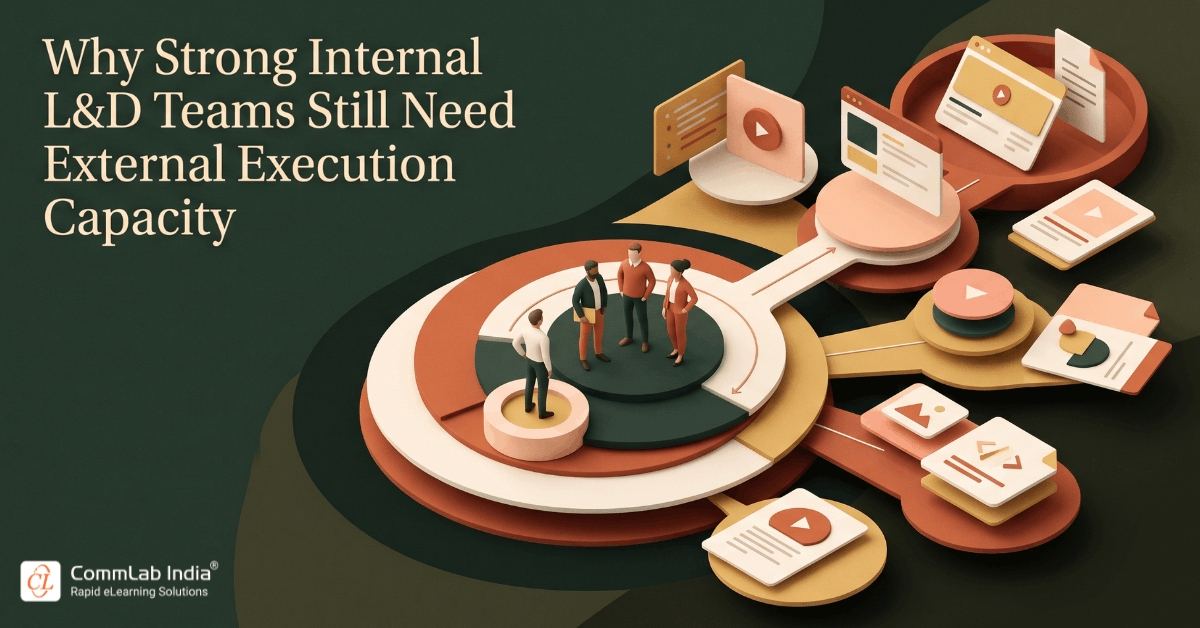
The goal is not to outsource everything. Nor is it to move strategic learning decisions away from the business. The goal is to protect the work that genuinely benefits from internal context and judgment, while moving suitable execution work into a more flexible production model.
The broader concept is on-demand learning execution: designing learning capacity so the enterprise retains strategic control while expanding execution capacity when workload requires it.
The practical issue is not simply what to outsource. It is deciding which work deserves scarce internal capacity and which work does not.
Table Of Content
- Start With a Different Question: Where Does Internal L&D Create Unique Value?
- The Work Internal L&D Should Protect
- Then Ask What Internal L&D Is Producing That Does Not Require That Level of Context
- Seven Types of Work Internal L&D Should Reconsider Producing In-House
- Use a Decision Framework, Not an Outsourcing List
- A Simple Portfolio Model: Own, Govern, or Execute
- The Opportunity Cost of Producing Everything Internally
- What Should Not Be Delegated Just Because It Is Difficult?
- What About AI? Should Internal L&D Stop Producing Work That AI Can Generate?
- A Practical Enterprise Example
- How to Start Redesigning the Internal Production Portfolio
- The Decision Is Not “What Can We Outsource?”
- Frequently Asked Questions
- Stop Measuring Internal L&D by How Much It Produces Itself
Start With a Different Question: Where Does Internal L&D Create Unique Value?
Internal L&D teams possess something an external provider cannot automatically reproduce: organizational context.
They know which stakeholders can approve a program, where resistance is likely to emerge, which business units interpret policies differently, which operational realities are absent from the source material, and which capability gaps actually matter.
That knowledge is especially valuable when the work requires interpretation rather than production. An internal L&D professional may be involved in determining whether a performance problem is really a training problem, negotiating competing stakeholder priorities, understanding how a new process affects different job roles, or deciding whether a learning intervention is appropriate at all.
A more useful distinction is:
Does this activity depend heavily on proprietary business context and internal judgment, or does it primarily require dependable execution against clearly defined standards?
The Work Internal L&D Should Protect
Before deciding what to stop producing, leaders should identify the work they want to protect. These activities generally create the highest value when they remain close to the organization.
Performance consulting and needs analysis
Internal teams are usually best positioned to understand the business problem before training becomes the proposed solution. A stakeholder may ask for a course because employees are making mistakes. The underlying issue may instead be an unclear process, poor system design, missing manager support, or conflicting incentives.
Stakeholder alignment and prioritization
Enterprise learning demand typically exceeds available capacity, so someone must decide which work matters most. That requires understanding business deadlines, regulatory exposure, strategic priorities, customer impact, workforce readiness, and executive expectations.
Learning architecture and solution design
Internal learning experts are often best positioned to determine how a new intervention fits into the broader learning ecosystem. Should the requirement become a course, performance support tool, manager resource, simulation, video, job aid, blended journey, or something else?
Governance and standards
An enterprise needs internal ownership of what constitutes acceptable instructional quality, which accessibility standards apply, how AI should be used, what approval rules govern high-risk content, which brand and design standards apply, and who has final sign-off. This becomes especially important as teams formalize AI governance for learning workflows.
Measurement and business alignment
Determining whether learning supported the intended business outcome requires access to operational context, stakeholders, and performance data. An execution partner may support analysis, but accountability for business relevance should remain internal.
Then Ask What Internal L&D Is Producing That Does Not Require That Level of Context
Once judgment-heavy work is protected, the internal production portfolio often looks different.
Many organizations discover that experienced L&D professionals are spending significant time updating screenshots, implementing reviewer comments, creating language versions, rebuilding old courses in a new authoring tool, performing technical QA, publishing to the LMS, or managing routine content revisions.
None of these activities is trivial. Poor execution can create quality problems. But the relevant question is not whether the activity matters. It is whether the activity needs to consume scarce internal capacity.
Seven Types of Work Internal L&D Should Reconsider Producing In-House
1. Routine Maintenance of Existing Courses
Course maintenance is one of the easiest forms of work to underestimate. Policies change, screenshots become outdated, products evolve, branding changes, accessibility requirements improve, links break, and regulatory language is revised.
As portfolios mature, maintenance can consume a substantial amount of production capacity. The internal team still needs to decide what changes and why, but it does not necessarily need to implement every update itself.
2. High-Volume, Template-Based eLearning Development
Not every learning requirement requires bespoke instructional design. Many enterprise portfolios contain recurring requirements such as policy updates, product knowledge, process training, standard onboarding, software walkthroughs, and compliance refreshers.
When design standards, templates, interaction patterns, and review processes are already established, production becomes more repeatable. Internal L&D can design the system without producing every asset inside the system. This is also where rapid eLearning development can be useful, because it relies on reusable content, templates, and streamlined workflows to reduce production time without removing instructional oversight.
3. Straightforward ILT or PowerPoint-to-eLearning Conversions
Enterprises often have large inventories of instructor-led materials, presentations, PDFs, and legacy training that need digital conversion. Some conversions require deep redesign. Others primarily require structured transformation and development. For a deeper look at this production pathway, see our guide to PowerPoint-to-eLearning conversion.
Internal L&D should determine whether the source content is instructionally sound, what needs redesign, which objectives matter, and what interaction level is appropriate. Once those decisions are made, the conversion itself may be suitable for scalable external production.
4. Localization Production and Language-Version Management
Global enterprises often underestimate how much production work multilingual learning creates. Translation is only one part of the workload. Teams may also need to manage terminology, linguistic review, text expansion, subtitles, voice-over, regional adaptations, technical QA, multiple published versions, and later updates. A well-designed eLearning localization strategy can reduce avoidable rework across languages, media, and regional adaptations.
If internal L&D manages every operational step across 10, 20, or 30 languages, localization can become one of the largest hidden consumers of capacity.
5. Technical Quality Assurance That Follows Established Standards
Quality assurance is essential, but not every QA activity requires senior internal L&D expertise. A mature QA framework separates instructional judgment from repeatable technical validation. A structured eLearning quality assurance process helps separate technical validation from the instructional judgments that should stay closer to internal L&D.
| Quality Area | Example Question | Best Ownership |
| Instructional quality | Does the learning approach support the intended performance? | Strong internal involvement |
| Content accuracy | Is the information correct and approved? | SME / internal owner |
| Technical QA | Do buttons, links, variables, audio, and navigation work correctly? | Scalable execution |
| Visual consistency | Does the course follow defined design standards? | Governed execution |
| Accessibility testing | Does the output meet required standards? | Specialist execution + internal governance |
| Linguistic QA | Is translated content accurate and appropriate? | Localization specialists + market reviewers |
6. Routine LMS Publishing and Administration
Learning administration can quietly absorb specialist L&D capacity. Uploading packages, assigning metadata, creating enrollments, setting completion rules, troubleshooting routine issues, publishing revised versions, generating standard reports, and managing catalog changes may all be necessary.
For some organizations, the LMS environment is complex enough to justify strong internal ownership. For others, routine administration is a strong candidate for operational support or staff augmentation. Where the work is ongoing but does not justify permanent hiring, L&D staff augmentation can provide role-specific capacity while the enterprise retains day-to-day control.
7. Predictable Production Surges
Some work should not permanently move outside the organization, but it should not permanently live inside it either.
A global product launch, regulatory deadline, or enterprise software rollout may temporarily require additional instructional designers, developers, multimedia specialists, QA resources, and localization capacity. Once the event is over, demand may decline sharply.
This is where on-demand learning execution becomes especially useful. The internal team retains business ownership and instructional direction while temporarily expanding production capacity around the business event.
Use a Decision Framework, Not an Outsourcing List
The previous categories should not become a blanket rule that certain activities must always be external. The more useful approach is to evaluate work against a consistent decision framework.
The Four Tests for Internal Production
- How much proprietary business context does the work require? The greater the dependence on internal knowledge, strategy, sensitive information, and stakeholder relationships, the stronger the case for internal ownership.
- How much professional judgment does the activity require? Work involving ambiguous performance problems, instructional decisions, risk, or business trade-offs should remain close to experienced internal professionals.
- How repeatable is the execution? The more standardized and governed the activity becomes, the easier it is to scale through external execution capacity.
- How variable is the demand? Highly variable work is expensive to staff permanently at peak capacity.
| Work Characteristic | Internal Production More Likely | Flexible Execution More Likely |
| Business context | High | Low to moderate |
| Judgment required | High | Defined by standards |
| Repeatability | Low | High |
| Demand pattern | Stable | Variable or spiky |
| Governance | Emerging | Well established |
| Specialist need | Continuous | Intermittent |
A Simple Portfolio Model: Own, Govern, or Execute
One practical way to operationalize the decision is to classify L&D work into three layers.
Own
These are activities where internal L&D should retain deep involvement because business context and judgment are central. Typical examples include capability strategy, performance consulting, stakeholder alignment, solution architecture, high-risk instructional decisions, and measurement.
Govern
These are activities where the enterprise needs to define the rules and retain accountability but does not need to perform every unit of production. Examples include design systems, accessibility standards, QA protocols, localization rules, AI governance, templates, and review processes.
Execute
These are activities that can often be performed through flexible production capacity once requirements and standards are clear. Examples may include routine development, course updates, technical QA, media production, localization production, LMS publishing, and large-scale conversions.
Key principle: Externalizing execution does not mean externalizing accountability.
The Opportunity Cost of Producing Everything Internally
The financial discussion around internal versus external learning production often focuses on direct cost. That misses the more important question: What is internal L&D unable to do because it is spending capacity elsewhere?
Suppose a senior instructional designer spends a week implementing routine changes across several courses. The cost is not simply the person's salary for that week. It may also include delayed stakeholder consulting, performance analysis, new-program architecture, measurement design, business-unit support, or innovation work.
This is the opportunity cost of internal production. The strongest internal teams therefore do not attempt to maximize the amount of work produced internally. They maximize the value of internal capacity.
What Should Not Be Delegated Just Because It Is Difficult?
An activity should not be moved outside simply because it is time-consuming or difficult. Some of the hardest work is exactly what the internal team should keep.
For example, during a global operating-model change, developing individual course screens may be scalable production work. But deciding how employees need to think and behave differently, which audiences face the greatest performance risk, how leaders should reinforce the change, and what success should look like all depend on enterprise context.
The rule should therefore never be “hard work goes outside.” It should be: repeatable execution can flex; context-rich judgment remains accountable inside the enterprise.
What About AI? Should Internal L&D Stop Producing Work That AI Can Generate?
AI changes the boundary, but it does not remove the need for the boundary.
Generative AI can accelerate first drafts, content transformation, question generation, script development, translation support, image ideation, and selected quality checks. That means some production work that previously required substantial manual effort can now be completed faster. Used well, AI in instructional design can shift effort away from first-draft production and toward stronger human review and decision-making.
However, this does not automatically mean the internal L&D team should perform all AI-enabled production itself. There are two separate questions: can AI accelerate the activity, and should internal L&D capacity be used to operate and govern that activity at scale?
AI changes execution economics. It does not eliminate execution capacity constraints. Human expertise remains essential for interpreting business context, validating accuracy, making instructional decisions, managing risk, and determining whether generated content is appropriate.
A Practical Enterprise Example
Consider an L&D team supporting a global technology implementation. The internal team needs to understand the new business processes, identify role impacts, work with functional leaders, determine training priorities, and define the learning architecture.
The production requirement, however, might involve 40 role-based learning modules, software simulations, quick-reference resources, manager materials, technical QA, accessibility checks, localization into 12 languages, and several update cycles before launch.
| Internal L&D | Flexible Execution Capacity |
| Analyze role impact | Produce approved learning assets |
| Define learning architecture | Develop simulations |
| Align with stakeholders | Build digital modules |
| Approve key instructional decisions | Perform technical QA |
| Define quality standards | Execute accessibility checks |
| Govern localization | Produce and test language versions |
| Measure readiness | Manage routine revisions |
The internal team has not lost control. It has concentrated its capacity where internal knowledge creates the greatest advantage.
How to Start Redesigning the Internal Production Portfolio
- Inventory production work. Review active and recently completed projects and categorize effort across analysis, design, production, QA, review, localization, administration, and maintenance.
- Identify repeatable work consuming scarce expertise. Look for activities performed by experienced internal staff even though they follow established standards.
- Assess demand variability. Determine which categories spike sharply around launches, compliance cycles, implementations, and global rollouts.
- Define what must remain internally accountable. Clarify the decisions, standards, and business relationships that should remain owned by the enterprise.
- Test the model on a defined workstream. Start with a bounded area such as course maintenance, rapid development, localization, or a defined surge.
The broader question of how recurring, surge, and specialist capacity should fit together belongs within the larger on-demand learning execution model rather than this individual production decision.
The Decision Is Not “What Can We Outsource?”
That framing is too vendor-centric. The better question is: What work should consume our internal L&D team's scarce capacity?
Once that is answered, the sourcing decision becomes clearer. Internal teams should concentrate on work where enterprise knowledge, judgment, stakeholder trust, and accountability create the greatest value. When leaders reach the sourcing stage, the question of eLearning development outsourcing should be evaluated through capacity, capability, consistency, and scalability rather than cost alone.
Execution that is repeatable, governed, specialist-heavy, or highly variable in volume can then be delivered through the most appropriate capacity model.
Frequently Asked Questions
1. Does this mean internal L&D should stop developing eLearning?
A. No. Internal development can make sense for high-context, strategically important, confidential, or continuously required work. The issue is whether internal teams should produce every type and volume of eLearning. Repeatable or highly variable production may be better handled through flexible execution while internal L&D retains standards and instructional accountability.
2. What learning work is easiest to move to external execution?
A. Routine course maintenance, template-based development, straightforward conversions, technical QA, localization production, version management, and selected LMS administration are often easier to externalize because requirements can be clearly defined and governed.
3. How do we avoid losing quality when production moves outside?
A. Quality should be governed through documented instructional standards, templates, accessibility requirements, QA protocols, review roles, source control, and approval processes. Externalizing production should not externalize quality ownership.
4. Should senior instructional designers stop doing production work entirely?
A. No. Production experience can be valuable, especially when projects are novel, complex, sensitive, or strategically important. The concern arises when senior professionals repeatedly spend large amounts of capacity on routine execution that could be completed under established standards by other qualified resources.
5. Is outsourcing the same as on-demand learning execution?
A. Not exactly. Outsourcing generally describes transferring a project or workstream to an external provider. On-demand learning execution is a broader capacity model in which enterprises combine internal expertise with flexible external production capacity according to recurring demand, temporary surges, or specialist requirements.
Stop Measuring Internal L&D by How Much It Produces Itself
A mature L&D function should not define its value by the percentage of learning assets it builds internally. Its value lies in ensuring that the right learning gets designed, produced, governed, and delivered when the business needs it.
That requires protecting internal capacity for the work where organizational context and professional judgment matter most. Routine production, maintenance, localization, QA, administration, and temporary demand spikes may still be essential. They simply do not always need to consume the enterprise's most scarce internal learning expertise.
The strongest question is therefore not “What should we outsource?” It is: What work should our internal L&D team be uniquely responsible for, and what work simply needs to be executed exceptionally well?