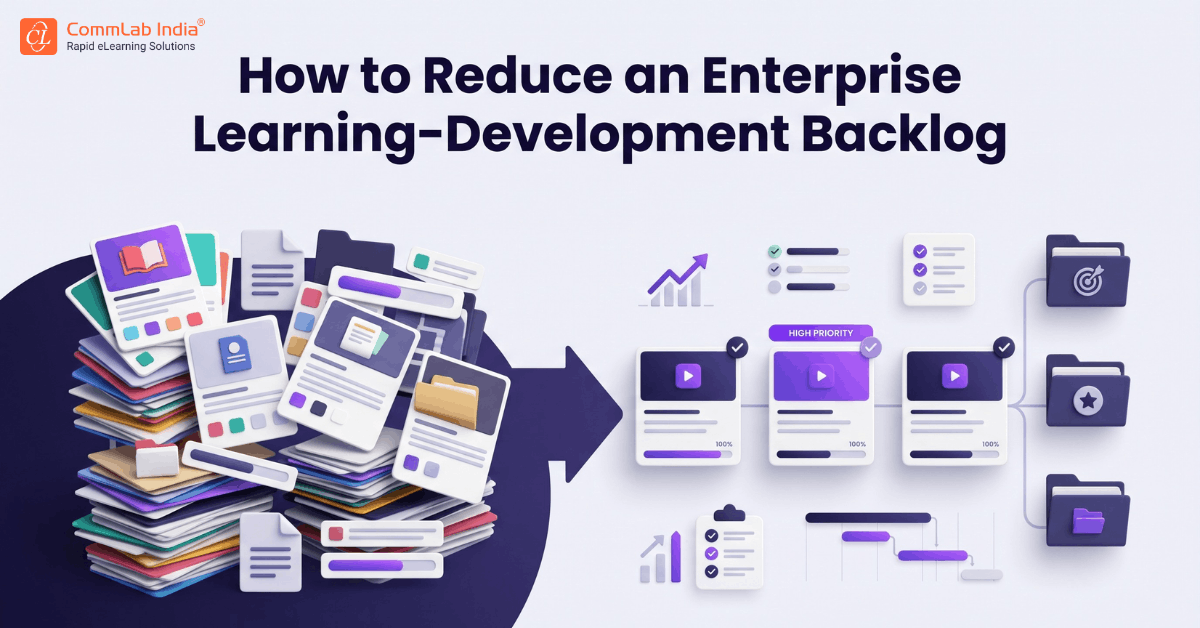
An enterprise learning backlog is rarely created because the L&D team is not working hard enough. More often, it develops because learning demand enters the system faster than the organization can convert that demand into finished, approved, deployable learning.
The backlog may begin with a few delayed courses. Over time, product training competes with compliance updates, leadership programs compete with systems training, course maintenance competes with new development, and localization begins after the English master is already late. Eventually, the queue itself starts influencing which business priorities L&D can support.
Reducing an enterprise learning-development backlog therefore requires more than asking teams to work faster or adding another authoring tool. The underlying production system needs to change.
A learning backlog is a flow problem before it is a volume problem.
Enterprise L&D teams need to identify where work is accumulating, reduce avoidable demand, remove workflow delays, protect scarce internal expertise, and add execution capacity selectively where the remaining constraint cannot be removed internally.
A Growing Backlog Is a Symptom, Not the Root Cause
When learning requests begin accumulating, the obvious response is often to focus on the size of the queue. How many courses are waiting? How many projects are overdue? How many instructional designers are available?
Those questions matter, but they do not explain why the backlog exists. A learning-development backlog usually emerges when one or more stages of the production system cannot process work at the rate it arrives. A clearly defined eLearning development process makes these dependencies easier to see and manage.
Request → Prioritization → Analysis → Design → Development → SME Review → QA → Localization → Deployment
If any stage becomes constrained, work begins accumulating before it. Adding more developers may increase the number of courses reaching SME review, but if the same three subject matter experts remain responsible for approvals, the backlog simply moves downstream.
The first task is therefore not to reduce the backlog indiscriminately. It is to understand where and why learning work is waiting.
Start by Separating Backlog Size from Backlog Health
Not every queue is unhealthy. A mature enterprise L&D function will normally have more potential work than it can execute immediately. Some requests are deliberately sequenced because other work has higher business priority.
The warning sign is not simply that work exists in the queue. It is that the queue is growing faster than the organization can clear it, or that important work is waiting beyond a reasonable business window.
| Measure | What It Reveals |
| Total approved projects waiting | Overall volume of committed demand |
| Queue age | How long approved work waits before production starts |
| Average cycle time | How long work takes from approval to deployment |
| Review latency | Time lost waiting for SME, legal, compliance, or business approval |
| Rework rate | How often content returns for substantial revision |
| Localization load | Additional production demand created by multilingual rollout |
| Release reliability | Percentage of learning delivered by the committed business date |
| Work by priority | Whether business-critical learning is delayed by lower-value work |
First Reduce the Work That Should Never Have Entered the Queue
One of the fastest ways to reduce an L&D backlog is to stop treating every request as a course-development request. Enterprise learning teams frequently inherit requests framed as solutions: "We need an eLearning course," "We need a 30-minute module," or "We need training for everyone."
Those requests may be valid, but they may also represent a stakeholder's preferred format rather than the actual performance requirement. A stronger intake process asks what employees need to do differently and what is preventing them from doing it now.
Sometimes a course is appropriate. In other cases, the requirement may be better addressed through a performance-support tool, job aid, manager conversation guide, short demonstration video, searchable process guidance, updated documentation, or practice embedded into an existing program.
Apply a production threshold before accepting work
- Is there a genuine performance or knowledge gap?
- Does learning materially contribute to closing it?
- Does the requirement justify the production effort being requested?
- What happens if this learning is delayed or not produced?
The fourth question is especially useful because it separates learning that is desirable from learning tied directly to business readiness, compliance, safety, customer impact, or operational performance.
Prioritize the Backlog by Business Consequence, Not by Arrival Date
Once unnecessary demand has been removed, the remaining queue still needs to be sequenced. A simple first-in, first-out system rarely works well for enterprise L&D because learning requests do not carry equal business consequences.
A compliance requirement with a fixed regulatory deadline cannot be treated the same way as an elective capability program. Product training required before launch has different timing implications from a course refresh that can reasonably wait another quarter.
| Decision Factor | Question |
| Business urgency | Is the learning tied to a fixed business or regulatory date? |
| Performance impact | What happens if people cannot perform the task correctly? |
| Audience scale | How many employees, customers, or partners are affected? |
| Delay consequence | What operational, commercial, compliance, or adoption risk increases if delivery slips? |
Find the Stage Where Work Spends the Most Time Waiting
A course may require 40 hours of active design and development but take eight weeks to reach deployment. The difference is usually waiting.
That is why reducing cycle time requires looking at elapsed time rather than production effort alone. Common enterprise bottlenecks include SME availability, compliance approval, legal review, content ownership, stakeholder disagreement, missing source material, localization handoffs, and unclear final approval authority.
Which stage:
- Analysis
- Storyboarding
- SME review
- Development
- Final approval
- QA and deployment
The team may initially conclude that development is the longest activity because it requires four days of effort. Yet review and approval create far more elapsed-time delay. Adding development capacity in this situation may do little to reduce backlog age.
SME Review Is Often the Hidden Backlog Multiplier
Subject matter experts are essential to enterprise learning development, but they rarely work full-time for L&D. They have operational responsibilities, competing priorities, and often little incentive to treat course review as their most urgent task.
The solution is not simply to ask SMEs to respond faster. The review model needs to reduce the amount of time and cognitive effort required from them.
- Agree review windows before development begins.
- Identify one accountable reviewer rather than several independent approvers.
- Ask SMEs to validate accuracy rather than redesign instructional treatment.
- Consolidate comments before sending feedback to the development team.
- Separate mandatory corrections from optional preferences.
- Establish escalation paths when review deadlines affect launch commitments.
Repeated review cycles often indicate that the requirements were insufficiently aligned before development began. Some apparent review problems are therefore intake problems appearing later in the workflow. The same review discipline is important when designing an eLearning outsourcing workflow, where unclear responsibilities can recreate the same delays across organizational boundaries.
Reduce Work in Progress Before Trying to Accelerate Everything
Overloaded L&D teams often respond to backlog pressure by starting more projects. That can make the problem worse.
When instructional designers, developers, SMEs, and project managers are spread across too many simultaneous assignments, every project spends more time switching between priorities and waiting for someone else's attention.
A more disciplined approach limits the number of projects actively moving through the system at the same time. Fewer projects may technically be "in progress," but more high-priority projects can reach completion.
Measure completion, not activity: The objective is not to maximize the number of projects started. It is to increase the flow of high-priority learning reaching deployment.
Standardize Repeatable Production Without Standardizing the Learning Strategy
A backlog often contains significant amounts of work that does not need to be redesigned from first principles every time. Recurring compliance modules, product updates, software demonstrations, policy training, simple conversions, and course maintenance can often benefit from a more standardized production system.
Templates, design systems, interaction libraries, QA protocols, review checklists, and reusable development patterns reduce unnecessary effort. The important distinction is between standardizing production decisions and standardizing instructional thinking. This is one reason rapid eLearning can be effective for suitable backlog items where source content already exists and timelines are compressed.
Enterprise teams can safely standardize established visual treatments, approved navigation patterns, accessibility requirements, assessment formats, reusable interaction components, development standards, and translation-ready design conventions while preserving instructional judgment for the decisions that genuinely require it.
Treat Maintenance as a Separate Capacity Stream
One reason enterprise learning backlogs become difficult to control is that new development and portfolio maintenance compete for the same people.
As the content estate grows, courses need updating because of policy changes, product changes, branding updates, accessibility requirements, technology migration, language revisions, or obsolete content. If this work is not planned explicitly, it appears as an interruption to new development.
A useful portfolio model separates three workstreams:
- New strategic development
- Recurring maintenance and updates
- Urgent business or regulatory change
Treating maintenance as planned demand makes the overall backlog more predictable and prevents existing content from silently consuming capacity intended for new programs.
Decide Which Work Requires Internal Expertise and Which Requires Execution Capacity
Once demand has been reduced, prioritized, and streamlined, some backlog may still remain. At that point, the constraint may genuinely be insufficient execution capacity.
Internal L&D usually creates the greatest value where organizational context and judgment matter most. That may include needs analysis, stakeholder alignment, performance consulting, prioritization, governance, and sensitive instructional decisions.
More standardized execution activities can often be expanded more flexibly, including development, multimedia production, course updates, QA, eLearning localization, and selected LMS administration.
This is where the broader model of on-demand learning execution becomes relevant. Rather than permanently expanding internal headcount to handle every peak, enterprises can create access to additional production capacity when the remaining backlog reflects a real throughput shortage.
The immediate backlog question is simple: after eliminating avoidable demand and workflow delay, does the organization still have more legitimate work than its available production capacity can execute? If the answer is yes, additional capacity is warranted. Where the requirement is for finished deliverables rather than individual roles, eLearning outsourcing becomes one possible execution option.
If the constraint is instead a defined role or specialist gap inside an otherwise effective workflow, L&D staff augmentation may be the more appropriate capacity response.
Use AI to Remove Production Friction, Not to Hide a Broken Workflow
AI can help reduce backlog pressure when it lowers effort in a stage that is genuinely constrained. Potential applications include summarizing source content, creating first-draft storyboards, generating question variations, restructuring existing content, drafting scripts, producing preliminary translations, and assisting with repetitive QA checks. A structured GenAI instructional design workflow is more useful than ad hoc prompting because the role of AI changes by stage.
The value depends on where the bottleneck sits. If storyboarding is constrained, AI-assisted drafting may help. If SME review is the problem, generating storyboards faster could simply increase the number waiting for approval.
AI should therefore be introduced after the production flow is understood, not as a substitute for diagnosing it. Human review remains essential for instructional decisions, contextual accuracy, business relevance, sensitive content, and final quality.
Build a Backlog-Reduction Sprint Around Flow, Not Heroics
Once the causes are understood, enterprises can use a focused backlog-reduction sprint rather than relying on permanent overtime.
- Inventory the queue. Capture every approved project, status, business priority, age, required release date, audience, expected effort, review requirements, and localization scope.
- Remove or reframe low-value work. Challenge whether each request still matters and whether it genuinely requires formal learning development.
- Reprioritize the remaining portfolio. Sequence projects according to business consequence and deadline rather than request age alone.
- Identify the constraint. Determine where the highest-priority work is waiting longest.
- Reduce active work in progress. Finish priority projects before activating additional low-priority work.
- Fix avoidable handoffs. Improve review responsibilities, feedback consolidation, intake quality, and approval governance.
- Standardize suitable production. Use reusable templates, workflows, QA standards, and approved components where they reduce repetitive effort.
- Add execution capacity only where required. If legitimate demand still exceeds the redesigned system's throughput, add flexible capacity against the actual constrained stages.
This order matters. Adding resources before fixing flow can increase activity without reducing the backlog meaningfully.
A Backlog Can Be Reduced Without Creating a Quality Problem
Speed and quality are sometimes treated as opposing objectives. In practice, many delays are not quality-producing activities. Waiting seven days for an SME to open an email does not improve instructional quality, and four rounds of contradictory stakeholder feedback do not automatically create better learning.
Quality controls should remain strong around instructional integrity, factual accuracy, accessibility, regulatory requirements, technical functionality, localization, and final approval. A formal eLearning quality assurance process helps keep those controls intact as throughput increases.
What should be reduced is unnecessary waiting, repeated interpretation, duplicated review, avoidable rework, and production work that should never have entered the queue.
Frequently Asked Questions
1. How do you reduce an L&D backlog quickly?
A. Begin by inventorying the queue, removing requests that no longer require formal learning, reprioritizing by business consequence, and identifying where high-priority work is waiting. Reducing work in progress and review delays often improves throughput faster than simply starting more projects.
2. When does a learning backlog indicate a capacity problem?
A. A backlog indicates a capacity problem when legitimate, prioritized demand continues to enter the system faster than the organization can complete it, even after unnecessary work and workflow delays have been addressed. Rising queue age and missed release commitments are particularly useful warning signs.
3. Should L&D hire more instructional designers to clear a backlog?
A. Not automatically. Additional instructional-design capacity helps only if instructional design is the actual constraint. If projects are waiting primarily for SMEs, development, localization, QA, or approvals, hiring more designers may simply move the queue to another stage.
4. Can outsourcing help reduce a learning backlog?
A. Yes, when the remaining backlog reflects a genuine execution-capacity shortage. External capacity can support development, QA, multimedia, localization, or other constrained activities. It is most effective after the organization has addressed avoidable demand, prioritization issues, and inefficient handoffs.
5. Can AI reduce an eLearning development backlog?
A. AI can accelerate selected activities such as source analysis, first drafts, assessment generation, and content transformation. Its impact depends on whether those activities are actual bottlenecks. AI does not solve delays caused by poor prioritization, slow approvals, weak governance, or insufficient downstream capacity.
Reduce the Queue by Redesigning the Flow
An enterprise learning-development backlog should not be treated simply as a pile of unfinished courses. It is evidence about how the learning production system is functioning.
A sustainable response begins by reducing unnecessary demand, prioritizing according to business consequence, limiting work in progress, improving review flow, standardizing repeatable production, and separating maintenance from new development.
Only after those steps should leaders determine whether the remaining constraint requires additional people or external execution capacity.
The goal is not to get everyone to work through the backlog faster. It is to redesign the system so high-priority learning moves through it reliably.