In many organizations, eLearning development looks deceptively straightforward on paper. A business need is identified. A few decks, documents, or SME notes are shared. A timeline is agreed upon. Then the project begins moving through design, development, review, and launch. But somewhere along the way, things start slipping. Stakeholders disagree on what the course should include. Review rounds multiply. Quality issues surface late. Timelines stretch. And what was meant to be a high-impact training initiative gradually turns into a coordination challenge.
That is because most eLearning projects do not struggle due to a lack of effort. They struggle because the development process itself is not designed to handle complexity.
For corporate training teams, eLearning development is not simply about turning content into online modules. It is a structured, cross-functional execution process that requires business alignment, instructional clarity, technical discipline, stakeholder governance, and quality control at every stage. When these pieces work together, development becomes faster, smoother, and far more scalable. When they do not, even a well-intentioned course can become difficult to build, harder to review, and underwhelming in impact.
At its best, the eLearning development process transforms subject matter expertise into a learning experience that is purposeful, usable, and aligned to performance outcomes. It helps organizations create training that not only launches on time, but also supports onboarding, compliance, product training, systems adoption, and role readiness in a way that actually fits how people work.
This article explores what a modern eLearning course development process should really look like, from planning and instructional design to quality assurance, project management, and post-launch optimization. More importantly, it explains how organizations can build a process that delivers consistently, rather than depending on last-minute effort and repeated course corrections.
Download Now: The 4Rs of Rapid eLearning
Table of Contents
- Why the eLearning Development Process Often Breaks Down
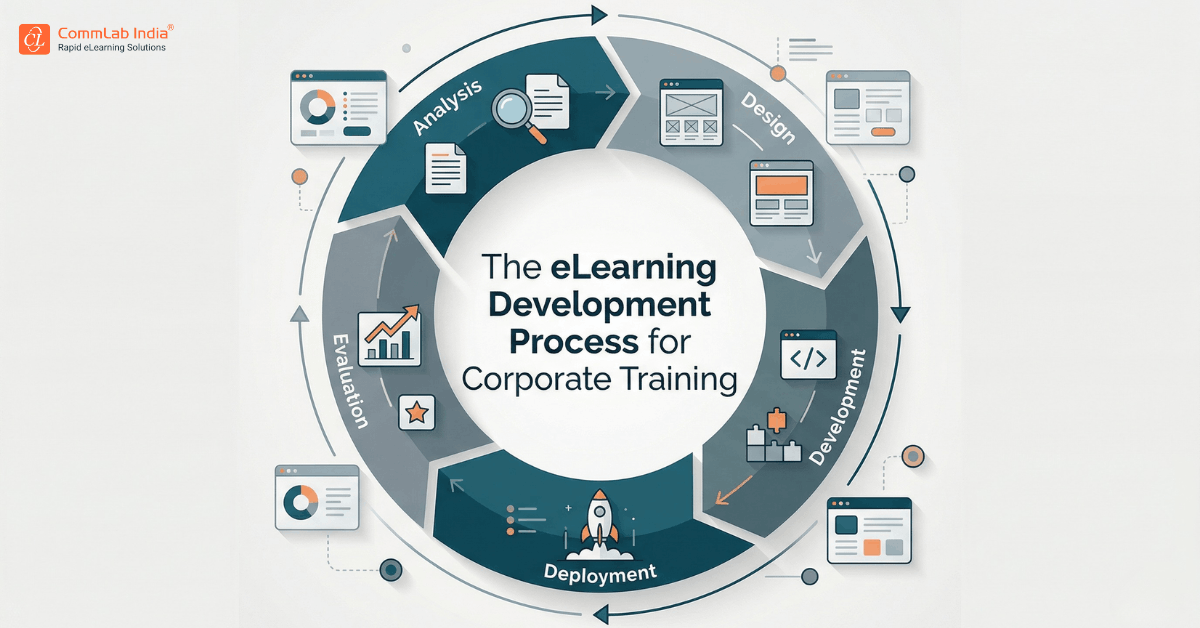
- What the Modern eLearning Development Process Actually Includes
- Stage 1: Strategic Scoping Before Development Begins
- Stage 2: Designing the Learning Experience Before Building It
- Stage 3: Development, Asset Production, and Technical Build
- Stage 4: Review Cycles, Quality Assurance, and Readiness Checks
- Stage 5: Launch, Governance, and Post-Deployment Optimization
- Agile, SAM, and Structured Workflows: Choosing the Right Development Model
- How to Manage eLearning Development Projects Without Chaos
- What High-Quality eLearning Development Looks Like in Practice
- Where Most Corporate Teams Lose Time, Quality, and Momentum
- How to Build a Repeatable eLearning Development System
- FAQs
- Conclusion
Why the eLearning Development Process Often Breaks Down
One of the most common mistakes organizations make is treating eLearning development as if it were primarily a content production task. In reality, it is a business-critical workflow involving multiple decision-makers, dependencies, and quality checkpoints that must all function in sync.
A course may begin with a training need, but by the time it is ready for launch, it has already passed through the hands of learning designers, SMEs, visual designers, developers, reviewers, project managers, and in some cases compliance or legal stakeholders. If that system is not structured well, friction shows up quickly.
Most breakdowns tend to happen for the same set of reasons:
- Projects begin with vague inputs
Teams are often asked to start development before the learning need, source content, or learner expectations are fully clarified. - Too many people influence the course, but too few own decisions
Stakeholder participation is necessary, but when approval authority is unclear, review cycles become slow and inconsistent. - Teams jump into screens too early
Development often starts before the instructional strategy has been properly defined, which leads to expensive rework later. - Quality is treated as a final-stage activity
When instructional, technical, and usability issues are only checked at the end, they become harder and costlier to fix. - Project management focuses on deadlines, not workflow discipline
Timelines matter, but so do dependencies, review structures, scope control, and decision flow.
In other words, most eLearning projects do not become difficult because the work is inherently chaotic. They become difficult because the process has not been designed to absorb and manage the realities of enterprise learning development.
A strong eLearning development process does not just help teams build courses faster. It helps them reduce rework, improve consistency, align stakeholders earlier, and deliver learning experiences that are easier to launch and maintain.
What the Modern eLearning Development Process Actually Includes
If you ask ten people what the eLearning development process is, many will describe it as a straightforward sequence: write a storyboard, build the course, review it, and publish it. While that may capture part of the workflow, it leaves out the strategic and operational complexity that determines whether the final output will actually succeed.
A modern development process should be viewed as a system, not a series of disconnected tasks.
That system includes:
- business goal alignment
- learner and role analysis
- source content evaluation
- instructional design planning
- visual and media production
- authoring and technical development
- review and stakeholder governance
- quality assurance
- LMS and deployment readiness
- post-launch maintenance and optimization
When organizations think about development this way, they stop seeing it as a one-time content creation effort and start seeing it as a repeatable capability.
A More Useful Lens for eLearning Development
Instead of asking, “What are the steps to build a course?”, stronger teams ask better questions:
- What business problem is this training trying to solve?
- What should learners be able to do differently after this?
- What must be built, and what can be removed?
- What does quality mean for this course?
- Who needs to review what, and at which stage?
- What will make this course maintainable after launch?
These questions lead to better decisions much earlier in the process, which is exactly where most quality and efficiency gains are made.
Stage 1: Strategic Scoping Before Development Begins
The earliest stage of eLearning development is often underestimated, even though it has a disproportionate impact on the success of the entire project.
This is where the team decides whether they are solving the right problem in the right way. If this stage is rushed or skipped, every later stage becomes more vulnerable to confusion, rework, and timeline slippage.
What Should Be Clarified Upfront
Before a project enters scripting, storyboarding, or production, several foundational questions need to be answered clearly.
1) What business outcome is the course expected to support?
Training should never exist in isolation. It must be connected to a business need such as:
- improving compliance adherence
- accelerating onboarding
- enabling product knowledge
- supporting software or process adoption
- reducing operational inconsistency
- reinforcing customer-facing skills
This helps the team make better content and design decisions later.
2) Who are the learners, and what context are they learning in?
A course for frontline sales teams should not be designed the same way as one for managers, service technicians, or manufacturing employees. Learner context matters because it affects not only content, but also format, device use, time availability, and cognitive load.
A good scoping discussion should account for:
- learner role and job context
- prior knowledge
- digital comfort level
- location or language needs
- work environment and access conditions
- time available for learning
3) What should learners be able to do after the training?
This is where many projects remain too vague. Objectives such as “understand the process” or “know the policy” may sound acceptable, but they are rarely specific enough to guide strong design decisions.
A stronger framing would be:
- identify non-compliant scenarios
- complete a workflow correctly
- respond to customer objections confidently
- perform a task using the system accurately
That shift matters because development becomes much easier when the desired learner performance is concrete.
4) Is the source content actually ready?
Many eLearning projects start with materials that are incomplete, outdated, inconsistent, or too dependent on SME explanation. That creates hidden risk from the beginning.
Typical source inputs may include:
- PowerPoint decks
- SOPs and policy documents
- instructor-led training materials
- manuals or product guides
- process maps
- recordings from SMEs
- PDFs or internal documentation
The question is not just whether content exists, but whether it is usable for development.
5) What constraints will shape the build?
A realistic scoping phase also accounts for execution realities such as:
- timeline expectations
- branding requirements
- LMS compatibility
- accessibility needs
- assessment rules
- compliance standards
- translation requirements
- reporting expectations
Without this clarity, the project may appear to be progressing while major assumptions remain unresolved.
What This Stage Should Produce
By the end of the scoping phase, the team should ideally have:
| Output | Why It Matters |
| Project brief | Aligns stakeholders around goals, audience, and scope |
| Defined learner profile | Helps shape the learning experience appropriately |
| Source content inventory | Identifies content readiness and gaps |
| Scope boundaries | Prevents uncontrolled additions later |
| Stakeholder map | Clarifies who reviews, approves, and contributes |
| Timeline assumptions | Grounds the project in realistic delivery expectations |
This stage may feel slower at the beginning, but it usually saves far more time than it costs.
Stage 2: Designing the Learning Experience Before Building It
Once the project has been scoped properly, the next priority is not production. It is design thinking.
This is the stage where the team determines how the learning experience should work before they decide how it should look or be built. It is where raw information begins to take shape as a learning journey rather than a content dump.
What This Stage Is Really About
Instructional design at this stage is less about decoration and more about decision-making. It involves asking:
- What belongs in the course, and what does not?
- What can be simplified without losing meaning?
- What needs explanation versus practice?
- How should the learner move through the experience?
- What kinds of interactions will support understanding?
This is where course quality begins to take form.
The Core Design Decisions
Content structure
The order in which content appears should reflect learner need, not simply the order in which source material was provided. A subject matter expert may explain a topic in one sequence, but learners may need it organized very differently for it to make sense in practice.
Instructional approach
The learning strategy should be shaped by what learners need to do after training. That might mean using:
- scenarios for decision-making
- guided walkthroughs for systems training
- process simulations for workflow tasks
- short explainer sequences for conceptual clarity
- role-based examples for job relevance
Assessment logic
Assessment should not be treated as an add-on at the end. It should be designed as part of the learning flow and aligned to the intended outcomes from the beginning.
Experience and interaction design
Interactivity should support learning, not simply make the course appear “engaging.” Meaningful interaction helps learners think, choose, practice, or apply. Decorative clicking rarely adds value.
What Teams Usually Produce at This Stage
Depending on the workflow, this stage may result in one or more of the following:
- a learning blueprint
- a design treatment
- a storyboard
- a prototype
- a screen concept or sample module
These artifacts are useful because they allow teams to validate direction before entering full production.
That is an important point: this stage is not just about creating documentation. It is about making the right decisions while change is still relatively inexpensive.
Stage 3: Development, Asset Production, and Technical Build
This is the stage that most stakeholders think of when they hear the phrase “eLearning development.” It is the point where design plans are translated into actual learner-facing course components.
But effective production depends heavily on what happened earlier. If scope and instructional strategy were not handled properly, development becomes a reactive cycle of building and rebuilding.
What Typically Happens in This Stage
The build phase often includes:
- authoring tool development
- on-screen content formatting
- visual design implementation
- media and animation integration
- voiceover synchronization
- assessments and interaction setup
- accessibility formatting
- mobile responsiveness checks
- LMS packaging preparation
This stage can move efficiently, but only if dependencies are managed with discipline.
Why Development Slows Down in Real Projects
Production rarely gets delayed because authoring tools are too slow. It gets delayed because the workflow around development is unstable.
Common blockers include:
- source content changes after build begins
- delayed SME inputs
- unapproved visual directions
- inconsistent feedback from multiple reviewers
- late additions to scope
- technical requirements surfacing too late
These issues are rarely “development problems” in the narrow sense. They are process problems that become visible during development because that is where unresolved decisions finally collide.
Development Works Best as a Coordinated System
Strong production does not happen when teams work in isolated handoffs. It happens when instructional, visual, technical, and review functions remain aligned throughout the build.
| Function | Contribution to the Build |
| Instructional Design | Protects learning flow, clarity, and pedagogical integrity |
| Visual Design | Shapes usability, visual hierarchy, and learner experience |
| Development | Builds interactions, logic, and technical functionality |
| SME Input | Ensures factual and contextual accuracy |
| QA | Validates quality, usability, and readiness |
| Project Management | Maintains momentum, scope, and review discipline |
The smoother these functions interact, the fewer expensive surprises emerge later.
Stage 4: Review Cycles, Quality Assurance, and Readiness Checks
If there is one stage where many eLearning teams either protect quality or quietly lose it, this is it.
Quality assurance is often treated too narrowly, as though its primary purpose is to catch visual inconsistencies or typographical errors at the end of production. In reality, the eLearning quality assurance process should validate whether the course works well as a learning experience, a technical asset, and a business deliverable.
What Quality Actually Means in eLearning
A course can look polished and still fail quality expectations if it is confusing, misaligned, inaccessible, or technically unreliable.
That is why QA must operate across multiple dimensions.
- Instructional quality: This checks whether the course is coherent, relevant, and aligned to what learners are expected to do.
- Functional quality: This validates navigation, interactions, branching logic, buttons, and assessment behavior.
- Visual quality: This ensures consistency in layout, typography, media placement, and overall learner-facing polish.
- Technical quality: This includes browser compatibility, LMS behavior, tracking, packaging stability, and performance across supported environments.
- Usability and accessibility quality: This confirms whether the course is easy to navigate and whether key accessibility requirements have been addressed where needed.
Review Rounds Should Have a Clear Purpose
One reason review cycles become frustrating is that too many stakeholders are often reviewing the wrong things at the wrong time.
A more structured approach is to define the purpose of each review round clearly:
- Design Review
Confirms whether the learning flow, structure, and experience direction are right. - Content Review
Focuses on factual accuracy, completeness, and business alignment. - Functional Review
Validates whether interactions and navigation work properly. - QA Review
Checks the full experience across instructional, visual, technical, and usability dimensions. - Final Sign-Off / UAT
Confirms launch readiness.
This kind of review discipline reduces noise and keeps projects from becoming trapped in endless revision loops.
Stage 5: Launch, Governance, and Post-Deployment Optimization
Publishing a course is not the finish line. It is the moment the course begins proving whether the development process actually worked.
A course that launches successfully but is never revisited can quickly become outdated, underused, or operationally fragile. That is why launch should be treated as part of a larger content lifecycle, not as the final task in the project plan.
What Should Happen Before Launch
Before a course goes live, the team should confirm that:
- all approvals are complete
- the correct package is ready for deployment
- completion and tracking settings are configured properly
- learner communication plans are in place
- support expectations are clarified
- metadata and reporting requirements are accurate
These may sound procedural, but they shape the learner experience and reporting reliability more than many teams expect.
What Should Happen After Launch
Once the course is live, it should be monitored not just for completion, but for performance and relevance.
This includes reviewing:
- completion trends
- learner drop-off points
- assessment performance
- learner feedback
- technical support issues
- business stakeholder observations
- content accuracy over time
A launch should create visibility, not closure. That is how teams identify what should be improved, maintained, retired, or expanded.
A Better Way to Think About Post-Launch Success
Rather than asking only, “Did the course go live?”, stronger teams ask:
- Is it being used as intended?
- Are learners completing it smoothly?
- Is the assessment telling us something useful?
- Does the content still reflect current reality?
- Who owns future updates?
That shift in thinking turns eLearning development from a project-based activity into a more sustainable operational capability.

Have You Met the 4 Rs of Rapid eLearning?
Accelerate Learning and Maximize its Impact With the 4 Rs of Rapid eLearning!
4Rs of rapid eLearning:
- Redesign
- Record
- Rebuild
- Republish
Agile, SAM, and Structured Workflows: Choosing the Right Development Model
There is no single “best” development model for every eLearning project. What matters is choosing a workflow that fits the complexity of the content, the speed of change, and the way stakeholders actually behave.
Structured or linear workflows
These are often useful when:
- content is stable
- compliance is strict
- review approvals are formal
- training accuracy must be tightly controlled
They provide predictability, but can become slow if stakeholders delay decisions.
Agile workflows
Agile approaches are often effective when:
- speed matters
- content is evolving
- multiple assets are being developed in parallel
- teams need frequent stakeholder input
Agile can increase responsiveness, but it only works well when teams maintain discipline around sprint planning, review scope, and backlog management.
SAM (Successive Approximation Model)
SAM is especially useful when stakeholders need to see early versions before they can respond meaningfully. It is often a strong fit for projects involving:
- experience-heavy design
- scenario-rich interactions
- rapid prototyping needs
- uncertain stakeholder expectations
What Most Corporate Teams Actually Need
In practice, many organizations benefit from a hybrid approach.
A realistic enterprise workflow often combines:
- structured scoping for alignment
- iterative design for validation
- agile production for speed
- formal QA and governance for quality and launch readiness
That is often more effective than trying to force every project into a single methodology.
How to Manage eLearning Development Projects Without Chaos
Even strong design and development teams can struggle if the project environment around them is unstable.
That is why eLearning project management should not be viewed as administrative support. It is a strategic function that protects momentum, reduces ambiguity, and keeps execution coherent.
What Needs to Be Managed Actively
A well-run eLearning project requires active oversight of:
- scope
to prevent unnecessary additions and shifting expectations - dependencies
so teams know what must happen before the next stage can move - review ownership
to avoid conflicting feedback and unclear sign-off - timeline realism
so schedules reflect actual development and review effort - risk
including content gaps, stakeholder delays, and technical blockers - communication
so decisions are documented and visible
What Better Project Management Looks Like
High-performing teams usually rely on a system that includes:
- milestone-based planning
- clear role ownership
- review deadlines
- centralized feedback
- version control discipline
- recurring status visibility
- risk escalation early, not late
Good project management does not just keep the course moving. It keeps the project from quietly becoming unmanageable.
What High-Quality eLearning Development Looks Like in Practice
Quality in eLearning is often easier to recognize in outcomes than in process descriptions.
When a development workflow is healthy, the course tends to feel coherent, polished, and purposeful. Stakeholders are aligned. Review cycles feel productive instead of exhausting. Launch happens with confidence rather than urgency.
Signs of a Healthy Development Process
A strong development process often produces visible patterns like these:
- The project starts with clarity
Teams know what problem they are solving and who the learners are. - Design decisions happen before production pressure builds
This reduces late-stage course corrections. - Feedback is consolidated and purposeful
Review cycles improve the course instead of derailing it. - Quality issues are identified early
Teams are refining, not rescuing, the course near the end. - Launch readiness feels controlled
The team is validating, not scrambling.
What Learners Experience as a Result
When the process behind a course is strong, learners usually experience the difference even if they cannot name it.
The course feels:
- focused rather than overloaded
- intuitive rather than frustrating
- relevant rather than generic
- polished rather than pieced together
- useful rather than performative
That is what process maturity looks like when translated into learner experience.
Where Most Corporate Teams Lose Time, Quality, and Momentum
Even experienced L&D teams can fall into predictable patterns that make development harder than it needs to be.
The problem is not usually a lack of talent. It is that small process weaknesses compound over time.
The Most Common Mistakes
Starting before the project is truly ready
Beginning quickly may feel productive, but it often means teams are building on unstable assumptions.
Allowing review cycles to expand endlessly
When too many stakeholders comment without structure, clarity declines rather than improves.
Treating SME input as a substitute for instructional design
Subject matter expertise is essential, but it does not automatically translate into effective learning design.
Confusing complexity with quality
More screens, more interactions, and more content do not necessarily produce a better learning experience.
Leaving quality validation too late
Late-stage QA often reveals issues that should have been caught during design or development.
Failing to define what “done” means
If completion criteria are unclear, projects keep moving without ever feeling truly finished.
These issues may seem operational, but together they shape the learner experience, the project timeline, and the team’s ability to scale.
How to Build a Repeatable eLearning Development System
If your team is creating more than a few courses a year, development cannot remain dependent on individual habits or improvised workflows. It needs to become a repeatable system.
That does not mean turning creativity into bureaucracy. It means creating enough structure that quality, efficiency, and clarity are not left to chance.
What a Repeatable System Should Include
Standardized project intake
A consistent intake process helps validate the business need, learner context, content readiness, and scope before development begins.
Reusable templates and frameworks
Templates reduce friction and improve consistency across projects. These may include:
- project briefs
- storyboard structures
- QA checklists
- review templates
- launch readiness checklists
Defined stage ownership
Each phase of the workflow should have clear ownership so the team knows who is responsible for decisions, outputs, and approvals.
Quality standards
The organization should define what “good” means across instructional, technical, visual, and usability dimensions.
Maintenance logic
Courses should not disappear into the LMS after launch. Teams should define who owns updates and what triggers revision.
Why This Matters Strategically
A repeatable development system does more than improve efficiency. It strengthens the credibility and capacity of the L&D function.
It allows teams to:
- support more business requests without becoming overwhelmed
- improve consistency across learning assets
- reduce rework and production waste
- onboard new team members more easily
- respond to organizational change with greater agility
That is when eLearning development stops being a reactive service and becomes a reliable business capability.
FAQs
1) What is the eLearning development process?
A. The eLearning development process is the structured workflow used to create digital training, from initial scoping and instructional design to development, review, quality assurance, deployment, and maintenance. It helps organizations turn business knowledge into effective, learner-ready digital experiences.
2) What are the main stages in eLearning development?
A. Most corporate eLearning projects move through five major stages: strategic scoping, learning design, production and development, quality assurance and review, and launch with post-deployment monitoring. Some teams also use iterative models such as Agile or SAM to improve speed and flexibility.
3) How long does it take to develop an eLearning course?
A. The timeline depends on factors such as course length, instructional complexity, interactivity, media requirements, review cycles, and stakeholder responsiveness. In many projects, delays are caused less by development effort and more by unclear inputs, approval bottlenecks, and late-stage changes.
4) Why is quality assurance important in eLearning development?
A. Quality assurance ensures the course is not only visually polished, but also instructionally sound, technically stable, and easy for learners to use. It helps catch issues related to navigation, tracking, content accuracy, functionality, and learner experience before launch.
5) Which model is better for eLearning development: ADDIE, Agile, or SAM?
A. Each model has strengths depending on the project context. Structured workflows are useful for stable and compliance-heavy training, while Agile and SAM are often better for iterative development and faster stakeholder feedback. Many enterprise teams benefit most from a hybrid model.
6) Why do eLearning development projects get delayed?
A. Most delays happen because of incomplete source content, unclear scope, too many reviewers, changing expectations, or weak project governance. In many cases, the real issue is not the authoring work itself, but the instability of the workflow around it.
7) How can organizations improve their eLearning project management?
A. Organizations can improve project execution by standardizing intake, defining stage ownership clearly, structuring review cycles, using QA checklists, and creating reusable workflows. The goal is to make delivery more predictable while protecting quality and reducing unnecessary rework.
Conclusion
The strongest eLearning teams are not simply better at producing courses. They are better at designing the system behind the course.
They understand that a successful learning experience is rarely the result of last-minute effort or creative improvisation. It is the outcome of strong scoping, thoughtful design, disciplined production, purposeful review, and quality governance that holds under real-world pressure.
That is what separates eLearning that merely gets built from eLearning that actually performs.
If corporate training is expected to drive meaningful business outcomes, then the eLearning development process cannot remain informal, fragmented, or dependent on individual heroics. It must be designed with the same level of intentionality that organizations apply to other operational capabilities.
Because when the process is strong, quality stops being accidental and starts becoming repeatable.