As GenAI becomes more common in instructional design, most teams eventually reach the same point.
The early excitement wears off.
The experimentation becomes uneven.
Some people use AI constantly.
Some barely use it at all.
Some produce impressive drafts.
Others produce polished weak work.
Leaders start asking whether the team is really getting smarter, faster, or better.
That is usually the moment when governance becomes necessary.
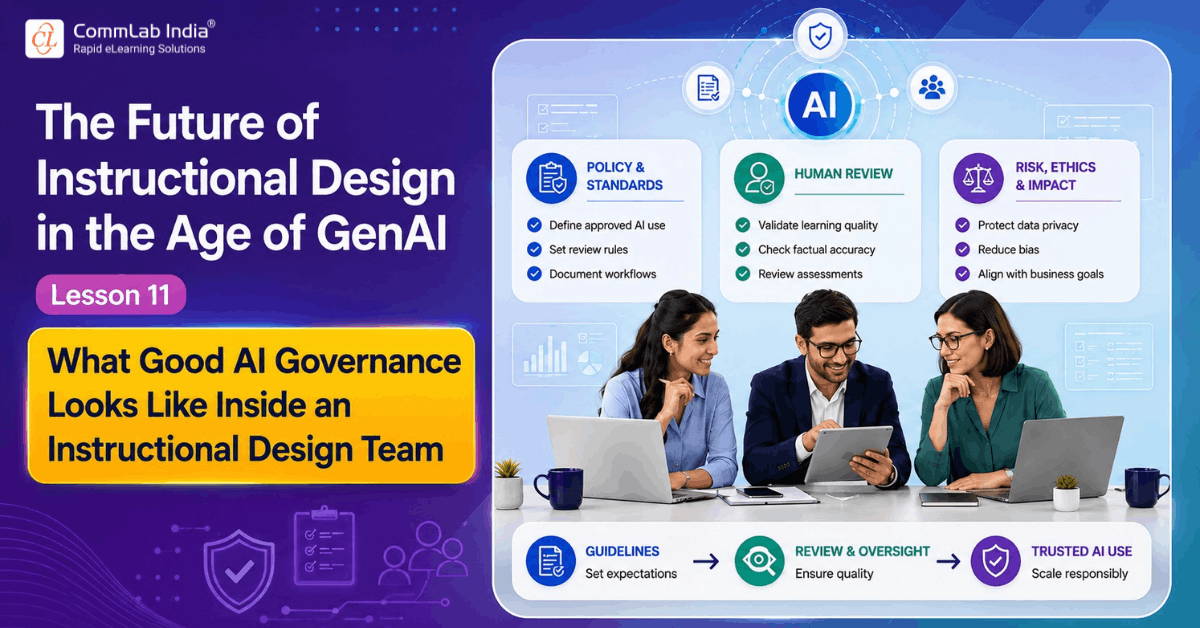
Unfortunately, the word governance tends to make people think of control, restriction, legal review, or tool policy. Those things matter. But in an instructional design team, good AI governance is not mainly about limiting use.
It is about shaping use.
That distinction matters.
Because the real question is not simply whether AI is allowed. The real question is whether AI is being used in ways that improve design quality, protect judgment, reduce avoidable risk, and build stronger professional practice over time.
That is what good governance should do.
If it does not do that, it is either too weak to matter or too bureaucratic to help.
This article is part of a series on the future of instructional design in the age of GenAI. The series explores how instructional designers can move beyond ad hoc prompting toward a more disciplined, challenge-based human–AI working method.
Table Of Content
- Governance Is Not the Same as Access Management
- The Purpose of Governance in an ID Team
- What Good Governance Looks Like in Practice
- What Good Governance Does Not Look Like
- The Leadership Implication
- The Larger Point
Governance Is Not the Same as Access Management
Many organizations begin and end at the wrong level.
They decide which tool the team can use.
They define what data can or cannot be uploaded.
They set some broad usage principles.
Perhaps they share a prompt guide.
Then they assume the governance problem is solved.
It is not.
That is infrastructure, not governance.
Useful infrastructure, yes. Necessary in some cases, yes. But not enough.
Because the biggest risks in AI-assisted instructional design are often not technical. They are professional.
They include:
- accepting AI output too quickly
- weakening instructional thinking through overdependence
- generating polished but poorly aligned design
- creating assessments that look sound but test little
- simplifying SME content too aggressively
- using AI inconsistently across the team
- producing speed gains without quality discipline
- letting junior designers rely on output they cannot yet evaluate properly
These are not tool-access problems.
They are workflow, review, and capability problems.
That is why governance in an instructional design team must go beyond permission and policy. It has to reach the level of how work is actually done.
The Purpose of Governance in an ID Team
In my view, good AI governance in instructional design should do five things.
First, it should protect quality.
Second, it should preserve human judgment.
Third, it should create consistency without killing initiative.
Fourth, it should reduce avoidable risk.
Fifth, it should help the team improve its way of working over time.
Those are better goals than simply “increase adoption.”
Adoption, by itself, proves very little.
A team can use AI heavily and still produce mediocre learning. In fact, heavy AI use can sometimes increase the risk of polished mediocrity if the review discipline is weak. Good governance exists to prevent that.
What Good Governance Looks Like in Practice
A strong governance model for an instructional design team does not have to be complicated. But it does have to be intentional.
1. Define the Role of AI in the Workflow
This is the first and most important step.
Do not leave AI use at the level of general encouragement. Define where it is expected to help and where human control must remain explicit.
For example:
- AI may assist with SME content simplification
- AI may suggest learning flow options
- AI may draft objective options, assessments, and narration
- AI may propose visual and interaction ideas
- AI may perform an audit or critique
But:
- the instructional designer must review and confirm all final design decisions
- business context and performance intent must remain human-owned
- final objective approval must remain human-owned
- final assessment and storyboard sign-off must remain human-owned
This matters because ambiguity around role leads to sloppy use. If AI is treated as a vaguely helpful layer, teams will use it in whatever way feels easiest. If its role is clearly positioned, usage becomes more disciplined.
2. Build Human Confirmation into Every Critical Stage
This is non-negotiable.
If AI outputs move directly into deliverables without explicit human confirmation, governance has already failed.
Instructional design is too judgment-dependent for that.
At minimum, critical checkpoints should include:
- SME understanding confirmed
- learning flow reviewed
- objectives and summative assessment aligned
- storyboard blueprint approved
- visual/interaction choices validated
- formative assessments reviewed
- final audit completed before development
This does not have to become a bureaucratic ceremony. But the review must be real.
The point is not just to “approve” output. The point is to ensure the human designer is still doing the work of reasoning, not merely acting as a light editor of generated material.
3. Separate Draft-Stage AI Use from Final-Output Standards
This is another important principle.
Teams should be explicit that draft-stage AI behavior and final-output standards are not the same thing.
In draft stages, the team may allow:
- exploratory prompting
- challenge prompts
- multiple rough options
- critique modes
- review challenge methods
In final outputs, the standard is different:
- no unresolved ambiguity
- no challenge artifacts left in place
- no unverified SME interpretation
- no unsafe simplification
- no AI-generated content accepted without human review
This distinction matters because creative exploration and production-grade accuracy are different things. Governance becomes stronger when the team names that openly.
4. Create Different Expectations for Different Levels of ID Maturity
One-size-fits-all AI governance is weak governance.
A junior ID should not be expected to use AI in exactly the same way as a senior one. Nor should they be trusted with the same kind of independence in reviewing AI output.
A stronger model would define different expectations:
- juniors use AI with more explicit reasoning prompts and more review
- mid-level IDs use AI for generation plus critique and justification
- seniors use AI more for challenge, audit, and pressure-testing
This is not about hierarchy for its own sake. It is about role fit.
Governance improves when the team acknowledges that AI support should differ by maturity.
5. Standardize Review Questions, Not Just Prompts
This is one of the most overlooked levers.
Many teams build prompt libraries. Very few build review libraries.
That is a mistake.
If you want better AI-assisted design, you need a standard set of review questions that designers ask before moving forward. For example:
- What has AI simplified too aggressively here?
- Where is the alignment weak?
- Which screen is likely to become text-heavy?
- Which assessment item looks fine but tests too little?
- What assumption is hiding inside this learning flow?
- What would an independent reviewer challenge here?
These questions are far more important than generic “write me a storyboard” prompts.
Why? Because they shape judgment.
And governance, in the end, is really about shaping judgment at scale.
6. Define No-Go Zones Clearly
Every team needs explicit boundaries.
These should include both content-risk zones and behavior-risk zones.
For example, AI should not be allowed to finalize or be trusted blindly in:
- safety-critical instructions
- regulatory or compliance interpretation
- medical or technical procedures where precision matters
- legally sensitive or policy-sensitive material without expert review
Likewise, the team should define behavioral no-go zones such as:
- copying AI output into deliverables without review
- using AI summaries as a substitute for SME understanding
- using AI-generated assessments without alignment checks
- skipping human confirmation because the AI output “looks good”
Clear boundaries reduce confusion. More importantly, they reduce rationalization.
7. Use AI to Strengthen Review, Not Just Production
This is where governance becomes smarter.
If AI is only governed as a production tool, the team misses one of its most useful roles. AI should also be governed as a review tool.
That means using it to:
- critique objectives
- audit assessment alignment
- identify text-heavy screens
- challenge weak interaction choices
- review narration for duplication
- perform structured end-stage audits
This is also where ideas like challenge-based prompting and Review Challenge Mode become relevant. Governance should not only say what AI may produce. It should also define how AI can be used to keep human review sharp.
That is a much more mature model.
8. Track Quality Patterns, Not Just Usage Volume
Many leaders make the mistake of measuring adoption as if that is the main success indicator.
It is not.
The better questions are:
- Is storyboard quality improving?
- Are junior IDs learning faster or becoming overly dependent?
- Are assessments getting stronger?
- Are text-heavy screens decreasing?
- Is rework from review stages going down?
- Are SMEs giving clearer feedback on instructional quality?
- Is AI improving consistency across designers?
These are governance questions too.
Because governance is not static. It should evolve based on what the team is actually experiencing. If AI use is rising but quality is not improving, the team does not have an adoption problem. It has a governance problem.
What Good Governance Does Not Look Like
It is worth saying this plainly.
Good AI governance is not:
- a document nobody reads
- a list of generic dos and don’ts
- a fear-based restriction system
- a one-time training session
- a prompt repository with no workflow discipline
- a compliance exercise divorced from daily practice
Those things may exist around the edges. But by themselves, they do not shape better work.
Good governance lives inside the workflow.
It shows up in the prompts people use, the review questions they ask, the checkpoints they respect, the challenge they build in, the standards they apply, and the maturity with which the team understands AI’s role.
That is what makes it real.
The Leadership Implication
For L&D leaders and team managers, this means the conversation has to mature.
The question is no longer, “Should our instructional design team use GenAI?”
That question is already behind us.
The better questions are:
- What kind of AI use are we encouraging?
- What kind are we allowing without enough scrutiny?
- Where are we gaining efficiency at the cost of judgment?
- How do we standardize stronger practice without killing initiative?
- What review discipline must be protected as AI use increases?
Those are governance questions worth asking.
Because the future problem will not be that design teams refused to use AI.
The future problem will be that many teams used it casually, inconsistently, and without enough thought about how it was reshaping professional practice.
Good governance is how you prevent that.
The Larger Point
The best use of GenAI in instructional design will not come from giving teams freedom alone.
And it will not come from restricting them heavily either.
It will come from giving them a more disciplined way to work.
That is what good governance really is.
Not control for its own sake.
Not policy for appearance’s sake.
But a practical system that helps teams use AI in ways that improve quality, preserve judgment, reduce risk, and strengthen the craft.
That is the standard that matters.
Next in the series: Why Every Instructional Designer Should Learn to Argue With AI.