One of the laziest assumptions in the current GenAI conversation is that all instructional designers should use AI in broadly the same way.
Give everyone access.
Share a prompt library.
Offer a few examples.
Encourage experimentation.
Let usage spread.
This sounds reasonable. It is also incomplete.
Because instructional designers are not all doing the same kind of thinking at the same level of maturity. A junior instructional designer and a senior one may both be working on a storyboard, but they are not bringing the same judgment, pattern recognition, business understanding, or design confidence to the task. If that is true, then the role AI should play for them cannot be identical.
This matters more than most teams realize.
If AI support is too weak for a junior designer, it may not help them learn. If it is too strong, it may quietly replace the very thinking they need to build. If AI is too explanatory for a senior designer, it becomes noise. If it is not challenging enough, it adds little value. In both cases, the problem is the same: the AI support is mismatched to the designer’s maturity.
That is why I believe one of the next important steps in AI-assisted instructional design is this:
Table Of Content
- We need maturity-sensitive AI use, not one-size-fits-all AI adoption.
- The Real Issue Is Not Access. It Is Role Fit.
- Junior Instructional Designers: AI as Mentor, Not Crutch
- Mid-Level Instructional Designers: AI as Collaborator and Critic
- Senior Instructional Designers: AI as Challenger and Auditor
- Why One-Size-Fits-All AI Support Is a Bad Idea
- What This Means for L&D Leaders and Team Managers
- The Larger Point
We need maturity-sensitive AI use, not one-size-fits-all AI adoption.
That is a much better model.
Because the goal is not merely to help people use AI. The goal is to help them use AI in ways that improve capability, judgment, and output quality at their current stage of development.
That requires distinction.
This article is part of a series on the future of instructional design in the age of GenAI. The series explores how instructional designers can move beyond ad hoc prompting toward a more disciplined, challenge-based human–AI working method.
The Real Issue Is Not Access. It Is Role Fit.
Most organizations think about AI rollout in operational terms.
Who has access?
Which tool are we standardizing on?
What prompt guide should we share?
What guardrails do we need?
All of that matters.
But there is another question that deserves equal attention:
What kind of cognitive role should AI play for different designers?
Should it explain?
Suggest?
Challenge?
Critique?
Audit?
Teach?
Pressure-test?
The right answer depends heavily on the designer.
That is why a maturity-based model makes sense.
In simple terms, I would frame it like this:
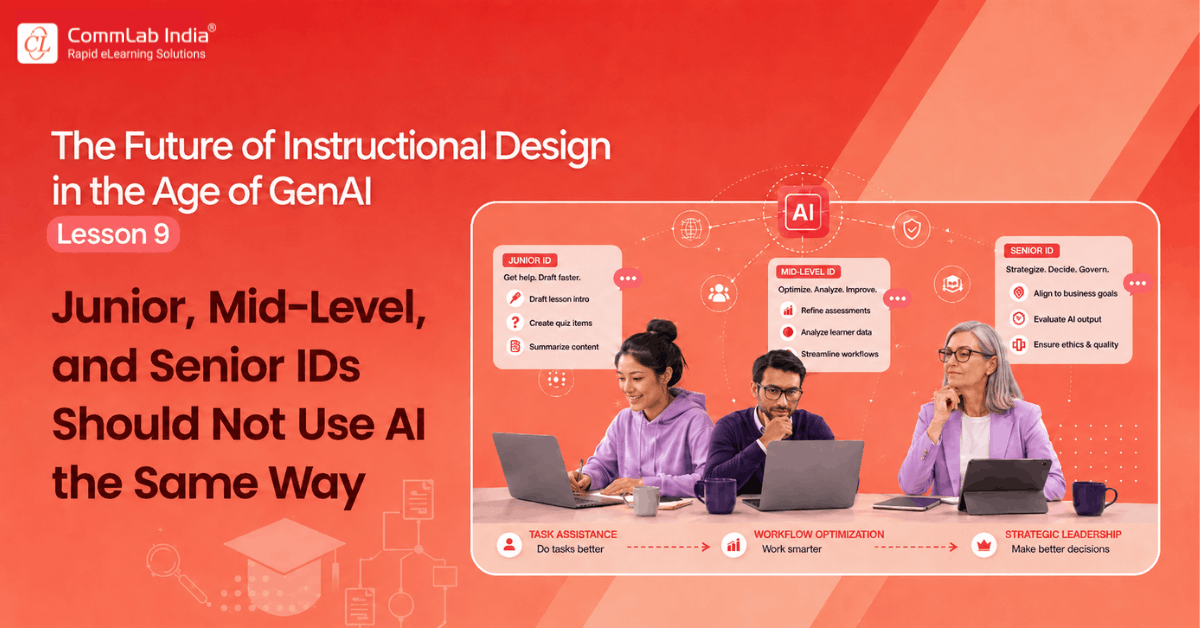
- Junior IDs need AI mainly as a guide and explainer
- Mid-level IDs need AI mainly as a collaborator and critic
- Senior IDs need AI mainly as a challenger and auditor
Those are not rigid categories. But they are useful.
Junior Instructional Designers: AI as Mentor, Not Crutch
For junior IDs, GenAI can be a powerful accelerant.
That is the good news.
The risk is that it can also become a substitute for learning the craft.
A junior designer is still building foundational capability. They are learning how to interpret SME content, translate content into flow, write meaningful objectives, avoid text-heavy treatment, choose suitable interactions, and align assessments properly. At this stage, they often need explanation as much as output.
That means AI should not primarily function as a content generator for them.
It should function as a mentoring partner.
For a junior ID, strong AI support should do things like:
- explain why a learning objective is weak
- show multiple ways to simplify content
- compare two interaction approaches and explain the trade-offs
- ask comprehension questions about SME material
- point out where a screen is likely to become text-heavy
- explain why a distractor is implausible
- model better practice, not just produce finished content
This is important because juniors do not just need speed. They need pattern formation.
They need to begin seeing what stronger IDs already see: where the logic is thin, where alignment is weak, where explanation is excessive, where content is being transferred rather than taught.
Used this way, AI can genuinely help them grow faster.
Used badly, it can do the opposite.
If the junior designer uses AI mainly to generate objectives, storyboards, assessments, and narration without understanding the reasoning behind them, then AI is not supporting development. It is masking underdevelopment. The designer may appear productive, but their instructional judgment may not be maturing at the same pace.
That is a dangerous illusion.
So for juniors, the question should not be, “How can AI help them do the work faster?”
It should be, “How can AI help them learn the work better while doing it?”
That is a much stronger standard.
Mid-Level Instructional Designers: AI as Collaborator and Critic
Mid-level IDs are in a different place.
They usually understand the basics. They can structure courses, write objectives, propose interactions, and build storyboards with some independence. Their challenge is not fundamental competence. It is inconsistency, complexity, and occasional limits in judgment when the SME material is messy, the performance need is unclear, or the design problem becomes more nuanced.
This is where AI becomes especially useful.
For mid-level IDs, the strongest role for AI is often as a collaborative thinking partner with a critical edge.
At this stage, AI can help by:
- offering multiple structural options
- critiquing assumptions
- challenging alignment
- suggesting alternative learning treatments
- pressure-testing assessments and scenarios
- identifying where the learning experience is becoming too explanation-heavy
- helping the designer compare options rather than simply generate deliverables
This is the maturity level where challenge-based prompting becomes particularly valuable.
A junior designer may still need too much explanation to benefit fully from adversarial critique. A senior designer may already be doing much of that critique naturally. But a mid-level designer often benefits greatly from being pushed to justify decisions, evaluate trade-offs, and defend design choices more explicitly.
This is where the AI should become less of a teacher and more of a serious peer.
Not someone who takes over.
Not someone who merely assists.
But someone who asks, “Why this option?”
“What is weak here?”
“What if the opposite were true?”
“Does this really test the stated objective?”
“Which of these three ideas is instructionally strongest, and why?”
That kind of interaction can move a mid-level ID forward significantly.
Because the gap at this stage is often not effort. It is sharper judgment.
Senior Instructional Designers: AI as Challenger and Auditor
Senior IDs do not typically need AI to explain basic principles or model standard good practice. In many cases, that kind of support becomes tedious.
Their value lies elsewhere.
They already know how to build learning flow. They already know how to handle difficult SME content, shape stronger objectives, critique weak assessments, and spot overloaded design. What they often need from AI is not production help. It is distance, pressure, and structured challenge.
That is why, for senior IDs, AI is most useful as a reviewer, challenger, and auditor.
It can help by:
- finding edge-case weaknesses
- identifying where assumptions may have gone unchallenged
- acting as an independent reviewer of a storyboard
- flagging subtle alignment issues
- surfacing cognitive overload or interaction bloat
- questioning whether a scenario is realistic enough
- auditing whether the course is business-aligned, not just instructionally neat
This is where the “nemesis prompt” idea fits especially well.
A senior designer does not usually need AI to tell them how to write a better screen title. They may, however, benefit from AI attacking the logic of a design they have become too close to. They may benefit from AI taking on the role of a skeptical SME, a second instructional architect, or a reviewer who was not involved in the build.
That is high-value use.
Because senior designers do not improve mainly by being helped. They improve by being challenged where they may have become too fluent, too fast, or too confident.
In that sense, AI becomes less of a supportive partner and more of a disciplined pressure-test mechanism.
That is a much better fit for mature capability.
Why One-Size-Fits-All AI Support Is a Bad Idea
Once you see these differences, a common mistake becomes obvious.
Many organizations are deploying AI support as if it were neutral.
Same tool.
Same prompt library.
Same expectations.
Same usage guidance.
That may be operationally convenient. But developmentally, it is weak.
A junior may overuse AI generation and underlearn the craft.
A mid-level designer may stay stuck in competent production without being pushed toward stronger judgment.
A senior designer may dismiss AI entirely because the support feels shallow or generic.
In all three cases, the organization misses the point.
AI should not merely be distributed. It should be positioned.
Its role should be intentionally different depending on who is using it and what kind of capability the team is trying to strengthen.
That is what mature adoption looks like.
What This Means for L&D Leaders and Team Managers
If you lead an instructional design team, this has practical implications.
Do not just give the team a prompt guide.
Do not just track adoption.
Do not just celebrate usage volume.
Instead, ask:
- What kind of AI interaction is most useful for junior IDs?
- Where should mid-level IDs be challenged more?
- How can senior IDs use AI for audit rather than routine drafting?
- What review discipline should differ by maturity?
- Where is AI currently accelerating output but not strengthening judgment?
These are better leadership questions.
Because the real opportunity is not just to make everyone faster.
It is to make the team stronger at multiple levels.
That will not happen if AI becomes a generic production layer sitting on top of uneven capability. It is much more likely to happen if AI is deliberately matched to the maturity and developmental needs of the designer.
The Larger Point
GenAI is often discussed as if it were a universal assistant.
It is not.
Its value depends heavily on the human it is interacting with, the stage of work, and the role it is being asked to play.
That is why instructional design teams should stop thinking only about tool adoption and start thinking more seriously about maturity-sensitive human–AI interaction.
Junior IDs need guidance.
Mid-level IDs need critique.
Senior IDs need challenge.
The stronger the match, the greater the benefit.
Because the future of AI-assisted instructional design will not be improved by treating every designer the same.
It will improve when we become more deliberate about how AI supports different levels of human capability.
That is the smarter path.
Next in the series: Why Review Challenge Mode May Be the Missing Layer in AI-Assisted Learning Design.