Adopting virtual instructor-led training is rarely the challenge for modern enterprises. The real challenge lies in making it work consistently, effectively, and at scale.
Many organizations move quickly to deploy VILT by selecting a platform, enabling virtual sessions, and transitioning existing content online. On the surface, this appears to be progress. Yet, over time, familiar issues begin to surface. Engagement drops, facilitators struggle to manage sessions, learners disengage, and outcomes fail to match expectations.
At this point, the instinct is often to question the platform.
In reality, the problem is rarely the technology itself. It is the absence of a structured approach that aligns platforms, tools, design, and delivery into a cohesive system.
VILT is not a standalone solution. It is an ecosystem that must be intentionally designed, implemented, and continuously optimized. Organizations that recognize this shift move from simply delivering virtual sessions to building scalable, high-performance learning systems.
This article reframes VILT implementation through that lens. It brings together platform selection, tool integration, migration strategy, and optimization into a unified approach that supports both execution readiness and long-term performance.
Download Now: Virtual Instructor-led Training – A Beginner’s Guide
Table of Contents
- Why VILT Implementations Struggle to Deliver Results
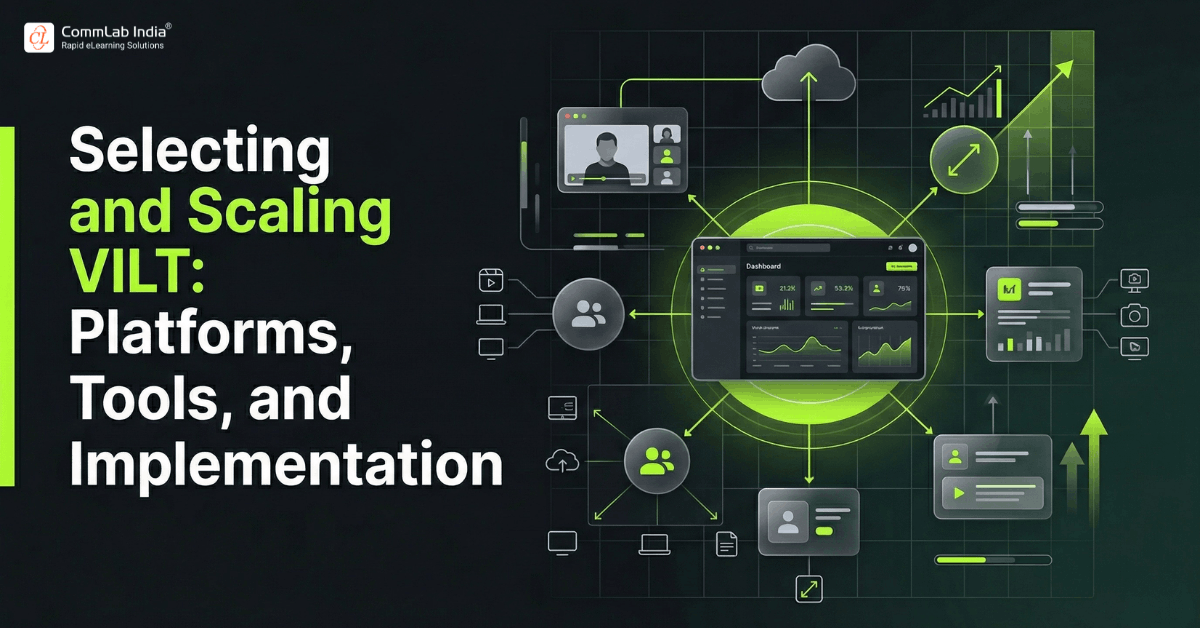
- Understanding the VILT Technology Ecosystem
- How to Evaluate and Select the Right VILT Platform
- The Expanding Role of Collaboration Tools in VILT
- A Practical Framework for Comparing VILT Platforms
- Common Implementation Challenges and What They Reveal
- Turning VILT Limitations into Design Strengths
- Migrating from ILT to VILT: A Transformation Approach
- Building a Structured VILT Implementation Model
- Optimizing VILT for Consistency and Scale
- FAQs
- Conclusion
Why VILT Implementations Struggle to Deliver Results
When VILT initiatives fall short, the root cause is rarely technical failure. More often, it is a mismatch between expectations and execution.
Organizations tend to approach VILT as a technology deployment rather than a learning transformation. Platforms are selected, sessions are scheduled, and facilitators are asked to adapt quickly without sufficient support or redesign.
This creates a series of cascading issues:
- Overreliance on platform features
Teams expect built-in tools to compensate for weak instructional design, which rarely works in practice. - Inconsistent facilitator performance
Without structured enablement, delivery quality varies widely across sessions. - Fragmented tool usage
Multiple tools are introduced without a clear integration strategy, increasing complexity. - Limited outcome measurement
Success is often measured by attendance rather than engagement or learning transfer.
These challenges are not isolated. They point to a deeper gap in how VILT is conceptualized and operationalized.
Understanding the VILT Technology Ecosystem
A common mistake in VILT implementation is viewing the platform as the entire solution. In reality, the platform is just one component of a broader ecosystem.
To function effectively, VILT relies on the coordinated interaction of multiple systems.
Core Components of the VILT Ecosystem
- Virtual classroom platform
Serves as the foundation for live delivery, enabling sessions, interaction, and facilitation. - Collaboration tools
Extend engagement through shared activities, discussions, and real-time input. - Content systems
Support pre-session preparation and post-session reinforcement. - Analytics and tracking tools
Provide visibility into participation, engagement, and learning outcomes.
The effectiveness of VILT depends not on any single component, but on how seamlessly these elements work together.
How to Evaluate and Select the Right VILT Platform
Choosing a VILT platform is often treated as a feature comparison exercise. While features matter, they should not be the primary decision driver.
The more important consideration is how well the platform aligns with your learning strategy and operational needs.
Key Capabilities That Define Platform Effectiveness
| Capability | Why It Matters | What to Look For |
| Interaction Design Support | Enables engagement during sessions | Breakout rooms, polls, whiteboards |
| Ease of Use | Drives adoption across learners and facilitators | Intuitive interface, minimal learning curve |
| Scalability | Supports growth across regions and teams | Stable performance with large audiences |
| Integration | Connects with existing systems | LMS, analytics tools, content platforms |
| Reliability | Ensures uninterrupted delivery | High uptime, strong technical support |
Rather than asking, “Which platform has the most features?”, a more strategic question is: “Which platform best supports the way we want learning to happen?”
The Expanding Role of Collaboration Tools in VILT
While platforms provide the environment, collaboration tools shape the experience within that environment.
These tools enable interaction, which is essential for engagement and learning effectiveness.
Where Collaboration Tools Add Value
- Interactive whiteboards
Help learners visualize ideas and co-create solutions, making abstract concepts more tangible. - Polling and feedback tools
Allow facilitators to gauge understanding in real time and adjust the session accordingly. - Shared workspaces
Support group activities where learners collaborate on tasks or case scenarios. - Communication channels
Enable continuous dialogue, ensuring learners remain connected throughout the session.
The key is intentionality. Introducing multiple tools without a clear purpose can overwhelm learners. When used strategically, however, these tools significantly enhance participation and engagement.
A Practical Framework for Comparing VILT Platforms
Platform comparison often becomes overwhelming due to the number of options available. A structured approach can simplify this process.
Evaluation Framework
| Evaluation Area | Key Question | Decision Insight |
| Use Case Fit | Does the platform support your training objectives? | Align features with learning needs |
| Audience Scale | Can it handle your learner volume and distribution? | Ensure global scalability |
| Facilitator Experience | How easy is it to manage sessions? | Reduce facilitator friction |
| Integration Needs | Does it connect with your existing ecosystem? | Avoid isolated systems |
| Cost vs Value | Does it justify investment through outcomes? | Focus on ROI, not just cost |
This framework ensures that platform selection is driven by strategic alignment rather than superficial comparisons.
Common Implementation Challenges and What They Reveal
Even well-planned VILT initiatives encounter challenges during execution. These challenges often reveal deeper gaps in design and readiness.
Recurring Challenges
- Facilitator readiness gaps
Many facilitators are not trained for virtual delivery, leading to reduced engagement. - Tool overload
Excessive tools create confusion rather than enhancing the experience. - Weak session design
Content-heavy sessions fail to sustain attention. - Technical disruptions
Poor preparation leads to interruptions that break session flow.
Each of these challenges reflects a need for stronger alignment between design, tools, and delivery.
Turning VILT Limitations into Design Strengths
What are often perceived as limitations of VILT can become opportunities when approached strategically.
- Lack of physical presence
Encourages structured interaction through digital tools, often resulting in more inclusive participation. - Shorter attention spans
Drives the need for modular, focused session design that improves retention. - Technology constraints
Promote simplicity, leading to clearer and more effective learning experiences.
By reframing limitations as design inputs, organizations can create more intentional and impactful VILT experiences.
Virtual Instructor-led Training – A Beginner’s Guide
Explore the Art and Science of Replicating the Real Classroom, Virtually
- Pillars of VILT
- Instructional strategies in VILT
- Tips to engage virtual learners
- Technology platforms for VILT
Migrating from ILT to VILT: A Transformation Approach
Migration is one of the most critical phases in VILT adoption, and it is often misunderstood.
Many organizations attempt to transfer classroom content directly into virtual formats. This approach rarely succeeds because it ignores the differences between physical and virtual learning environments.
A Structured Migration Approach
- Assess existing content
Identify which elements can be adapted and which require redesign. - Redefine learning objectives
Ensure they align with what can be achieved effectively in a virtual environment. - Restructure session flow
Break content into shorter segments with integrated interaction. - Enable facilitators
Provide training focused on virtual engagement and session management. - Pilot and refine
Test sessions, gather feedback, and improve iteratively.
Migration is not a technical exercise. It is a strategic redesign of the learning experience.
Building a Structured VILT Implementation Model
To achieve consistency and scalability, organizations need a clear implementation model that guides every stage of VILT deployment.
End-to-End Implementation Framework
| Stage | Focus | Outcome |
| Strategy | Define learning goals | Clear direction |
| Platform Selection | Choose the right tools | Strong foundation |
| Design | Create engaging sessions | Effective experiences |
| Enablement | Train facilitators | Consistent delivery |
| Execution | Deliver sessions | Learning impact |
| Optimization | Improve continuously | Scalable performance |
This structured approach ensures that VILT is implemented as a system rather than a series of disconnected efforts.
Optimizing VILT for Consistency and Scale
Once VILT is implemented, the focus must shift to optimization. This is where long-term value is created.
Key Areas of Optimization
- Standardizing session design
Ensures consistent learner experience across programs. - Measuring engagement and outcomes
Moves beyond attendance to meaningful performance indicators. - Refining facilitation practices
Improves delivery quality and learner interaction. - Simplifying tool usage
Reduces complexity and enhances usability.
Optimization transforms VILT from a functional capability into a strategic advantage that supports enterprise-wide learning.
FAQs
1. What are the most important features in a VILT platform?
A. The most important features include interaction tools such as breakout rooms and polls, ease of use for learners and facilitators, scalability, integration with existing systems, and platform reliability.
2. How do you choose the right VILT platform for your organization?
A. The right platform should align with your training objectives, audience size, and integration needs. Evaluating platforms based on use cases rather than feature lists leads to better decisions.
3. What are common challenges in VILT implementation?
A. Common challenges include facilitator readiness gaps, poor session design, tool overload, and technical issues. Addressing these requires a structured implementation approach.
4. How can organizations migrate from ILT to VILT successfully?
A. Successful migration involves redesigning content for virtual delivery, restructuring sessions, training facilitators, and piloting programs to refine the approach.
5. What tools enhance VILT sessions the most?
A. Tools such as interactive whiteboards, polling systems, and collaboration platforms enhance engagement when used strategically within the session.
6. How can VILT programs be optimized over time?
A. Optimization involves standardizing design practices, measuring engagement and outcomes, refining facilitation techniques, and simplifying tool usage.
7. Is VILT suitable for all types of training?
A. VILT is suitable for many scenarios, especially those requiring interaction and scalability. However, highly hands-on training may still require in-person experiences.
Conclusion
The success of VILT does not depend on selecting the most advanced platform or deploying the latest tools. It depends on how effectively these elements are brought together within a structured system.
Organizations that approach VILT as a technology solution will achieve limited results. Those that treat it as an integrated capability, combining platforms, design, facilitation, and optimization, will unlock its full potential.
In the end, VILT is not just about delivering training in a virtual format. It is about creating learning experiences that are scalable, consistent, and capable of driving real business impact.