
For years, instructor-led training stood as the cornerstone of corporate learning. Organizations invested heavily in classrooms, facilitators, and structured sessions designed to build skills through direct human interaction. This model worked well in a world where work itself was centralized and predictable.
That reality has changed.
Distributed teams, hybrid work environments, and accelerating business cycles have fundamentally altered how learning must be delivered. What was once a logistical challenge has now become a strategic imperative. Learning leaders are no longer deciding whether to digitize training. They are deciding how to architect learning experiences that balance reach, engagement, and measurable impact.
This is where the confusion begins.
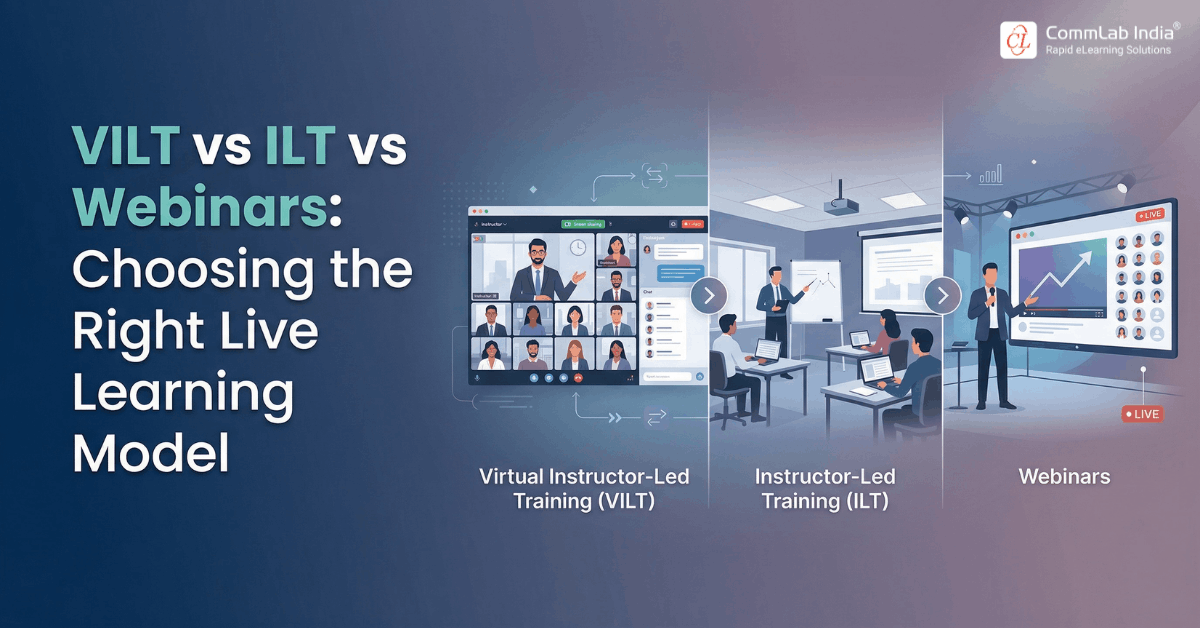
Virtual instructor-led training, traditional classroom training, and webinars are often grouped together under the umbrella of “live learning.” On the surface, they appear similar. In practice, they are designed for very different outcomes.
Understanding these differences is not a matter of preference. It is a matter of strategy.
Download Now: Virtual Instructor-led Training – A Beginner’s Guide
Table of Contents
- The Shift from Delivery Formats to Learning Strategy
- Understanding the True Nature of ILT, VILT, and Webinars
- Why Surface-Level Comparisons Create Poor Decisions
- Rethinking ILT in a Distributed World
- The Engagement Architecture of VILT
- Why Webinars Cannot Substitute Learning Experiences
- Mapping Modalities to Business Outcomes
- The Strategic Rise of VILT in Enterprise Learning
- Misconceptions That Undermine VILT Effectiveness
- Designing a Cohesive Live Learning Ecosystem
- FAQs
- Conclusion
The Shift from Delivery Formats to Learning Strategy
Most organizations still approach learning delivery as a format decision. Should this be classroom-based, virtual, or delivered as a webinar?
This question, while common, is fundamentally flawed.
What matters is not the format itself, but the role it plays in enabling learning outcomes. When organizations default to convenience or familiarity, they often end up misaligning delivery with intent. The result is predictable: disengaged learners, inconsistent outcomes, and underwhelming ROI.
A more strategic approach begins with a different question:
What kind of learning experience does this outcome demand?
When viewed through this lens, ILT, VILT, and webinars stop being interchangeable options and start becoming distinct tools within a broader learning architecture.
Understanding the True Nature of ILT, VILT, and Webinars
At a conceptual level, these three modalities are not variations of the same idea. They represent fundamentally different approaches to learning.
Instructor-led training in its traditional form is immersive and human-centric. It thrives on physical presence, immediate feedback, and dynamic interaction. Virtual instructor-led training retains the facilitation element but reimagines the environment through digital platforms. Webinars, on the other hand, are designed primarily for dissemination rather than transformation.
This distinction becomes clearer when viewed across key dimensions.
A Comparative View of Live Learning Modalities
| Dimension | ILT | VILT | Webinars |
| Learning Intent | Deep skill development | Scalable skill development | Information sharing |
| Interaction Design | High, organic | High, structured | Limited, optional |
| Learner Role | Active participant | Active participant | Passive audience |
| Scalability | Constrained by logistics | Highly scalable | Mass scalable |
| Facilitation Style | Instructor-led | Facilitator-driven | Presenter-led |
What this table reveals is not just operational differences, but a deeper divergence in how learning is experienced and applied.
Why Surface-Level Comparisons Create Poor Decisions
Many organizations evaluate these formats based on cost, convenience, or technology. While these factors are important, they do not determine learning effectiveness.
The more meaningful differences lie in how each modality supports:
- Cognitive engagement, or the extent to which learners actively process information
- Behavioral application, which determines whether learning translates into action
- Instructional flexibility, or the ability to adapt learning experiences dynamically
When these dimensions are ignored, decisions tend to favor scalability over effectiveness, leading to widespread reliance on webinars for use cases that require deeper engagement.
This is not a technology problem. It is a design and strategy problem.
Rethinking ILT in a Distributed World
Instructor-led training continues to hold strong value, particularly in scenarios that demand high levels of immersion and real-time interaction. Leadership development programs, complex simulations, and hands-on technical training often benefit from the richness of face-to-face environments.
However, ILT comes with structural limitations that are becoming increasingly difficult to justify.
- Travel and logistics increase cost and complexity
- Scheduling constraints limit accessibility
- Delivery inconsistency arises across locations
These constraints do not diminish ILT’s value, but they do restrict its scalability. As organizations expand globally and operate across time zones, relying solely on classroom-based training becomes unsustainable.
ILT is no longer the default. It is a high-impact option reserved for specific contexts where its strengths are essential.
The Engagement Architecture of VILT
Virtual instructor-led training occupies a unique position because it is not simply a digital version of ILT. When designed intentionally, it becomes a distinct modality with its own strengths.
At its core, VILT enables organizations to scale instructor-led experiences without losing the essence of facilitation. However, its effectiveness depends entirely on how it is designed.
A well-structured VILT session typically integrates multiple layers of interaction:
- Breakout discussions, which allow small-group collaboration and peer learning
- Live polling and questioning, which maintain attention and provide instant feedback
- Scenario-based activities, which simulate real-world decision-making
- Collaborative tools, which enable shared problem-solving
These elements transform VILT from a passive session into an active learning experience.
Without them, VILT risks becoming indistinguishable from a webinar.
Virtual Instructor-led Training – A Beginner’s Guide
Explore the Art and Science of Replicating the Real Classroom, Virtually
- Pillars of VILT
- Instructional strategies in VILT
- Tips to engage virtual learners
- Technology platforms for VILT
Why Webinars Cannot Substitute Learning Experiences
Webinars are often misunderstood because they share the same delivery medium as VILT. Both take place online, often on similar platforms. Yet their design intent is entirely different.
Webinars are built for reach. They are effective when the goal is to communicate, inform, or inspire a large audience. Their structure typically prioritizes clarity and efficiency over interaction.
However, this strength becomes a limitation when applied to learning.
Skill development requires practice, feedback, and engagement. These are not core features of webinars. While some interactivity can be introduced, it is rarely sufficient to support meaningful behavioral change.
In practical terms:
- Webinars can introduce a concept
- VILT can help learners apply it
- ILT can deepen mastery where needed
Confusing these roles often leads to overuse of webinars for training, resulting in low retention and limited impact.
Mapping Modalities to Business Outcomes
A mature learning strategy does not treat these modalities as competitors. Instead, it aligns them with specific business outcomes.
Where Each Modality Delivers Maximum Value
- ILT is most effective when learning requires deep immersion, hands-on practice, or high emotional engagement
- VILT is ideal for scaling instructor-led training across geographies while maintaining interaction and consistency
- Webinars are best suited for awareness, communication, and large-scale knowledge sharing
This alignment ensures that each format is used where it creates the most value, rather than where it is most convenient.
The Strategic Rise of VILT in Enterprise Learning
VILT has gained prominence not because it replaces ILT, but because it addresses a structural gap in modern learning ecosystems.
Organizations today require training that is:
- Consistent across regions
- Accessible to distributed teams
- Scalable without exponential cost increases
VILT meets these requirements while retaining the human element of facilitation.
More importantly, it allows learning teams to design repeatable, high-quality learning experiences that can be delivered globally with minimal variation. This consistency is critical in large enterprises where training outcomes must align with business standards.
VILT is not just a delivery method. It is an enabler of scalable learning systems.
Misconceptions That Undermine VILT Effectiveness
Despite its potential, VILT is often underutilized due to persistent misconceptions. These beliefs influence design decisions and ultimately impact outcomes.
- “VILT is just a webinar”
This leads to minimal interaction and poor engagement, reducing VILT to a passive experience. - “Virtual environments limit participation”
In reality, participation depends on facilitation design, not physical presence. - “ILT is inherently superior”
Effectiveness is determined by alignment with learning objectives, not delivery mode. - “Learners cannot stay engaged online”
Engagement is driven by structure, pacing, and interaction, all of which can be designed into VILT.
Addressing these misconceptions is essential for unlocking the full potential of VILT.
Designing a Cohesive Live Learning Ecosystem
The future of enterprise learning lies in integration, not substitution. Organizations must move beyond isolated decisions and build cohesive learning ecosystems.
A structured approach often follows a layered model:
- Webinars introduce ideas and create awareness
- VILT sessions enable practice, discussion, and skill-building
- ILT experiences reinforce and deepen learning where necessary
This progression ensures that learners move from understanding to application in a structured manner.
Designing such an ecosystem requires clarity of intent, alignment with business goals, and investment in instructional design capability.
FAQs
1. What is the key difference between VILT and ILT?
A. VILT is delivered through virtual platforms, enabling remote participation while maintaining instructor-led interaction. ILT takes place in physical classrooms and offers direct, in-person engagement. Both support deep learning, but VILT provides greater scalability and flexibility.
2. Can VILT replace classroom training completely?
A. VILT can replace many classroom-based programs, especially for distributed teams. However, certain scenarios that require physical interaction or hands-on practice may still benefit from ILT.
3. How is VILT different from webinars?
A. VILT is designed for interactive learning and skill-building, incorporating activities and discussions. Webinars are primarily presentation-driven and focus on sharing information with large audiences.
4. Why do organizations struggle with VILT adoption?
A. Many organizations treat VILT like webinars, resulting in low engagement. Lack of facilitator training and weak instructional design also contribute to ineffective VILT programs.
5. When should webinars be used instead of VILT?
A. Webinars are ideal for awareness, communication, and knowledge sharing at scale. They are not suitable for scenarios that require active participation or skill development.
6. Is VILT as effective as ILT?
When designed well, VILT can deliver outcomes comparable to ILT for many use cases. Its effectiveness depends on how interaction and engagement are built into the experience.
7. What is the future of instructor-led training?
A. Instructor-led training is evolving into a blended model that combines ILT and VILT. Organizations are increasingly using VILT to scale learning while reserving ILT for high-impact experiences.
Conclusion
The conversation around VILT, ILT, and webinars is often framed as a comparison. In reality, it is a question of orchestration.
Each modality plays a distinct role in enabling learning outcomes. The organizations that succeed are not those that choose one over the other, but those that integrate them thoughtfully.
VILT stands at the center of this transformation because it resolves a critical tension. It allows learning to scale without losing the human element that makes it effective.
That balance is not just a technical advantage. It is a strategic one.
And it is shaping the future of how enterprises learn.



![VILT vs Webinar: Who’s the Gamechanger for Your Corporate Training? [Video]](https://www.commlabindia.com/hubfs/Imported_Blog_Media/vilt-edge-over-webinar.jpg)