As organizations move beyond early experimentation with AI, a more fundamental realization is taking shape across Learning and Development teams. The real challenge is no longer about adopting AI tools, but about structuring AI in a way that meaningfully impacts capability building and business performance.
This shift has brought AI agents into focus.
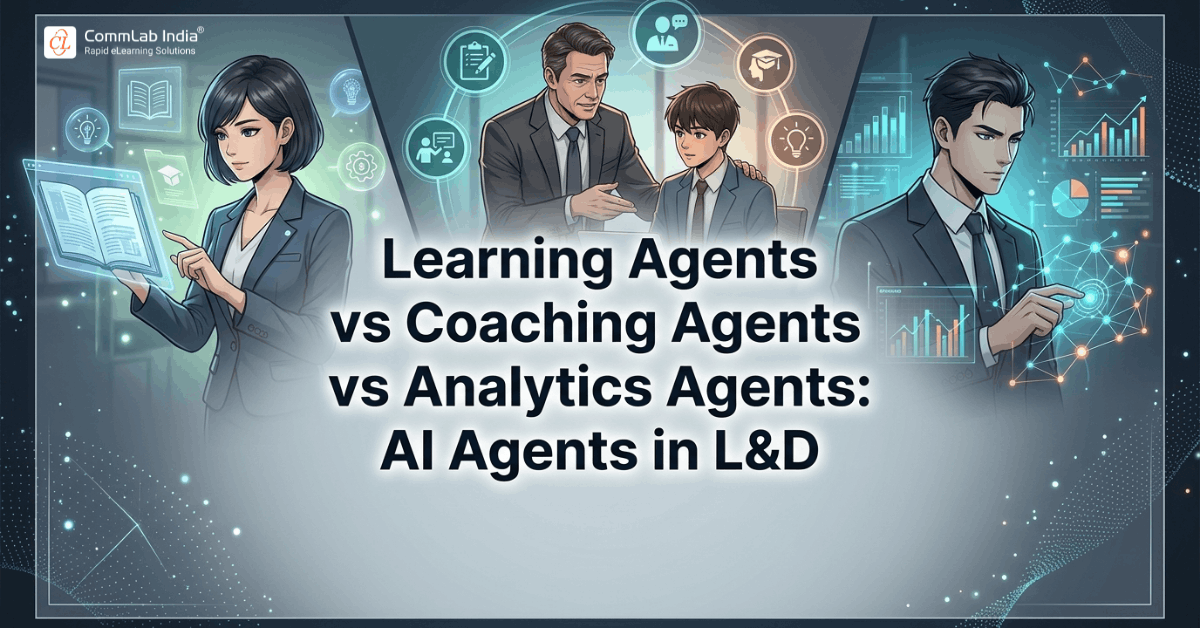
Unlike general-purpose AI tools that respond to prompts in isolation, AI agents are purpose-built, goal-driven systems designed to operate within defined roles. In the context of L&D, three categories are rapidly emerging as foundational pillars of an intelligent learning ecosystem:
- Learning agents that orchestrate learning experiences
- Coaching agents that drive behavior change
- Analytics agents that enable insight and optimization
Understanding how these agents differ, and more importantly how they complement each other, is essential. Without this clarity, organizations risk deploying disconnected AI initiatives that create activity, but not impact.
Download eBook: AI-Powered L&D Trends 2026
Table of Contents
- From AI Tools to Agent Systems: Why Specialization Matters
- At a Glance: Key Differences Between AI Agent Types
- Learning Agents: Orchestrating Personalized Learning
- Coaching Agents: Driving Performance and Behavior Change
- Analytics Agents: Enabling Insight and Optimization
- How These Agents Work Together: A Closed-Loop System
- When to Use Each Type of Agent
- Implementation Considerations for L&D Leaders
- Common Pitfalls to Avoid
- The Future of AI Agents in L&D
- FAQs: AI Agents in Learning and Development
From AI Tools to Agent Systems: Why Specialization Matters
The first wave of AI in L&D was largely centered around efficiency. Teams used AI to generate content faster, automate responses, or recommend courses. While useful, these applications often remained surface-level enhancements layered onto traditional systems.
What they lacked was depth in three critical areas:
- Context awareness across the learner journey
- Decision-making aligned with business outcomes
- Integration into real work environments
AI agents address this gap by introducing functional specialization, where each agent is responsible for a specific layer of the learning value chain. Instead of a single system attempting to do everything, organizations can now build coordinated ecosystems of agents, each optimized for a distinct purpose.
This shift mirrors how high-performing teams operate in the real world. Specialists deliver better outcomes than generalists when roles are clearly defined and aligned toward a common goal.
At a Glance: Understanding the Three Core Agent Types
| Dimension | Learning Agents | Coaching Agents | Analytics Agents |
| Primary Role | Orchestrate learning journeys | Improve performance through feedback | Drive insights and optimization |
| Core Focus | Content, pathways, skill acquisition | Behavior, application, decision-making | Data, trends, business alignment |
| Timing of Impact | Before and during learning | During and after application | Continuous across lifecycle |
| Outputs | Learning paths, content recommendations | Feedback, nudges, corrections | Insights, predictions, dashboards |
| Business Value | Faster capability development | Higher performance quality | Better strategic decisions |
Learning Agents: Orchestrating Personalized Learning at Scale
Learning agents form the foundation of AI-driven L&D systems, as they are responsible for designing and delivering learning experiences that are tailored to each individual.
Rather than relying on static course structures, learning agents continuously analyze learner context, including role requirements, existing skill levels, engagement patterns, and performance signals. Based on this evolving understanding, they dynamically construct learning pathways that adapt in real time.
This means that learning is no longer predefined. It becomes responsive, contextual, and continuously optimized.
Where Learning Agents Create the Most Impact
- Personalized learning journeys
Each learner receives a path aligned to their role, skill gaps, and pace, eliminating the inefficiencies of one-size-fits-all training. - Adaptive progression
Learning content adjusts based on performance, ensuring that learners neither stagnate nor feel overwhelmed. - Content orchestration across systems
Agents pull from LMS platforms, knowledge repositories, and external libraries to create cohesive learning experiences.
Example in Practice
Consider a sales professional struggling with objection handling. A learning agent can identify this gap through performance signals, assign targeted microlearning modules, introduce scenario-based exercises, and reassess readiness before allowing progression. The result is a learning experience that evolves with the learner, rather than remaining static.
Coaching Agents: Enabling Real-Time Performance and Behavior Change
If learning agents answer the question of what needs to be learned, coaching agents focus on how effectively that knowledge is applied in real situations.
Coaching agents operate as continuous performance companions, providing real-time feedback and guidance as learners engage in tasks, simulations, or on-the-job activities. Their primary goal is not content delivery, but behavioral improvement and skill refinement.
How Coaching Agents Add Value
- Immediate, contextual feedback
Feedback is delivered at the moment of action, making it highly relevant and easier to apply. - Guided practice and reinforcement
Learners can repeatedly practice skills with intelligent guidance, accelerating mastery. - Focus on behavior change
The emphasis shifts from knowledge acquisition to consistent, high-quality performance.
Example in Practice
During a simulated customer interaction, a coaching agent can analyze responses, tone, and decision-making patterns. It can highlight missed opportunities, suggest alternative approaches, and track improvement across multiple attempts. Over time, this creates a measurable shift in performance quality.
Analytics Agents: Powering Insight, Prediction, and Strategic Alignment
While learning and coaching agents operate closer to the learner experience, analytics agents function at a system-wide level, enabling visibility, foresight, and optimization.
Their role is to transform large volumes of learning and performance data into actionable insights that guide decision-making.
Rather than simply reporting what has happened, analytics agents help answer more strategic questions:
- Where are the emerging skill gaps?
- Which interventions are actually improving performance?
- What learning investments are delivering measurable ROI?
Where Analytics Agents Create Value
- Data-driven decision making
L&D leaders can move beyond intuition and rely on evidence-backed insights. - Predictive capability development
Future skill gaps can be identified before they impact business outcomes. - Clear measurement of impact
Learning initiatives can be directly linked to performance and business metrics.
Example in Practice
An analytics agent might detect declining performance in a customer support team and correlate it with reduced engagement in training programs. Based on this insight, it can recommend targeted interventions, flag at-risk employees, and track improvement over time. This transforms L&D into a proactive function rather than a reactive one.
The Real Transformation: When These Agents Work Together
While each agent type delivers value independently, the true transformation occurs when they are integrated into a unified system.
In such a system:
- Learning agents design the journey
- Coaching agents refine execution
- Analytics agents continuously optimize outcomes
Integrated Workflow Example
| Stage | Agent Involved | Action |
| Identify gap | Analytics Agent | Detects skill gap in negotiation |
| Enable learning | Learning Agent | Assigns personalized learning path |
| Improve performance | Coaching Agent | Provides real-time feedback during practice |
| Measure impact | Analytics Agent | Tracks improvement and business outcomes |
This creates a closed-loop learning ecosystem, where insights drive learning, learning drives performance, and performance feeds back into insights.
When Should You Use Each Type of Agent?
While these agents are most powerful when combined, understanding their individual application helps prioritize implementation.
Use Learning Agents When:
- You need to scale personalized learning across large audiences
- Your current learning model relies heavily on static courses
- You want to improve engagement and completion rates
Use Coaching Agents When:
- Performance improvement is a priority
- Skills require repeated practice and refinement
- Real-time feedback can significantly impact outcomes
Use Analytics Agents When:
- You need visibility into learning effectiveness
- You want to align L&D with business KPIs
- Predictive insights can drive strategic workforce planning
Implementation Considerations for L&D Leaders
Successfully deploying AI agents requires more than selecting the right tools. It involves building the right foundation and approach.
Key Steps to Consider
- Start with a clearly defined objective
Focus on a high-impact use case such as onboarding acceleration or sales performance improvement. - Build a strong data foundation
Clean, structured, and integrated data is essential for all agent types to function effectively. - Begin with a focused pilot
Start with one type of agent to demonstrate value before scaling to a broader ecosystem. - Progress toward multi-agent systems
Gradually integrate learning, coaching, and analytics agents to create a cohesive system. - Establish governance and oversight
Ensure transparency, ethical usage, and human-in-the-loop decision-making.
Common Pitfalls to Avoid
Even well-intentioned AI initiatives can fall short if certain risks are not addressed early.
- Treating all AI agents as interchangeable
Each agent has a distinct role, and lack of clarity can dilute impact. - Over-prioritizing tools over strategy
Technology alone cannot solve structural gaps in learning design. - Ignoring data readiness
Poor data quality leads to poor recommendations and insights. - Focusing only on content, not performance
Learning outcomes must ultimately translate into business results. - Lack of system integration
Disconnected agents cannot deliver the full value of an intelligent ecosystem.
The Future: Toward Intelligent, Autonomous Learning Systems
The evolution of AI agents signals a broader transformation in how organizations approach learning.
We are moving away from:
- Static courses delivered through LMS platforms
- Periodic training events
- Reactive learning interventions
And toward:
- Continuous, adaptive learning ecosystems
- Real-time performance support
- Predictive workforce development systems
In this emerging model, learning is no longer an isolated function. It becomes an integrated, intelligent system that continuously builds capability in alignment with business needs.
FAQs: AI Agents in Learning and Development
1. What is the difference between AI agents and AI tools in L&D?
A. AI tools typically respond to user prompts and perform isolated tasks, such as generating content or answering questions. AI agents, on the other hand, are autonomous systems that can make decisions, execute workflows, and continuously optimize learning outcomes without constant human input.
2. How do learning agents differ from coaching agents?
A. Learning agents focus on delivering and personalizing learning experiences, while coaching agents focus on improving how learners apply those skills in real-world situations through feedback and guidance.
3. What role do analytics agents play in L&D?
A. Analytics agents analyze learning and performance data to generate insights, predict future skill needs, and measure the impact of training programs on business outcomes.
4. Can these AI agents work together in a single system?
A. Yes, and that is where the real value lies. When learning, coaching, and analytics agents work together, they create a closed-loop system that continuously improves learning effectiveness and performance outcomes.
5. Are AI agents replacing L&D teams?
A. No, AI agents are augmenting L&D teams by automating repetitive tasks and providing deeper insights. This allows L&D professionals to focus on strategy, experience design, and aligning learning with business goals.
6. What is the first step to implementing AI agents in L&D?
A. The first step is to identify a high-impact use case, such as onboarding or sales training, and pilot a single agent type before expanding into a multi-agent ecosystem.
Final Thought
Understanding the distinction between learning, coaching, and analytics agents is not just a matter of terminology. It is a strategic lens that helps L&D leaders design systems that deliver real impact.
Organizations that embrace this model will move beyond simply delivering training. They will create intelligent capability engines that drive measurable performance outcomes at scale.