Every organization says it "does blended learning" now. There is a webinar here, an eLearning course there, a few microlearning nuggets, and an occasional workshop. Yet learners still feel overwhelmed, managers do not see behavior change, and L&D teams are left wondering which mix of formats actually works.
The problem is rarely a lack of content. It is the absence of intentional architecture.
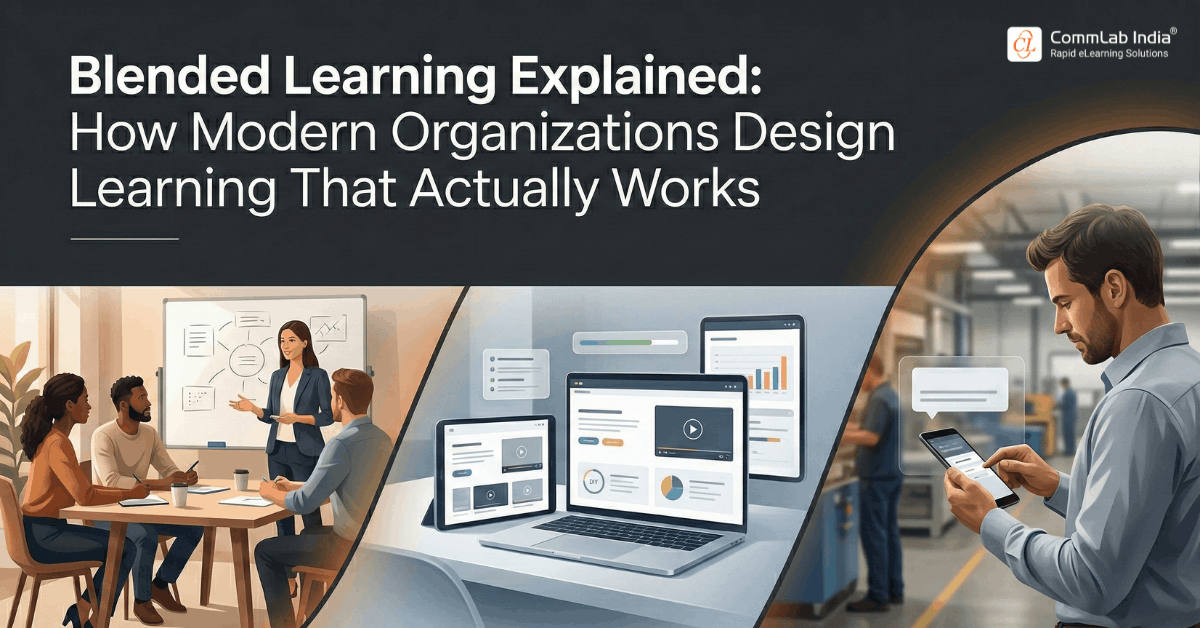
Blended learning is a planned combination of classroom or live experiences with digital and on the job learning so that each component plays a clear role in driving performance. A blended learning model is the underlying design pattern that decides how and when these components work together over time.
When you choose models and formats deliberately, a "blend" stops being a random mix of assets. It becomes a learning journey with a beginning, middle, and continuation that fits your context, culture, and constraints.
This article reframes blended learning models as strategic design choices. You will explore the core models in modern use, how factors like audience and risk shape your blend, the role of bookend and flipped approaches, and how to pick formats that support software training, compliance, and behavior change.
Download Now: How L&D And Business Can Align to Conquer The Future Of Work
Table of Contents
- Blended Learning Models in Plain Language
- The Design Variables That Shape Your Blend
- The Five Dimensions of a Strong Learning Blend
- Core Blended Learning Models for Corporate Training
- The Bookend Model: Using Live Sessions as Anchors
- Flipped Classrooms Inside Blended Learning
- Building A Blended Learning Framework for Your Organization
- Choosing Formats That Work Together
- Example Architectures: From Concept to Program Blueprint
- FAQ
Blended Learning Models in Plain Language
Blended learning models describe how different learning experiences are sequenced and combined across time and delivery channels.
Instead of asking "Should we build eLearning or a workshop", models ask a better question:
At what moments in the learner journey should we use digital, human, social, or on the job experiences, and in what order, to achieve the outcome?
Typical elements within a blend include:
- Self-paced online modules
- Virtual instructor led training (VILT)
- In person workshops
- Microlearning and nudges
- Social or collaborative activities
- Coaching and mentoring
- Practice labs and simulations
- On the job assignments and performance support
A model is simply a repeatable pattern that orchestrates these elements into a coherent journey.
For example: digital pre-work, live session, digital practice, on the job assignment, and follow up coaching is a model. So is live kick off, spaced microlearning, and manager check ins.
Thinking in models helps you reuse what works instead of starting from a blank page for every program.
The Design Variables That Shape Your Blend
There is no universal best blended learning model. The "right" pattern depends on a specific set of variables. If you try to choose formats without looking at these, you end up with a pretty blueprint that does not work in practice.
Key design variables include:
Business outcome and risk level
- Is the training about awareness, skill building, or behavior change tied to regulation and safety?
- High risk topics like compliance, safety, and financial practices need more structured assessment and reinforcement than a simple awareness program.
Audience profile
- Digital comfort levels, time availability, location, and language all shape what is realistic.
- First line workers, sales teams, and managers will not engage with the same patterns.
Work context
- Are learners desk-based, field based, or on the shop floor?
- Can they join long sessions, or do they need short, mobile friendly touchpoints?
Content type
- Conceptual topics suit explainer modules and discussion.
- Procedural tools and software need demonstrations, simulations, and practice labs.
Technology ecosystem
- LMS or LXP capabilities, virtual classroom tools, collaboration platforms, and access to devices all matter.
When you consciously map these variables, blended learning design feels like solving a puzzle with clear constraints instead of guessing which formats might be trendy.
The Five Dimensions of a Strong Learning Blend
Many "blends" focus only on format variety. True blended design looks across several dimensions that together create a complete learning experience.
| Dimension | Key Design Questions |
| Time |
What should happen before, during, and after any live or anchor event? How will learning be spaced to leverage forgetting and reinforcement curves? |
| Modality |
Which parts of the journey are best suited for live interaction, self-paced content, collaborative work, or on-the-job application? Are we overusing one modality, such as slide-driven virtual sessions? |
| Social Interaction |
Where should learners collaborate, debate, or reflect together? How will managers or mentors be involved throughout the journey? |
| Support |
What performance support, job aids, and quick-reference resources will be available at the moment of need? Are there clear channels for questions and coaching during application? |
| Assessment |
How will understanding be checked at multiple points in the journey, not just at the end? Do we include both knowledge checks and performance-based tasks? |
Strong blended programs deliberately design across all five dimensions. If one or more is missing, the blend may look good on a slide but fail in reality.
Core Blended Learning Models for Corporate Training
There are many possible variants, but most corporate programs fall into a handful of archetypes. Understanding these helps you choose patterns instead of isolated activities.
1. Live Led with Digital Support: A live workshop or virtual class is the main event, supported by digital pre-work and follow up.
Typical sequence
- Short pre-work module, reading, or video series
- Live session for practice, discussion, and feedback
- Post-session activities and on the job application
- Reinforcement microlearning and manager check ins
Best for
- Leadership development
- Behavioral skills such as coaching, feedback, and collaboration
- Rollouts that need discussion and alignment
The key is to avoid using live time for basic content transmission. Digital pre-work should cover foundations so that live time can be devoted to practice and real scenarios.
2. Digital First with Targeted Human Touch: Self-paced digital content is the primary channel, with live or social elements added at key moments for alignment or coaching.
Typical sequence
- Core content through eLearning, videos, and infographics
- Scheduled Q&A or coaching sessions
- Discussion forums or social reflection
- Structured assignments reviewed by peers or experts
Best for
- Large, distributed populations
- Standardized content such as product knowledge or process training
- Programs where scheduling long live sessions is difficult
The risk in this model is learner drop off. You need strong communication, expectations set by managers, and easy access to support.
3. Continuous Performance-Focused Blends: Learning is woven into the flow of work as a continuous series of touchpoints, not a single program.
Typical components
- Short digital bursts triggered by events, such as new responsibilities or system changes
- On the job tasks with embedded job aids
- Manager coaching guides
- Periodic cohort events or communities of practice
Best for
- Sales capability building
- Role transitions for managers and leaders
- Ongoing software or process adoption
This model works well when you need habit formation rather than one time knowledge transfer. It demands strong coordination with business leaders and often relies on automation from your learning systems.
The Bookend Model: Using Live Sessions as Anchors
The bookend model is a powerful variation of the live led approach. It treats live sessions as "bookends" across a digital journey rather than a standalone event.
How the bookend model works
1. Kick off live session
- Introduces purpose, expectations, and relevance.
- Creates social connection and psychological safety.
- Diagnoses current capability and gathers real examples.
2. Digital and on the job middle
- Learners complete self-paced modules, simulations, or labs.
- They attempt real tasks in the workflow with support.
- Short nudges and resources keep the topic visible.
3. Closing live session
- Debrief real experiences, not hypothetical cases.
- Address obstacles and refine mental models.
- Commit to personal action plans with manager involvement.
Why the bookend model works
- It ensures a clear start and finish to the journey.
- Live time is used for context and reflection instead of coverage.
- Digital components have a narrative purpose between the bookends, not as optional extras.
This pattern is particularly effective for change initiatives, leadership journeys, and complex skills where reflection on real experience is central.
How L&D And Business Can Align to Conquer The Future Of Work
Bridging the Gap Between Organizational and Individual Goals!
- Learning Strategies Shaping the Future
- Changing Role of Learning Professionals
- Learning to Solve Business Challenges
- And More!
Flipped Classrooms Inside Blended Learning
Flipped classrooms and blended learning are often confused. They are related but not identical.
Flipped classroom
- Core content is consumed by learners before the session, usually through video or eLearning.
- Live time is used for problem solving, practice, and feedback.
Blended learning
- Combines multiple modalities over time, which may or may not include a flipped classroom component.
- A blended program that uses a flipped model for its workshops.
- A flipped classroom that is a stand alone intervention without broader blending.
You can have:
When to use flipped approaches
Flipped design is especially useful when:
- You need to cover a large amount of conceptual material.
- Learners can realistically do pre-work.
- Live time is limited and must focus on application.
Practical tips:
- Keep pre-work concise and explicit about expectations.
- Use entry quizzes or short activities to make pre-work visible.
- Design live sessions that truly depend on pre-work, not sessions that repeat it.
In corporate training, a flipped session works best as one piece of a broader blended architecture instead of a one off format experiment.
Building A Blended Learning Framework for Your Organization
A blended learning framework is a reusable way of thinking, not a one size fits all template. It should help your teams move from "Which format should we use" to "What pattern best fits this problem".
Step 1: Start With Outcomes and Moments That Matter
- Clarify the performance gap or risk you need to address.
- Identify critical moments where learners must think or act differently.
- Distinguish between awareness, skill, and behavior requirements.
Step 2: Map The Learner Journey
- Sketch what happens from the first touchpoint to sustained performance.
- Mark where you need to inform, demonstrate, practice, apply, and reinforce.
- Consider stakeholders such as managers and peers at each moment.
Step 3: Assign Models and Modalities
- Decide whether a live led, digital first, continuous, or bookend pattern fits best.
- For each stage of the journey, decide the primary modality and supporting formats.
- Ensure each modality has a clear purpose, not just presence.
Step 4: Integrate Assessment and Support
- Build checkpoints across the journey: quick quizzes, scenario based questions, peer reviews, or observed tasks.
- Equip learners with reference materials and job aids that stay available after the formal program ends.
Step 5: Pilot, Measure, And Simplify
- Start with a manageable pilot group instead of redesigning all programs at once.
- Measure completion, confidence, behavior indicators, and business metrics where possible.
- Simplify the blend where you see low usage or confusion, even if it looks clever on paper.
Over time, your framework will become a catalog of proven models that L&D teams can adapt rather than reinvent.
Choosing Formats That Work Together
Formats are the building blocks of your models. Choosing them well is about fit and complementarity.
High Value Blended Formats
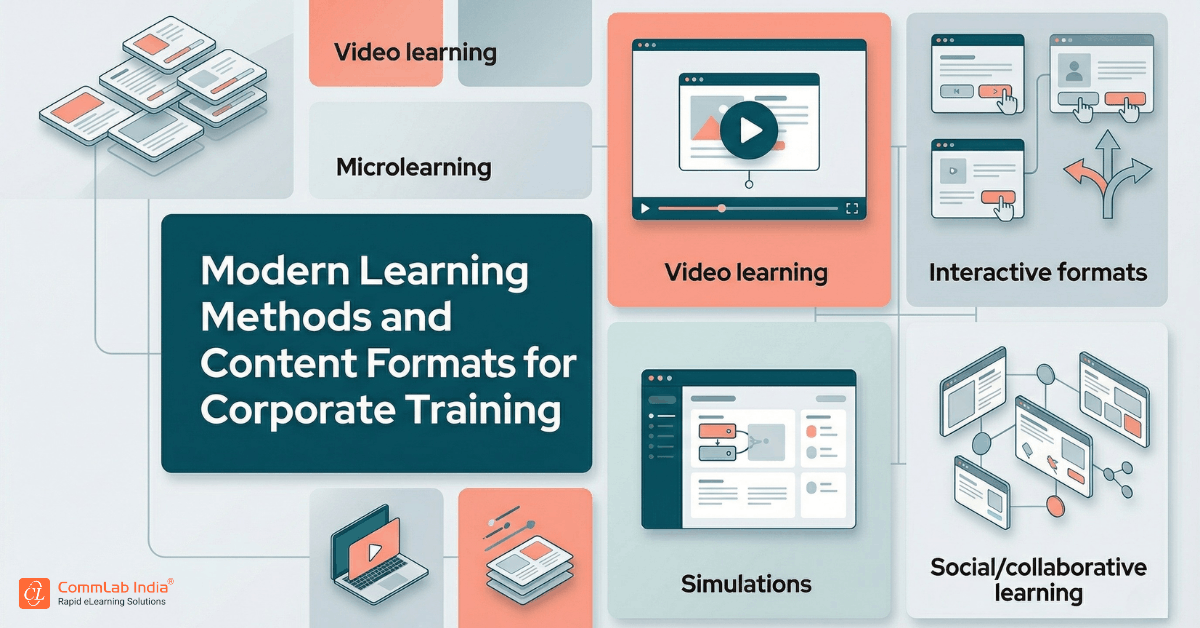
- Self-paced modules and microlearning: Great for delivering core concepts, foundational knowledge, and simple procedures. They should be short, focused, and accessible on multiple devices.
- Virtual or in person workshops: Best used for interaction, practice, feedback, and decision making. They should not repeat content learners can consume alone.
- Video explainers and demo: Highly effective for showing processes, behaviors, and real examples. They shine when combined with guided practice and reflection activities.
- Social and collaborative tasks: Discussion forums, group assignments, and peer feedback help learners apply ideas to their own context and learn from others.
- Job aids and performance support: Checklists, quick reference cards, on screen helpers, and searchable knowledge bases ensure support at the moment of need.
- Coaching and manager involvement: Simple conversation guides and follow up questions help managers reinforce learning in regular one on ones.
The art lies in choosing a few formats that complement one another rather than every format your tools can offer.
Example Architectures: From Concept to Program Blueprint
Abstract models are useful, but L&D teams often need concrete starting points. Here are three example architectures you can adapt.
New Manager Fundamentals
Objective
Equip first time managers with basic people management skills over three months.
Pattern
Bookend model with continuous reinforcement.
Architecture
- Week 1: Live virtual kick off, expectations, and role shift discussion.
- Weeks 1 to 2: Self-paced modules on feedback, coaching, and delegation.
- Week 3: Flipped workshop where managers practice real conversations using scenarios from their teams.
- Weeks 4 to 10: Biweekly microlearning nudges and reflection prompts delivered by email or app.
- Week 6: Manager-of-managers check in, with guidance on how to reinforce skills.
- Week 12: Closing live session to share wins, address obstacles, and commit to next steps.
Software Rollout for A New CRM
Objective
Enable sales teams to use a new CRM consistently, focusing on opportunity management and forecasting.
Pattern
Digital first with targeted live touchpoints.
Architecture
- Pre-launch: Short teaser video and message from sales leadership.
- Week 1: Self-paced conceptual module on process changes and benefits.
- Week 1: Live demo session where the instructor shares a realistic sales scenario from lead to close.
- Week 2: Hands on virtual lab. Learners complete guided exercises in a sandbox environment.
- Weeks 2 to 3: On the job practice with job aids embedded inside the CRM and quick reference cards.
- Week 3: Drop in office hours and peer sharing of tips.
- Weeks 4 to 6: Microlearning reminders on data quality, pipeline hygiene, and forecasting.
- End of month: Performance dashboard shared with managers to coach based on CRM usage patterns.
Compliance Program with Audit Requirements
Objective
Ensure regulatory standards are understood, applied, and defensible in an audit.
Pattern
Live led with structured assessment and performance support.
Architecture
- Pre-work: Short awareness module linked directly to relevant policies and regulations.
- Live session: Scenario based workshop where learners work through realistic cases and consequences.
- Post-session: Scenario driven assessment with branching feedback and remediation pathways.
- Ongoing: Quarterly microlearning scenarios based on new incidents or regulatory updates.
- Support: Always available policy library, FAQs, and contact channels for questions.
Each blueprint can be scaled up or down depending on your population and risk level, but the underlying models remain recognizable and reusable.
FAQ
1. What is a blended learning model in corporate training?
A. A blended learning model is a deliberate pattern that combines live, digital, social, and on the job learning experiences over time to achieve specific performance outcomes. It defines when and how each component is used, rather than leaving formats to ad hoc decisions.
2. How is blended learning different from a flipped classroom?
A. A flipped classroom moves content consumption to pre-work and uses live time for practice and discussion. Blended learning is a broader approach that sequences multiple modalities across an entire learning journey. A flipped classroom can be one component within a blended program.
3. Which blended learning model is best for leadership development?
A. Leadership development often benefits from a bookend model or live led pattern, with an initial live session, digital learning and on the job practice in the middle, and a closing session for reflection and commitment. Continuous reinforcement and manager involvement are essential.
4. What formats work best in blended learning for software training?
A. Effective software blends use short conceptual modules, video or interactive demos, guided simulations, practice labs or sandboxes, and job aids embedded into the system. Occasional live labs or office hours help address questions and build confidence.
5. How do I decide which formats to include in my blend?
A. Start with business outcomes, audience constraints, and work context. Choose formats that: deliver core concepts efficiently, enable realistic practice, support collaboration where valuable, and provide performance support during real work. Avoid adding formats just because the tools are available.
6. How can I measure the impact of blended learning models?
A. Combine learning analytics with performance data. Track completion and satisfaction, but also behavior indicators, quality of work outputs, error rates, and business metrics that relate to the skill or process being trained. Use feedback and data to refine your models.
7. When should I use a continuous blended model instead of a onetime program?
A. Use continuous models when you are building complex capabilities like sales effectiveness, leadership, or culture change. These require repeated practice, coaching, and reinforcement over time, which a single program cannot deliver.
Conclusion
Blended learning is no longer about adding a few digital pieces around a workshop. It is about designing purposeful architectures that move people from awareness to confident performance.
By understanding key design variables, choosing models that match your context, using patterns like the bookend and flipped approaches wisely, and pairing formats that support both learning and doing, you can transform scattered activities into cohesive journeys.
The payoff is significant: learners who feel supported, managers who see real behavior change, and organizations that can respond quickly to new skills and systems.
Blended learning models are not abstract theory. They are practical tools for designing training that finally feels intentional, aligned, and effective.