Organizations are investing heavily in digital learning. Yet many still struggle with engagement gaps, poor retention, and weak performance transfer. The problem is not content volume. It is design architecture.
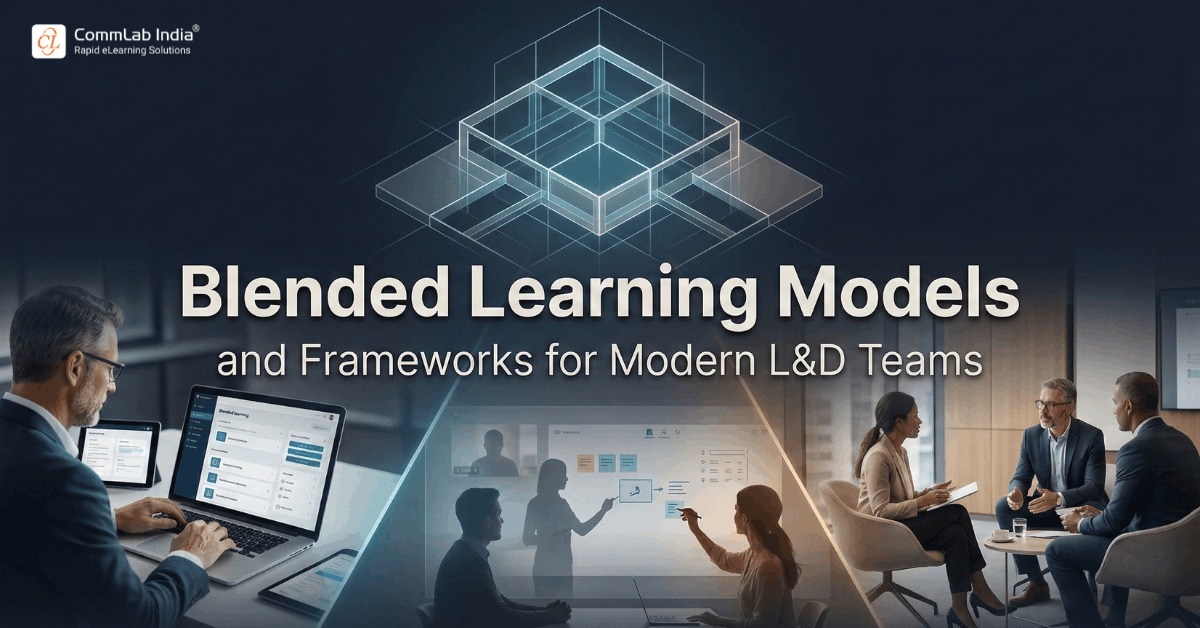
Blended learning is often positioned as a mix of classroom and online training. That description is technically correct but strategically incomplete. Blended learning is not about combining formats. It is about orchestrating learning experiences across modalities to improve comprehension, application, and performance.
Download Now: AI in Corporate Training
When designed intentionally, blended learning creates continuity between structured instruction, digital reinforcement, social interaction, and workplace practice. When designed poorly, it becomes fragmented scheduling disguised as innovation.
This article clarifies what blended learning truly means, why it matters for modern organizations, and when it works best. It moves beyond surface definitions and into design logic.
Table of Contents
- What Blended Learning Actually Means
- Why Traditional Single-Mode Training Falls Short
- The Strategic Importance of Blended Learning
- When Blended Learning Works and When It Does Not
- Designing Blended Learning as a System, Not an Event
- The Role of Technology Without Overdependence
- Organizational Conditions That Make Blended Learning Effective
- The Future Direction of Blended Learning Models
- FAQ
What Blended Learning Actually Means
Blended learning is a structured learning model that integrates multiple instructional methods across time to improve learning transfer and performance outcomes.
It typically combines:
- Instructor-led training
- Digital self-paced modules
- Virtual collaboration
- On-the-job application
- Reinforcement interventions
However, the defining characteristic is not the mix. It is intentional sequencing.
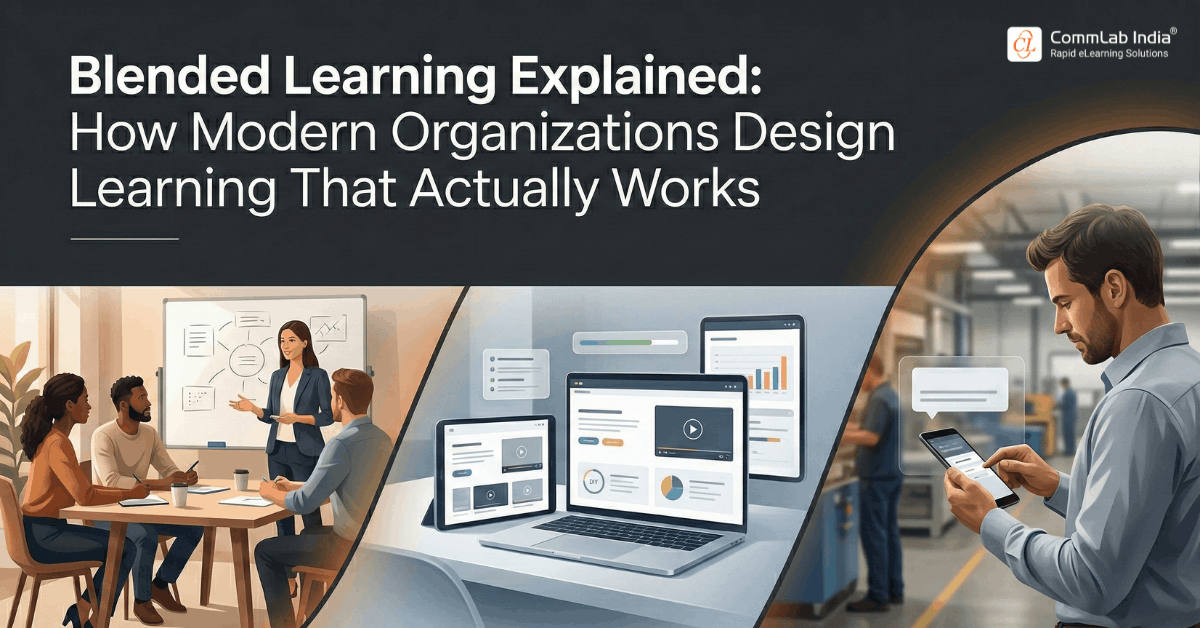
Blended learning connects modalities to serve a specific instructional purpose. Foundational knowledge may be delivered digitally. Complex discussion may occur in live sessions. Practice may happen through simulations. Reinforcement may be spaced across weeks.
Extraction-ready definition: Blended learning is a structured training approach that combines digital, instructor-led, and experiential learning methods in a coordinated sequence to improve retention, engagement, and performance.
The difference lies in design logic, not format count.
Why Traditional Single-Mode Training Falls Short
Most traditional corporate training relies heavily on one dominant mode:
- Classroom-heavy programs that overwhelm learners in compressed timeframes
- E-learning-only programs that lack social and applied reinforcement
Both approaches have structural limitations.
Classroom-only training often suffers from cognitive overload. Digital-only training may struggle with accountability and contextual application.
Modern workforce realities intensify these issues:
- Distributed teams
- Shorter attention spans
- Compressed schedules
- Rapid skill obsolescence
Blended learning addresses these constraints by distributing learning across time and channel.
Instead of asking learners to absorb everything at once, it allows progressive exposure, reinforcement, and application.
AI in Corporate Training
Partner, Not Replacement
- AI in Corporate Training
- AI Toolkit for Super-charged Learning
- Challenges to Consider with AI Implementation
- And More!
The Strategic Importance of Blended Learning
Blended learning matters not because it is modern, but because business itself has become structurally more complex.
Organizations today operate in environments defined by constant technological change, distributed teams, regulatory volatility, and compressed innovation cycles. Skills no longer evolve every few years. They evolve continuously. That reality exposes the limits of traditional, single-event training models.
Consider the pressures most organizations face:
- Continuous digital transformation that reshapes workflows and required competencies
- Hybrid and remote work structures that reduce informal learning moments
- Rapid compliance updates that require ongoing reinforcement
- Multi-generational workforce expectations around flexibility and autonomy
- Shorter skill half-lives that demand ongoing upskilling
In this context, training cannot function as an isolated workshop or standalone module. Learning must be sustained, reinforced, and integrated into workflow. This is where blended learning becomes strategically significant.
Blended learning enables learning to occur across time, context, and modality. Instead of concentrating instruction into a single exposure, it distributes it. Instead of relying solely on knowledge transfer, it builds reinforcement mechanisms. Instead of treating learning as an event, it embeds it into performance cycles.
Specifically, blended learning supports:
- Spaced repetition
Knowledge is revisited across intervals, improving retention and reducing cognitive overload. - Contextual application
Learners apply concepts between sessions, linking theory to real-world tasks. - Social learning
Live discussions and peer interaction deepen understanding and surface tacit knowledge. - Feedback loops
Multiple touchpoints create opportunities for coaching, clarification, and correction. - Performance support
Digital assets remain accessible beyond formal sessions, enabling just-in-time reinforcement.
Strategically, this transforms training architecture.
Blended learning shifts organizations away from event-based delivery models and toward learning ecosystems. An event delivers information. An ecosystem builds capability.
This distinction matters at scale.
Event-based training typically produces short-term knowledge spikes followed by rapid decay. Learning ecosystems create progressive skill accumulation supported by reinforcement, accountability, and application.
For enterprise L&D leaders, the implication is clear. Blended learning is not a formatting decision. It is an operational strategy for sustaining workforce capability in environments where skills must evolve continuously.
When designed intentionally, blended learning becomes infrastructure for long-term performance development rather than a scheduling convenience.
When Blended Learning Works and When It Does Not
Blended learning is not universally effective. Its success depends on how well the learning architecture aligns with organizational readiness, instructional intent, and execution discipline.
The table below outlines the conditions under which blended learning delivers strong outcomes and the situations where it may fall short.
|
Blended Learning Is Highly Effective When |
Blended Learning Is Less Effective When |
|
Skills require both conceptual understanding and applied practice |
There is no clear sequencing logic between modalities |
|
Behavior change is required, not just knowledge transfer |
Live sessions merely repeat digital content |
|
Stakeholders can commit to structured scheduling across phases |
Digital modules are treated as optional or disconnected |
|
Managers actively reinforce learning on the job |
Leadership support and accountability are weak |
|
Technology infrastructure is stable and accessible |
The objective is rapid information broadcast only |
Blended learning is not always necessary. For simple procedural updates, a standalone digital module may suffice. The decision depends on complexity, performance risk, and business stakes.
Designing Blended Learning as a System, Not an Event
The most common failure in blended learning is fragmentation.
Organizations often assemble components that look blended on paper: a pre-course e-learning module, a classroom workshop, a follow-up email. Yet these elements frequently operate as isolated activities rather than interconnected stages of a coherent learning journey.
Without narrative continuity, learners experience discontinuity. Pre-work feels optional. Workshops feel repetitive. Follow-ups feel disconnected. The result is not reinforcement, but dilution.
Effective blended learning requires architectural discipline.
Clear learning journey mapping
The learning journey must be intentionally sequenced from awareness to mastery. Each stage should answer a specific question:
- What should the learner know now?
- What should they be able to do next?
- What performance outcome are we building toward?
Defined purpose for each modality
Every modality must serve a distinct instructional function. Digital modules may introduce foundational concepts. Live sessions may facilitate discussion, problem-solving, or peer learning. Applied tasks may translate knowledge into action. If two modalities serve the same purpose, redundancy emerges.
Integrated assessment checkpoints
Assessment should not be confined to a final quiz. Instead, it should appear at strategic intervals to diagnose comprehension, guide discussion, and reinforce accountability.
Reinforcement architecture
Retention requires spacing. Reinforcement may include microlearning nudges, manager-led discussions, scenario refreshers, or performance support tools embedded into workflow.
Performance alignment
Each stage must clearly connect to business outcomes. Learners should understand not just what they are learning, but why it matters operationally.
A system-level blended design typically unfolds across phases:
- Phase 1: Pre-work that establishes baseline knowledge and prepares learners for deeper engagement.
- Phase 2: Live or collaborative sessions that expand understanding and surface practical challenges.
- Phase 3: Applied assignments or simulations that test real-world execution.
- Phase 4: Reinforcement mechanisms that sustain behavior change over time.
Each stage must build on the previous one. There should be visible continuity between exposure, exploration, application, and reinforcement.
Blended learning is choreography, not aggregation. Its power lies in progression.
The Role of Technology Without Overdependence
Technology enables blended learning but does not define it.
Common enabling tools include:
- Learning Management Systems coordinate progression.
- Virtual classroom platforms facilitate interaction.
- Collaboration tools extend peer exchange.
- Mobile applications support accessibility.
- Analytics dashboards provide insight.
Yet technology is infrastructure, not strategy.
Overreliance on tools can create friction. When learners are required to navigate multiple disconnected platforms without instructional clarity, cognitive energy shifts from learning to logistics.
Effective blended learning ensures seamless progression between modalities. The transition from self-paced module to live discussion should feel intentional. Reinforcement tools should integrate into workflow rather than disrupt it.
Digital tools accelerate access, scalability, and measurement. But they cannot compensate for weak design logic.
The guiding principle is simple: instructional architecture drives technology selection, not the reverse. Digital tools are accelerators. They are not substitutes for learning strategy.
Organizational Conditions That Make Blended Learning Effective
Blended learning does not operate in isolation from organizational culture. Its effectiveness depends on structural and cultural alignment.
- Leadership alignment
When senior leaders endorse the initiative and communicate its relevance, participation gains legitimacy. Without visible sponsorship, blended learning risks being deprioritized. - Manager reinforcement
Manager involvement is critical. Blended learning often includes applied tasks that require workplace context. If managers do not reinforce learning, schedule conversations, or provide feedback, momentum declines rapidly. - Clear scheduling discipline
Blended learning unfolds across time. Without structured scheduling and accountability checkpoints, learners may disengage between phases. - Accessible digital infrastructure
Technical reliability reduces friction. Platform instability erodes trust and participation. - Measurement beyond attendance
When organizations track only participation metrics, the signal communicated is compliance rather than capability.
Among these conditions, managerial reinforcement is often the most decisive. Learners translate knowledge into behavior through feedback, conversation, and contextual application. Without that reinforcement, blended learning becomes episodic.
Ultimately, culture determines effectiveness more than content. A culture that values learning as performance infrastructure will extract far greater value from blended models.
The Future Direction of Blended Learning Models
Blended learning is evolving beyond static combinations of classroom and e-learning.
Several structural shifts are emerging:
- Microlearning integration: Short, targeted reinforcement modules extend learning beyond formal sessions and reduce cognitive overload.
- Social learning layers: Peer discussion forums, collaborative projects, and community channels deepen contextual understanding.
- AI-enabled personalization: Adaptive pathways adjust reinforcement intensity, pacing, and content based on learner performance data.
- Continuous reinforcement loops: Learning no longer concludes after the final session. Follow-up nudges, performance support tools, and reflection prompts sustain engagement.
- Skills-based progression models: Blended learning increasingly aligns with organizational capability frameworks, enabling measurable skill progression rather than course completion.
The trajectory is clear. Blended learning is moving toward adaptive ecosystems that integrate instruction, application, reinforcement, and analytics into a cohesive system.
It is becoming infrastructure rather than format.
Organizations that recognize this evolution will treat blended learning not as a training technique, but as a capability architecture designed to support continuous workforce development.
FAQ
What is blended learning in simple terms?
Blended learning is a structured training approach that combines digital modules, live instruction, and real-world practice in a coordinated sequence. The goal is to improve retention and performance by using multiple learning methods intentionally rather than relying on a single format.
Why is blended learning important for modern organizations?
Modern work environments are hybrid, fast-paced, and skill-intensive. Blended learning distributes learning across time and formats, enabling better retention, application, and reinforcement. It supports continuous capability development instead of one-time knowledge delivery.
When does blended learning work best?
Blended learning works best when skills require both conceptual understanding and practical application. It is particularly effective for leadership development, compliance programs, technical training, and behavioral change initiatives.
Is blended learning better than e-learning alone?
Not always. For simple knowledge updates, standalone e-learning may be sufficient. Blended learning becomes valuable when complexity, behavior change, or performance risk require layered reinforcement and structured sequencing.
What are the main components of a blended learning program?
A typical blended learning model includes digital pre-work, live sessions or collaboration, applied assignments, and reinforcement interventions. The key is that each component builds on the previous stage to create a coherent learning journey.
How do you measure blended learning effectiveness?
Effectiveness should be measured through retention checks, behavior observation, performance metrics, and longitudinal outcomes rather than attendance or completion rates alone. The focus must be on impact, not participation.
Conclusion
Blended learning is often misunderstood as a format decision. In reality, it is a design philosophy.
It recognizes that learning is not absorbed in a single sitting, through a single medium, or in isolation from application. It acknowledges workforce complexity and responds with structured continuity.
When executed strategically, blended learning transforms training from episodic instruction into sustained capability development.
Organizations that understand this distinction will not merely combine formats. They will design learning systems that work.